
In the production of gray iron castings for industrial applications, such as flywheels in medium-speed engines, achieving defect-free components is critical for cost-effectiveness and operational reliability. Recently, our manufacturing line encountered a significant issue with shrinkage depression defects on the upper plane of gray iron flywheels. These depressions, often exceeding 3 mm in depth and sometimes reaching over 5 mm, led to high scrap rates, impacting both production costs and order fulfillment. This article details my first-hand experience in analyzing the root causes of these defects and implementing effective solutions, with a focus on gray iron casting processes. The insights shared here are based on practical investigations involving metallurgical composition, gating system design, pouring parameters, and mold integrity, all aimed at enhancing the quality of gray iron castings.
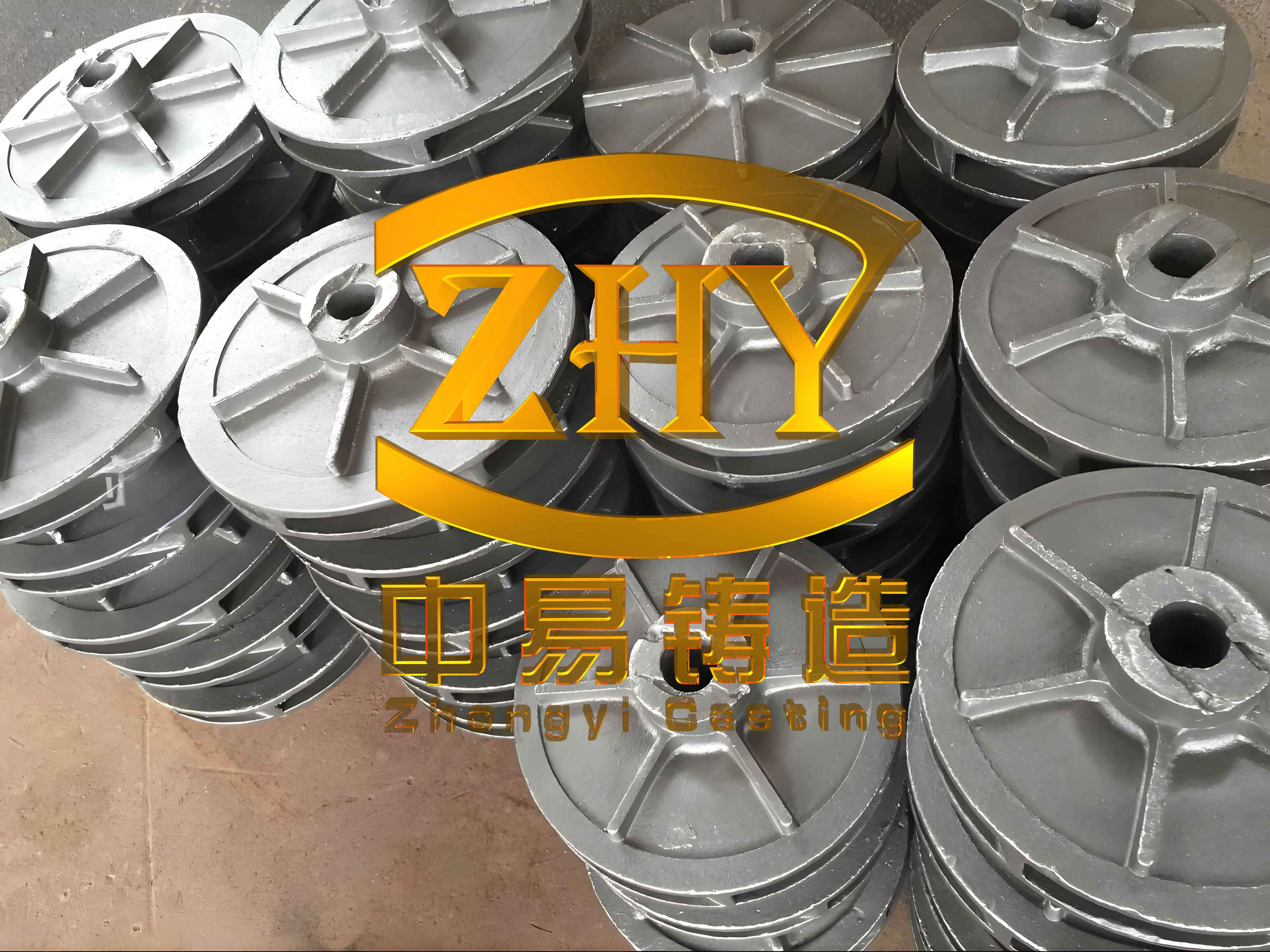
The flywheel in question is a gray iron casting with a contour size of approximately 702 mm in diameter and 133 mm in height, featuring a minimum wall thickness of 46 mm. The raw casting weight is 245 kg, and the material specification is HT250 gray iron, requiring a hardness range of 190–240 HBW. The microstructure should predominantly consist of Type A graphite with minimal Type B, a graphite length no less than Grade 4, and a pearlite content exceeding 98%. After casting, the components undergo aging treatment to relieve stresses. Initially, the production process utilized alkaline phenolic resin self-hardening sand on a流水线, with two castings per mold box. The gating system was of a closed type, with a cross-sectional area ratio configured as follows: total sprue area : total runner area : total ingate area = 1.64 : 2.05 : 1, where the ingate served as the choke point. The molten iron composition adhered to the specifications shown in Table 1, and pouring was conducted at an initial temperature of 1350–1360°C, with one ladle serving two molds.
| Element | C | Si | Mn | P | S | Cu | Cr |
|---|---|---|---|---|---|---|---|
| Content | 3.3 | 1.9 | 0.95 | 0.04 | 0.09 | 0.4 | 0.28 |
The shrinkage depression defects manifested as concave pits on the upper surface of the gray iron casting, often accompanied by small “iron beans” within the pits. Prior to shot blasting, these pits retained a coating layer, whereas the iron beans did not, indicating that the depressions resulted from volumetric shrinkage during solidification, and the beans were expelled molten iron due to graphite expansion in the later stages. This confirmed the defects as shrinkage depression, a common challenge in gray iron casting that arises from inadequate feeding during the liquid-to-solid transition. To address this, I embarked on a thorough analysis spanning multiple factors, each contributing to the volumetric deficits in the gray iron casting.
First, I examined the metallurgical aspects. The carbon equivalent (CE) plays a pivotal role in the solidification behavior of gray iron casting. A lower CE places the iron in the hypoeutectic range, widening the mushy zone and increasing solidification shrinkage. The carbon equivalent can be calculated using the formula:
$$ CE = C + \frac{Si + P}{3} $$
For the initial composition, with C at 3.3%, Si at 1.9%, and P at 0.04%, the CE is approximately:
$$ CE = 3.3 + \frac{1.9 + 0.04}{3} = 3.3 + 0.647 = 3.947 $$
This value is relatively low for gray iron casting, often targeting above 4.0 for better feedability. A low CE reduces graphite precipitation, which normally compensates for shrinkage through expansion, thereby exacerbating depression defects. Additionally, the pouring temperature of 1350–1360°C was considered high, leading to excessive liquid contraction as the metal cools from pouring temperature to the liquidus. The liquid contraction volume, $\Delta V_l$, can be estimated as:
$$ \Delta V_l = \alpha_l \cdot (T_p – T_l) $$
where $\alpha_l$ is the coefficient of liquid thermal contraction for gray iron casting (typically around $1.0 \times 10^{-4} \, \text{°C}^{-1}$), $T_p$ is the pouring temperature, and $T_l$ is the liquidus temperature (approximately 1150°C for this composition). For $T_p = 1360°C$, the contraction is:
$$ \Delta V_l = 1.0 \times 10^{-4} \cdot (1360 – 1150) = 1.0 \times 10^{-4} \cdot 210 = 0.021 \, \text{or} \, 2.1\% $$
This significant liquid shrinkage demands efficient feeding, which was compromised by the existing gating design. The closed gating system with the ingate as the choke resulted in turbulent flow, with ingate velocities reaching up to 200 cm/s, causing uneven filling and rapid closure of the ingates, thus hindering liquid feed during solidification. Moreover, the mold strength was inadequate due to insufficient ramming time (15 seconds), leading to mold wall movement under metallostatic pressure and contributing to shrinkage in the gray iron casting. To quantify this, the mold stiffness, $S$, relates to the compaction energy, and lower stiffness allows for mold dilation, increasing the apparent shrinkage.
To tackle these issues, I implemented a multi-faceted approach. Starting with the metallurgy, I adjusted the carbon content from 3.25% to 3.3% to slightly raise the CE, promoting more graphite expansion and reducing shrinkage. The target composition was refined as shown in Table 2, aiming for improved feedability in gray iron casting.
| Element | C | Si | Mn | P | S | Cu | Cr |
|---|---|---|---|---|---|---|---|
| Content | 3.35 | 1.9 | 0.95 | 0.04 | 0.09 | 0.4 | 0.28 |
Concurrently, I reduced the pouring temperature to 1350°C to minimize liquid contraction, implementing strict monitoring via cameras in the pouring area and scheduling concentrated pouring sessions for flywheels to avoid temperature spikes from prior casts. This lowered the liquid contraction to:
$$ \Delta V_l = 1.0 \times 10^{-4} \cdot (1350 – 1150) = 1.0 \times 10^{-4} \cdot 200 = 0.020 \, \text{or} \, 2.0\% $$
a modest but beneficial reduction. Additionally, I increased the pouring overflow volume to compensate for liquid level drops from turbulent filling, ensuring a more stable feed. To enhance mold integrity, I extended the sand ramming time from 15 to 25 seconds, improving the mold hardness and reducing wall movement. The mold strength, often characterized by the compression strength $\sigma_c$, is critical for gray iron casting; higher strength minimizes mold yield, which can be expressed as:
$$ \Delta V_m = \frac{P}{\sigma_c} \cdot A $$
where $\Delta V_m$ is the mold dilation volume, $P$ is the metallostatic pressure, and $A$ is the area. By increasing ramming, $\sigma_c$ rises, reducing $\Delta V_m$ and subsequent shrinkage.
The most transformative step involved redesigning the gating system using Magma simulation software. The original closed system was replaced with a closed-open hybrid, incorporating a choke between the sprue and runner to calm the flow, followed by an open configuration. This modification reduced ingate velocities to approximately 80 cm/s, as verified by simulation. Furthermore, the circular runner was altered to a 3/4 ring with a slag trap at the end to enhance flow stability. The ingate height was increased from 5 mm to 8 mm, with a proportional width reduction, to delay solidification and extend feeding capabilities. The new gating ratio was optimized to improve feeding efficiency in gray iron casting. The Magma simulations, as shown in flow pattern comparisons, confirmed smoother filling and better thermal profiles. Table 3 summarizes the key changes in gating parameters.
| Parameter | Original Design | Optimized Design |
|---|---|---|
| Gating Type | Closed | Closed-Open Hybrid |
| Choke Location | Ingate | Sprue-Runner Junction |
| Ingate Velocity | ~200 cm/s | ~80 cm/s |
| Ingate Height | 5 mm | 8 mm |
| Runner Design | Full Circle | 3/4 Circle with Slag Trap |
| Flow Stability | Low | High |
To further elucidate the solidification dynamics, I considered the shrinkage compensation mechanism in gray iron casting. The total volume change during solidification, $\Delta V_{total}$, combines liquid contraction, solidification shrinkage, and graphite expansion:
$$ \Delta V_{total} = \Delta V_l + \Delta V_s – \Delta V_g $$
where $\Delta V_s$ is the solidification shrinkage (typically 1-2% for gray iron), and $\Delta V_g$ is the expansion from graphite precipitation (up to 2-3%). By increasing CE and optimizing cooling, $\Delta V_g$ is enhanced, offsetting deficits. The feeding requirement, $F$, can be approximated as:
$$ F = \frac{\Delta V_{total}}{V_c} \cdot 100\% $$
where $V_c$ is the casting volume. With adjustments, $F$ was reduced, mitigating depression risks. The Magma software also allowed for thermal analysis, predicting shrinkage-prone zones and guiding riser placement, though risers were not used here due to the gating modifications.
After implementing these measures—adjusting CE, lowering pouring temperature, increasing mold strength, adding overflow, and optimizing the gating system—the production of approximately 100 flywheels resulted in smooth, depression-free surfaces. This success underscores the importance of a holistic approach in gray iron casting, where interactive factors must be balanced. The improvements not only eliminated shrinkage but also enhanced overall casting quality, reducing scrap rates and ensuring timely deliveries. In reflection, this experience highlights that shrinkage depression in gray iron casting is often a multifactorial problem, necessitating systematic analysis and targeted interventions.
In conclusion, the key to resolving shrinkage depression in gray iron casting lies in meticulous control over composition, temperature, and mold design. By raising carbon equivalent, lowering pouring temperature, improving sand compaction, and adopting a平稳充型的 gating system with taller ingates, significant defects can be eradicated. These strategies, validated through simulation and practical trials, offer a robust framework for similar challenges in gray iron casting production. Future work could explore advanced alloys or real-time monitoring to further optimize gray iron casting processes, but the current solutions provide a reliable foundation for high-integrity components like flywheels. Throughout this endeavor, the focus remained on enhancing the reliability and efficiency of gray iron casting, ensuring that each component meets stringent industrial standards.
To summarize the critical parameters in a consolidated form, Table 4 presents the overall impact of each measure on shrinkage reduction in gray iron casting.
| Measure | Description | Effect on Shrinkage | Key Formula/Parameter |
|---|---|---|---|
| Carbon Equivalent Increase | Raised C from 3.25% to 3.3% | Enhances graphite expansion, reduces shrinkage | CE = C + (Si+P)/3; Target CE > 4.0 |
| Pouring Temperature Reduction | Lowered from 1360°C to 1350°C | Decreases liquid contraction volume | $\Delta V_l = \alpha_l \cdot (T_p – T_l)$ |
| Mold Strength Enhancement | Increased ramming time from 15s to 25s | Reduces mold dilation, improves dimensional stability | $\sigma_c$ (compression strength) increased |
| Gating System Optimization | Changed to closed-open hybrid, taller ingates | Improves flow stability and feeding capability | Ingate velocity reduced from 200 to 80 cm/s |
| Overflow Addition | Increased溢流量 | Compensates for liquid level fluctuations | Empirical adjustment based on pouring practice |
This comprehensive approach demonstrates that through systematic analysis and iterative improvements, shrinkage depression in gray iron casting can be effectively controlled, leading to higher yields and better performance in critical applications. The lessons learned here are applicable across various gray iron casting projects, emphasizing the need for integrated process optimization.