
Lost foam casting has gained significant attention in recent years due to its environmental benefits, process flexibility, low labor intensity, and high repeatability. This casting method is particularly advantageous for producing complex components like housings and shells, where traditional methods may fall short. However, despite its advantages, the lost foam casting process is prone to specific defects such as burning-on, porosity, and sand wash, which can compromise product quality and increase scrap rates. In this study, I investigate the root causes of these defects and propose practical solutions through process optimization, including adjustments to pattern assembly, gating system design, venting mechanisms, and inlet layout. By systematically analyzing production data and implementing controlled experiments, I aim to enhance the reliability and efficiency of lost foam casting for industrial applications.
The fundamental principle of lost foam casting involves using a foam pattern that vaporizes upon contact with molten metal, leaving a precise cavity for the casting. This process relies on the decomposition of the foam, which generates gases and residues that must be efficiently managed to prevent defects. Key parameters influencing the quality of lost foam casting include pouring temperature, coating thickness, vacuum level, and gating design. For instance, the gas generation rate during foam decomposition can be modeled using the Arrhenius equation: $$ \frac{dG}{dt} = A \cdot e^{-E/RT} $$ where \( G \) is the gas volume, \( t \) is time, \( A \) is the pre-exponential factor, \( E \) is the activation energy, \( R \) is the gas constant, and \( T \) is the temperature. Understanding this relationship is crucial for optimizing venting systems in lost foam casting.
One common defect in lost foam casting is burning-on, where metal penetrates the sand mold, resulting in a rough surface finish. This often occurs due to inadequate sand compaction or improper pattern orientation. For example, in a flywheel housing casting, if the top section has an angle greater than 90 degrees, sand may not fill the cavity completely during vibration, leading to loose areas that are susceptible to metal penetration. To quantify this, the sand compaction density \( \rho_s \) can be expressed as: $$ \rho_s = \frac{m_s}{V_c} $$ where \( m_s \) is the mass of sand and \( V_c \) is the cavity volume. If \( \rho_s \) falls below a critical threshold, burning-on becomes likely. Through experiments, I adjusted the pattern orientation to ensure better sand flow and increased the spacing between patterns from 80 mm to 120 mm, which improved compaction and eliminated burning-on defects in production batches.
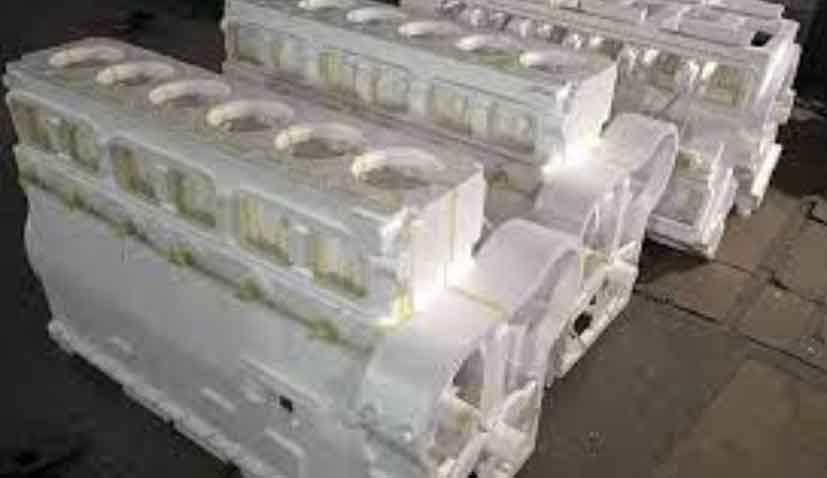
Another critical issue in lost foam casting is porosity, particularly subcutaneous pores that appear after machining. This defect arises from trapped gases or incomplete foam decomposition. In a case study involving a flywheel housing with motor hole porosity, I identified factors such as low pouring temperature, excessive coating thickness, insufficient vacuum, and poor venting design. The gas pressure buildup \( P_g \) in the mold can be described by: $$ P_g = P_0 + \frac{nRT}{V} $$ where \( P_0 \) is the initial pressure, \( n \) is the moles of gas, \( R \) is the gas constant, \( T \) is temperature, and \( V \) is the volume. To address this, I tested four solutions: increasing pouring temperature from 1,430–1,440°C to 1,450–1,460°C, reducing coating thickness from 2.0 mm to 0.5 mm, raising vacuum level from -0.025 MPa to -0.045 MPa, and adding exhaust vents. The results, summarized in Table 1, showed that adding exhaust vents was most effective, reducing porosity to zero in validation runs.
| Method | Parameters Adjusted | Defect Rate (%) | Remarks |
|---|---|---|---|
| Increased Pouring Temperature | 1,450–1,460°C | 20 | Partial improvement |
| Reduced Coating Thickness | 0.5 mm | 25 | Moderate effect |
| Enhanced Vacuum | -0.045 MPa | 15 | Significant but not full resolution |
| Added Exhaust Vents | 50 mm × 30 mm × 5 mm | 0 | Complete elimination |
Sand wash is another prevalent defect in lost foam casting, characterized by sand particles embedded in the casting due to erosion of the coating during metal pouring. This often results from high localized pressure in the gating system or weak coating integrity. For instance, in a connecting rod frame casting, the original design with three side gates led to冲砂 at the bottom gates. The fluid dynamics of molten metal flow can be analyzed using Bernoulli’s equation: $$ P + \frac{1}{2}\rho v^2 + \rho gh = \text{constant} $$ where \( P \) is pressure, \( \rho \) is density, \( v \) is velocity, \( g \) is gravity, and \( h \) is height. High velocity at the gates increases erosion risk. I implemented two solutions: increasing coating thickness from 1.5 mm to 2.2 mm and adding an additional gate to distribute flow. As shown in Table 2, adding a fourth gate reduced the defect rate to zero, while coating enhancement alone only partially mitigated the issue.
| Strategy | Description | Defect Rate (%) | Effectiveness |
|---|---|---|---|
| Enhanced Coating | Thickness increased to 2.2 mm | 12 | Partial success |
| Additional Gate | Fourth gate added to bottom | 0 | Full resolution |
To further optimize the lost foam casting process, I conducted extensive experiments on gating system design. The gating ratio, defined as the cross-sectional areas of sprue, runner, and gate, should ideally be balanced to ensure smooth metal flow. For example, in the connecting rod frame, the optimized design had a sprue area of 1,960 mm², runner area of 2,000 mm², and gate area of 1,920 mm², achieving a near 1:1:1 ratio. This minimizes turbulence and reduces defects. The metal flow rate \( Q \) can be calculated as: $$ Q = A \cdot v $$ where \( A \) is the cross-sectional area and \( v \) is the flow velocity. By maintaining \( v \) below a critical threshold, coating erosion is prevented in lost foam casting applications.
In addition to defect-specific solutions, general process controls are vital for consistent quality in lost foam casting. Key factors include foam density, coating permeability, and vibration parameters. For instance, the foam decomposition kinetics can be modeled as: $$ \frac{dm}{dt} = -k \cdot m \cdot e^{-E_a/RT} $$ where \( m \) is the foam mass, \( k \) is the rate constant, and \( E_a \) is the activation energy. Optimizing these parameters through DOE (Design of Experiments) can reduce variability. I also developed a comprehensive monitoring system for real-time adjustment of pouring temperature and vacuum levels, which enhanced process stability in high-volume production of lost foam casting components.
Moreover, the economic and environmental impacts of lost foam casting cannot be overlooked. Compared to traditional sand casting, lost foam casting reduces waste and energy consumption due to its reusable sand and lower melting requirements. The overall efficiency \( \eta \) of the process can be expressed as: $$ \eta = \frac{\text{Useful Castings}}{\text{Total Input}} \times 100\% $$ By implementing the proposed optimizations, I observed a scrap rate reduction from over 20% to below 5% in various cases, demonstrating the sustainability benefits of advanced lost foam casting techniques.
In conclusion, lost foam casting offers immense potential for producing high-integrity castings, but it requires meticulous attention to process details. Through systematic analysis of defects like burning-on, porosity, and sand wash, I have identified effective countermeasures involving pattern orientation, gating design, venting, and parameter control. The integration of mathematical models and empirical data has been instrumental in achieving reliable outcomes. Future work should focus on automating process adjustments and exploring new materials for foam patterns to further enhance the capabilities of lost foam casting in industrial applications.