
The development of large-scale, high-strength casting parts for machine tools presents a significant metallurgical challenge. Critical components like crossbeams must possess exceptional tensile strength and stiffness to resist deformation under heavy loads and their own weight. QT600-3, a pearlitic matrix spheroidal graphite iron (SGI), offers a compelling combination of high strength and hardness, making it theoretically suitable for such demanding applications. However, translating this potential into a reliable, as-cast production process for massive components is non-trivial.
My work focused on a specific challenge: the production of a machine tool beam casting part with a finished length of 9 meters and a raw weight of 18.7 tonnes. The complexity of this casting part lies in its highly variable wall thickness: an average wall of 30 mm, ribs at approximately 25 mm, and guide rail sections reaching up to 120 mm. For a high-strength grade like QT600-3 targeted in the as-cast condition, this variation creates a conflict: thin sections are prone to the formation of hard, brittle carbides (chill), while thick sections suffer from long solidification times that can lead to graphite flotation, degenerate graphite forms (e.g., chunky, exploded graphite), and unstable pearlite content. The core production difficulty, therefore, is achieving precise microstructural control: suppressing carbides in thin walls, ensuring fully pearlitic matrix in thick sections, and maintaining a high count of well-formed graphite nodules throughout the entire massive casting part.
This article details the optimized melting and treatment practices I employed to overcome these hurdles. The strategy hinges on three pillars: rigorous control of chemical composition, the use of a heavy rare-earth-based long-lasting inoculant applied via a ladle-transfer (“inverted ladle”) method, and a multi-stage, compound inoculation process. The results confirm that this integrated approach can consistently produce sound, large-section QT600-3 casting parts in the as-cast state, meeting and exceeding the required mechanical specifications.
1. Rationale for Chemical Composition Selection and Control
The chemical composition is the foundational blueprint for the final microstructure and properties of any casting part. For heavy-section QT600-3, each element plays a calculated role, and its concentration must be carefully balanced against competing effects.
Carbon (C) is the primary graphitizing element. It promotes graphite nodule formation, increases fluidity, and reduces shrinkage porosity. However, excessive carbon equivalent (CE) is the primary driver for graphite flotation in thick sections. The CE is commonly calculated as:
$$ CE = \%C + \frac{1}{3}(\%Si + \%P) $$
For these large casting parts, a composition near the eutectic point is targeted to maximize graphite count without triggering flotation. The aim is to maintain a final carbon content between 3.5% and 3.8%.
Silicon (Si) is a potent graphitizer and ferrite promoter. To sustain a high pearlite fraction in the as-cast condition, silicon must be kept at a moderate level. Excess silicon also lowers the ductile-to-brittle transition temperature, which can be detrimental. A range of 1.9% to 2.2% was selected.
Manganese (Mn) is a pearlite stabilizer and strengthens the matrix. Yet, in slowly cooled heavy casting parts, Mn segregates to cell boundaries, where it can form intercellular carbides, severely impairing toughness. Its content is therefore restricted to 0.3%-0.6%.
Phosphorus (P) and Sulfur (S) are detrimental impurities. P forms hard, brittle phosphides at grain boundaries and must be minimized. S, however, has a dual role. While high final S levels impair nodularity, a certain level in the base iron (around 0.020%) is beneficial. It reacts with Mg/Ce during treatment, providing sulfide substrates that act as potent nucleation sites for graphite. The goal is to start with a controlled S level and then reduce it effectively during treatment.
Alloying Elements: Copper (Cu), Tin (Sn), and Antimony (Sb) are crucial for matrix control in the absence of a heat treatment. Cu promotes pearlite formation, refines its structure, and has mild graphitizing power. Sn and Sb are extremely powerful pearlite promoters. Furthermore, small additions of Sb (<0.015%) are known to counteract the formation of degenerate graphite in heavy sections by segregating to the graphite-liquid interface and modifying growth kinetics. The addition levels must be precise to avoid excessive hardness or embrittlement.
$$ \text{Pearlite Potential Factor} \propto (\%Mn + k_{Cu}\%Cu + k_{Sn}\%Sn + k_{Sb}\%Sb) $$
where k coefficients represent the relative potency of each element.
Barium (Ba) is introduced via the inoculant. Ba has a strong affinity for oxygen and sulfur, forming compounds (BaO, BaS) that are excellent lattice matches for graphite, providing highly effective heterogeneous nucleation sites. This significantly increases the graphite nodule count.
The comprehensive target composition for the final casting part is summarized in Table 1.
| Element | Base Iron Aim (%) | Final Iron Aim (%) |
|---|---|---|
| C | 3.8 – 4.1 | 3.5 – 3.8 |
| Si | 0.7 – 1.2 | 1.9 – 2.3 |
| Mn | 0.3 – 0.6 | 0.3 – 0.6 |
| S | < 0.020 | < 0.020 |
| P | < 0.040 | < 0.040 |
| Cu | — | 0.3 – 0.6 |
| Sn | — | < 0.05 |
| Sb | — | < 0.015 |
2. Optimized Production Process for Large Casting Parts
2.1. Melting Practice and Temperature Control
The charge consists of 40-60% low-phosphorus pig iron (to provide inherent nucleation sites) and 60-40% clean steel scrap. Graphitic carburizer is used to adjust the final carbon level. The pig iron is added in the latter stages of melting to preserve its nucleation potential. Superheating to 1500-1540°C is essential to dissolve impurities, eliminate genetic pig iron graphite characteristics, and homogenize the melt for this critical casting part.
Temperature control during treatment is vital. The optimal temperature for the “inverted ladle” treatment is 1400-1440°C. A higher temperature increases Mg fuming and loss, while a lower temperature risks incomplete dissolution of the treatment alloys. The pouring temperature for such a large casting part is set at 1300-1350°C to prevent mistruns while minimizing shrinkage porosity.
2.2. Spheroidization Treatment
The choice of spheroidizer is critical for heavy-section casting parts prone to fading. A heavy rare-earth (RE) containing alloy is used (1.2-1.5% addition). Heavy RE elements like yttrium have higher boiling points and greater solubility in iron than magnesium, providing longer-lasting protection against parasitic reactions (e.g., with sulfur or oxygen) during the extended solidification of a large casting part, thereby combating fade.
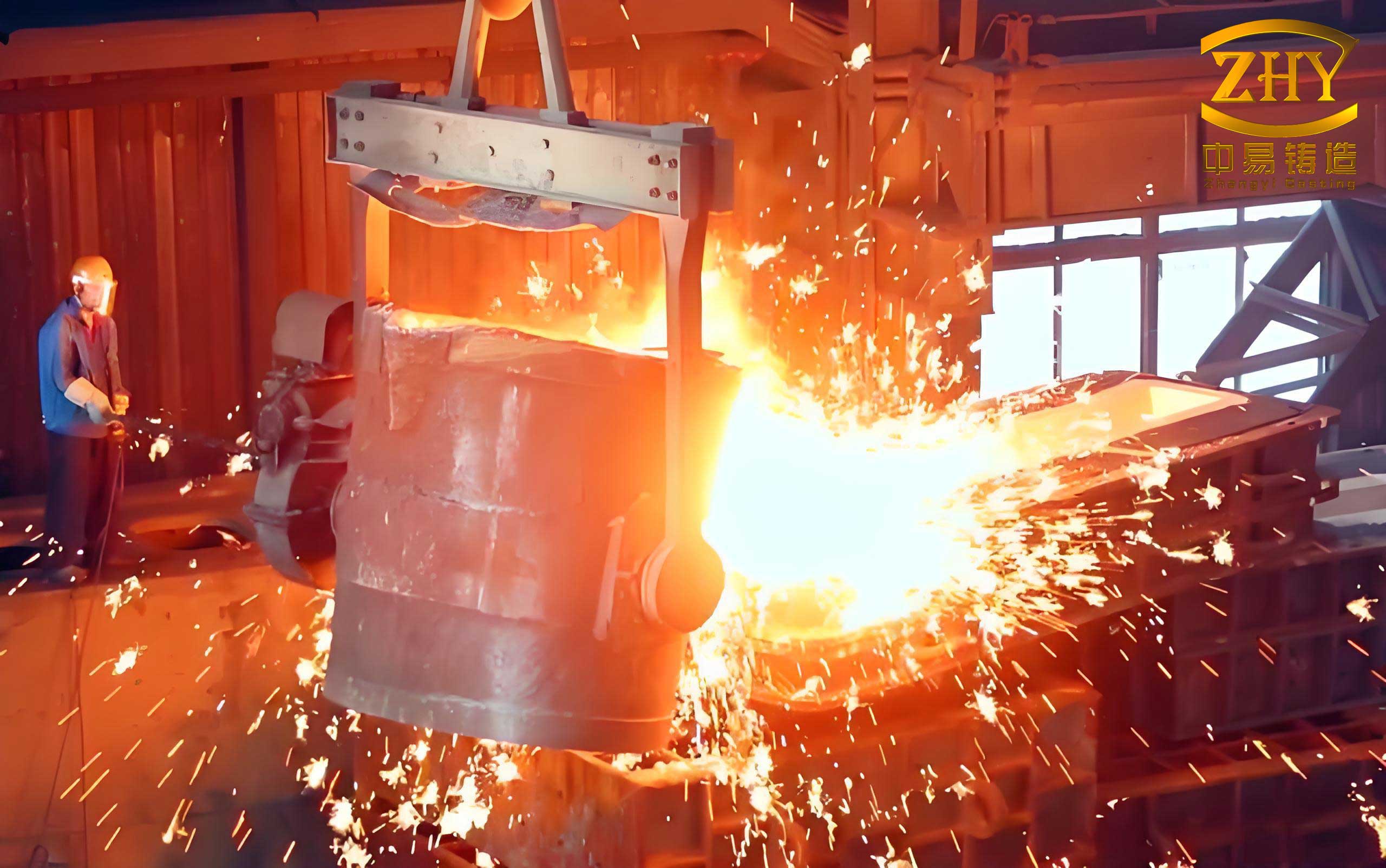
The “inverted ladle” process is employed. The spheroidizer and initial inoculant are placed in an empty treatment ladle. Molten base iron is transferred from the furnace ladle into this treatment ladle, initiating the reaction. This method allows for the simultaneous treatment of large volumes of iron, minimizing waiting time and fading before pouring the massive casting part.
| Element | Mg | RE (Heavy) | Ca | Si | Other (Bi, Sb) |
|---|---|---|---|---|---|
| Content (%) | 6 – 7 | 1.5 – 2.5 | 1.5 – 2.5 | 42 – 45 | Trace amounts |
2.3. Multi-Stage Compound Inoculation
Inoculation is not a single event but a process managed through multiple stages to ensure a high nodule count throughout the solidification of the large casting part. The mechanism can be described by the nucleation rate, which depends on the undercooling and the availability of effective substrates:
$$ \frac{dN}{dt} \propto \Delta T^m \cdot S_{eff} $$
where \(dN/dt\) is the nucleation rate, \(\Delta T\) is the undercooling, \(m\) is a constant, and \(S_{eff}\) is the concentration of effective substrates (e.g., BaS, CaS). Multiple additions increase \(S_{eff}\) at different times.
The four-stage practice used is:
- Transfer Ladle Inoculation: 0.1-0.3% FeSi (5-15 mm) is added to the empty transfer ladle. This pre-inoculates the base iron, reducing initial undercooling and creating a favorable platform for spheroidization.
- Treatment Ladle Inoculation: After placing the spheroidizer in the treatment ladle, it is covered with 0.4-0.7% Ba-bearing inoculant (5-15 mm, 2-6% Ba). The Cu, Sn, and Sb alloying additions are also added here. This is the primary inoculation event.
- Late-Stream Inoculation: When about one-third of the iron has been transferred into the treatment ladle, an additional 0.1-0.3% Ba-bearing inoculant is added. This boosts nucleation late in the treatment process.
- Flow or Mould Inoculation: During pouring of the final casting part, 0.1% fine-grade (0.5-1.5 mm) inoculant is added to the metal stream. This last-minute addition counteracts inoculation fade that occurs between treatment and the end of pouring.
3. Production Results and Metallurgical Analysis
The described methodology was implemented for the production of the 9-meter beam casting parts. The metallurgical principles at work are rooted in interfacial energy and nucleation theory. In Mg/RE-treated iron, the interfacial energy between the melt and the prismatic plane {10\(\bar{1}\)0} of graphite is higher than that between the melt and the basal plane (0001). This energy differential directs graphite growth preferentially along the <0001> direction, encouraging spheroidal growth. The treatment process itself (Mg/RE + Inoculation) fulfills the other prerequisite: it provides a multitude of heterogeneous nucleation sites (oxides, sulfides) and removes elements (S, O) that inhibit graphite growth.
The “inverted ladle” process ensures treatment consistency for the large volume of iron needed for the casting part. The multi-stage inoculation continuously replenishes effective nuclei. The elements Ba, Ca, and Mg from the treatment alloys react with O and S, lowering their content and simultaneously creating potent substrates. This leads to a dramatic increase in the number of graphite nodules (N). The final nodule count can be related to the inoculation practice:
$$ N \approx k \cdot \left( \sum_{i=1}^{n} I_i \cdot e^{-\lambda t_i} \right) $$
where \(k\) is a constant, \(I_i\) is the potency of the i-th inoculation, \(\lambda\) is the fading constant, and \(t_i\) is the time between inoculation and solidification. Multiple inoculations at different times (\(t_i\)) combat the exponential decay from fading.
Meanwhile, the carefully balanced additions of Cu, Sn, and Sb ensure that the austenite decomposes into a stable, fine pearlitic matrix during the slow cooling of the thick sections of the casting part, without the need for a subsequent heat treatment.
The quality was assessed via separately cast Y-blocks and attached test coupons from the casting parts themselves. The results, detailed in Table 3, demonstrate that the properties not only meet but often surpass the requirements of the QT600-3 specification.
| Casting Part ID | Test Coupon Type (Thickness) | Nodularity Grade | Nodule Count (mm⁻²) | Pearlite Content (%) | Tensile Strength (MPa) | Elongation (%) |
|---|---|---|---|---|---|---|
| Beam #1 | Y-Block | 2 | — | 95 | 726 | 4.5 |
| Attached (40 mm) | 2 | 286 | 95 | 677 | 3.0 | |
| Attached (70 mm) | 2 | 194 | 95 | 617 | 3.0 | |
| Beam #2 | Attached (40 mm) | 2 | 196 | 95 | 705 | 4.5 |
| Attached (70 mm) | 2 | 158 | 95 | 608 | 4.0 |
Micrographs revealed a fully pearlitic matrix with well-formed, spheroidal graphite. No chunky graphite or significant carbide networks were observed in the critical sections. The variation in nodule count and slight differences in mechanical properties between Beam #1 and Beam #2, despite similar chemistry, can be attributed to subtle differences in local solidification conditions inherent to producing such a massive casting part. For instance, a slightly higher cooling rate in certain regions of Beam #2 likely resulted in a finer pearlite interlamellar spacing (\(\lambda_p\)), which is known to increase strength according to the Hall-Petch type relationship for pearlite:
$$ \sigma_y \approx \sigma_0 + k_y \cdot (\lambda_p)^{-1/2} $$
where \(\sigma_y\) is the yield strength, \(\sigma_0\) and \(k_y\) are material constants. Furthermore, a higher degree of graphite spheroidal perfection (roundness) in Beam #2 likely contributed to its better elongation values, underscoring the critical link between graphite morphology and ductility in these casting parts.
4. Conclusion
The successful as-cast production of heavy-section QT600-3 machine tool beam casting parts is feasible through a meticulously designed and integrated metallurgical approach. The key findings are:
- Precise Chemical Control: A lean alloying strategy with controlled levels of C, Si, and Mn, supplemented with precise additions of Cu, Sn, and Sb, is essential to achieve a strong, fully pearlitic matrix while preventing degenerate graphite formations in thick sections of the casting part.
- Robust Treatment Practice: The combination of a heavy rare-earth spheroidizer applied via the “inverted ladle” method provides effective and fade-resistant nodularization for the large volume of iron required for such a casting part.
- Multi-Stage Inoculation: A compound, multi-point inoculation strategy using Ba-bearing alloys is critical to generate a high and uniform population of graphite nodules throughout the entire massive casting part, countering inoculation fade and ensuring a fine microstructure.
This holistic methodology ensures simultaneous control over graphite morphology (spheroidization), graphite quantity (inoculation), and matrix structure (alloying), leading to casting parts with consistent and superior mechanical properties directly from the mould. The process offers a reliable and potentially cost-effective manufacturing route for other large, high-integrity ductile iron casting parts where heat treatment is logistically challenging or economically prohibitive.