
This article details the industrial production process for high-aluminum zinc-based alloys (ZA alloys) using sand casting, based on extensive practical development and experimentation. These alloys offer a promising, cost-effective alternative to traditional copper-based bearing materials. The focus here is on the controlled melting practices and specialized sand casting techniques required to produce sound, high-integrity sand casting parts, overcoming common defects associated with these alloys.
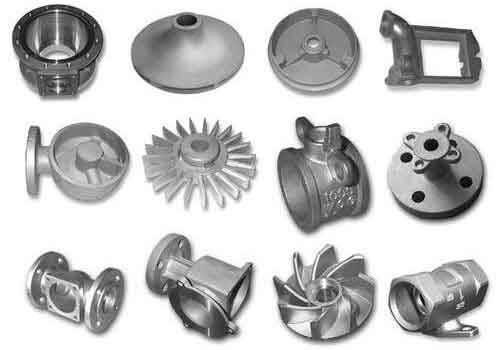
The target alloy composition for producing sand casting parts is designed for manufacturability and performance: 21.0–28.0% Al, 2.0–3.0% Cu, 0.010–0.035% Mg, impurities ≤0.19%, and the balance Zn. This range accounts for normal process variations while ensuring desirable mechanical properties.
Alloy Characteristics and Raw Materials
High-aluminum zinc-based alloys are characterized by a wide freezing range, leading to a pasty mode of solidification, and a significant density difference between aluminum and zinc. This combination makes them prone to shrinkage porosity, inverse segregation (often called “bottom shrinkage” or “inverse segregation”), and dross formation during casting. Successful production of sand casting parts therefore demands precise control over every stage.
Primary materials include aluminum ingot (99.6-99.7% Al), zinc ingot (Zn-0 or Zn-1), magnesium ingot (99.95% Mg), copper (Cu-1), and a self-prepared Al-50%Cu master alloy. Molding is performed with conventional green sand. The melting equipment consists of oil-fired crucible furnaces, with tools for handling, ZnCl2 for fluxing, and a suitable thermometer for temperature control.
Melting Process and Technology
After comparative trials, the indirect melting method was adopted. This involves first preparing the Al-Cu master alloy, then adding it to the molten zinc. This method offers superior control over temperature, reduces operational difficulty, and minimizes element loss compared to the direct method of adding all elements to the melt.
Elemental Loss and Charge Calculation
Accurate charge calculation is critical for achieving the final target composition. Aluminum experiences the highest melt loss. The typical melt losses and average charge composition for producing these sand casting parts are summarized below.
| Element | Melt Loss (%) |
|---|---|
| Zn | 1–3 |
| Al | 5–20 |
| Mg | 10–30 |
| Cu | 0.5–1.0 |
| Charge Material | Average Proportion (%) |
|---|---|
| Zn | 72–75 |
| Al | 25–28 |
| Cu | 2.5–3.5 |
| Mg | 0.02–0.035 |
| Flux (ZnCl2) | 0.10–0.15 |
| Modifier | 0.05–0.07 |
Key Melting Parameters and Practices
The melting procedure follows: preparation of charge/tools → charging → heating and melting → fluxing and modification → quality testing and pouring. Several points are paramount for the quality of sand casting parts.
1. Melting Temperature Control: The optimal melting temperature range is 580–600°C, providing a superheat of 60–80°C. A temperature above 600°C increases oxidation, gas absorption, and elemental losses (especially Al and Mg), degrading mechanical properties. A temperature below 580°C provides insufficient superheat, compromising the time needed for effective fluxing, modification, and dross removal.
2. Flux Preparation and Use: Zinc chloride (ZnCl2) must be thoroughly dehydrated. Inadequate dehydration introduces hydrogen into the melt, which can cause outright rejection during quality tests or reduce mechanical properties by 30–50%. Flux should be pre-dried and kept warm near the furnace in aluminum foil until use.
3. Use of Return Material: The proportion of internal returns (gates, risers, rejected castings) should not exceed 20% of the total charge. While using 100% returns can increase tensile strength and hardness, it severely reduces elongation, making the alloy brittle. This is due to increased impurity content and intermetallic networks, which cause lattice distortion upon solidification.
4. Modification Treatment: Modification is performed concurrently with the second fluxing operation. A cerium-based mischmetal (RECe-45) is used. The modifier reacts to form compounds like AlCe4, Al4CuCe, and Mg9Ce, which act as potent nucleation sites. This refines the as-cast grain structure, inhibits the floating of low-density Al-rich phases (reducing inverse segregation), and helps minimize bottom shrinkage. An addition of 0.05–0.10% typically increases both strength and elongation by about 10%. Excessive addition (>0.1%) continues to increase strength but sharply reduces ductility.
Sand Casting Process Design
The design of the sand casting process for these alloys is fundamentally guided by their solidification characteristics. The following parameters are established: linear shrinkage of 0.8–1.3% (use lower value for restrained casting), machining allowances similar to those for aluminum alloys, and volumetric shrinkage of 3.0–4.0%.
Solidification Principle Selection
The most critical defect in high-aluminum zinc sand casting parts is “bottom shrinkage,” where shrinkage porosity forms in the lower section of a casting, beneath the riser. This is caused by inverse segregation where the less dense, primary Al-rich phase floats upwards, effectively making solidification progress from the top down.
The casting’s geometric modulus, defined as volume divided by cooling surface area (V/F), is the key criterion for selecting the solidification principle.
$$ M = \frac{V}{F} $$
Where \( M \) is the modulus (cm), \( V \) is the volume (cm³), and \( F \) is the surface area (cm²).
- For castings with \( M \geq 1 \) cm, wall thickness ≥ 30 mm, or weight > 20 kg, a directional solidification principle must be used. This involves strong thermal gradients using chills and risers to feed the isolated liquid pools.
- For castings with \( M < 1 \) cm, wall thickness < 20 mm, or weight < 20 kg, a simultaneous solidification principle can be employed, as bottom shrinkage is not pronounced.
Gating System Design
Considering the alloy’s high thermal conductivity, large freezing range, relatively low pouring temperature, and tendency to oxidize, the gating system must ensure rapid, smooth, and non-turbulent filling. A bottom-gated open or step gating system is preferred. To avoid localized overheating at the ingates and aid slag trapping, the following area ratios are used:
$$ \Sigma F_{\text{sprue}} : \Sigma F_{\text{runner}} : \Sigma F_{\text{ingate}} = 1 : 5 : 3 $$
The total cross-sectional area of the sprue(s) is determined by:
$$ \Sigma F_{\text{sprue}} = \frac{K \cdot G}{t \cdot \sqrt{H_p}} $$
Where:
- \( \Sigma F_{\text{sprue}} \) is the total sprue cross-sectional area (cm²)
- \( K \) is a coefficient (18–32, higher for more restrained molds)
- \( G \) is the total metal weight poured through the sprue (kg)
- \( t \) is the pouring time (s), calculated as \( t = k \cdot \sqrt[3]{G} \)
- The wall thickness factor \( k \) is given in the table below.
- \( H_p \) is the effective metallostatic pressure head height (cm).
| Casting Wall Thickness (mm) | ≤ 6 | 6–10 | 10–15 | > 15 |
|---|---|---|---|---|
| k value | 3.0 | 3.2 | 3.6 | 4.0 |
Riser and Chill Design
For larger sand casting parts requiring directional solidification, side risers are most effective. Top risers often lead to “secondary bottom shrinkage” below them. Side risers draw the thermal hot spot away from the casting body into the riser neck. Riser dimensions are designed using the modulus method:
$$ M_{\text{casting}} : M_{\text{riser neck}} : M_{\text{riser}} = 1 : (1.1 \text{ to } 1.5) : (1.2 \text{ to } 1.8) $$
For smaller sand casting parts (<20 kg, \( M < 1 \) cm), top risers are sufficient under the simultaneous solidification principle. Chills, typically made of cast iron, are used to control solidification direction. Chill thickness is usually 0.5 to 1.5 times the adjacent casting wall thickness.
Pouring Temperature: Controlled between 510°C and 525°C, this is particularly important for smaller castings produced with the simultaneous solidification principle.
Supplementary Analysis for High-Efficiency Centrifugal Casting of Pipes
While the core focus is on sand casting parts, the principles of process control extend to other methods. For instance, high-efficiency horizontal centrifugal casting machines represent a significant advancement for producing drainage pipes (e.g., Ø75–Ø250 mm, lengths 1830–3040 mm). Their advantages include compact layout, high automation, low energy consumption, and high productivity (>50 pipes of Ø100×1830 mm per hour).
The key to efficiency in such processes lies in optimizing rotational speed and drive power. The mold speed must generate a sufficient centrifugal force (G-factor) to ensure good metallurgical cohesion without causing segregation or hot tearing. An empirical rule for the G-factor is between 40 and 80. The rotational speed \( N \) (rpm) can be derived from the inner radius of the mold \( R_i \) (m):
$$ G = \frac{\omega^2 R_i}{g} = \frac{(2\pi N / 60)^2 R_i}{9.81} $$
Rearranging to solve for \( N \):
$$ N \approx \frac{42.3}{\sqrt{R_i}} \sqrt{G} $$
For a typical pipe mold with an internal radius of 0.1 m and a target G of 60, the speed would be approximately:
$$ N \approx \frac{42.3}{\sqrt{0.1}} \sqrt{60} \approx \frac{42.3}{0.316} \times 7.75 \approx 1038 \text{ rpm} $$
The main drive motor power \( P \) (kW) must overcome the inertia of the rotating mold and metal, along with bearing friction. It can be estimated by considering the torque \( T \) required to accelerate the system to operational speed \( \omega \) (rad/s) within a time \( t_a \) (s):
$$ T = I \cdot \alpha = I \cdot \frac{\omega}{t_a} $$
where \( I \) is the mass moment of inertia of the rotating assembly (kg·m²). The power is then:
$$ P = T \cdot \omega = \frac{I \cdot \omega^2}{t_a} $$
Considering additional frictional losses (efficiency \( \eta \)), the installed motor power \( P_m \) is:
$$ P_m = \frac{P}{\eta} $$
For a system with \( I = 50 \text{ kg·m}^2 \), target \( N = 1050 \text{ rpm} \) (\( \omega \approx 110 \text{ rad/s} \)), acceleration time \( t_a = 10 \text{ s} \), and efficiency \( \eta = 0.85 \):
$$ P = \frac{50 \cdot (110)^2}{10} = 60,500 \text{ W} = 60.5 \text{ kW} $$
$$ P_m = \frac{60.5}{0.85} \approx 71.2 \text{ kW} $$
Thus, a motor of approximately 75 kW would be selected. These calculations underscore the engineering precision required, whether for static sand casting parts or high-speed centrifugal processes, to ensure quality and efficiency.
Results: Chemical Composition and Mechanical Properties
Implementing the described melting and sand casting process consistently yields sand casting parts meeting the target composition. The mechanical properties achieved in sand-cast test bars are highly competitive, as shown below for five representative heats.
| Heat | Chemical Composition (%) | Mechanical Properties | |||||
|---|---|---|---|---|---|---|---|
| Al | Cu | Mg | σb (MPa) | σ0.2 (MPa) | δ5 (%) | HB | |
| 1 | 24.64 | 2.28 | 0.034 | 362 | 325 | 7.3 | 103 |
| 2 | 23.80 | 2.10 | 0.030 | 381 | 340 | 9.6 | 99 |
| 3 | 25.20 | 2.39 | 0.036 | 404 | 363 | 11.3 | 113 |
| 4 | 21.71 | 2.35 | 0.030 | 398 | — | 2.5 | 113 |
| 5 | 21.66 | 2.24 | 0.030 | 364 | 316 | 2.9 | 126 |
The tensile strength (σb) ranges from 362 to 410 MPa, yield strength (σ0.2) from 316 to 369 MPa, elongation (δ5) from 2.5% to 11.3%, and hardness (HB) from 99 to 126. These values meet and in some cases exceed domestic standards for sand-cast ZA alloys and are comparable to international specifications.
Quality and Economic Outcomes
By adhering to the defined process parameters—using the modulus (V/F) criterion to choose between directional and simultaneous solidification, implementing appropriate gating/risering, and controlling pouring temperature—the defects of “bottom shrinkage” and “secondary bottom shrinkage” have been effectively eliminated in production sand casting parts. The modification treatment plays a crucial role in achieving a uniform microstructure, which is directly linked to the reliability of the final sand casting parts.
The practical application has been validated through the successful production of over 900 kg of various sand casting parts, including bearing sleeves, worm wheels, nuts, and valve bodies. These components have demonstrated satisfactory performance in service. Furthermore, the material cost for producing these high-aluminum zinc-based alloy sand casting parts is estimated to be 30% to 50% lower than equivalent copper-alloy castings, offering a significant economic advantage.
Conclusion
The industrial-scale production of high-integrity sand casting parts from high-aluminum zinc-based alloys is achievable through meticulous control of both melting and foundry practices. Key conclusions are:
- Using an indirect melting method in an oil-fired crucible furnace, with strict control over temperature (580–600°C), flux dehydration, return material proportion (<20%), and modification with 0.05–0.10% Ce-based mischmetal, results in alloys with tensile strength up to 410 MPa and elongation up to 11.3%.
- The sand casting process must be designed using a linear shrinkage of 0.8–1.3% and volumetric shrinkage of 3–4%. The casting modulus (V/F) is the decisive factor for selecting the solidification principle: directional for \( M \geq 1 \) cm and simultaneous for \( M < 1 \) cm. This, combined with bottom-gated systems (1:5:3 ratio), side risers for large castings, and controlled pouring temperature (510–525°C), produces sound sand casting parts free from inverse segregation defects.
- The technology is proven for manufacturing a wide range of functional components, offering performance at a substantially lower cost than traditional copper-based alloys. The principles of precise thermal and metallurgical control demonstrated here are fundamental to quality casting, whether for static sand casting parts or high-productivity methods like centrifugal casting.