
In my experience as a foundry engineer specializing in large-scale castings, the production of heavy-section components presents a unique set of challenges. The project involving the manufacturing of a butterfly valve plate, with a weight of 24 tonnes and a maximum wall thickness exceeding 100 mm, stands as a significant case study in pushing the boundaries of spheroidal graphite cast iron capabilities. This component was destined for a critical application in a hydroelectric power station, where reliability and performance under pressure are non-negotiable. The inherent difficulties with such massive sections of spheroidal graphite cast iron include the propensity for graphite degeneration, nodular fading, severe element segregation, and the formation of shrinkage porosity, all of which can dramatically compromise mechanical properties.
The technical specifications were stringent. The material grade was equivalent to QT450-10, requiring a combination of strength and ductility. Furthermore, the casting was subject to 100% ultrasonic testing according to EN12680-3, demanding a quality level of 2 throughout the entire body. All machined surfaces required 100% magnetic particle inspection to EN1369 Level 2. A minimum nodularity rating was mandated, and perhaps most critically, weld repair was strictly prohibited, placing immense pressure on achieving first-time quality. This narrative details the systematic engineering approach adopted to successfully meet these demands.
1. Foundry Process Design and Numerical Simulation
The geometry of the butterfly plate, with its large, flat profile and eccentric mass distribution, dictated a horizontal pouring orientation with the major flat face facing down. This choice facilitated molding and ensured stability during casting. The mold was built using a two-part flask system with phenolic-modified furan resin self-setting sand. A spirit-based coating was applied with varying thickness to suit different sections of the pattern.
The gating and feeding system was designed as a bottom-pouring, open type to ensure calm filling and minimize turbulence and oxide formation. The cross-sectional area ratios were carefully calculated based on established principles for heavy castings. The relationship is often expressed as:
$$ \Sigma A_{sprue} : \Sigma A_{runner} : \Sigma A_{gate} = 1 : 1.2 : 1.8 $$
where \( A \) represents the cross-sectional area. Choke was placed at the sprue base. A slag trap was integrated into the runner system to filter out oxides and inclusions during the pour.
For heavy-section spheroidal graphite cast iron, controlling the solidification time is paramount to prevent microstructural degradation. Literature and practice suggest aiming for a total solidification time under two hours. To achieve this and to manage thermal profiles, external chills were strategically placed. Their function is two-fold: to eliminate isolated hot spots caused by varying wall thickness and to accelerate the local cooling rate, thereby shortening the local solidification time and refining the microstructure. The feeding system employed specialized insulating sleeves for the risers. These sleeves improve feeding efficiency by maintaining a longer liquid phase in the riser, directing shrinkage into the riser, and also acting as collection points for floating slag and inclusions.
In modern foundry practice, proceeding to production without simulation is an unnecessary risk. We utilized ProCAST simulation software extensively to iterate and optimize the process design. By digitally modeling the placement of chills, risers, and the gating system, we could predict the formation of shrinkage porosity and macro-shrinkage with high accuracy prior to any metal being poured. The simulation outputs clearly showed that the majority of shrinkage was successfully directed into the insulated risers, with only minor, isolated micro-porosity predicted in areas between chills on the upper surfaces. This confirmed the fundamental soundness of our design, as the minor porosity indicated would likely be healed by the graphitization expansion inherent to spheroidal graphite cast iron, especially when combined with the direct feeding from the gates. This virtual prototyping phase was indispensable for ensuring a successful first casting, saving significant time and cost associated with trial-and-error methods.
2. Metallurgical Design and Melting Practice
The quality of a spheroidal graphite cast iron casting is fundamentally determined at the melting and treatment stage. For this heavyweight component, every aspect of metallurgy was meticulously planned.
2.1 Charge Materials and Chemistry Control
The selection of high-purity raw materials is the first critical step in producing high-integrity heavy-section spheroidal graphite cast iron. The charge consisted of 80% premium high-purity pig iron specifically manufactured for ductile iron production, with a strict control on trace elements. The total content of trace elements known to interfere with graphite nodularity (e.g., Pb, Bi, Sb, Ti) was kept below 0.1%. The remaining 20% was composed of low-manganese carbon steel scrap with a stable and known composition.
| Element | Target Range (wt.%) | Rationale and Effect |
|---|---|---|
| Carbon (C) | 3.4 – 3.6 | High carbon equivalent improves fluidity and promotes graphitization expansion for self-feeding. Must be balanced against risk of graphite flotation. |
| Silicon (Si) | 2.3 – 2.5 | Promotes ferrite formation and graphitization. Excessive Si can promote chunk graphite formation in heavy sections and increase brittle transition temperature. |
| Manganese (Mn) | ≤ 0.30 | Strong carbide promoter. Pronounced segregation tendency in heavy sections; can form detrimental carbides at cell boundaries. |
| Sulfur (S) | ≤ 0.020 | Detrimental to nodularity. Consumes nodularizing agent. A minimal, consistent level is desirable. |
| Phosphorus (P) | ≤ 0.040 | Forms low-melting phosphide eutectic at grain boundaries, severely reducing toughness and promoting shrinkage. |
| Magnesium (Mg)res | 0.040 – 0.060 | Essential nodularizing element. Excessive residual Mg increases shrinkage tendency and dross. |
| Rare Earth (RE)res | 0.010 – 0.020 | Counteracts trace element interference, desulfurizes. Excessive RE leads to graphite shape degradation and carbides. |
The Carbon Equivalent (CE) was aimed near the eutectic point for optimal casting characteristics, calculated as:
$$ CE = \%C + \frac{\%Si + \%P}{3} $$
For our target range, this yielded a CE of approximately 4.3-4.4.
2.2 Melting, Nodularizing, and Inoculation
Melting was conducted in a medium-frequency coreless induction furnace with a 30-tonne capacity. After the charge was fully molten, the slag was removed, and a final composition adjustment was made. The melt was then superheated to 1500°C and held for 5-10 minutes to ensure homogeneity and dissolution of nuclei. It was then allowed to cool naturally in the furnace to the treatment temperature.
For the treatment of this massive casting, the wire feeding method was selected for both nodularization and inoculation. This method offers excellent reproducibility, high magnesium recovery, and a cleaner working environment compared to traditional sandwich techniques. The treatment was carried out in a preheated ladle at 1360-1380°C.
| Process Step | Wire Type | Diameter (mm) | Objective |
|---|---|---|---|
| Nodularization | High-Mg Ferrosilicon | 9 – 13 | Introduce Mg for graphite spheroidization. |
| Post-Inoculation | Ferrosilicon (Si-Ba) | 9 – 13 | Enhance nucleation, prevent chill, improve nodule count. |
Immediately after treatment, the ladle was covered with a sufficient quantity of charcoal dust to insulate the metal and aggregate any remaining slag, which was subsequently skimmed off. Pouring commenced at temperatures between 1320-1360°C. A crucial step was stream inoculation during pouring, adding 0.1% barium-containing ferrosilicon inoculant to the metal stream as it entered the mold. This late inoculation is vital for heavy-section spheroidal graphite cast iron to combat fading and ensure a high nodule count throughout the slow solidification process. The pouring sequence followed a “slow-fast-slow” pattern to minimize turbulence and reoxidation during the initial filling and final topping up stages.
3. Solidification Control and Microstructural Development
The successful production of heavy-section spheroidal graphite cast iron hinges on managing the solidification kinetics. The slow cooling rates in the thermal center of thick sections create an environment prone to metallurgical instabilities. The primary objectives are to maximize the nodule count, minimize the time in the critical solidification range, and avoid conditions that lead to degenerated graphite forms like vermicular or chunk graphite.
The cooling rate \( \dot{T} \) in a sand-cast section can be approximated by simple Chvorinov-type relationships, but is heavily influenced by the use of chills. The local solidification time \( t_f \) is inversely related to the nodule count \( N \). A key relationship we aimed to enforce was:
$$ t_f < t_{critical} \approx 120 \text{ minutes} $$
where \( t_{critical} \) is the time beyond which nodular fading and degeneration become highly probable. The chills act to reduce \( t_f \) locally by increasing the effective modulus of cooling. The graphitization expansion pressure \( P_{exp} \) generated during the eutectic reaction is a function of the nodule count and the carbon content, and it is this pressure that compensates for the liquid-to-solid contraction (shrinkage), effectively providing self-feeding. This can be conceptually represented as:
$$ P_{exp} \propto N \cdot V_{graphite} $$
where \( V_{graphite} \) is the volume fraction of graphite. A high and uniformly distributed nodule count \( N \) is therefore essential not only for mechanical properties but also for soundness in heavy-section spheroidal graphite cast iron castings.
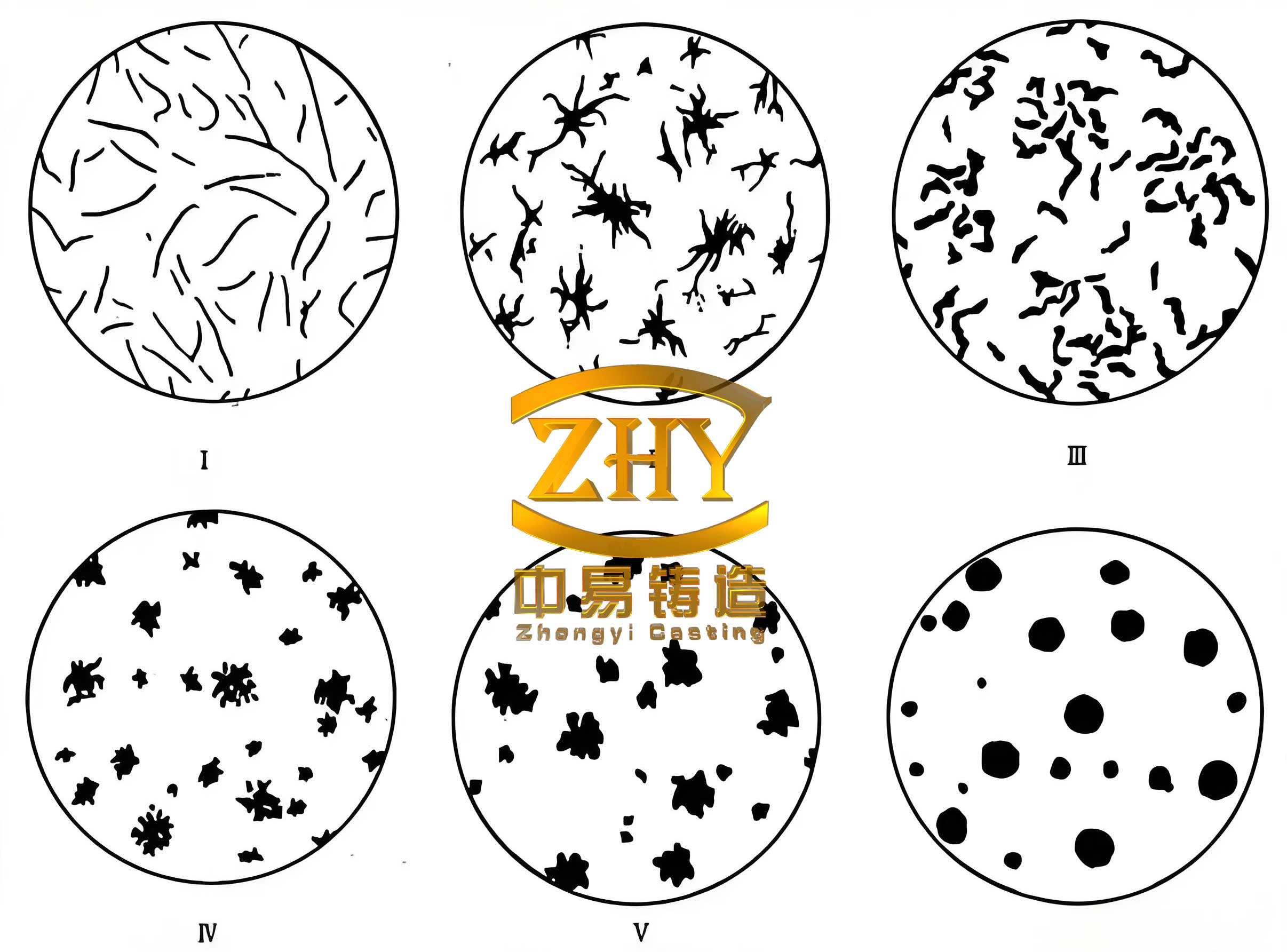
The effectiveness of our process was validated by the metallographic examination of separately cast test blocks. The microstructure revealed a ferritic matrix with well-dispersed, spherical graphite nodules. Nodularity consistently exceeded 90%, with a graphite size rating of 6 (ASTM A247). The absence of degenerate graphite forms, carbides, or significant segregation at the cell boundaries confirmed that the combination of low-manganese chemistry, effective inoculation, and controlled solidification was successful. This optimal microstructure is the direct precursor to achieving the required mechanical properties.
4. Quality Verification and Mechanical Performance
Verification of the casting quality was a multi-stage process. Integral to the casting itself were attached test lugs, designed to represent the thermal conditions of the thickest sections of the valve body. These lugs were later machined into standard tensile test specimens. The results from these specimens provided the definitive proof of the casting’s integrity.
| Property | Standard Requirement (QT450-10) | Average Measured Value |
|---|---|---|
| Tensile Strength, Rm | ≥ 390 MPa | 430 MPa |
| Yield Strength, Rp0.2 | ≥ 260 MPa | 285 MPa |
| Elongation, A | ≥ 10 % | 15.5 % |
The data clearly shows that the mechanical properties significantly surpassed the minimum requirements of the grade, demonstrating the excellent combination of strength and ductility achievable in well-produced heavy-section spheroidal graphite cast iron. Following the machining of the casting, non-destructive testing was performed under the witness of the client and inspectors. The 100% ultrasonic examination confirmed the internal soundness, with all areas meeting the specified Level 2 quality. Magnetic particle inspection of all machined surfaces revealed no surface or sub-surface defects. The final dimensional checks and surface roughness evaluation also conformed to the technical specifications.
5. Synthesis of Critical Success Factors
The production of this oversized butterfly valve plate can be distilled into several key principles that are broadly applicable to the manufacture of demanding heavy-section spheroidal graphite cast iron castings.
| Process Stage | Key Control Factor | Purpose & Effect |
|---|---|---|
| Design & Simulation | ProCAST Numerical Simulation | Predicts shrinkage/porosity, optimizes riser/chill placement, validates gating, ensures first-time quality. |
| Molding | Insulating Riser Sleeves + Strategic Chills | Improves feeding yield; accelerates local cooling to shorten solidification time and refine microstructure. |
| Raw Materials | High-Purity Pig Iron & Low-Trace Element Charge | Minimizes nuclei-poisoning elements, provides a clean, predictable base iron for treatment. |
| Chemistry | Low Mn (<0.3%), Controlled Si (~2.4%), CE ~Eutectic | Minimizes segregation and carbide formation; balances fluidity, self-feeding, and prevents graphite degeneration. |
| Treatment | Wire Feeding Nodularization + Multiple Inoculation | Ensures high, reproducible Mg recovery and provides potent, late-stage nucleation for high nodule count. |
| Process Control | Strict Thermal Management (Superheat, Treatment Temp, Pouring Temp) | Controls nucleation potential, treatment efficiency, and final solidification structure. |
Firstly, the entire endeavor must be treated as a cohesive, systematic engineering project. From initial design to final inspection, each step must be planned with precision and executed with discipline. Secondly, leveraging computational tools like ProCAST is no longer optional for such high-value castings; it is a necessity for risk mitigation and process optimization. Thirdly, the foundation of quality spheroidal graphite cast iron is laid with the selection of pure, predictable charge materials. Fourthly, the wire feeding treatment method proved exceptionally effective for achieving consistent and clean nodularization in a large mass of iron. Finally, and overarching all the above, is the imperative of stringent process control at every stage—thermal, chemical, and operational. This holistic approach ensures that the remarkable properties of spheroidal graphite cast iron, such as its near-steel strength combined with good ductility and excellent castability, can be reliably realized even in the most challenging, heavy-section geometries like the oversized butterfly valve plate. The successful delivery of this component, meeting all rigorous specifications without the need for weld repair, stands as a testament to the viability of well-engineered spheroidal graphite cast iron for critical, large-scale industrial applications.