
In my extensive experience within the heavy casting industry, the manufacture of critical components like rollers for rotary kilns represents a significant technological challenge. The shift from traditional steel castings to spheroidal graphite cast iron, often referred to as ductile iron, for such applications is driven by a compelling combination of economic and performance factors. While steel offers high strength and toughness, spheroidal graphite cast iron provides superior damping capacity, wear resistance, and machinability, all at a lower production cost and with better castability. This article details my firsthand account and methodological approach to producing a high-integrity, heavy-section roller from grade QT700-2 spheroidal graphite cast iron, a process where controlling microstructure and eliminating internal defects is paramount.
The component in question is a large roller, with a maximum diameter of 1300 mm, a height of 760 mm, and a formidable maximum wall thickness of 415 mm, resulting in a rough casting weight of approximately 7.5 tonnes. Components of this scale fall squarely into the category of heavy-section spheroidal graphite cast iron, a class of materials notorious for the metallurgical challenges posed during solidification. The extended solidification time in such thick sections promotes graphite degeneration, carbide formation, and segregation, which can severely compromise mechanical properties. Furthermore, the inherent volume contraction during solidification makes these castings highly susceptible to shrinkage porosity and macro-shrinkage defects. Therefore, the production strategy must be meticulously crafted from the outset, integrating advanced simulation, precise process design, and stringent metallurgical control.
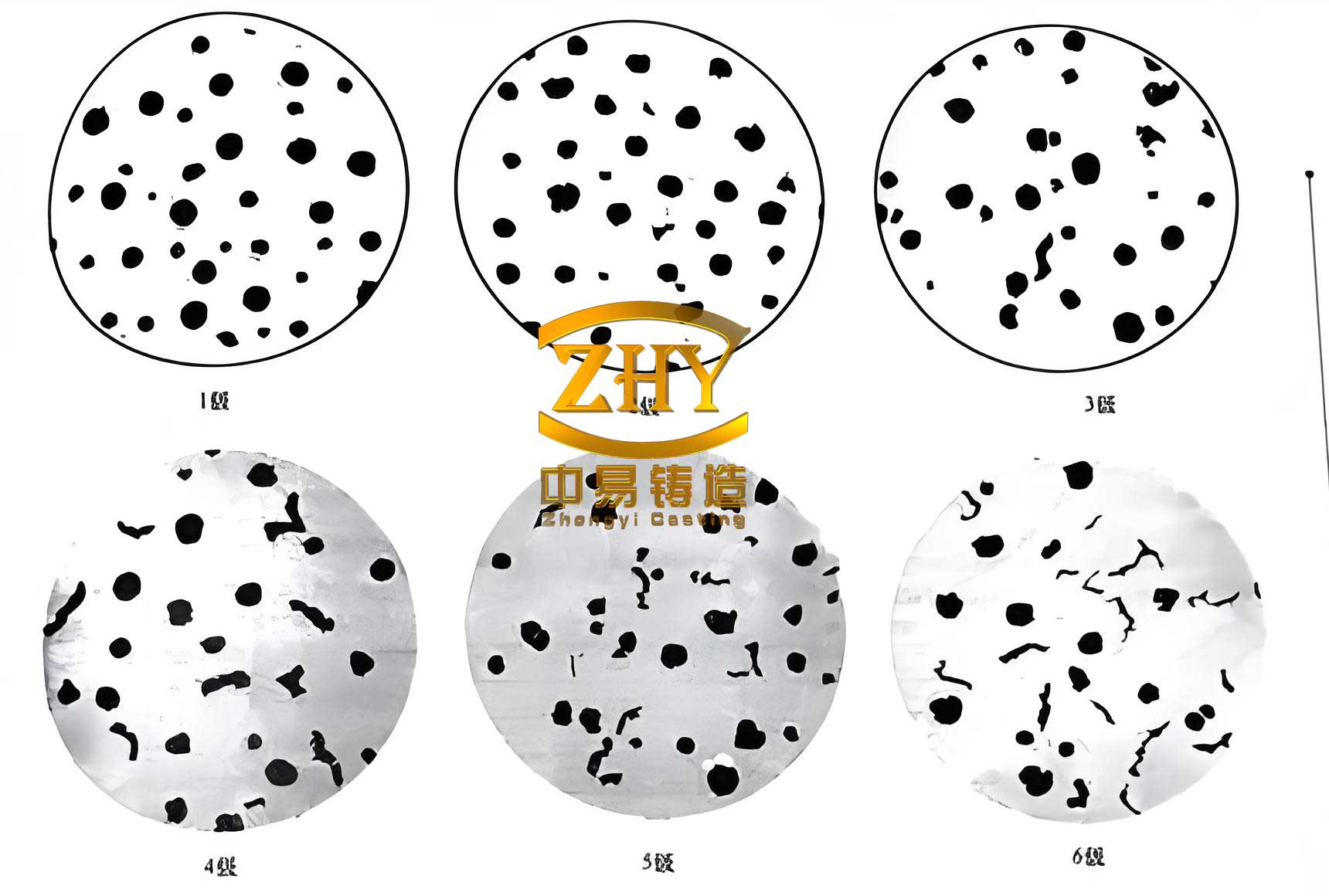
The technical specifications for the roller were exceptionally rigorous. Beyond the standard mechanical property requirements for QT700-2—which mandates a minimum tensile strength of 700 MPa, a yield strength of 380 MPa, and an elongation of 2%—the casting was subject to full non-destructive testing. All machined surfaces required ultrasonic testing according to EN 12680-3 (Grade 3) and liquid penetrant testing according to EN 1371-1 (Grade 3). Metallurgically, the spheroidal graphite cast iron had to achieve a graphite nodularity grade of 3 or better per ISO 945-1 (equivalent to GB/T 9441), with a predominantly pearlitic matrix to ensure the required hardness and strength. The chemical composition window was carefully defined to support these objectives, as summarized in Table 1.
| Element | Target Range (wt.%) | Critical Function |
|---|---|---|
| Carbon (C) | 3.2 – 3.6 | Promotes graphite formation, ensures fluidity. |
| Silicon (Si) | 1.6 – 2.0 | Ferritizer, promotes graphite formation, influences solidification pattern. |
| Manganese (Mn) | 0.5 – 0.6 | Strengthens pearlite, but must be controlled to avoid segregation. |
| Phosphorus (P) | < 0.02 | Low level is crucial to prevent embrittling phosphide eutectic. |
| Sulfur (S) | < 0.05 | Must be low to avoid interfering with magnesium treatment. |
| Magnesium (Mg) | 0.04 – 0.06 | Key spheroidizing element for graphite nodularization. |
| Rare Earths (RE) | 0.01 – 0.03 | Counteracts deleterious trace elements, modifies graphite shape. |
The foundational step in crafting a successful process was a comprehensive casting geometry and solidification analysis. Given the cost and lead time associated with a prototype casting of this size, reliance on trial-and-error was impractical. We employed finite element method (FEM) based numerical simulation software (ProCAST) to model the filling and, more critically, the solidification sequence of the spheroidal graphite cast iron. The simulation accounts for the latent heat release during the eutectic reaction, a dominant feature in cast iron solidification. The heat transfer during solidification can be modeled using Fourier’s law, and the progression of the solidus front is tracked. A key simplified metric for solidification time in a sand casting, often used for initial estimates, is Chvorinov’s rule:
$$ t = B \left( \frac{V}{A} \right)^n $$
where \( t \) is the total solidification time, \( V \) is the volume of the casting, \( A \) is its surface area, \( B \) is a mold constant, and \( n \) is an exponent typically around 2 for many casting conditions. For our roller’s massive section, the \( V/A \) ratio is very high, leading to prolonged \( t \), which qualitatively predicts the challenge. The numerical simulation, however, provides a far more precise and spatially resolved prediction.
Our initial process design featured a bottom-gating system to ensure calm mold filling and minimize turbulence and oxide formation. Several insulating sleeves were placed on the top surface to act as feeding risers. Chills, both internal and external, were strategically placed to promote directional solidification towards these risers. The simulation of this initial layout, however, predicted a high risk of shrinkage porosity in the thermal centers of the thick sections, particularly in the web regions connecting the hub to the rim. The simulated shrinkage criterion, often based on the Niyama criterion \( G/\sqrt{\dot{T}} \) (where \( G \) is the temperature gradient and \( \dot{T} \) is the cooling rate), indicated values below the critical threshold in these zones, signaling potential microporosity. This is a common issue in heavy-section spheroidal graphite cast iron due to the expansive graphite formation during eutectic solidification, which can sometimes hinder effective interdendritic feeding.
Guided by the simulation, we iteratively optimized the process. The key modifications involved enhancing the chilling effect and improving the feeding paths. The diameter of the intermediate external chills was increased significantly to extract heat more rapidly from the critical web areas. Furthermore, we added feeding aids (chamfers) on the inner diameter of the hub to create a more pronounced thermal gradient directing solidification towards the central riser. The revised layout, when simulated, showed a dramatic improvement. The areas previously flagged for shrinkage now displayed solidification patterns consistent with sound metal, with the isolated shrinkage zones confined entirely to the riser bodies, which are later removed during machining. This validated the principle that a synergistic combination of chills and risers is essential for producing sound heavy-section spheroidal graphite cast iron castings. The comparative outcomes are conceptually summarized in Table 2.
| Process Feature | Initial Design | Optimized Design | Impact on Solidification |
|---|---|---|---|
| External Chills (Web Region) | Standard size | Increased diameter (~25% larger) | Higher cooling rate ( \( \dot{T} \) ), steeper thermal gradient ( \( G \) ). |
| Internal Feeding Geometry | Straight wall | Added taper/chamfer | Improved feeding channel, maintains positive \( G \) towards riser. |
| Riser Insulation | Standard sleeves | High-efficiency insulating sleeves | Extended feeding time, improves feeding efficiency. |
| Predicted Shrinkage (Simulation) | Present in casting body | Confined to risers only | Eliminates internal defects in the final spheroidal graphite cast iron part. |
With a robust casting method established, the focus shifted to the metallurgical process of creating the high-quality spheroidal graphite cast iron itself. This begins with careful charge calculation and melting. We used a base charge of high-purity pig iron (low in trace elements like Ti, Sb, Pb) and selected steel scrap to achieve the target chemistry from Table 1. Melting was conducted in a medium-frequency induction furnace, which provides excellent stirring and temperature homogeneity. The melt was superheated to approximately 1500°C and held for a short period to ensure complete dissolution of charge materials and reduction of inherent nuclei, a step that can influence final graphite nodule count.
The treatment of the iron to convert the graphite morphology from flake to spheroidal is the most critical metallurgical operation. We employed the wire-feeding inoculation method for both nodularizing and inoculating the melt. This method offers superior reproducibility and environmental control compared to traditional sandwich techniques. The process involves immersing a cored wire containing a precisely measured alloy (typically a Mg-Fe-Si alloy with rare earths) into the molten iron at a controlled speed. The reaction for magnesium treatment can be simplified as:
$$ \text{Mg (in wire)} + \text{S (in melt)} \rightarrow \text{MgS (slag)} $$
$$ \text{[Mg] (dissolved)} \rightarrow \text{Mg acts on graphite growth interface} $$
The dissolved magnesium segregates to the growing graphite/liquid interface, altering the interfacial energy and inducing spherical growth. The residual magnesium level is critical; too low leads to imperfect nodularity (vermicular graphite), while too high promotes carbide formation and dross defects. The wire-feeding process allows for precise targeting of this residual range (0.04-0.06%). Inoculation, performed simultaneously or immediately after via a separate wire containing ferrosilicon-based inoculants, is vital for increasing the number of graphite nucleation sites. The nodule count \( N \) is a key parameter influencing mechanical properties and is governed by factors like inoculation potency and cooling rate. A higher \( N \) generally leads to smaller, more uniformly distributed nodules, improving strength and ductility. The relationship between cooling rate \( \dot{T} \) and nodule count can be empirically expressed for a given base iron and inoculation practice as:
$$ \log(N) \propto – \frac{Q}{R \dot{T}} $$
where \( Q \) is an effective activation energy and \( R \) is the gas constant, highlighting why heavy sections with low \( \dot{T} \) require potent inoculation to achieve an acceptable \( N \). The treatment temperature was carefully maintained between 1350°C and 1380°C to ensure good magnesium recovery and effective inoculation. Post-treatment, the metal was quickly transferred to the pouring ladle and cast at a temperature between 1330°C and 1360°C to minimize magnesium fade and inoculation fade.
After cooling and shakeout, the casting underwent extensive quality verification. Dimensional checks confirmed the geometry was within tolerance. The first critical test was non-destructive evaluation (NDE). Ultrasonic testing across all machined surfaces showed no reflectors above the permissible level for Grade 3 according to the relevant standard, indicating an absence of significant internal discontinuities such as shrinkage cavities or non-metallic inclusions. Liquid penetrant examination further confirmed the integrity of the surface, with no crack-like indications detected. These results validated the effectiveness of the optimized feeding and gating system for this spheroidal graphite cast iron component.
Mechanical properties were assessed via separately cast test bars (for standard reference) and, more importantly, via attached test blocks (70 mm thick) cast onto the roller itself. The properties from the attached test blocks, which better represent the heavy-section properties of the actual casting, are presented in Table 3. All values exceeded the minimum requirements for QT700-2, demonstrating the success of the metallurgical and process controls.
| Property | Standard Requirement (QT700-2) | Measured Average Value | Remarks |
|---|---|---|---|
| Tensile Strength, \( R_m \) | > 700 MPa | 753 MPa | Specimen diameter: 14 mm |
| Yield Strength, \( R_{p0.2} \) | > 380 MPa | 494 MPa | |
| Elongation, \( A \) | > 2 % | 3 % | |
| Brinell Hardness, HBW | 225 – 305 | 257 | 10/3000 load |
Metallographic examination of samples taken from the attached block provided the final confirmation of quality. The microstructure revealed a well-nodularized graphite structure with a nodularity exceeding 90%, corresponding to a rating of 2-3 according to ISO 945-1. The graphite size was predominantly in the size class 5-6 (medium to small). The matrix consisted of over 90% fine pearlite with a small amount of ferrite surrounding the graphite nodules, which is the ideal microstructure for achieving the high strength and moderate ductility of the QT700-2 grade. This excellent microstructure in a heavy-section spheroidal graphite cast iron is a direct result of the balanced chemistry, effective wire-feeding treatment, and the controlled solidification conditions imposed by the chills.
Reflecting on this production campaign, several key factors contributed to the successful manufacture of this demanding heavy-section spheroidal graphite cast iron roller. First, the integration of numerical simulation was indispensable for proactively identifying and resolving potential shrinkage defects, saving considerable time and resources. Second, the adoption of the wire-feeding treatment process provided unmatched control over the critical magnesium and inoculation additions, ensuring consistent high nodularity and nodule count despite the challenging slow-cooling conditions. Third, the holistic design philosophy that coupled insulating risers with aggressive chilling in specific zones proved effective in managing the solidification of such a massive spheroidal graphite cast iron casting. The synergy between process design and metallurgy cannot be overstated; even the best melting practice can be undone by poor feeding, and vice-versa.
This experience underscores that producing high-performance heavy-section spheroidal graphite cast iron components is a fully tractable engineering challenge. It requires a disciplined approach that marries modern simulation tools with precise foundry engineering and rigorous metallurgical control. The successful substitution of spheroidal graphite cast iron for steel in this application highlights its potential for other heavy-duty, wear-resistant components, offering a compelling balance of performance, cost, and manufacturability. Future work may explore further optimization of chill materials and geometries, advanced inoculants for even higher nodule counts in heavy sections, and the application of these principles to even larger and more complex geometries in spheroidal graphite cast iron.