
In my experience working with complex castings, particularly cylinder blocks for compressors, I have found that achieving high-quality nodular cast iron components for low-temperature applications is a significant challenge. These cylinder blocks must withstand harsh operational conditions, requiring sufficient strength, stiffness, and durability. Their intricate shapes, large dimensions, varying wall thicknesses, and stringent requirements for internal quality and surface roughness contribute to high rejection rates. Therefore, to produce cylinder blocks that meet stringent standards, it is essential to meticulously control every aspect of the production process, from raw material selection to final processing. This article delves into the key factors involved in manufacturing low-temperature nodular cast iron cylinder blocks, focusing on process optimization to reduce defects and enhance performance. Throughout this discussion, I will emphasize the critical role of nodular cast iron in achieving these goals, as its unique microstructure provides the necessary mechanical properties.
The cylinder block in question is designed for low-temperature environments, necessitating the use of QT350-22L nodular cast iron according to standards such as GB/T 1348 and JB/T 9104. Key mechanical properties include a tensile strength ≥350 MPa, yield strength ≥220 MPa, elongation ≥22%, hardness ≤160 HB, and impact energy ≥12 J at -40°C in V-notch tests. The casting weighs approximately 4 tons, with overall dimensions of 1060 mm × 540 mm × 1400 mm, a main wall thickness of 55 mm, and a maximum thickness of 170 mm. Given these specifications, the production process must be carefully tailored to ensure consistency and quality. In this context, I will explore the foundational steps, starting with casting process selection.
Based on available production facilities and equipment, I recommend using furan resin sand molding for its precision and stability. Melting is conducted in a 5-ton medium-frequency electric furnace, with horizontal molding and vertical pouring to facilitate proper filling and solidification. To further optimize the process, simulation software like Huazhu CAE can be employed for solidification analysis, helping to predict and mitigate potential defects such as shrinkage porosity. This proactive approach is vital for complex nodular cast iron castings, where thermal gradients and cooling rates significantly influence the final microstructure and properties.
Moving to production process control, I will break it down into several critical aspects: charge material ratio, molten iron chemical composition selection, choice of nodulizing and inoculating agents, and specific processing parameters. Each of these elements plays a pivotal role in determining the quality of the nodular cast iron.
Charge Material Ratio
The foundation of high-quality nodular cast iron lies in the purity and composition of the charge materials. In my practice, I prefer using No. 10 high-quality carbon scrap steel as the primary raw material due to its low impurity content. The chemical composition of this scrap steel is summarized in Table 1.
| Element | C | Si | Mn | P | S | Ti | Cr | V | Fe |
|---|---|---|---|---|---|---|---|---|---|
| Content (wt%) | 0.09 | 0.12 | 0.16 | 0.08 | 0.017 | 0.02 | 0.071 | 0.001 | Balance |
To adjust the carbon content, a high-temperature graphitized carburizer is added. This carburizer is selected for its high fixed carbon and low sulfur content, which minimizes adverse effects on the nodular cast iron. Its composition is detailed in Table 2.
| Property | Fixed Carbon | Ash | Moisture | S | N |
|---|---|---|---|---|---|
| Content (wt%) | ≥98.5 | ≤1 | ≤1 | <0.1 | ≤0.015 |
Note: The carburizer particle size is 1–5 mm.
The charge ratio is calculated to achieve the desired base composition before treatment. Typically, the scrap steel constitutes the majority, with carburizer and other alloys added based on furnace analysis. This careful balance ensures that the molten iron has a consistent starting point for subsequent treatments, which is crucial for producing reliable nodular cast iron.
Molten Iron Chemical Composition Selection
The chemical composition of the molten iron is a cornerstone in producing high-performance nodular cast iron. Each element must be controlled within specific ranges to optimize both casting properties and mechanical performance, especially for low-temperature applications.
First, the carbon equivalent (CE) is a key parameter that influences fluidity, shrinkage, and soundness. For nodular cast iron, the carbon equivalent is defined as:
$$ CE = C + \frac{1}{3}(Si + P) $$
In my experience, a CE between 4.4% and 4.6% is ideal for this cylinder block, as it promotes good fluidity while minimizing shrinkage defects. This range aligns with typical values for thick-section nodular cast iron castings.
Carbon content itself is critical. Higher carbon levels increase graphite nodule count, reduce nodule size, and improve roundness, all of which enhance the ductility and impact resistance of nodular cast iron. However, excessive carbon can lead to graphite flotation. For this application, I target a carbon content of 3.65% to 3.75%.
Silicon is a strong graphitizer that helps prevent carbide formation. To ensure adequate ferrite formation and toughness, the final silicon content should be 1.80% to 2.00%. Given that multiple inoculations will add silicon, the base iron silicon is controlled at 0.80% to 1.00%.
Manganese is a pearlite stabilizer that can reduce toughness, particularly at low temperatures. Thus, for low-temperature nodular cast iron, manganese should be limited to below 0.3% to maintain impact properties.
Phosphorus and sulfur are harmful impurities. Phosphorus embrittles the matrix, so I keep it below 0.1%. Sulfur interferes with nodulization and promotes slag inclusions; therefore, the base iron sulfur content is controlled below 0.03%.
Titanium can disrupt graphite spheroidization and impair mechanical properties. Hence, titanium content is restricted to ≤0.04%.
Additionally, nickel is added to enhance tensile strength without compromising low-temperature toughness. I recommend adding 0.6% to 0.8% nickel in granular form via the pouring ladle using a冲入法 (plunging method).
To summarize, the target chemical composition ranges for the treated nodular cast iron are as follows:
| Element | C | Si | Mn | P | S | Mg | RE | Ti | Ni |
|---|---|---|---|---|---|---|---|---|---|
| Range (wt%) | 3.65–3.75 | 1.80–2.00 | <0.30 | <0.10 | <0.03 | 0.04–0.06 | 0.02–0.03 | ≤0.04 | 0.6–0.8 |
Nodulizing and Inoculating Agent Selection
The transformation of cast iron into nodular cast iron relies on effective nodulization and inoculation. These processes ensure the formation of spherical graphite nodules and a fine matrix structure.
For nodulization, I use a T-1 type nodulizing agent containing magnesium and rare earth elements. The addition rate is 1.4% of the iron weight. Magnesium content is controlled at 0.04% to 0.06% in the final iron to minimize shrinkage and chill tendencies, while rare earth content is kept at 0.02% to 0.03% to improve graphite roundness. The nodulizing agent composition is shown in Table 4.
| Element | Mg | RE | Ba | Ca | Si | Fe |
|---|---|---|---|---|---|---|
| Content (wt%) | 6.5–7.5 | 1.8–2.5 | 1.8–2.5 | Appropriate | 43–45 | Balance |
Note: The nodulizing agent particle size is 10–25 mm. Treatment is performed using the冲入法 (plunging method), where the agent is placed in the ladle and molten iron is poured over it.
Inoculation is equally important for refining graphite structure and increasing nodule count. I employ a BS-3 type inoculant specifically designed for nodular cast iron. The total inoculation addition is 1.0%, distributed as follows: 0.4% as a cover in the ladle, 0.45% for ladle inoculation, and 0.15% for stream inoculation using a浮硅 (floating silicon) method. This multi-stage approach enhances inoculation effectiveness, promoting a uniform distribution of fine graphite nodules throughout the nodular cast iron matrix.
The processing parameters are tightly controlled: tapping temperature from the furnace is 1500–1530°C, nodulizing treatment time is 60–90 seconds, pouring temperature is 1350–1380°C, pouring time is 120–150 seconds, and annealing time is 72 hours to ensure hardness below 140 HB. These parameters are critical for achieving the desired microstructure and properties in nodular cast iron.
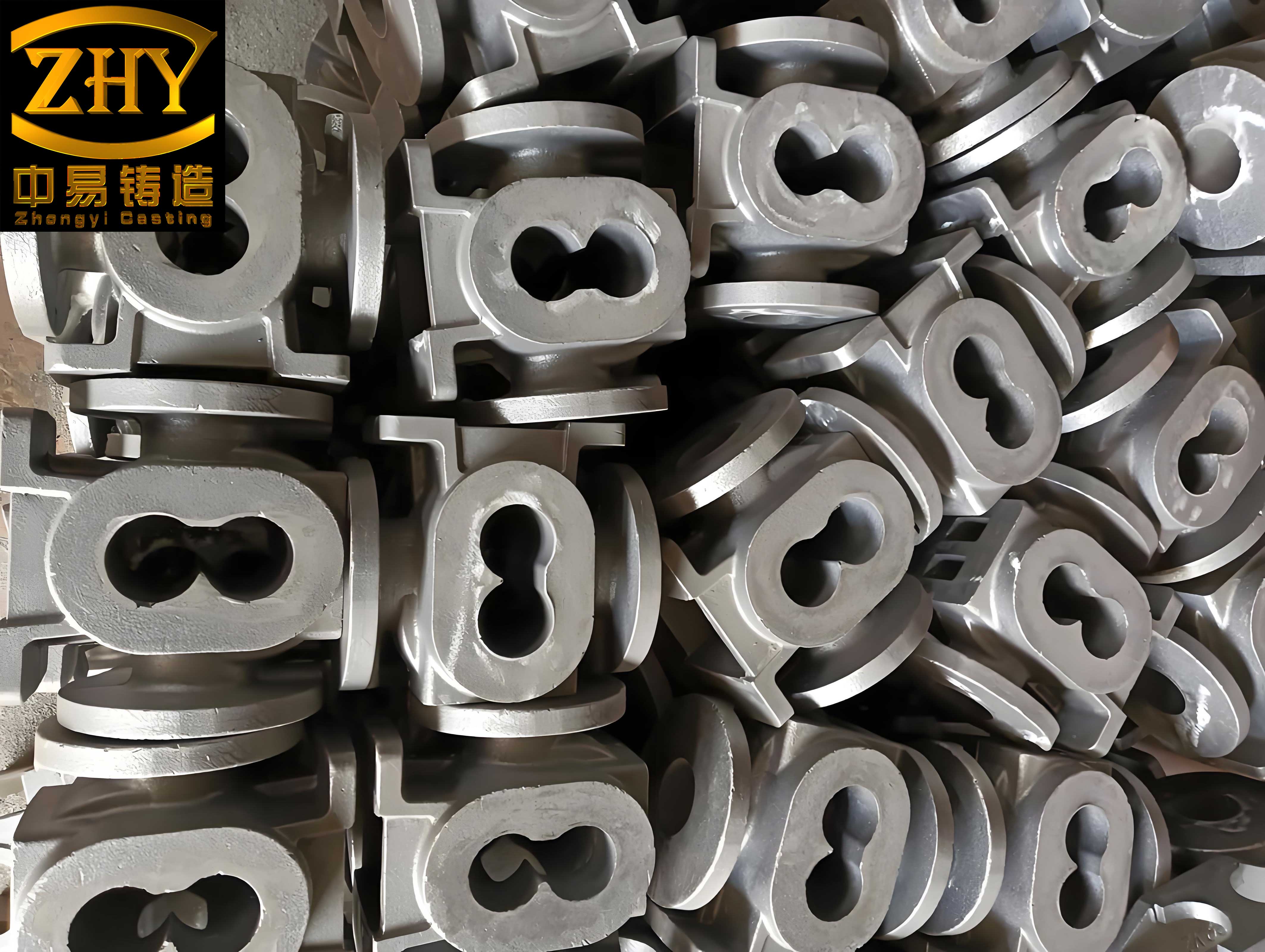
The microstructure of nodular cast iron, as shown in the image, typically consists of spherical graphite nodules embedded in a ferritic or pearlitic matrix. For low-temperature applications, a predominantly ferritic matrix is preferred due to its superior toughness and impact resistance. The image illustrates the ideal graphite morphology, which is essential for the mechanical performance of nodular cast iron. In my process, achieving such a structure requires precise control over composition and cooling rates.
Trial Production Results
To validate the process, trial productions were conducted. The chemical compositions of the base iron and treated iron were analyzed, as summarized in Table 5.
| Iron Type | C | Si | Mn | P | S | Mg | RE | Ti | Ni |
|---|---|---|---|---|---|---|---|---|---|
| Base Iron (wt%) | 3.95 | 0.85 | 0.246 | 0.018 | 0.023 | – | – | 0.0038 | 0.036 |
| Treated Iron (wt%) | 3.77 | 1.82 | 0.254 | 0.019 | 0.016 | 0.030 | 0.015 | 0.0063 | 0.728 |
The treated iron composition aligns well with the target ranges, demonstrating effective control. Subsequently, the mechanical properties and microstructure of the nodular cast iron were evaluated at -40°C using separately cast samples subjected to the same heat treatment. The results are presented in Table 6.
| Tensile Strength (MPa) | Yield Strength (MPa) | Elongation (%) | Hardness (HB) | Impact Energy at -40°C (J) | Nodularity Grade | Graphite Size | Matrix Structure |
|---|---|---|---|---|---|---|---|
| 410 | 240 | 24 | 120 | 16, 18, 20 | Grade 3 | Grade 6 | 95% Ferrite |
All parameters meet or exceed the requirements, confirming that the process yields high-quality low-temperature nodular cast iron. The impact energy values are particularly satisfactory, indicating good toughness under cryogenic conditions. This success underscores the importance of meticulous process control in producing nodular cast iron for demanding applications.
Further Considerations in Process Optimization
Beyond the basic controls, several additional factors can influence the quality of nodular cast iron cylinder blocks. In my experience, thermal analysis during solidification is invaluable. By monitoring cooling curves, I can assess the effectiveness of inoculation and nodulization. The relationship between cooling rate and graphite nucleation can be expressed using equations like:
$$ N = k \cdot \exp\left(-\frac{Q}{RT}\right) $$
where \( N \) is the nodule count, \( k \) is a constant, \( Q \) is the activation energy, \( R \) is the gas constant, and \( T \) is temperature. This highlights how temperature control impacts the microstructure of nodular cast iron.
Another aspect is the design of gating and risering systems. For thick-section nodular cast iron castings, proper feeding is essential to prevent shrinkage porosity. The modulus method can be applied to calculate riser sizes:
$$ M = \frac{V}{A} $$
where \( M \) is the modulus (volume-to-surface area ratio), \( V \) is volume, and \( A \) is surface area. Ensuring that risers have a higher modulus than the casting sections helps promote directional solidification.
Moreover, the role of trace elements cannot be overlooked. Elements like antimony, lead, or bismuth can degenerate graphite morphology in nodular cast iron. Therefore, raw materials must be screened for such impurities. Regular spectroscopic analysis of molten iron is recommended to maintain composition within tight tolerances.
Heat treatment is another critical step. For low-temperature nodular cast iron, a ferritizing anneal is typically performed to maximize ductility and impact resistance. The annealing cycle involves heating to 900–950°C, holding for 2–4 hours, then slow cooling to 700°C, followed by furnace cooling. This process ensures the decomposition of any pearlite or carbides, resulting in a fully ferritic matrix. The hardness after annealing should be below 140 HB, as achieved in our trials.
Economic and Quality Implications
Implementing these controls has significant economic benefits. By reducing rejection rates, manufacturers can save on material and energy costs. For instance, if the rejection rate drops from 10% to 5% for a 4-ton nodular cast iron casting, the savings per casting can be substantial. This can be quantified as:
$$ \text{Savings} = (\text{Rejection Rate Reduction}) \times (\text{Production Cost per Casting}) $$
In addition, consistent quality enhances customer satisfaction and opens doors to more demanding markets, such as cryogenic equipment or offshore applications where low-temperature nodular cast iron is essential.
To further illustrate the process flow, I have summarized the key steps in Table 7.
| Step | Description | Key Parameters |
|---|---|---|
| Charge Preparation | Select high-purity scrap steel and carburizer | Scrap steel: Low P, S; Carburizer: Fixed carbon ≥98.5% |
| Melting | Melt in medium-frequency furnace | Temperature: 1500–1530°C; Composition adjustment |
| Nodulization | Add nodulizing agent via plunging method | Agent: T-1 type; Addition: 1.4%; Mg: 0.04–0.06% |
| Inoculation | Multi-stage inoculation with BS-3 agent | Total addition: 1.0%; Stream inoculation: 0.15% |
| Pouring | Vertical pouring in resin sand molds | Pouring temperature: 1350–1380°C; Time: 120–150 s |
| Solidification | Controlled cooling using simulation | Annealing: 72 hours; Hardness target: <140 HB |
| Testing | Mechanical and microstructural evaluation | Tensile, impact at -40°C, graphite nodularity |
This table encapsulates the holistic approach required for producing reliable nodular cast iron components. Each step interlinks, and deviations can compromise the final product. Therefore, continuous monitoring and adjustment are necessary, especially when dealing with variable raw material batches.
Conclusion
In summary, producing low-temperature nodular cast iron cylinder blocks demands a comprehensive understanding of material science and process engineering. From selecting high-purity charge materials to controlling chemical compositions, nodulization, inoculation, and thermal parameters, every detail matters. The successful trial results demonstrate that with meticulous control, it is possible to achieve the desired mechanical properties and microstructure for cryogenic applications. Nodular cast iron, with its unique combination of strength and ductility, is ideally suited for such demanding roles. By adhering to the practices outlined here—emphasizing precision in composition, treatment, and cooling—manufacturers can consistently produce high-quality castings, reduce waste, and enhance profitability. As technology advances, further refinements in simulation and real-time monitoring will likely push the boundaries of what is achievable with nodular cast iron, solidifying its position as a material of choice for critical components in low-temperature environments.
Throughout this discussion, I have strived to highlight the intricacies of working with nodular cast iron, underscoring its versatility and the careful balance required to harness its full potential. Whether for cylinder blocks or other heavy-section castings, the principles remain the same: control, consistency, and continuous improvement are key to success in the foundry industry.