
In the realm of lost foam casting, the quality of the pattern material is paramount, often determining the success or failure of the entire process. From my perspective as a researcher deeply involved in this field, I have come to understand that approximately 50% of the final quality of castings hinges on the properties of the pattern material itself. This is especially critical for the production of high-integrity cast iron parts, where surface defects can lead to significant performance issues. Therefore, a comprehensive investigation into the characteristics and thermal degradation behavior of pattern materials is not merely academic; it is essential for advancing industrial practices and ensuring the reliability of cast iron components. This article delves into the pyrolysis mechanisms of various pattern materials, with a particular focus on how their decomposition products directly compromise the surface finish of cast iron parts. By synthesizing existing knowledge and presenting new analytical perspectives, I aim to elucidate the complex physico-chemical interactions at the metal-pattern interface and propose pathways for mitigation.
The most commonly employed pattern materials in lost foam casting are Expanded Polystyrene (EPS), Polymethyl Methacrylate (EPMMA), and Styrene-Methyl Methacrylate copolymer (STMMA). Their fundamental characteristics dictate their behavior during the pouring of molten metal. A comparative analysis of their properties is presented in the table below, which highlights key differences in molecular architecture and elemental composition.
| Property | EPMMA (Expandable Polymethyl Methacrylate) | EPS (Expandable Polystyrene) | STMMA (Styrene-Methyl Methacrylate Copolymer) |
|---|---|---|---|
| Molecular Structure | Linear chain structure: $$-[\text{CH}_2\text{C(CH}_3\text{)(COOCH}_3)]_n-$$ | Contains aromatic benzene rings: $$-[\text{CH}_2\text{CH(C}_6\text{H}_5)]_n-$$ | Copolymer combining linear and aromatic segments (typically 70% MMA, 30% Styrene). |
| Empirical Formula | $$(\text{C}_5\text{H}_8\text{O}_2)_n$$ | $$(\text{C}_8\text{H}_8)_n$$ | Varies with composition. |
| Carbon Content (wt.%) | ~60% | ~92% | ~69.6% (for 70/30 ratio) |
| Cohesive Energy Density (J/cm³) | ~347 | ~309 | Intermediate |
| Primary Pyrolysis Solid Residue | Lower yield of solid carbon | High yield of solid carbon | Moderate yield |
The data clearly shows that EPS, with its stable benzene rings, has a significantly higher carbon content than EPMMA. This fundamental difference is the root cause of their divergent pyrolysis pathways and, ultimately, their impact on the surface quality of cast iron parts. The linear chain of EPMMA lacks the thermal stability conferred by aromatic structures, leading to a different mode of decomposition.
The thermal degradation of a pattern material upon contact with molten iron is a rapid, complex sequence of physical and chemical transformations. It involves heat transfer, mass transfer, and momentum exchange, all of which govern the filling pattern of the metal and the formation of defects in the final casting. Based on my analysis, the pyrolysis mechanism can be systematically broken down into four overlapping stages: thermal deformation/softening, depolymerization, pyrolysis/cracking, and combustion.
Stage 1: Thermal Deformation and Softening. When heated, polymeric materials first undergo physical changes before chemical bonds break. EPS begins to shrink markedly around 150°C, softens at approximately 200°C, and forms a viscous liquid by 300°C. EPMMA exhibits this volume collapse and softening at slightly higher temperatures, around 200°C and 250°C respectively, due to its higher cohesive energy density (347 J/cm³ vs. 309 J/cm³ for EPS). This initial phase is crucial as it affects the geometry of the cavity ahead of the metal front.
Stage 2: Depolymerization. This is the initial chemical breakdown where long polymer chains unzip into monomers or smaller oligomers. The molecular structure dictates the mechanism. EPMMA, with its linear chain, undergoes a “zipper-like” depolymerization from chain ends, predominantly yielding gaseous monomer (methyl methacrylate):
$$ -[\text{CH}_2\text{C(CH}_3\text{)(COOCH}_3)]_n- \rightarrow n \cdot \text{CH}_2=\text{C(CH}_3\text{)(COOCH}_3) $$
In contrast, the presence of benzene rings in EPS makes its decomposition more random, producing a mixture of liquid styrene oligomers and some gases rather than a clean unzipping to monomer. This liquid intermediate is prone to further degradation.
Stage 3: Pyrolysis/Cracking. Under the high-temperature, oxygen-deficient environment at the metal front, the depolymerized products undergo further cracking. The overall stoichiometry for complete pyrolysis in an inert atmosphere can be summarized by the following equations:
For EPS:
$$ \text{C}_8\text{H}_8(s) \rightarrow 8\text{C}(s) + 4\text{H}_2(g) $$
For EPMMA:
$$ \text{C}_5\text{H}_8\text{O}_2(s) \rightarrow 3\text{C}(s) + 2\text{CO}(g) + 4\text{H}_2(g) $$
These equations reveal critical insights. Per mole of material, EPMMA generates more gas (6 moles) than EPS (4 moles). Conversely, EPS produces a substantially larger mass of solid carbon residue. For instance, 100g of EPS yields about 92g of solid carbon, while 100g of EPMMA yields only about 36g. This prolific generation of solid carbon from EPS is a key factor in defect formation for cast iron parts.
Stage 4: Combustion. If oxygen infiltrates the mold cavity from the coating or atmosphere, partial combustion of the pyrolysis products can occur. This can consume some of the solid carbon and gaseous hydrocarbons, producing CO and CO₂. The extent of combustion is highly dependent on process conditions like vacuum level and coating permeability.
To understand the specific challenges in producing sound cast iron parts, a detailed examination of EPS pyrolysis during casting is necessary. The process is temperature-dependent and can be segmented into distinct thermal regimes, as summarized in the table below.
| Temperature Range (°C) | Primary Process | Key Products Formed | State of Matter |
|---|---|---|---|
| ~150 – 400 | Softening, Melting, Initial Depolymerization | Liquid oligomers (LEPS), some styrene vapor | Liquid, Vapor |
| 400 – 700 | Active Cracking & Gasification | Gases: H₂, CO, CO₂, small CnHm (e.g., benzene, toluene). Liquid intermediates decrease. | Gas, Diminishing Liquid |
| 700 – 1550+ | Intensive Pyrolysis & Secondary Reactions | Abundant H₂ (up to ~48 vol%), massive solid carbon (soot/char), CO, and other gases. | Gas, Solid Carbon |
The products exist in three states within the mold cavity: gaseous, liquid, and solid. Each state plays a role in determining the final quality of the cast iron parts.
Gaseous Products: The rapid evolution of gases (H₂, CO, CO₂, hydrocarbons) directly ahead of the molten iron creates a pressure counter-force. This affects the morphology of the metal flow front—often causing it to become turbulent or fragmented—and alters the filling mechanics from a smooth, laminar advance to a more disordered one. This disturbed flow can entrap gases or pyrolysis residues, leading to surface defects on the cast iron parts.
Liquid Products: In lower temperature zones or during rapid heating, not all liquid polystyrene (LEPS) fully vaporizes or cracks. This viscous liquid can be trapped at the metal-mold interface. If it does not fully decompose or get expelled through the coating, it can become incorporated into the solidifying metal surface, creating blemishes or carbonaceous inclusions. Furthermore, this liquid can serve as a precursor for additional solid carbon formation via secondary cracking reactions: $$ \text{LEPS (liquid)} \rightarrow \text{more gases} + \text{solid C} $$
Solid Products: This is the most critical factor for cast iron parts. The massive amount of solid carbon generated from EPS pyrolysis, as predicted by the stoichiometry, forms fine soot or char particles. During the casting of iron, these particles present a formidable challenge. They have a vastly different density compared to molten iron and are not readily wetted or dissolved by it, especially in gray or ductile iron compositions. If these solid carbon particles are not effectively evacuated through the permeable coating or oxidized by residual oxygen, they are pushed by the advancing metal front. They tend to accumulate at the upper surfaces or stagnant zones of the cavity, adhering to the mold wall. Upon solidification of the cast iron part, this layer of carbon manifests as a surface defect known as “carbon fold” or “lustrous carbon defect,” which appears as wrinkled, shiny, or flaky patches severely degrading the surface integrity. The visual manifestation of such defects on a cast iron component can be observed in the following illustration.
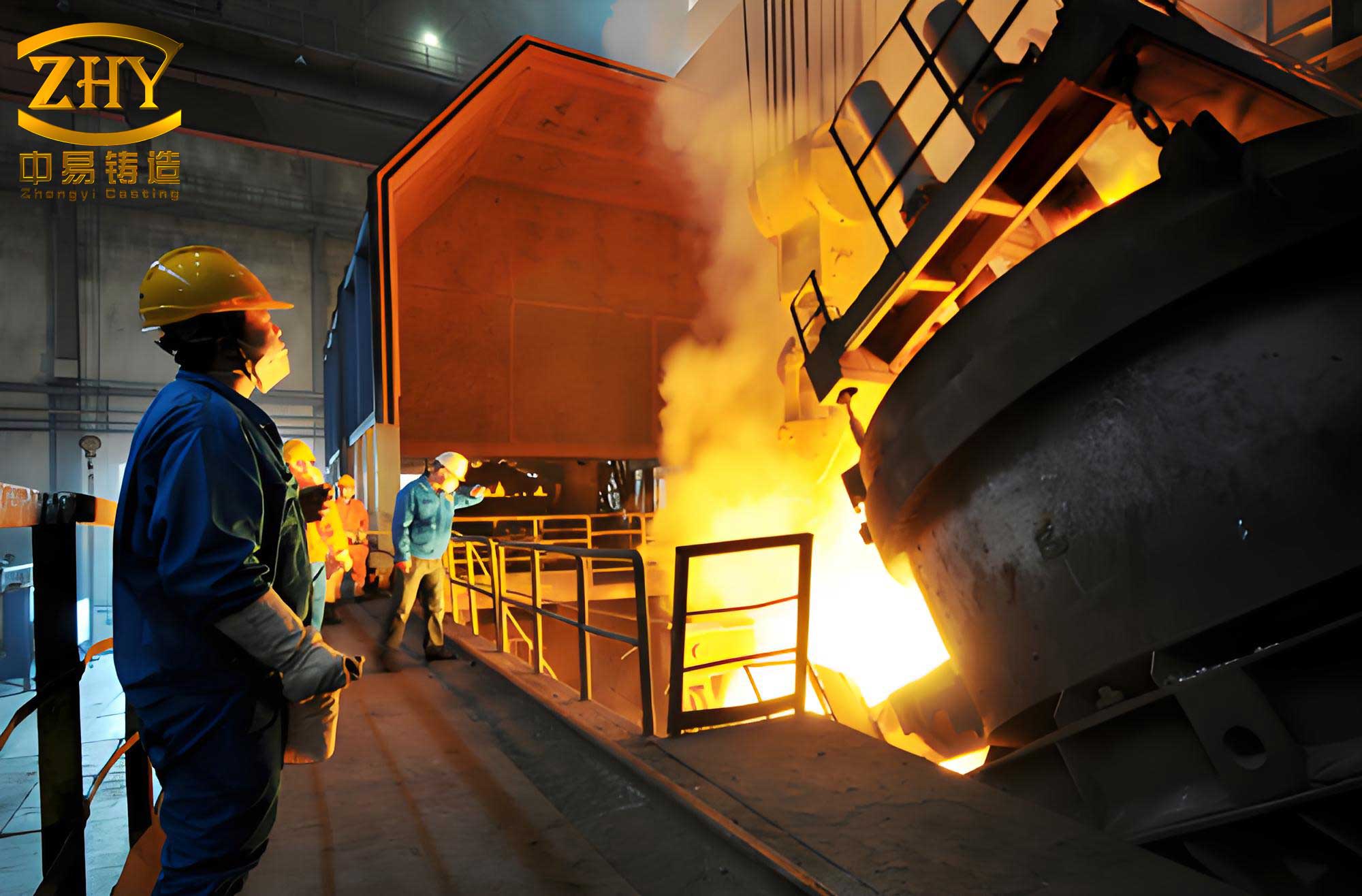
This defect is not merely cosmetic; it can act as a stress concentrator, impair machinability, and reduce fatigue life, which is unacceptable for many engineering applications of cast iron parts.
The interplay between these product states defines the casting outcome. The gaseous products create an unstable filling environment, while the solid carbon provides the direct material for defect formation. This is particularly acute for cast iron parts because the high pouring temperatures (often above 1390°C for ductile iron) drive EPS into the intensive pyrolysis regime, maximizing solid carbon yield. While EPMMA generates more gas, which requires robust venting, its lower solid carbon output often results in cleaner surfaces for ferrous castings, explaining its preference for critical cast iron parts in some applications. The relationship can be conceptualized with the following equation representing the defect formation potential (P_d): $$ P_d \propto \frac{Y_C \cdot \rho_{metal}}{E_v \cdot k_{ox}} $$ where \(Y_C\) is the yield of solid carbon from the pattern, \(\rho_{metal}\) is the metal density (high for iron), \(E_v\) is the evacuation efficiency of gases and solids through the coating, and \(k_{ox}\) is the rate of oxidation of carbon at the interface. For cast iron parts, a high \(Y_C\) (as with EPS) and a high \(\rho_{metal}\) combine to create a high inherent risk, which must be counteracted by optimizing \(E_v\) and \(k_{ox}\).
To further quantify the impact, consider the mass balance during the casting of a typical cast iron part. If an EPS pattern weighing \(m_p\) grams is used, the approximate mass of solid carbon generated, \(m_C\), can be estimated as: $$ m_C \approx 0.92 \times m_p $$ This carbon must be managed within the limited volume and time of the mold filling and solidification process. Failure to do so directly correlates with the percentage of defective surface area on the cast iron part.
In conclusion, my investigation confirms that the thermal pyrolysis of pattern materials is a central phenomenon controlling the surface quality in lost foam casting. The molecular structure and carbon content of the pattern material predetermine its pyrolysis mechanism and product distribution. Specifically for EPS, which is widely used due to its cost and ease of processing, the high-yield generation of solid carbon is the fundamental material source of surface defects on cast iron parts. The concomitant release of large volumes of gas exacerbates the problem by disturbing metal flow. Therefore, the path to producing flawless cast iron parts lies not only in selecting appropriate pattern materials but more critically in developing and implementing strategies to aggressively remove and eliminate solid carbon residues from the mold cavity. Future research directions I propose should intensely focus on: (1) Engineering advanced coating systems with ultra-high permeability and catalytic properties to enhance the evacuation and oxidation of solid carbon; (2) Developing modified pattern materials or additives that suppress solid carbon formation in favor of gaseous products that are easier to remove; and (3) Optimizing process parameters such as pouring temperature, vacuum level, and gating design to create dynamic conditions unfavorable for carbon adhesion to the surface of cast iron parts. By mastering the science of pattern pyrolysis, we can transform the lost foam process into a consistently reliable method for manufacturing high-quality cast iron components.