
In my extensive experience as a casting engineer specializing in vacuum casting processes, I have consistently focused on optimizing techniques for producing complex geometries, particularly arc-shaped casting parts. The V-process, or vacuum casting, is a revolutionary method that originated in Japan and has gained prominence due to its ability to create high-precision casting parts without binders. This process involves sealing a mold with an EVA film, evacuating air to create a pressure differential that compacts dry sand, forming a precise cavity. After core setting, mold assembly, pouring, and solidification, the vacuum is released, allowing the sand to collapse and yield intact casting parts. The fine sand grain size (70/140 mesh), combined with the EVA film and powdered coating, ensures excellent dimensional accuracy, sharp contours, and smooth surfaces for casting parts. Moreover, the continuous vacuum during pouring enhances fluidity, making it ideal for intricate arc-shaped casting parts like counterweights for excavators. This article delves into the comprehensive quality control measures I implemented to successfully produce such casting parts, emphasizing process design, parameter optimization, and rigorous in-process checks.
The arc-shaped casting parts under consideration are counterweights for excavators, characterized by their curved profile and thin-walled structure. These casting parts are made of HT250 gray iron, with overall dimensions of 1852 mm in length, 382 mm in width, and 725 mm in height. The primary wall thickness is 27 mm, and the weight is approximately 400 kg. The curvature and assembly surfaces demand high precision, posing significant challenges in preventing deformation and ensuring mechanical properties. Below is a table summarizing the key characteristics of these casting parts:
| Parameter | Value |
|---|---|
| Material | HT250 Gray Iron |
| Dimensions | 1852 mm × 382 mm × 725 mm |
| Wall Thickness | 27 mm |
| Weight | 400 kg |
| Shape | Arc-shaped, thin-walled |
| Key Requirements | High curvature accuracy, flatness of assembly surfaces ≤ 1 mm |
The production setup included a 12.5-ton medium-frequency induction furnace, V-process vacuum molding equipment, water-circulation vacuum pumps, standard V-process sand boxes (2250 mm × 1800 mm × 650/950 mm), and a 3-ton ladle. This infrastructure supported the mass production of these casting parts, but the unique geometry necessitated tailored process designs to mitigate issues like distortion and cold shuts.
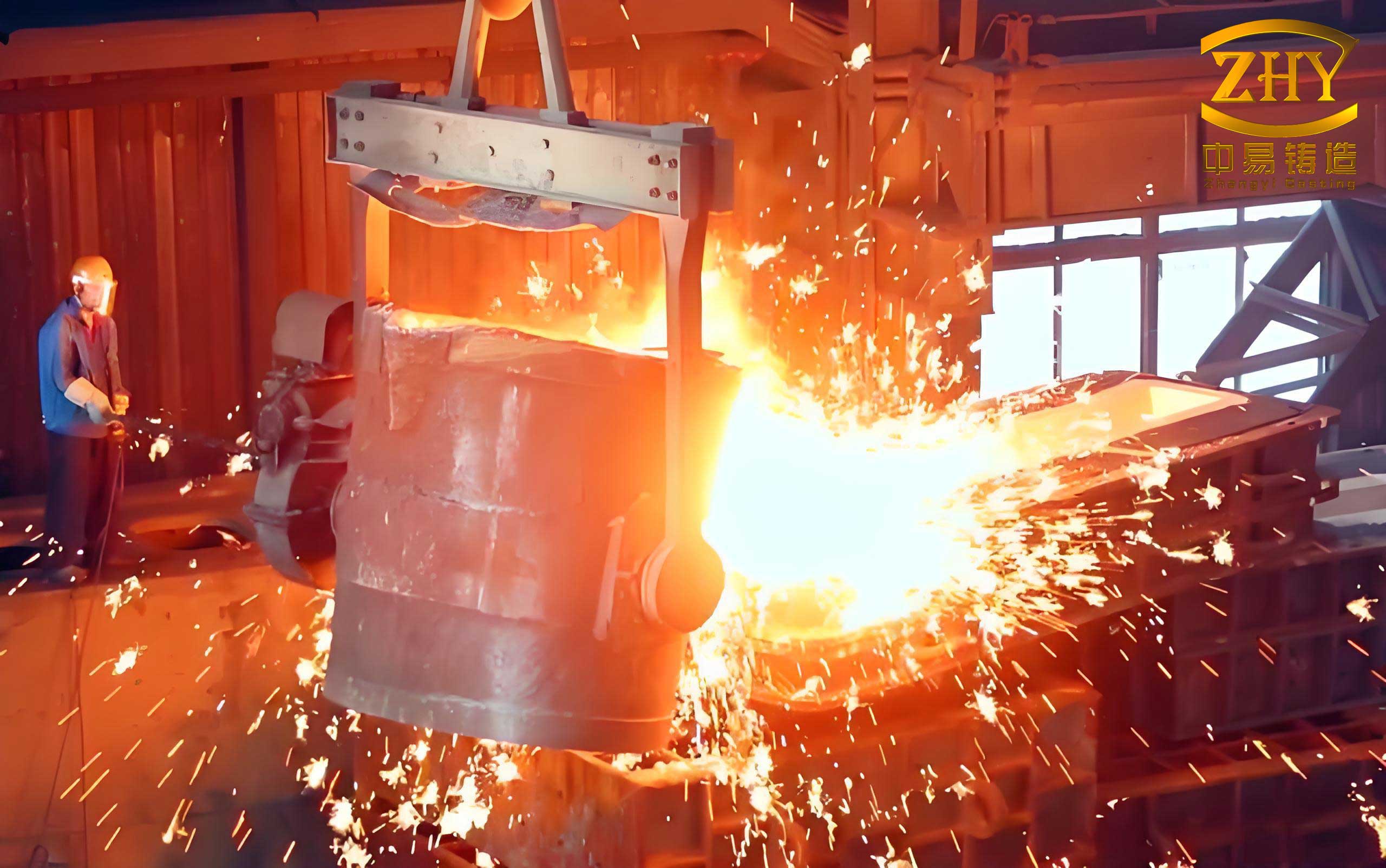
My initial analysis of the casting parts’ manufacturability revealed several critical aspects. Due to the arc shape and thin walls, these casting parts are prone to deformation during solidification shrinkage, necessitating the use of process bars or ribs. Additionally, the structure limits the placement of vents and feeding risers, but gray iron’s inherent graphite expansion allows for self-feeding, reducing reliance on external risers. The V-process involves significant gas generation from the EVA film during pouring, so vents must be incorporated into the process bars to avoid defects like porosity. Pre-embedded parts are required for side lifting holes and cover plate brackets, and cores must be flush with the mold surface to ensure flatness. To minimize post-casting grinding, assembly lug structures were optimized without compromising functionality. Finally, the HT250 material requires inoculation to enhance mechanical properties, ensuring the casting parts meet performance standards.
In the casting process design, I prioritized the parting plane selection based on draft analysis. Using software simulations, I identified positive draft areas (green), vertical surfaces (yellow), and negative draft areas (red). To avoid misalignment and ensure curvature accuracy, the entire casting parts were designed to form in the drag half of the mold. Given the sand box dimensions, a two-up pattern was adopted, with a sink depth of 145 mm in the drag to maintain adequate sand coverage. This approach minimized parting lines and enhanced the surface quality of the final casting parts.
The gating system was meticulously designed as a bottom-pouring system to prevent sand erosion and metal splashing, which could lead to defects in the thin-walled casting parts. The gating ratio was set to ensure smooth filling and effective slag trapping. The choke area calculation is fundamental for determining runner dimensions, and I used the following formula:
$$A = \frac{W}{\rho \cdot t \cdot C \sqrt{2gH}}$$
Where:
– \(A\) is the choke cross-sectional area (cm²),
– \(W\) is the pouring weight (kg),
– \(\rho\) is the molten iron density (0.00695 kg/cm³),
– \(t\) is the pouring time (s),
– \(C\) is the flow coefficient (taken as 0.6),
– \(g\) is the acceleration due to gravity (980 cm/s²),
– \(H\) is the effective static head (cm).
The pouring time \(t\) is estimated using \(t = S \sqrt{W}\), where \(S\) is a coefficient dependent on wall thickness and weight, ranging from 1.1 to 1.45. For these casting parts, with \(W = 400 \, \text{kg}\) and \(S = 1.3\), the calculated pouring time is approximately 26 seconds. Based on this, the choke area \(A\) was computed, leading to the following gating dimensions summarized in the table:
| Component | Cross-Sectional Area (cm²) | Dimensions |
|---|---|---|
| Sprue (top/bottom) | 20 | φ70 mm / φ50 mm |
| Runner | 25.2 | 45/50 mm × 55 mm |
| Ingate (2 nos.) | 31.5 total | 42/45 mm × 35 mm each |
The gating ratio was maintained at \(\sum A_{\text{sprue}} : \sum A_{\text{runner}} : \sum A_{\text{ingate}} = 1 : 1.2 : 1.5\), promoting turbulent-free filling and reducing oxidation risks for the casting parts. Two ingates were used to facilitate rapid pouring, countering potential cold shuts in the tall, thin-walled casting parts.
Risers in V-process casting primarily serve as vents and slag collectors rather than feeders, due to the self-feeding capability of gray iron casting parts. However, to manage gas evolution, vents were integrated into process bars. Each casting part included two vent risers with a bottom diameter of 60 mm and top diameter of 80 mm, exceeding three times the sprue area to ensure adequate degassing during pouring.
Process bars are crucial for stabilizing arc-shaped casting parts against distortion. I designed these bars on one side of the casting parts, with dimensions derived from empirical rules: thickness at 0.4 to 0.6 times the casting wall thickness, and width at 1.5 to 2 times the bar thickness. For a wall thickness of 27 mm, the process bar was set at 40 mm thick and 60 mm wide. This ensured early solidification of the bars, providing mechanical support to the casting parts during cooling. The vent risers were placed on these bars to optimize space and functionality.
Shrinkage allowances and draft angles were carefully selected to maintain dimensional accuracy in the casting parts. Linear shrinkage rates were 0.8% for length and width, and 0.5% for height, applied uniformly. Draft angles were set at 1:100 for general surfaces, with steeper angles of 1:10 for deep pockets and clearances of 1 mm to accommodate mold movements.
During production, I enforced strict controls across all stages. Mold preparation involved regular inspections of wooden patterns for warping, cracks, or wear. Curvature was verified using templates, and any defects were repaired promptly to ensure the EVA film could conform perfectly. The molding sequence included applying talcum powder, heating the EVA film to 80–120°C until it became mirror-like, and vacuum-forming it over the pattern. A alcohol-based white coating with a Baume density of 1.35–1.50 was sprayed to a thickness of 0.5 mm, avoiding leaks or pooling. After filling with dry sand, vibration compaction for 120 seconds ensured a mold hardness above 90 HB, critical for preventing defects in the casting parts. Cores were set precisely, with seams patched using coating paste.
Melting and pouring parameters were tightly monitored to achieve consistent quality in the casting parts. The molten iron composition for HT250 was maintained within specified ranges, as shown in the table below:
| Element | Target Range (wt.%) | Typical Value (wt.%) |
|---|---|---|
| Carbon (C) | 3.2–3.4 | 3.30 |
| Silicon (Si) | 1.8–2.2 | 1.99 |
| Manganese (Mn) | 0.8–1.2 | 0.88 |
| Phosphorus (P) | ≤ 0.1 | 0.09 |
| Sulfur (S) | ≤ 0.12 | 0.10 |
| Carbon Equivalent (CE) | 3.8–4.1 | 3.95 |
Inoculation was performed with 0.3% ferrosilicon to refine graphite structure. Pouring temperature was controlled at 1300°C ± 10°C, with a fast initial pour followed by a slower stream to minimize turbulence. The vacuum pressure was kept above 0.05 MPa throughout pouring to prevent mold wall movement and distortion in the casting parts. After pouring, the vacuum was maintained for 4 hours to ensure complete solidification under pressure, enhancing density and reducing shrinkage voids in the casting parts.
To validate the process, I conducted mechanical tests on each batch of casting parts. Separate test bars were cast and evaluated for tensile strength and hardness, while curvature was checked using gauges. The results, compiled from multiple production runs, are presented below:
| Batch | Number of Casting Parts | Tensile Strength (MPa) | Hardness (HBW) | Curvature Accuracy |
|---|---|---|---|---|
| 1 | 20 | 259 | 189 | Qualified |
| 2 | 8 | 274 | 188 | Qualified |
| 3 | 20 | 288 | 191 | Qualified |
All batches met the HT250 specifications, with tensile strengths exceeding 250 MPa and hardness values within the expected range. The arc-shaped casting parts consistently exhibited precise curvature, demonstrating the effectiveness of the process bars and controlled solidification. Additionally, visual inspections confirmed smooth surfaces and minimal grinding requirements for assembly faces, reducing post-processing time for these casting parts.
In conclusion, the successful production of arc-shaped casting parts via V-process casting hinges on a holistic approach to quality control. My methodology involved strategic parting plane selection to avoid misalignment, a bottom-pouring gating system calculated using fluid dynamics principles, and process bars integrated with vents to counteract deformation and gas defects. Rigorous monitoring of mold conditions, sand compaction, molten metal composition, and pouring parameters ensured repeatable results. The data from mechanical tests and curvature checks validate that these measures yield casting parts with excellent dimensional stability, mechanical performance, and surface finish. This experience underscores the versatility of V-process casting for complex geometries and highlights the importance of tailored process designs in achieving high-quality casting parts for demanding applications. Future work could explore automation in mold coating or real-time vacuum control to further enhance efficiency for such casting parts.