
In the field of water supply systems, valves play a critical role in regulating flow and pressure. The primary material used for valve bodies and components is often spheroidal graphite iron, also known as ductile iron or nodular cast iron. This material is favored due to its exceptional combination of mechanical properties, corrosion resistance, and cost-effectiveness. However, ensuring the quality of spheroidal graphite iron castings is paramount to guarantee the reliability and longevity of valves in applications such as water distribution, heating, ventilation, and firefighting systems. In this article, we will explore the comprehensive quality control methodologies applied to spheroidal graphite iron components in water supply valves, drawing from extensive testing data and practical experience.
The use of spheroidal graphite iron in valve manufacturing stems from its superior performance compared to gray iron or cast steel. Its unique microstructure, characterized by spherical graphite nodules embedded in a metallic matrix, imparts high strength, good ductility, and excellent impact resistance. For water supply valves, which typically operate under low to medium pressures (usually not exceeding 4.0 MPa, often around 1.6 MPa) and with water as the medium at temperatures below 100°C, spheroidal graphite iron offers an ideal balance of properties. Moreover, its service life can span 60 to 80 years under standard conditions, making it a durable choice for infrastructure. Nonetheless, achieving consistent quality in spheroidal graphite iron castings requires rigorous control throughout the production process, addressing potential defects in casting techniques that could compromise performance.
In our work, we have implemented a multi-faceted quality control framework focusing on mechanical performance, metallographic examination, hardness, and chemical composition. Each aspect is critical, as deviations can lead to failures such as reduced mechanical strength, structural instability, or diminished impact resistance. By adhering to standardized testing protocols and analyzing accumulated data, we ensure that every spheroidal graphite iron component meets the stringent requirements for water supply valves. This article delves into these techniques, providing detailed insights into their application and significance.
Project Overview and the Role of Spheroidal Graphite Iron
Our project involves the production and validation of spheroidal graphite iron components for a range of water supply valves, including gate valves, butterfly valves, and check valves. These valves are designed for use in municipal water systems, building services, and industrial applications where reliability is paramount. The spheroidal graphite iron castings serve as both pressure-bearing and non-pressure-bearing parts, such as valve bodies, bonnets, and discs. Given the operational environment—low pressure, ambient to moderately elevated temperatures, and exposure to water—the material must exhibit consistent properties to prevent leaks, fractures, or corrosion over time.
We have gathered extensive test data from routine inspections, which form the basis for our quality control strategies. This data encompasses tensile strength, elongation, hardness values, graphite morphology, and chemical element concentrations. By correlating these parameters, we can identify trends and optimize casting processes to enhance the quality of spheroidal graphite iron. For instance, variations in graphite spheroidization directly affect mechanical performance, while chemical composition influences microstructure and corrosion behavior. Thus, our approach is holistic, targeting every stage from molten iron treatment to final inspection.
Material Properties and Advantages of Spheroidal Graphite Iron
Spheroidal graphite iron derives its name from the spherical shape of graphite particles within the iron matrix, a structure achieved through inoculation with magnesium or cerium during casting. This morphology contrasts with the flake graphite in gray iron, leading to distinct advantages. Below, we summarize the key properties of spheroidal graphite iron relevant to valve applications:
- Strength: The spherical graphite nodules act as stress relievers rather than stress concentrators, resulting in high tensile and yield strength. Typically, the tensile strength of spheroidal graphite iron ranges from 400 to 900 MPa, depending on the grade and heat treatment, which is significantly higher than that of gray iron.
- Ductility and Toughness: Due to the nodular graphite structure, spheroidal graphite iron exhibits considerable elongation (up to 18% or more) and good impact resistance, making it less brittle and more resilient to dynamic loads.
- Corrosion and Oxidation Resistance: The iron matrix, often composed of ferrite or pearlite, provides inherent resistance to water, steam, and saline environments, reducing the risk of degradation over time.
- Wear Resistance: When alloyed or heat-treated to form a pearlitic matrix, spheroidal graphite iron shows enhanced hardness and wear resistance, suitable for components subjected to friction.
- Cost-Effectiveness: Compared to steel castings, spheroidal graphite iron offers lower production costs due to easier casting processes and reduced machining requirements, while still delivering high performance.
These properties make spheroidal graphite iron an ideal material for water supply valves. However, to fully leverage these advantages, precise control during manufacturing is essential. Any inconsistency in graphite formation or matrix structure can undermine the material’s performance, highlighting the need for robust quality assurance measures.
Technical Challenges in Spheroidal Graphite Iron Valve Production
Despite its benefits, producing high-quality spheroidal graphite iron components for valves presents several technical challenges. In our experience, these challenges primarily stem from casting process variations and the demanding service conditions of water supply systems.
Firstly, the pressure rating of valves is typically low (≤4.0 MPa), but they must withstand cyclic loading and potential water hammer effects. This requires spheroidal graphite iron with consistent mechanical properties, especially tensile strength and fatigue resistance. Variations in cooling rates or inoculation efficiency can lead to inhomogeneous microstructures, affecting performance.
Secondly, the operating temperature range for water supply valves is usually -30°C to 350°C, though most applications involve water below 100°C. Spheroidal graphite iron must maintain its integrity across this range, necessitating control over phase transformations (e.g., ferrite-to-pearlite ratio) to avoid embrittlement at low temperatures or softening at high temperatures.
Thirdly, longevity is a critical factor; valves are expected to last decades with minimal maintenance. This demands excellent corrosion resistance and microstructural stability. Imperfections such as shrinkage porosity, slag inclusions, or degenerate graphite forms (e.g., vermicular or flake graphite) can initiate failures over time.
To address these challenges, we have developed a comprehensive quality control protocol. The following sections detail each technique, emphasizing how they collectively ensure the reliability of spheroidal graphite iron components.
Application of Quality Control Techniques for Spheroidal Graphite Iron
Our quality control framework encompasses multiple testing methods, each targeting specific aspects of spheroidal graphite iron properties. We apply these techniques to every batch of castings, using statistical analysis to monitor trends and implement corrective actions when needed.
Mechanical Performance Testing
Mechanical testing is the cornerstone of quality assessment for spheroidal graphite iron. We evaluate tensile strength, yield strength, and elongation to verify that the material meets the specified grade requirements, such as QT400-15, QT450-10, or QT500-7 according to standards like GB/T 1348-2019 or ISO 1083. The testing process follows standardized procedures, ensuring reproducibility and accuracy.
We begin by sampling: test bars are either separately cast or cut from the casting itself (attached test bars), depending on the casting’s size and shape. The sample must represent the casting’s characteristics, considering factors like wall thickness and cooling conditions. For instance, for thick-section castings, we use attached test bars to simulate the actual cooling rate. The test bar is then machined into a standard tensile specimen with a gauge length and diameter conforming to GB/T 228.1-2010 (equivalent to ISO 6892-1).
The tensile test is conducted on a hydraulic universal testing machine. The specimen is gripped and subjected to a gradually increasing load until fracture. During the test, we record the load-extension curve to determine key parameters. The tensile strength (Rm) is calculated as the maximum load divided by the original cross-sectional area:
$$ R_m = \frac{F_m}{A_0} $$
where $F_m$ is the maximum force and $A_0$ is the original cross-sectional area. The yield strength (Rp0.2) is the stress at which a 0.2% plastic strain occurs, determined from the curve. Elongation (A) is measured by reassembling the fractured specimen and comparing the final gauge length to the original:
$$ A = \frac{L_u – L_0}{L_0} \times 100\% $$
where $L_0$ is the original gauge length and $L_u$ is the final gauge length after fracture.
We typically test multiple specimens per batch and average the results. The data is compiled in spreadsheets for analysis. For example, for spheroidal graphite iron grade QT450-10, we expect Rm ≥ 450 MPa, Rp0.2 ≥ 310 MPa, and A ≥ 10%. Deviations prompt investigations into casting parameters like inoculation or cooling. Below is a summary table of mechanical properties for common spheroidal graphite iron grades used in valves:
| Grade (Standard) | Tensile Strength, Rm (MPa) | Yield Strength, Rp0.2 (MPa) | Elongation, A (%) | Typical Hardness (HBW) |
|---|---|---|---|---|
| QT400-15 (EN) | ≥ 415 | ≥ 275 | ≥ 18 | 143–187 |
| QT450-10 (GB) | ≥ 450 | ≥ 310 | ≥ 10 | 160–210 |
| QT500-7 (GB) | ≥ 500 | ≥ 320 | ≥ 7 | 170–230 |
| QT600-3 (GB) | ≥ 600 | ≥ 370 | ≥ 3 | 190–270 |
These values guide our acceptance criteria. In addition to tensile tests, we occasionally perform impact tests (e.g., Charpy test) for valves intended for low-temperature service, assessing toughness to ensure spheroidal graphite iron does not become brittle.
Metallographic Examination
Metallographic analysis is vital for assessing the microstructure of spheroidal graphite iron, which directly governs its mechanical properties. We focus on graphite morphology (spheroidization rate, size, distribution) and the matrix structure (ferrite, pearlite content). This examination helps identify casting defects and optimize process parameters.
We start by sectioning a sample from the casting, typically from a representative area like the gate or riser. The sample is mounted in resin, then ground and polished using a series of abrasive papers (e.g., from 60-grit to 1200-grit) followed by diamond polishing to achieve a mirror-like surface. Etching with 2–5% nital (nitric acid in ethanol) reveals the matrix structure, while unetched samples are used for graphite analysis.
The prepared sample is observed under an optical microscope at magnifications of 50x to 500x. For graphite assessment, we use 100x magnification to evaluate spheroidization grade, nodule count, and size according to standards like ISO 945 or GB/T 9441. The spheroidization rate is classified into levels from 1 (excellent, >95% spheroids) to 6 (poor, with flake graphite). Our data shows that spheroidal graphite iron with spheroidization grades 2 (90%), 3 (80%), or 4 (75%) exhibits satisfactory mechanical properties, while grades 5 or 6 often lead to reduced strength and ductility.
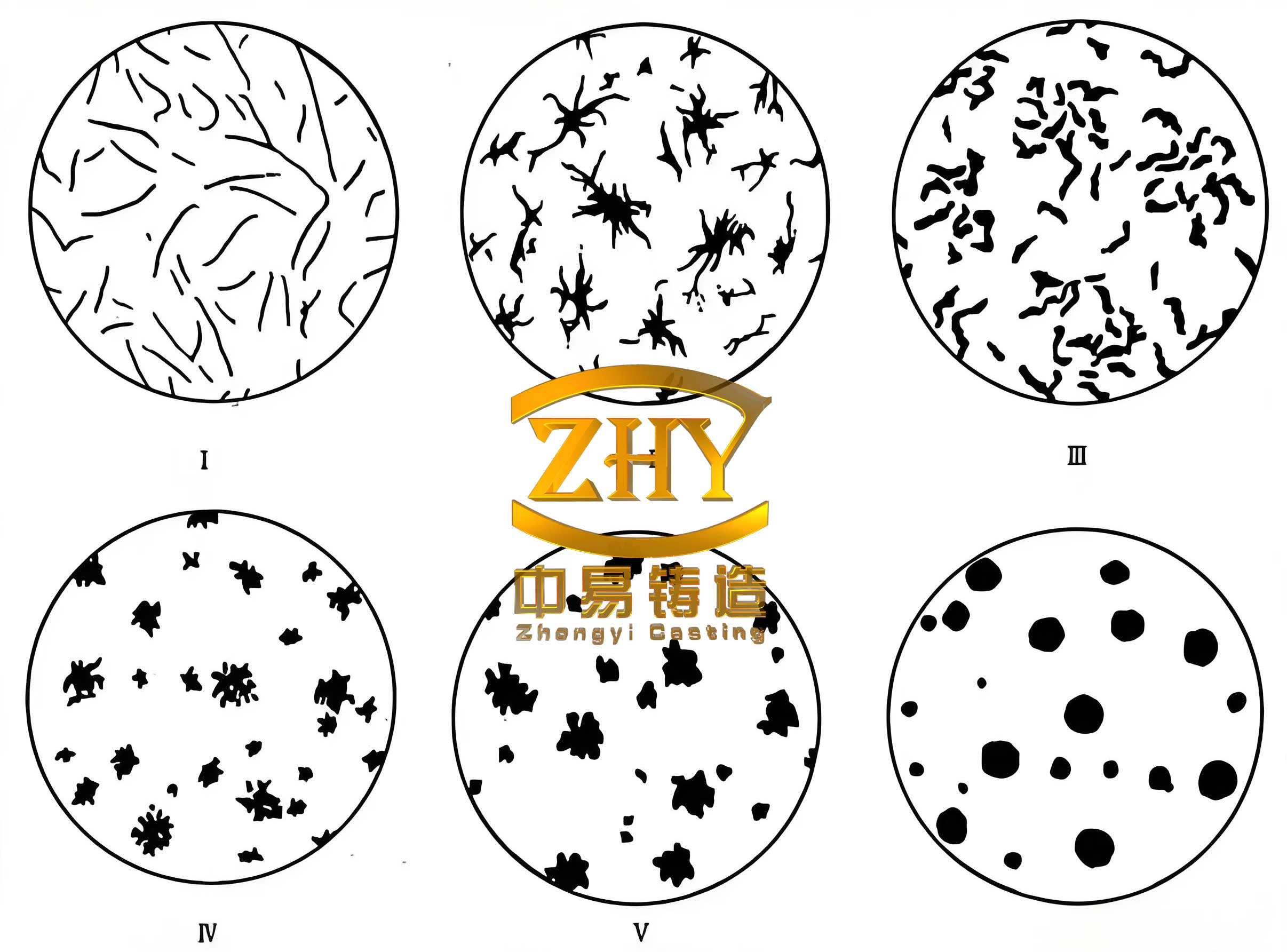
The image above illustrates typical spheroidal graphite iron microstructure, showing spherical graphite nodules in a ferritic matrix. Such imagery aids in qualitative and quantitative analysis.
We employ image analysis software (e.g., JX-2000) to quantify parameters. For each sample, we capture multiple fields of view and calculate averages. Key metrics include:
- Spheroidization Rate: Percentage of graphite nodules with circularity above a threshold (e.g., >0.6). We compute it as:
$$ \text{Spheroidization Rate} = \frac{N_s}{N_t} \times 100\% $$
where $N_s$ is the number of spherical nodules and $N_t$ is the total graphite particles. - Nodule Count: Number of nodules per unit area (e.g., nodules/mm²), which affects strength. Higher counts generally improve properties.
- Matrix Composition: Using point counting or image analysis, we determine the volume fraction of ferrite and pearlite. For ferritic grades like QT400-15, ferrite content should exceed 80%, while pearlitic grades like QT500-7 have higher pearlite fractions.
Our historical data indicates a strong correlation between spheroidization rate and tensile strength. For instance, spheroidal graphite iron with 80% spheroidization (grade 3) typically achieves Rm around 450 MPa, whereas dropping to 70% (grade 4 borderline) can reduce Rm by 10–15%. This underscores the importance of metallographic control in producing reliable spheroidal graphite iron components.
Hardness Testing
Hardness is a quick indicator of material strength and wear resistance. For spheroidal graphite iron, we use the Brinell hardness test (HBW) due to its suitability for coarse-grained materials. Hardness values complement tensile data and help assess uniformity across castings.
We prepare test surfaces by machining or grinding to ensure flatness and a roughness Ra ≤ 1.6 µm. The thickness must be at least eight times the indentation depth to avoid substrate effects. Testing is performed with a Brinell hardness tester using a tungsten carbide ball indenter (10 mm diameter) under a load of 3000 kgf (29.42 kN) for 10–15 seconds, as per GB/T 231.1-2018 (ISO 6506-1).
After indentation, the diameter is measured with a reading microscope, and hardness is determined from a conversion table or calculated using the formula:
$$ \text{HBW} = \frac{2F}{\pi D (D – \sqrt{D^2 – d^2})} $$
where $F$ is the applied force (in kgf), $D$ is the ball diameter (10 mm), and $d$ is the indentation diameter (mm). We take multiple readings per sample and average them. Typical hardness ranges for valve-grade spheroidal graphite iron are 140–230 HBW, depending on the grade and matrix.
Hardness mapping across a casting can reveal variations due to cooling rates; for example, thicker sections may show lower hardness if ferrite content is higher. We use this data to optimize pouring and cooling practices, ensuring consistent properties throughout the spheroidal graphite iron component.
Chemical Composition Analysis
Chemical composition profoundly influences the microstructure and properties of spheroidal graphite iron. Key elements include carbon (C), silicon (Si), manganese (Mn), sulfur (S), and phosphorus (P), along with trace elements like magnesium (Mg) for spheroidization. We analyze samples using optical emission spectrometry (OES) or wet chemical methods, ensuring compliance with standards.
Samples are taken from molten iron during pouring or from castings via drilling. The analysis targets the following ranges for common spheroidal graphite iron grades:
| Element | QT400-15 Range | QT450-10 Range | QT500-7 Range | Influence on Properties |
|---|---|---|---|---|
| C (Carbon) | 3.0–3.9% | 3.4–3.9% | 3.6–3.8% | Promotes graphite formation; high C increases fluidity but may reduce strength. |
| Si (Silicon) | 1.8–2.8% | 2.3–2.7% | 2.5–2.9% | Strengthens ferrite, improves corrosion resistance; excess Si can embrittle. |
| Mn (Manganese) | < 0.5% | < 0.5% | < 0.6% | Stabilizes pearlite; high Mn segregates and promotes carbides. |
| S (Sulfur) | < 0.025% | < 0.025% | < 0.025% | Interferes with spheroidization; must be minimized. |
| P (Phosphorus) | < 0.08% | < 0.08% | < 0.08% | Forms brittle phosphides; low P is crucial for toughness. |
We also monitor residual magnesium (Mg) content, typically 0.03–0.06%, which ensures proper graphite spheroidization. The relationship between composition and properties can be expressed through empirical formulas. For example, the carbon equivalent (CE) predicts castability and microstructure:
$$ \text{CE} = \%C + \frac{\%Si + \%P}{3} $$
For spheroidal graphite iron, CE usually ranges from 4.3 to 4.6. Deviations outside specified limits can lead to defects like graphite flotation (if CE is too high) or poor spheroidization (if Mg is low). By controlling chemistry, we lay the foundation for high-quality spheroidal graphite iron castings.
Additional Control Methods
Beyond the core tests, we implement supplementary quality checks to ensure overall integrity. These include:
- Surface Quality Inspection: Visual and dye-penetrant testing to detect surface defects like cracks, cold shuts, or sand inclusions that could compromise pressure tightness.
- Dimensional Measurement: Using coordinate measuring machines (CMM) or calipers to verify that castings meet drawing tolerances, ensuring proper fit and function in valve assemblies.
- Pressure Testing: Hydrostatic or pneumatic tests on finished valves to validate leak-tightness under operating pressures, though this is more a product test than a material test.
- Non-Destructive Testing (NDT): Techniques like ultrasonic testing or radiography for critical components to identify internal flaws without damaging the spheroidal graphite iron casting.
These methods form a comprehensive quality assurance system, catching issues that might escape standard tests. For instance, dimensional errors could cause assembly problems, while surface defects might initiate corrosion. By integrating all approaches, we maximize the reliability of spheroidal graphite iron components.
Data Analysis and Process Optimization
Collecting data is only the first step; analyzing it to drive improvements is key. We use statistical process control (SPC) tools, such as control charts and regression analysis, to monitor trends in mechanical properties, hardness, and microstructure. For example, we might plot tensile strength versus spheroidization rate to establish correlation curves, enabling predictive quality control.
Consider the relationship between spheroidization rate (SR) and tensile strength (Rm). From our data, we can model it as:
$$ R_m = \alpha \cdot \text{SR} + \beta $$
where $\alpha$ and $\beta$ are constants derived from historical data. For spheroidal graphite iron grade QT450-10, we found $\alpha \approx 2.5$ MPa per percentage point and $\beta \approx 250$ MPa when SR is between 70% and 90%. This helps set acceptable SR limits during production.
Similarly, we analyze hardness- strength correlations. For ferritic spheroidal graphite iron, hardness (HBW) and tensile strength (Rm) often relate linearly:
$$ R_m \approx k \cdot \text{HBW} $$
where $k$ is around 2.3–2.5 for typical grades. Deviations from this ratio might indicate microstructural anomalies, prompting further investigation.
Chemical composition data is used to adjust furnace charges and inoculation practices. For instance, if sulfur content trends upward, we increase magnesium addition to maintain spheroidization. We also track element ratios, such as Si/C ratio, which affects matrix formation. Optimal ratios for ferritic spheroidal graphite iron are around 0.7–0.9, calculated as:
$$ \text{Si/C Ratio} = \frac{\%Si}{\%C} $$
By continuously refining these parameters, we enhance the consistency and performance of spheroidal graphite iron castings.
Case Studies and Practical Applications
To illustrate the effectiveness of our quality control techniques, we present a few case studies from valve production. These examples highlight how addressing specific issues improved spheroidal graphite iron quality.
Case Study 1: Improving Tensile Strength in Thick-Section Valves
We encountered a batch of valve bodies (200 mm wall thickness) with tensile strength below 400 MPa, despite using QT450-10 grade. Metallography revealed low spheroidization rate (65%) and coarse graphite nodules in the core. Analysis traced this to slow cooling and insufficient inoculation. We modified the gating system to enhance cooling and increased post-inoculation. Subsequent castings showed spheroidization >80% and Rm > 450 MPa, demonstrating the interplay between process and microstructure in spheroidal graphite iron.
Case Study 2: Hardness Uniformity Across Valve Discs
Valve discs exhibited hardness variations from 150 HBW at edges to 190 HBW at the center, leading to machining difficulties. Chemical analysis showed normal composition, but metallography indicated varying pearlite content due to uneven cooling. We implemented forced air cooling in the mold and adjusted pouring temperature. Hardness now ranges 165–175 HBW, ensuring consistent machinability and wear resistance for the spheroidal graphite iron component.
Case Study 3: Corrosion Resistance Enhancement
For valves in saline water applications, we faced premature corrosion. Chemical analysis indicated high phosphorus (0.1%) and low silicon. We tightened composition limits to P < 0.05% and Si > 2.5%, promoting a more protective ferritic matrix. Accelerated corrosion tests showed improved performance, underscoring the role of chemistry in spheroidal graphite iron durability.
These cases show that a holistic quality control approach, combining multiple techniques, is essential for optimizing spheroidal graphite iron properties.
Future Directions and Innovations
The field of spheroidal graphite iron quality control is evolving with advancements in technology. We are exploring several innovations to further enhance our methods:
- In-Line Process Monitoring: Using thermal analysis cups or spectrometers during pouring to real-time adjust composition and inoculation, reducing variability in spheroidal graphite iron production.
- Advanced Imaging Techniques: Implementing scanning electron microscopy (SEM) or 3D tomography for detailed microstructure analysis, especially for complex valve geometries.
- Machine Learning Models: Developing predictive algorithms that integrate historical data from mechanical tests, metallography, and chemistry to forecast casting quality and optimize parameters automatically.
- Sustainability Focus: Recycling spheroidal graphite iron scrap and optimizing energy use in melting, aligning quality control with environmental goals.
These efforts aim to make quality control more proactive and efficient, ensuring that spheroidal graphite iron components meet ever-higher standards for water supply valves.
Conclusion
In conclusion, quality control of spheroidal graphite iron components for water supply valves is a multifaceted endeavor requiring meticulous attention to mechanical performance, microstructure, hardness, and chemical composition. Our experience demonstrates that by applying standardized testing protocols—such as tensile testing, metallographic examination, Brinell hardness measurement, and spectroscopic analysis—we can consistently produce spheroidal graphite iron castings that meet the demanding requirements of low-pressure, long-service-life applications. The integration of data analysis and process optimization further enhances reliability, preventing defects and ensuring optimal properties like corrosion resistance, impact strength, and wear resistance.
Spheroidal graphite iron remains a material of choice for valve manufacturers due to its balanced properties and cost-effectiveness. However, its quality is not inherent; it must be assured through rigorous control at every production stage. We encourage continuous improvement and adoption of new technologies to advance the field. By doing so, we can guarantee the safety and efficiency of water supply systems worldwide, relying on high-performance spheroidal graphite iron components that stand the test of time.