
In the high-volume production of ductile iron casting parts, maintaining a consistently low rejection rate is a persistent challenge. Fluctuations in scrap rates, sometimes soaring beyond acceptable limits, are often traced back to inconsistencies in the melting, nodularization, and inoculation processes. This article details my first-hand experience in diagnosing and solving a severe shrinkage porosity issue in a critical safety casting part—a commercial vehicle wheel hub—by employing thermal analysis technology to understand and optimize the solidification characteristics of the molten iron.
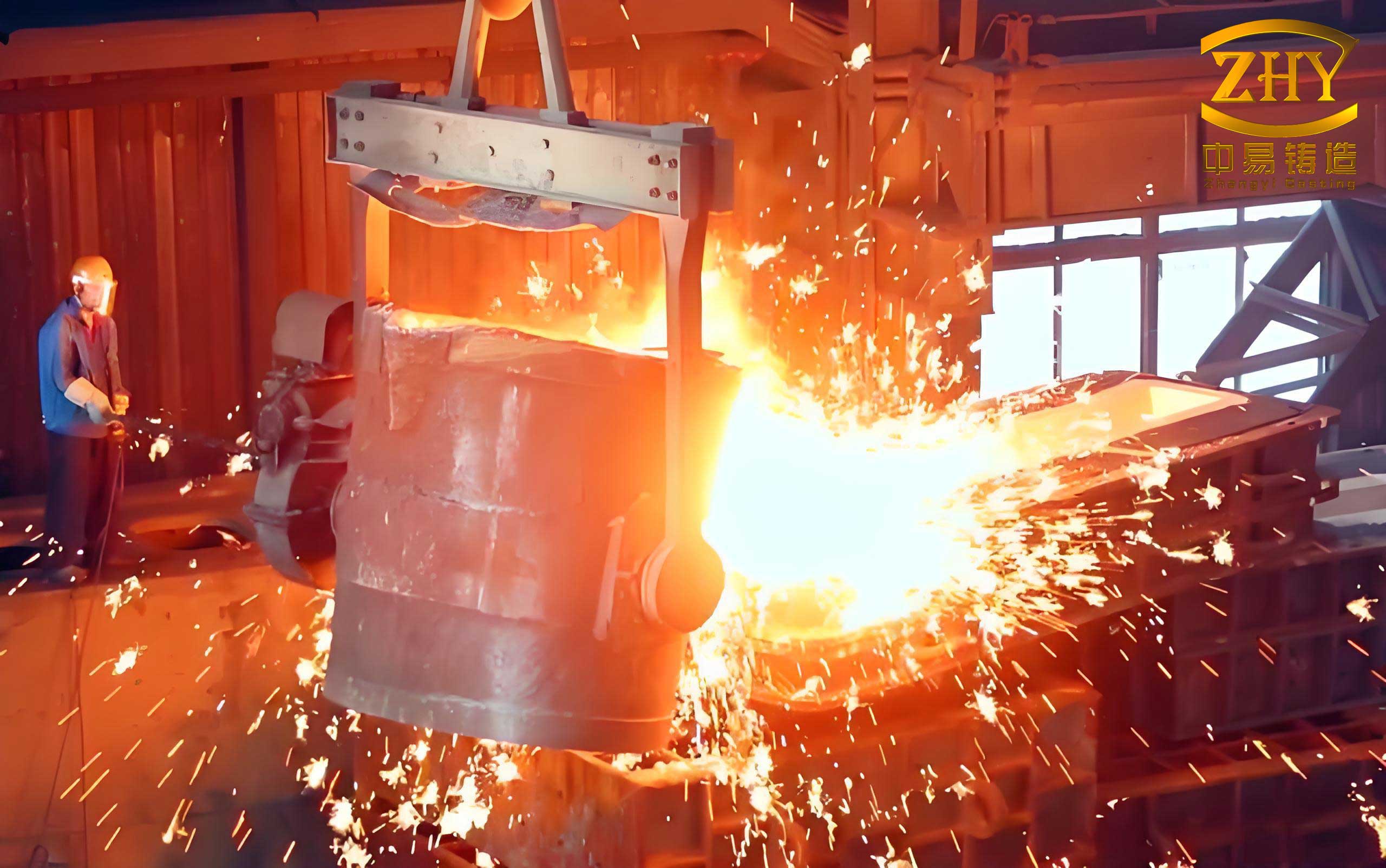
The subject of this study was a QT450-10 ductile iron wheel hub, a quintessential safety-critical casting part. Its structural complexity, featuring multiple isolated hot spots and varying wall thicknesses, made it inherently prone to shrinkage defects. Initial efforts focused on gating and feeding system design using established principles like Equilibrium Solidification Theory. Numerical simulation software was used to validate the design, predicting potential shrinkage in the bearing journal areas. Based on simulation suggestions to enhance the self-feeding capacity of the casting part, the carbon equivalent was carefully controlled, and what was considered a robust inoculation practice was implemented.
The initial production process for this casting part involved melting in a medium-frequency furnace, followed by nodularization using a cored wire containing 30% Mg. The inoculation sequence included a ladle addition of 0.4% Si-Ca-Ba inoculant (3-8 mm) and a late-stream addition of 0.1% fine-grained inoculant (0.2-0.7 mm). While small batch trials showed promise, mass production revealed a severe problem: the rejection rate for shrinkage porosity in the first bearing journal area exceeded 12%, which was completely unacceptable for such a vital casting part. This discrepancy between trial and mass production indicated an underlying process instability that traditional methods could not easily pinpoint.
This is where thermal analysis proved invaluable. To diagnose the root cause, I utilized a dedicated thermal analysis instrument immediately after the iron was transferred to the pouring ladle. A sample was taken from the top of the ladle and poured into a pre-inoculated thermal analysis cup. The resulting cooling curve and its derived parameters provided a direct window into the solidification behavior of the iron destined for the casting part.
The thermal analysis graph from the problematic production batch revealed critical insights. The iron displayed a eutectic solidification pattern with no primary austenite, which was good. However, two key parameters were far from ideal:
- Recalescence Temperature (ΔTR): Recorded at 9.2 °C, significantly higher than the ideal range of 2-7 °C.
- Thermal Conductivity Coefficient (K): Recorded at 20, which was below the ideal range of 22-28.
Interpreting these values for a eutectic iron is crucial. A high recalescence temperature indicates an excessively vigorous onset of eutectic graphite precipitation during the early stages of solidification. This premature and intense graphitization consumes available nucleation sites (like sulfur and oxygen) too rapidly. Consequently, by the time the final isolated liquid pools in the casting part solidify, there is a deficiency of active nuclei. This leads to insufficient graphite expansion in these last-to-freeze zones, which is precisely what the low Thermal Conductivity Coefficient confirmed. The iron lacked the necessary self-feeding capability in the critical final stage, leading to shrinkage porosity in the heavy sections of the wheel hub casting part.
The diagnosis pointed squarely at over-inoculation. The standard ladle addition of 0.4% inoculant was causing too many nucleation sites to form too early. The solution was counter-intuitive but clear: reduce the inoculation intensity to delay and prolong graphite precipitation. For the next ladle, I reduced the ladle inoculation amount from 0.4% to 0.3%, keeping all other parameters constant. A subsequent thermal analysis test confirmed the improvement:
| Process Parameter | Initial Production (High Reject) | Optimized Process | Ideal Range |
|---|---|---|---|
| Ladle Inoculant Addition | 0.4% | 0.3% | – |
| Recalescence Temp. (ΔTR) | 9.2 °C | 6.5 °C | 2 – 7 °C |
| Thermal Conductivity Coeff. (K) | 20 | 24 | 22 – 28 |
| Shrinkage Rejection Rate | >12% | <2% | Target |
The results were immediate and significant. The recalescence dropped to 6.5°C, indicating a more controlled initial graphite formation. More importantly, the Thermal Conductivity Coefficient rose to 24, signaling a marked improvement in the graphite expansion potential during the final stages of solidification. This enhanced self-feeding capability directly translated to a dramatic reduction in shrinkage defects in the finished casting part.
The role of thermal analysis in this context is to quantify the solidification behavior that theories like Equilibrium Solidification describe qualitatively. For instance, the feeding design for this casting part was based on calculating the feeding modulus. The key formulas used in the initial design phase were:
First, the Mass Perimeter Quotient ($Q_m$) was calculated based on the casting weight $G$ and the representative modulus of the casting part $M_c$:
$$
Q_m = \frac{G}{M_c^3}
$$
Next, the Solidification Time Fraction ($P_c$) was determined, which influences the shrinkage behavior:
$$
P_c = \frac{1.0}{e^{(0.5M_c + 0.01Q_m)}}
$$
This was used to find the Shrinkage Modulus Factor ($f_2$) and subsequently the Shrinkage Modulus of the casting part ($M_s$):
$$
f_2 = \frac{1}{\sqrt{P_c}} \quad \text{and} \quad M_s = f_2 \times M_c
$$
Finally, the required Feeder Modulus ($M_R$) was calculated using balance ($f_1$) and pressure ($f_3$) coefficients:
$$
M_R = f_1 \times f_3 \times M_s
$$
While these calculations are essential for designing a sound feeding system, they operate under assumed conditions for graphite expansion. Thermal analysis bridges this gap by providing real-time, specific data on how a particular batch of iron will actually behave during solidification. It answers the critical question: “Is this iron’s graphitization behavior aligned with the assumptions made during the design phase for this casting part?” In our case, the initial thermal analysis showed it was not, due to over-inoculation.
Implementing the optimized inoculation practice based on thermal analysis feedback led to a stable and high-quality production process for this demanding casting part. Over a monitored batch of thousands of wheel hubs, the rejection rate specifically attributed to shrinkage porosity was reduced to well under 2%, achieving the target for high-volume manufacturing. The overall scrap rate for the casting part from all defects was also brought under control. This outcome underscores a vital principle: more inoculation is not always better. Excessive inoculant not only wastes material and increases the cost of the casting part but can actively degrade its internal soundness by disrupting the optimal graphite precipitation sequence.
In conclusion, the integration of thermal analysis into the process control loop is transformative for producing high-integrity ductile iron casting parts. It moves quality assurance from a reactive, post-mortem inspection of defective parts to a proactive, real-time control of the molten metal’s inherent properties. By instantly revealing parameters like recalescence and the thermal conductivity coefficient, it allows for precise adjustments to inoculation practice. This ensures the graphite expansion occurs in a sustained and controlled manner throughout the solidification of the casting part, effectively implementing the self-feeding principle assumed in sound feeding design. For any foundry serious about consistently producing complex, high-quality ductile iron casting parts with minimal scrap, thermal analysis is not just a tool; it is an essential component of a modern, data-driven manufacturing strategy.