
In the context of declining wind power subsidies and the transition to grid parity, the wind energy industry is compelled to continuously advance technology and reduce costs. As a critical component in wind turbines, nodular cast iron parts, such as frames, hubs, and bearing housings, account for 20% to 30% of the total weight of the rotor-nacelle assembly. Therefore, optimizing the material properties of nodular cast iron is paramount for achieving lightweight design and cost reduction in wind turbine systems. Traditionally, the QT400-18AL grade nodular cast iron, corresponding to EN-GJS-400-18U-LT, has been widely used in wind power applications. However, with the trend toward larger megawatt turbines, castings often feature large sections exceeding 100 mm in thickness, leading to challenges like graphite flotation, spheroidal graphite degeneration, and reduced mechanical properties. This study aims to develop a high-strength ferritic nodular cast iron that maintains excellent low-temperature impact toughness while surpassing the strength of QT400-18AL, thereby enabling thinner wall sections and enhanced material efficiency.
We begin by outlining the performance requirements for large-section nodular cast iron castings in high-power wind turbines. Based on design load specifications, the material must meet stringent mechanical and microstructural criteria. The key requirements include: (1) Mechanical properties, particularly low-temperature impact energy at -20°C, must not fall below the standards set by GB/T 1348-2009; (2) Microstructural features, such as a spheroidal graphite rate ≥90%, ferrite content ≥90%, pearlite content <10%, cementite ≤1%, and phosphide eutectic ≤1%, with graphite size finer than grade 5. These criteria ensure reliability under harsh operating conditions.
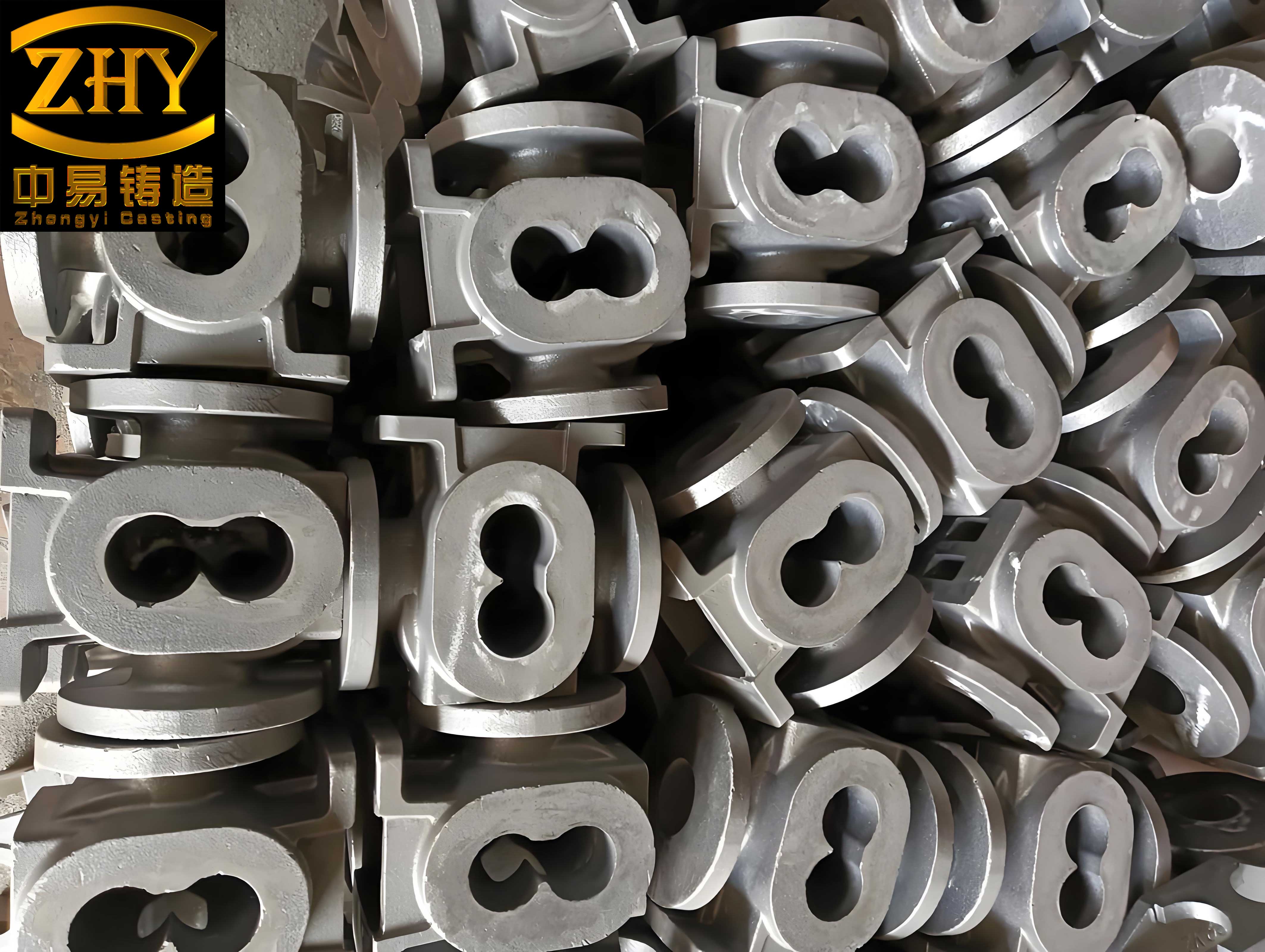
To achieve these goals, we conducted a detailed analysis of chemical composition, focusing on elements that promote graphitization and strengthen the ferritic matrix. Silicon (Si) and nickel (Ni) were identified as key alloying elements. Si enhances graphitization, dissolves in ferrite, and increases strength, but excessive Si raises the ductile-brittle transition temperature, impairing low-temperature toughness. The relationship between Si content and impact toughness can be approximated by: $$ \Delta T_{db} = k_{Si} \cdot [Si] $$ where $\Delta T_{db}$ is the shift in ductile-brittle transition temperature, $k_{Si}$ is a constant (approximately 5.5–6°C per 0.1% Si), and [Si] is the silicon concentration. Thus, we controlled Si content between 2.1% and 2.5% to balance strength and toughness.
Nickel, with its graphitization capability about one-fifth to one-third that of Si, dissolves infinitely in iron, stabilizes and refines pearlite, and improves toughness through solid solution strengthening. The strengthening effect can be described by: $$ \sigma_{ss} = G \cdot \epsilon^{3/2} \cdot \sqrt{c} $$ where $\sigma_{ss}$ is the solid solution strengthening contribution, $G$ is the shear modulus, $\epsilon$ is the lattice strain, and $c$ is the solute concentration. However, excessive Ni can cause lattice distortion and reduce toughness. We maintained Ni content between 0.2% and 0.7% to optimize performance. Other elements like carbon (C), manganese (Mn), phosphorus (P), and sulfur (S) were kept low to prevent detrimental phases. Table 1 summarizes the target chemical composition ranges for the high-strength nodular cast iron.
| Element | Target Range | Role in Nodular Cast Iron |
|---|---|---|
| C | 3.5–3.8 | Promotes graphitization, affects fluidity |
| Si | 2.1–2.5 | Graphitizer, ferrite strengthener |
| Mn | <0.25 | Minimize to avoid pearlite stabilization |
| P | <0.04 | Minimize to reduce phosphide eutectic |
| S | <0.01 | Minimize for effective nodularization |
| Ni | 0.2–0.7 | Solid solution strengthener, toughness enhancer |
| Mgres | 0.03–0.05 | Ensures spheroidal graphite formation |
| REres | 0.02–0.03 | Improves nodularization efficiency |
Raw material selection is critical for consistency in nodular cast iron production. We used high-quality materials: (1) Pig iron with low Mn, P, and S, accounting for 20–40% of the charge; (2) Carbon steel scrap with controlled levels of carbide-forming elements (e.g., Cr, Cu), making up 30–40% of the charge; (3) Return material (30–40% of the charge) to optimize cost and recycling. This blend ensures stable chemistry and reduces impurities that could hinder the properties of nodular cast iron.
Nodularization and inoculation processes are vital for achieving the desired microstructure in nodular cast iron. We employed a rare-earth magnesium nodularizer added via the sandwich method. The nodularizer composition included 40–45% Si, 6–7% Mg, 1–2% RE, 1–2% Ba, 0.8–2% Ca, and balance Fe. For inoculation, we used two stages: a silicon-barium inoculant (70–75% Si, 4–6% Ba, 0.8–1.5% Ca, Al ≤1.5%) added during tapping, and a silicon-bismuth inoculant (70–75% Si, 1–2% Bi, 0.8–1.5% Ca, Al ≤1.5%) added during mold filling. These steps enhance graphite nucleation and minimize chilling. The efficiency of nodularization can be expressed as: $$ N = \frac{N_g}{N_t} \times 100\% $$ where $N$ is the nodularity percentage, $N_g$ is the number of spheroidal graphite particles, and $N_t$ is the total graphite count. Our target was $N \geq 90\%$.
| Process Step | Material | Composition Key Components | Addition Method | Purpose |
|---|---|---|---|---|
| Nodularization | RE-Mg FeSi | Mg: 6–7%, RE: 1–2% | Sandwich | Spheroidize graphite |
| Primary Inoculation | Si-Ba FeSi | Ba: 4–6% | Stream during tapping | Promote graphite nucleation |
| Secondary Inoculation | Si-Bi FeSi | Bi: 1–2% | Stream during pouring | Prevent undercooling, refine graphite |
Melting and annealing processes were carefully controlled. We used a medium-frequency induction furnace to melt the charge at 1,430°C, followed by nodularization, inoculation, and microalloying treatments. The molten nodular cast iron was poured into furan resin sand molds at 1,330–1,360°C, with controlled pouring speed to minimize turbulence. After casting, the parts were slowly cooled in the mold to below 400°C to avoid thermal stresses. A high-temperature annealing treatment was then applied: heating below 60°C/h to 900–950°C, holding for 2–5 hours, furnace cooling to 600°C, and air cooling. This annealing transforms pearlite to ferrite, enhancing ductility and impact toughness. The kinetics of ferritization can be modeled by: $$ X_f = 1 – \exp(-k t^n) $$ where $X_f$ is the ferrite fraction, $k$ is a rate constant, $t$ is time, and $n$ is an exponent dependent on temperature.
We conducted extensive testing on trial castings with attached test blocks. The chemical composition and mechanical properties were measured, as shown in Tables 3 and 4. For comparison, Table 5 lists the standard requirements for QT400-18AL nodular cast iron according to GB/T 1348 and GB/T 25390.
| Sample ID | C | Si | Mn | P | S | Ni | Mgres | REres |
|---|---|---|---|---|---|---|---|---|
| NC-1 | 3.66 | 2.17 | 0.21 | 0.028 | 0.005 | 0.35 | 0.043 | 0.023 |
| NC-2 | 3.63 | 2.21 | 0.18 | 0.026 | 0.005 | 0.41 | 0.041 | 0.025 |
| NC-3 | 3.61 | 2.15 | 0.17 | 0.030 | 0.005 | 0.38 | 0.035 | 0.028 |
| Sample ID | Tensile Strength (MPa) | Yield Strength (MPa) | Elongation (%) | Hardness (HBW) | Impact Energy at -20°C (J) |
|---|---|---|---|---|---|
| NC-1 | 398 | 282 | 25.3 | 141 | 15.2 |
| NC-2 | 405 | 284 | 23.9 | 143 | 14.1 |
| NC-3 | 392 | 275 | 25.1 | 138 | 15.7 |
| Average | 398.3 | 280.3 | 24.8 | 140.7 | 15.0 |
| Standard | Tensile Strength (MPa) | Yield Strength (MPa) | Elongation (%) | Hardness (HBW) | Impact Energy at -20°C (J) |
|---|---|---|---|---|---|
| GB/T 1348 | 360 | 220 | 12 | 120–175 | 10 |
| GB/T 25390 | 370 | 220 | 12 | 120–175 | 10 |
The results demonstrate that our developed nodular cast iron exhibits superior mechanical properties. Compared to QT400-18AL, the average tensile strength increased by approximately 11%, calculated as: $$ \text{Increase} = \frac{398.3 – 365}{365} \times 100\% \approx 11\% $$ where 365 MPa is the average standard tensile strength (360 MPa and 370 MPa). The yield strength improved by about 27%, using: $$ \text{Increase} = \frac{280.3 – 220}{220} \times 100\% \approx 27\% $$ Elongation also exceeded standard requirements, and low-temperature impact energy averaged 15 J, well above the 10 J threshold. Microstructural analysis confirmed a spheroidal graphite rate >90%, ferrite content >90%, and pearlite <5% after annealing, meeting all specified criteria.
We further analyzed the strengthening mechanisms in this high-strength nodular cast iron. The overall yield strength can be expressed as a sum of contributions: $$ \sigma_y = \sigma_0 + \sigma_{ss} + \sigma_{gb} + \sigma_{disp} $$ where $\sigma_0$ is the lattice friction stress, $\sigma_{ss}$ is solid solution strengthening (from Si and Ni), $\sigma_{gb}$ is grain boundary strengthening, and $\sigma_{disp}$ is dispersion strengthening from graphite particles. For nodular cast iron, the graphite morphology significantly affects toughness; the impact energy $CVN$ at low temperature correlates with graphite nodularity $N$ and ferrite content $F$: $$ CVN = \alpha \cdot N + \beta \cdot F – \gamma \cdot [Si] $$ where $\alpha, \beta, \gamma$ are material constants. Our composition optimized these parameters.
The role of nickel in nodular cast iron is particularly noteworthy. At levels of 0.2–0.7%, Ni enhances toughness by reducing the ductile-brittle transition temperature $T_{db}$, as approximated by: $$ T_{db} = T_0 – m \cdot [Ni] $$ where $T_0$ is the base transition temperature and $m$ is a positive constant. However, beyond 0.7%, Ni may form intermetallics, increasing brittleness. Our experimental data validate this range, as samples with Ni around 0.4% showed balanced strength and impact energy.
Process optimization also involved controlling cooling rates to prevent defects in large-section nodular cast iron. The solidification time $t_s$ for a casting of thickness $d$ can be estimated using Chvorinov’s rule: $$ t_s = B \cdot \left( \frac{V}{A} \right)^2 $$ where $B$ is a mold constant, $V$ is volume, and $A$ is surface area. For thick sections, slow cooling promotes graphite growth but risks graphite flotation. We adjusted pouring temperature and mold design to achieve a cooling rate below 10°C/min in the critical range from 1,150°C to 900°C, ensuring fine graphite and minimal segregation.
| Process Stage | Parameter | Value | Rationale |
|---|---|---|---|
| Melting | Temperature | 1,430°C | Ensure complete dissolution of alloys |
| Pouring | Temperature | 1,330–1,360°C | Balance fluidity and minimize gas pickup |
| Cooling | Rate in mold | <10°C/min (to 400°C) | Avoid thermal stresses, control microstructure |
| Annealing | Heating rate | <60°C/h | Prevent distortion and cracking |
| Annealing | Holding temperature | 900–950°C | Austenitize for ferritization |
| Annealing | Holding time | 2–5 hours | Ensure complete phase transformation |
| Annealing | Cooling rate | Furnace cool to 600°C | Promote ferrite formation |
In terms of economic impact, the enhanced strength of this nodular cast iron allows for weight reduction in wind turbine components. The weight savings $\Delta W$ can be estimated using the formula: $$ \Delta W = W_0 \cdot \left(1 – \frac{\sigma_{std}}{\sigma_{enh}}\right) $$ where $W_0$ is the original weight, $\sigma_{std}$ is the standard yield strength, and $\sigma_{enh}$ is the enhanced yield strength. For a typical 5 MW turbine, using our nodular cast iron could reduce casting weight by up to 15%, contributing significantly to cost reduction and improved energy efficiency.
We also investigated the scalability of this high-strength nodular cast iron for industrial production. Statistical process control (SPC) methods were applied to monitor key variables such as chemical composition, nodularization efficiency, and mechanical properties. Control charts for tensile strength and impact energy confirmed process stability, with all data points within ±3σ limits. This ensures consistent quality in mass production of nodular cast iron parts.
Future work will focus on further optimizing the nodular cast iron composition for even higher strengths (e.g., beyond 450 MPa tensile strength) while maintaining low-temperature toughness. Additive manufacturing of nodular cast iron prototypes is also being explored to reduce lead times. Additionally, life-cycle assessment (LCA) studies are underway to quantify the environmental benefits of lightweight nodular cast iron components in wind turbines.
In conclusion, our research demonstrates that a high-strength nodular cast iron can be successfully developed through precise chemical design, stringent raw material control, and optimized processing techniques. This nodular cast iron offers approximately 11% higher tensile strength and 27% higher yield strength than conventional QT400-18AL, while meeting low-temperature impact toughness requirements. The findings underscore the potential of advanced nodular cast iron materials to enable lightweight design and cost reduction in wind power systems, supporting the industry’s transition to grid parity. Continued innovation in nodular cast iron technology will be crucial for sustainable energy development.