
In the field of foundry engineering, the production of complex structural components such as engine cylinder blocks presents significant challenges, particularly in the design of gating systems. As a researcher focused on digital forming manufacturing technology and equipment, I have observed that the design of gating systems for cast iron parts often relies heavily on empirical knowledge, leading to poor process repeatability, high defect rates in new product development, and difficulties in precise gating and riser system design. This reliance on experience results in inconsistent casting quality and hampers the digitalization and green transformation of casting processes. Therefore, in this study, we aim to systematically investigate the intrinsic rules governing gating system design for engine cylinder block cast iron parts, leveraging statistical analysis of real-world production data to establish a foundation for digital process design. The findings are expected to enhance the casting quality of these critical cast iron parts and promote sustainable manufacturing practices.
The engine cylinder block is a quintessential example of intricate cast iron parts, widely used in automotive, marine, engineering machinery, and other sectors. Its complex geometry, stringent internal quality requirements, and substantial production difficulties encapsulate core manufacturing technologies. Under sand casting conditions, the gating system design is a pivotal factor influencing the casting quality of these cast iron parts. Traditional approaches depend on worker expertise, resulting in varied and non-digitalized processes that are unstable when casting designs or production conditions change. This instability contributes to high scrap rates and inefficiencies. To address this, our research adopts a data-driven methodology, collecting and analyzing typical casting cases to uncover statistical patterns in gating system parameters. By doing so, we seek to formulate design principles that can be digitized, thereby improving the continuity and perfection of casting processes for cast iron parts.
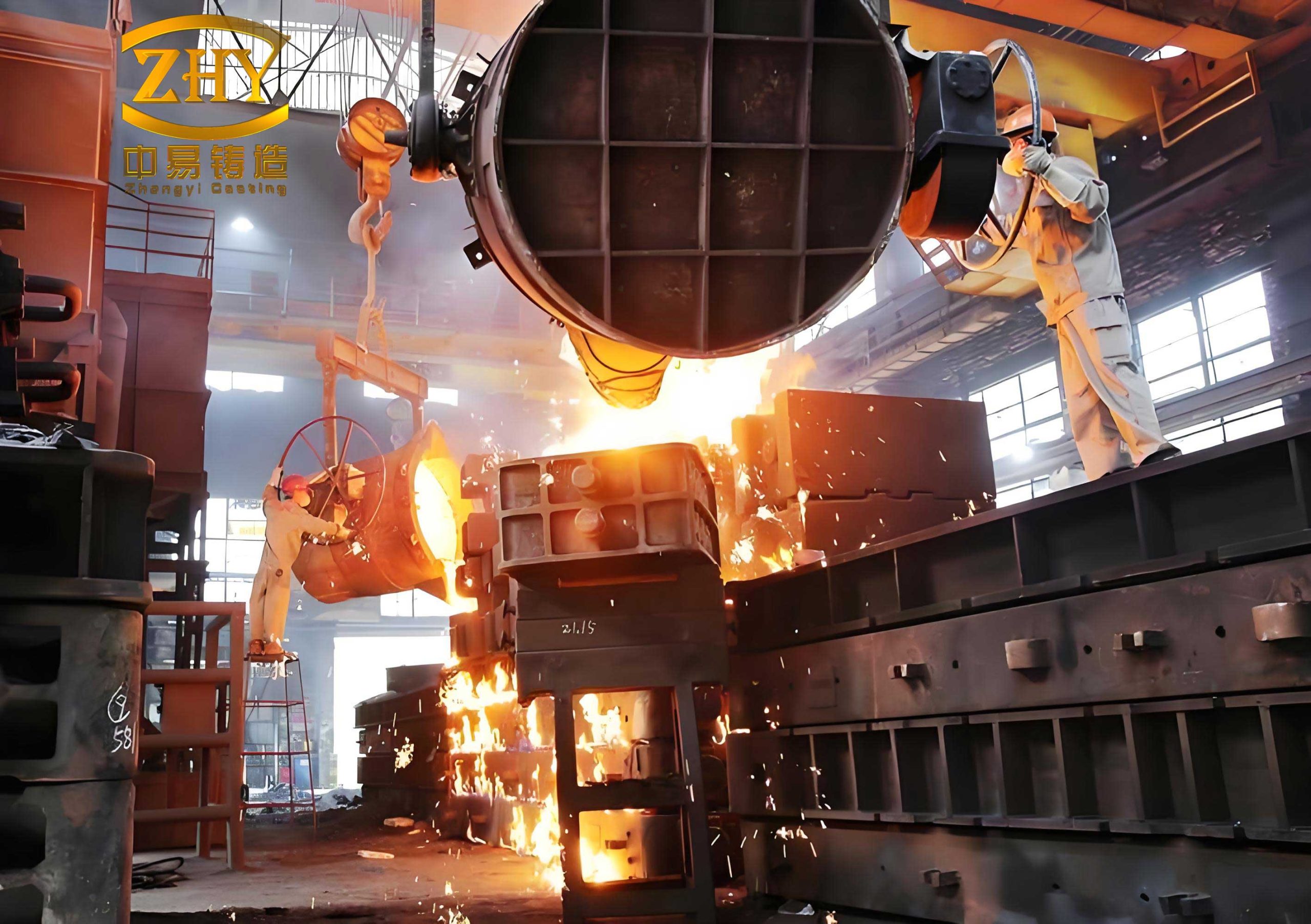
To conduct this study, we gathered 30 typical production cases of engine cylinder block cast iron parts from domestic foundries. These cases encompass a diverse range of specifications, including L-type and V-type engine blocks, varying cylinder counts (e.g., 4, 6, 8, 10, 12, and 16 cylinders), weights from 38 kg to 91,000 kg, and applications across industries such as automotive, agricultural machinery, engineering machinery, power generation, locomotives, and marine sectors. The data compilation involved detailed records of gating process parameters: pouring time, average pressure head, cross-sectional areas of the sprue, runner, and ingate, as well as the metal introduction method. This dataset provides a robust basis for statistical analysis, allowing us to derive meaningful insights into the design rules for cast iron parts. We employed statistical methods, including regression analysis and distribution studies, to identify correlations and trends. The focus is on understanding how these parameters interact and influence the casting outcomes for such complex cast iron parts.
The analysis begins with the metal introduction methods, which are categorized into bottom gating, middle gating, and step gating. From the 30 cases, we observed that step gating is the most widely used, accounting for 51% of applications across various weights of cast iron parts. Middle gating follows at 36%, primarily for small to medium-sized cast iron parts, while bottom gating is least common at 13%, limited to small cast iron parts. This distribution highlights the preference for methods that ensure uniform filling and reduce defects in these critical cast iron parts. To quantify this, we can express the preference ratio as: $$P_{\text{method}} = \frac{N_{\text{method}}}{N_{\text{total}}} \times 100\%$$ where \(P_{\text{method}}\) is the percentage usage of a specific gating method, \(N_{\text{method}}\) is the number of cases using that method, and \(N_{\text{total}} = 30\). For step gating, \(P_{\text{step}} = 51\%\), indicating its dominance in handling complex geometries of cast iron parts.
| Gating Method | Number of Cases | Percentage (%) | Typical Weight Range of Cast Iron Parts |
|---|---|---|---|
| Bottom Gating | 4 | 13 | 10–100 kg |
| Middle Gating | 11 | 36 | 50–500 kg |
| Step Gating | 15 | 51 | 100–91,000 kg |
Next, we examined the gating system types based on the cross-sectional area ratios of the sprue, runner, and ingate. The systems are classified as closed, open, semi-closed, and closed-open. Our statistical analysis reveals that closed systems are not used for these cast iron parts, while open systems are rarely employed (17%). Semi-closed and closed-open systems are predominant, with 40% and 43% usage, respectively. This indicates a balance between flow control and turbulence reduction in cast iron parts production. The area ratios can be represented as: $$\sum F_{\text{ingate}} : \sum F_{\text{runner}} : \sum F_{\text{sprue}}$$ where \(F\) denotes cross-sectional area. For semi-closed systems, the ratio ranges from 1.26:1:1.05 to 1.72:1:1.37, whereas for closed-open systems, it is 0.51:1:0.56 to 0.64:1:0.79. These ratios are critical for designing efficient gating systems for cast iron parts.
| Gating System Type | Number of Cases | Percentage (%) | Area Ratio (\(\sum F_{\text{ingate}}:\sum F_{\text{runner}}:\sum F_{\text{sprue}}\)) | Weight Range of Cast Iron Parts |
|---|---|---|---|---|
| Open | 5 | 17 | 1.02:1:0.83 to 1.29:1:0.91 | 10–50 kg |
| Semi-Closed | 12 | 40 | 1.26:1:1.05 to 1.72:1:1.37 | 50–1,000 kg and >2,000 kg |
| Closed-Open | 13 | 43 | 0.51:1:0.56 to 0.64:1:0.79 | 50–1,500 kg |
From these findings, we summarized four typical gating processes for cast iron parts based on weight categories: bottom gating open system for small cast iron parts (<200 kg), middle gating closed-open system for medium cast iron parts (200–1,000 kg), step gating closed-open system for medium to large cast iron parts, and step gating semi-closed system for large cast iron parts (>1,000 kg). Each process has distinct technical properties regarding filling stability, defect prevention (e.g., shrinkage, cold shuts, slag inclusion), and cleanability. For instance, the middle gating closed-open system offers the best overall performance for medium cast iron parts, combining the advantages of both closed and open systems to ensure smooth filling and effective slag trapping. This categorization aids foundries in selecting appropriate processes for different cast iron parts.
| Gating Process | Metal Introduction | System Type | Weight Range of Cast Iron Parts | Filling Stability | Defect Resistance | Comprehensive Performance |
|---|---|---|---|---|---|---|
| Bottom Open | Bottom | Open | <200 kg | Good | Poor | Poor |
| Middle Closed-Open | Middle | Closed-Open | 200–1,000 kg | Fair | Good | Good |
| Step Closed-Open | Step | Closed-Open | 200–1,500 kg | Good | Fair | Fair |
| Step Semi-Closed | Step | Semi-Closed | >1,000 kg | Good | Fair | Fair |
A key aspect of gating system design for cast iron parts is the determination of process parameters, such as the flow coefficient and pouring time. The flow coefficient, denoted as \(\mu_3\), characterizes the metal flow behavior in the mold cavity. Based on the pouring times from our cases and applying the large orifice outflow theory, we calculated \(\mu_3\) values. The distribution shows that 70% of \(\mu_3\) values fall between 0.4 and 0.6, with a recommended range of 0.50–0.60 for cast iron parts. Specifically, we suggest \(\mu_3 = 0.50\) for bottom gating, \(\mu_3 = 0.55\) for middle gating, and \(\mu_3 = 0.50–0.55\) for step gating. This coefficient is crucial for accurate gating system calculations in cast iron parts production. The statistical distribution can be modeled using a normal distribution: $$f(\mu_3) = \frac{1}{\sigma \sqrt{2\pi}} e^{-\frac{(\mu_3 – \mu)^2}{2\sigma^2}}$$ where \(\mu\) is the mean value (approximately 0.52) and \(\sigma\) is the standard deviation (approximately 0.08) based on our data.
| Flow Coefficient \(\mu_3\) Range | Number of Cases | Percentage (%) | Recommended for Cast Iron Parts |
|---|---|---|---|
| <0.45 | 5 | 16.6 | Not recommended |
| 0.45–0.50 | 5 | 16.6 | Limited use |
| 0.50–0.55 | 10 | 33.4 | Ideal for step gating |
| 0.55–0.60 | 6 | 20.0 | Ideal for middle gating |
| 0.60–0.65 | 2 | 6.7 | Case-specific |
| >0.65 | 2 | 6.7 | Case-specific |
Pouring time is another critical parameter for cast iron parts, directly affecting mold filling and defect formation. Our analysis of the 30 cases reveals that pouring time \(t\) increases with casting weight \(m\), but the rate of increase diminishes for heavier cast iron parts. For weights up to 1,000 kg, the relationship is steeper, while for weights above 1,000 kg, it plateaus, indicating that large cast iron parts require faster pouring to avoid localized overheating. We derived a piecewise function to describe this relationship: $$t = \begin{cases} 10.60 \ln m – 27.06 & \text{for } 0 < m \leq 1000 \\ 20.41 \ln m – 80.60 & \text{for } m > 1000 \end{cases}$$ where \(t\) is in seconds and \(m\) in kilograms for cast iron parts. Alternatively, an empirical formula is often used in production: $$t = S \sqrt{m}$$ where \(S\) is a coefficient varying with weight ranges. For cast iron parts, we recommend \(S = 1.9–2.4\) for 10–100 kg, \(S = 1.7–2.2\) for 100–500 kg, \(S = 1.5–1.8\) for 500–1,000 kg, \(S = 1.5–1.9\) for 1,000–5,000 kg, and \(S = 1.0–1.1\) for >5,000 kg. These formulas facilitate quick estimation in digital design systems for cast iron parts.
| Weight Range of Cast Iron Parts (kg) | Coefficient \(S\) | Typical Pouring Time (s) | Pouring Speed |
|---|---|---|---|
| 10–100 | 1.9–2.4 | 12–23 | Slow |
| 100–500 | 1.7–2.2 | 23–40 | Medium |
| 500–1,000 | 1.5–1.8 | 40–58 | Medium |
| 1,000–5,000 | 1.5–1.9 | 58–90 | Fast | >5,000 | 1.0–1.1 | 90–105 | Fast |
To validate these design rules, we applied them to a practical case: a diesel engine cylinder block cast iron part for heavy-duty trucks. This cast iron part is an L-type six-cylinder block made of HT250, with dimensions 727.5 mm × 344.5 mm × 372.3 mm, a general wall thickness of 5.4 mm, a minimum wall thickness of 4.3 mm, and a weight of 407.3 kg. Following our summarized principles, we selected a middle gating closed-open system due to its excellent comprehensive performance for medium-sized cast iron parts. Using the recommended parameters: area ratio \(\sum F_{\text{sprue}} : \sum F_{\text{runner}} : \sum F_{\text{ingate}} = 1.07 : 1 : 1.26\), flow coefficient \(\mu_3 = 0.55\), and pouring time calculated as \(t = 10.60 \ln 407.3 – 27.06 = 36.6\) seconds (or \(t = 1.8 \sqrt{407.3} = 36.6\) seconds). The cross-sectional areas were computed based on the large orifice outflow theory: $$\sum F_{\text{ingate}} = \frac{m}{0.31 \mu_3 t \sqrt{h}} = 39.2 \text{ cm}^2$$ with \(h = 360\) mm derived from pressure head calculations. Subsequently, \(\sum F_{\text{runner}} = 36.6 \text{ cm}^2\) and \(\sum F_{\text{sprue}} = 46.9 \text{ cm}^2\). The casting process employed hot box cores, a parting line along the cylinder and crankshaft bore centers, and top risers for feeding and venting, with a pouring temperature of 1,370–1,420°C. The resulting cast iron part exhibited good surface quality and dimensional accuracy.
Production data from a random day showed an output of 672 cast iron parts, with defect analysis indicating low rates of cracks and gas holes (13 and 15 defects, respectively), confirming the gating system’s effectiveness in preventing such issues for cast iron parts. However, sand inclusions and rough surfaces were more prevalent (35 and 18 defects), primarily due to inadequate sand mold strength during handling. The overall scrap rate was 9.4%, which is relatively low for complex cast iron parts, demonstrating the robustness of the design rules. Metallographic examination of the bearing areas revealed type A graphite with lengths of 50–150 μm, uniformly distributed and meeting the technical specifications for cast iron parts. This case underscores the practical applicability of our statistically derived rules for enhancing the quality and efficiency of cast iron parts production.
Beyond immediate applications, this research contributes to the broader digitalization of casting processes for cast iron parts. By establishing quantitative relationships between design parameters and casting outcomes, we enable the development of digital gating system design software. Such systems can integrate these rules to automate process planning, reduce reliance on trial-and-error, and optimize resource use. For instance, digital twins of casting processes for cast iron parts can simulate fluid flow and solidification using computational fluid dynamics (CFD) and finite element analysis (FEA), with our rules providing initial inputs for faster convergence. Moreover, the green manufacturing aspect is addressed through reduced scrap rates and material savings, aligning with sustainable development goals for cast iron parts industries. Future work could expand the database to include more diverse cast iron parts, such as those with different alloys or geometries, to refine the rules further.
In conclusion, this study systematically investigates the gating system design rules for engine cylinder block cast iron parts through statistical analysis of 30 production cases. We have identified preferred metal introduction methods and gating system types, summarized typical processes for different weight categories of cast iron parts, and derived mathematical models for key parameters like flow coefficient and pouring time. The validation via a practical case confirms that these rules enhance casting quality and process stability for cast iron parts. This research not only shortens the gap between academic findings and industrial application but also provides a methodological framework for studying other complex cast iron parts. By leveraging data and statistical tools, we pave the way for digitalized, efficient, and green casting processes, ultimately advancing the manufacturing of high-performance cast iron parts for critical engineering applications.