
In the context of global efforts toward environmental protection, energy conservation, emission reduction, and lightweight design, the automotive industry is undergoing a transformative shift. Electric vehicles (EVs) have emerged as a pivotal solution to reduce tailpipe emissions, with aluminum alloy power battery packs serving as critical components for energy storage and safety. The performance of these battery packs directly influences the safety, stability, and reliability of EV power systems, making research into their manufacturing processes essential. Among various techniques, precision investment casting offers high dimensional accuracy and excellent surface finish, which are vital for complex components like battery packs. While numerous studies have explored battery pack structural design and lightweight optimization, there is limited focus on precision investment casting for aluminum alloy battery packs. This study addresses this gap by investigating the precision investment casting of ZL210A aluminum alloy power battery packs, combining design, simulation, and experimental validation to provide theoretical insights and technical support for EV applications.
The precision investment casting process for aluminum alloy battery packs involves several key stages: structural design of the battery pack, development of the casting system, simulation of the casting process using advanced software, and experimental verification. This integrated approach ensures the production of high-quality castings with minimized defects. In this work, I focus on the ZL210A aluminum alloy, a high-strength casting material known for its good mechanical properties and lightweight characteristics. The battery pack design is tailored for EVs, with dimensions of 1250 mm × 1000 mm × 150 mm and an average wall thickness of 8.5 mm, as illustrated in the following table summarizing key parameters:
| Parameter | Value | Unit |
|---|---|---|
| Length | 1250 | mm |
| Width | 1000 | mm |
| Height | 150 | mm |
| Average Wall Thickness | 8.5 | mm |
| Material Density | 2700 | kg/m³ |
| Liquidus Temperature | 650 | °C |
| Solidus Temperature | 547.5 | °C |
The ZL210A aluminum alloy’s chemical composition is critical for its casting performance, as shown in the table below. This alloy primarily consists of copper, titanium, and other elements that enhance strength and castability, making it suitable for precision investment casting.
| Element | Composition (wt%) |
|---|---|
| Cu | 5.00 |
| Ti | 0.25 |
| Fe | 0.10 |
| Si | 0.05 |
| Mn | 0.80 |
| Zn | 0.03 |
| Other | 0.30 |
| Al | Balance |
To achieve optimal results in precision investment casting, the gating system was designed with simplicity and functionality in mind. It features symmetrical ingates that converge into a central sprue, along with three risers placed at intersections of reinforcing ribs to compensate for solidification shrinkage. This design facilitates controlled alloy flow, filling time, and solidification temperature, which are essential for minimizing defects. The governing equations for fluid flow and heat transfer during casting are fundamental to understanding the process. For instance, the Navier-Stokes equation describes fluid dynamics: $$ \rho \left( \frac{\partial \mathbf{u}}{\partial t} + \mathbf{u} \cdot \nabla \mathbf{u} \right) = -\nabla p + \mu \nabla^2 \mathbf{u} + \mathbf{f} $$ where \(\rho\) is density, \(\mathbf{u}\) is velocity, \(p\) is pressure, \(\mu\) is viscosity, and \(\mathbf{f}\) represents body forces. Heat conduction is modeled using Fourier’s law: $$ q = -k \nabla T $$ with \(q\) as heat flux, \(k\) as thermal conductivity, and \(T\) as temperature. The energy equation during solidification incorporates latent heat release: $$ \rho c_p \frac{\partial T}{\partial t} = \nabla \cdot (k \nabla T) + L \frac{\partial f_s}{\partial t} $$ where \(c_p\) is specific heat, \(L\) is latent heat, and \(f_s\) is solid fraction. These equations underpin the simulation of precision investment casting processes.
For simulation, I employed ProCAST software to create a detailed model of the battery pack casting. The simulation accounted for thermal physical properties, boundary conditions such as an interfacial heat transfer coefficient of 905 W/(m²·K), specific heat capacity of 890 J/(kg·K), and environmental settings including a room temperature of 25°C, mold preheat temperature of 325°C, pouring temperature of 750°C, and pouring speed of 15 kg/s. The simulation results revealed symmetrical solidification patterns, with the gating system maintaining higher temperatures than the mold cavity to facilitate feeding and reduce shrinkage defects. The total shrinkage porosity predicted by the simulation was 3.68%, primarily localized in the gating system, risers, and complex structural regions of the battery pack. This low defect rate validates the gating design for precision investment casting. To further analyze solidification, the cooling curve can be expressed as: $$ T(t) = T_0 + (T_p – T_0) e^{-\beta t} $$ where \(T_0\) is initial temperature, \(T_p\) is pouring temperature, and \(\beta\) is a cooling constant dependent on material and mold properties.
Experimental verification was conducted under conditions matching the simulation. The castings were produced using precision investment casting techniques, and X-ray inspection of 50 samples showed shrinkage porosity ranging from 3.51% to 3.96%, with an average of 3.72%. This close agreement with the simulation result of 3.68% confirms the accuracy of the model. Additionally, the battery packs were integrated into EVs and tested over 8000 km without issues, demonstrating the reliability of the precision investment casting approach. The relationship between porosity and mechanical properties can be approximated by: $$ \sigma = \sigma_0 (1 – P)^n $$ where \(\sigma\) is actual strength, \(\sigma_0\) is defect-free strength, \(P\) is porosity volume fraction, and \(n\) is an empirical exponent. For ZL210A alloy, typical values of \(n\) range from 1.5 to 2.5, highlighting the importance of minimizing defects in precision investment casting.
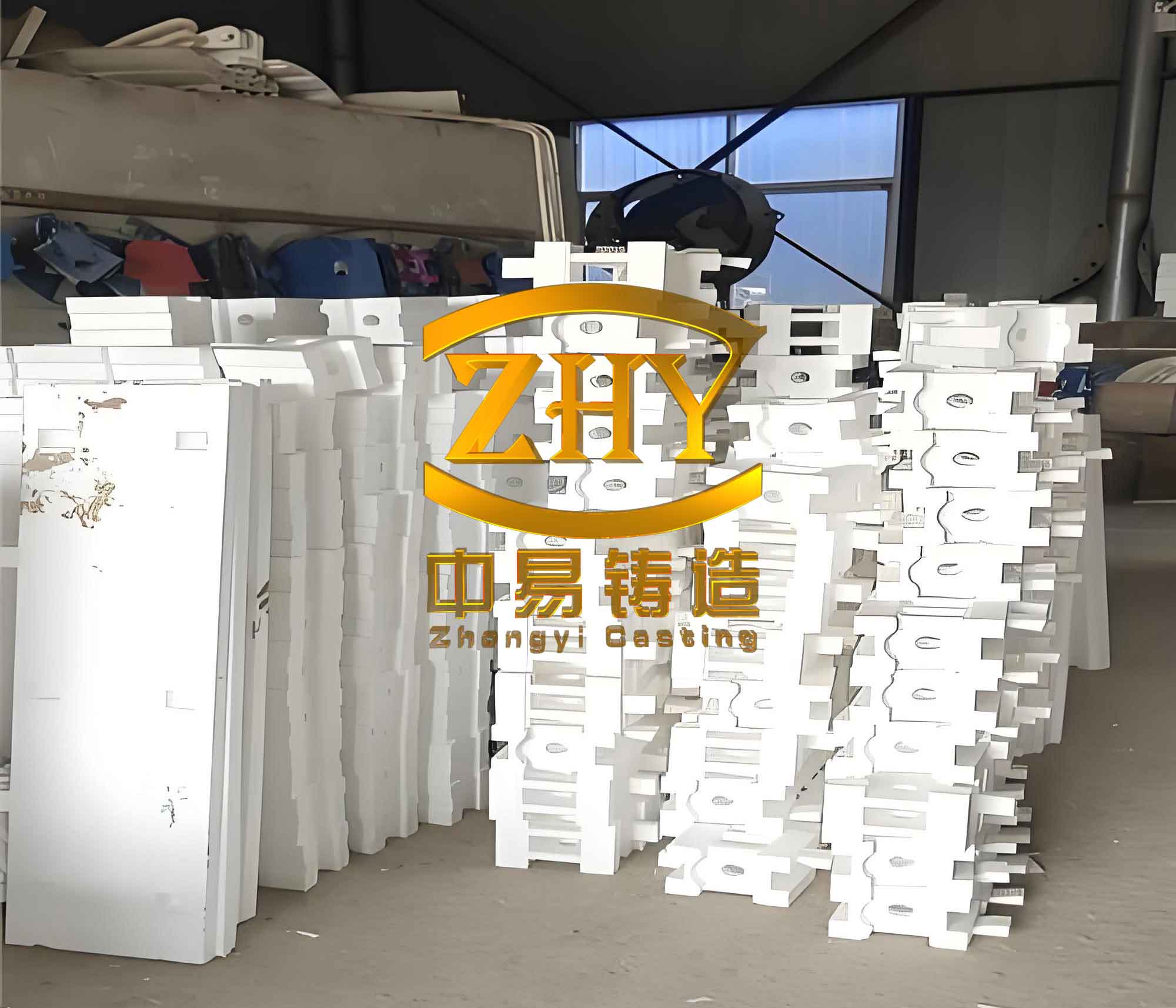
The image above illustrates a lost foam casting process, which shares similarities with precision investment casting in terms of achieving complex geometries and fine details. In precision investment casting, the use of ceramic molds allows for high accuracy, and processes like lost foam can be adapted for aluminum alloys to enhance surface quality. This visual aid underscores the versatility of advanced casting methods in manufacturing EV components. To optimize the precision investment casting process, statistical models can be applied. For example, the Taguchi method uses orthogonal arrays to analyze parameter effects, with a signal-to-noise ratio (S/N) given by: $$ S/N = -10 \log_{10} \left( \frac{1}{n} \sum_{i=1}^n y_i^2 \right) $$ where \(y_i\) are response values such as shrinkage percentage. By varying factors like pouring temperature and mold preheat, the optimal conditions for minimal defects in precision investment casting can be determined.
In discussing the broader implications, precision investment casting offers significant advantages for EV battery packs, including weight reduction and improved structural integrity. The lightweight nature of aluminum alloys, combined with the precision of investment casting, contributes to overall vehicle efficiency. For instance, the density reduction can be quantified using the rule of mixtures for composite materials, but in this case, the monolithic ZL210A alloy provides a balance of strength and lightness. The thermal management of battery packs during operation also relates to casting quality, as defects like porosity can affect heat dissipation. The heat transfer equation in solids: $$ \frac{\partial T}{\partial t} = \alpha \nabla^2 T $$ where \(\alpha = k/(\rho c_p)\) is thermal diffusivity, emphasizes the need for homogeneous material properties achieved through precision investment casting.
Furthermore, the economic and environmental benefits of precision investment casting are noteworthy. By reducing material waste and energy consumption through optimized designs, this process aligns with sustainable manufacturing goals. The life cycle assessment (LCA) of battery packs can incorporate casting parameters, with emissions modeled as: $$ E = \int_0^T \dot{m} \cdot C \, dt $$ where \(E\) is total emissions, \(\dot{m}\) is mass flow rate of resources, and \(C\) is emission factor. Precision investment casting minimizes scrap rates, thereby lowering \(E\) and supporting green initiatives in EV production.
In conclusion, this study demonstrates the effectiveness of precision investment casting for ZL210A aluminum alloy power battery packs. The designed gating system ensured controlled solidification, with simulation and experimental results showing low shrinkage porosity around 3.7%. The integration of simulation tools like ProCAST with practical validation provides a robust framework for advancing precision investment casting in EV applications. Future work could explore alternative alloys, advanced simulation techniques, or hybrid casting methods to further enhance performance. Overall, precision investment casting stands as a key technology for achieving lightweight, reliable, and sustainable EV components, driving the automotive industry toward a cleaner future.
To summarize key formulas and data, the following table presents a comparison of simulation and experimental results for shrinkage porosity in precision investment casting:
| Aspect | Simulation Result | Experimental Average | Unit |
|---|---|---|---|
| Total Shrinkage Porosity | 3.68% | 3.72% | % |
| Porosity Range | N/A | 3.51–3.96% | % |
| Validation Error | — | ≈0.04% | % |
The consistency between simulation and experiment underscores the reliability of precision investment casting for complex parts. Additionally, the mechanical properties of ZL210A alloy can be expressed via constitutive equations, such as the Hollomon equation for stress-strain behavior: $$ \sigma = K \epsilon^n $$ where \(K\) is strength coefficient, \(\epsilon\) is strain, and \(n\) is strain-hardening exponent. For cast alloys, \(n\) typically ranges from 0.1 to 0.3, highlighting the need for defect control in precision investment casting to maintain ductility. As EVs evolve, continuous improvement in precision investment casting will play a crucial role in meeting performance and environmental targets, making this research a valuable contribution to the field.