
In the cement industry, grinding balls are critical components used in ball mills for pulverizing raw materials and clinker. Among various materials, white cast iron, particularly alloyed with chromium, molybdenum, and copper, has gained attention due to its high hardness and wear resistance. However, a persistent issue with white cast iron grinding balls is their tendency to fracture during operation, leading to increased downtime and costs. In this study, we investigate the failure mechanisms of chromium-molybdenum-copper white cast iron grinding balls and propose modifications in casting and heat treatment processes to mitigate breakage. Our approach involves transitioning from sand casting to metal mold casting, coupled with appropriate heat treatment, to enhance the microstructure and mechanical properties. This article presents a comprehensive analysis of our research, incorporating tables and formulas to summarize key findings, with a focus on improving the performance of white cast iron in grinding applications.
The widespread use of white cast iron in grinding balls stems from its excellent abrasion resistance, attributed to the presence of hard carbides in the microstructure. However, the brittle nature of white cast iron often leads to catastrophic failure under impact and cyclic loading. Previous studies have identified defects such as shrinkage porosity, cavities, and cracks as primary crack initiation sites. Additionally, we emphasize that the continuous network of carbides in white cast iron exacerbates fracture susceptibility by providing paths for crack propagation. Our research aims to address these issues by optimizing the manufacturing process. We hypothesize that metal mold casting can refine the microstructure, reduce defects, and alter carbide morphology, thereby lowering the breakage rate. Furthermore, heat treatment is employed to relieve internal stresses and improve toughness. Through experimental validation, we demonstrate significant reductions in breakage and enhanced wear resistance, contributing to the broader understanding of white cast iron behavior.
To contextualize our work, it is essential to review the failure mechanisms in white cast iron grinding balls. The fracture process typically initiates from stress concentrators, which can be intrinsic defects or microstructural features. In white cast iron, these include shrinkage cavities, gas pores, and inclusions formed during solidification. The brittle carbides, especially when interconnected as a network, act as preferential sites for crack nucleation and growth. Under operational stresses, cracks propagate rapidly, leading to fragmentation. We analyze this using fracture mechanics principles. The stress intensity factor \(K\) for a crack in a brittle material like white cast iron can be expressed as:
$$K = Y \sigma \sqrt{\pi a}$$
where \(Y\) is a geometric factor, \(\sigma\) is the applied stress, and \(a\) is the crack length. When \(K\) exceeds the fracture toughness \(K_{IC}\) of the material, failure occurs. For white cast iron, \(K_{IC}\) is relatively low due to high carbide content, making it prone to fracture. Additionally, the impact energy \(U\) absorbed during grinding can be related to the strain energy release rate \(G\):
$$G = \frac{K^2}{E’}$$
with \(E’\) being the effective modulus. By minimizing crack initiation sites, we aim to increase the effective fracture toughness. Our analysis shows that reducing defect size through improved casting methods can significantly enhance performance. The following table summarizes common defects in sand-cast white cast iron and their effects:
| Defect Type | Typical Size (mm) | Effect on Breakage Rate |
|---|---|---|
| Shrinkage Porosity | 0.1-2.0 | High: Acts as stress concentrator |
| Gas Pores | 0.05-0.5 | Moderate: Reduces load-bearing area |
| Inclusions | 0.01-0.2 | Low to Moderate: Depends on composition |
| Carbide Network | Continuous | Very High: Facilitates crack propagation |
The microstructure of white cast iron plays a pivotal role in its mechanical properties. In as-cast conditions, the carbide phase often forms a continuous network, embrittling the matrix. We propose that metal mold casting can alter this by promoting faster cooling rates, which refine the carbides and reduce their connectivity. This hypothesis is based on solidification theory. The cooling rate \(R\) influences the secondary dendrite arm spacing \(\lambda_2\), given by:
$$\lambda_2 = k R^{-n}$$
where \(k\) and \(n\) are material constants. Faster cooling in metal molds decreases \(\lambda_2\), leading to finer microstructures. For white cast iron, this translates to dispersed carbides rather than networks. Additionally, the fraction of carbides \(f_c\) can be estimated using the lever rule in the Fe-C phase diagram, but alloying elements like chromium and molybdenum modify this. We use the following equation to approximate the carbide volume fraction in chromium-molybdenum-copper white cast iron:
$$f_c = \frac{C – C_{\alpha}}{C_{carbide} – C_{\alpha}} + \sum_{i} k_i X_i$$
where \(C\) is the carbon content, \(C_{\alpha}\) is the carbon solubility in ferrite, \(C_{carbide}\) is the carbon in carbides, \(k_i\) are coefficients, and \(X_i\) are alloying element concentrations. By controlling cooling rates, we can manipulate \(f_c\) and its distribution. Our experimental setup involves producing grinding balls via both sand casting and metal mold casting, followed by heat treatment. The composition of the white cast iron used is shown in the table below:
| Element | Content (wt%) | Role in White Cast Iron |
|---|---|---|
| Carbon | 2.8-3.2 | Forms carbides for hardness |
| Chromium | 1.5-2.5 | Enhances carbide formation and corrosion resistance |
| Molybdenum | 0.5-1.0 | Improves hardenability and refines microstructure |
| Copper | 0.8-1.5 | Promotes pearlite suppression and strengthens matrix |
| Silicon | 0.4-0.8 | Influences graphitization but limited in white cast iron |
| Manganese | 0.5-1.0 | Stabilizes carbides and reduces sulfur effects |
The metal mold casting process was designed with preheated molds to control thermal gradients. The molds were made of cast iron and maintained at 200-300°C to avoid thermal shock. Pouring temperature was set at 1350-1400°C to ensure fluidity while minimizing gas entrapment. After casting, the grinding balls underwent heat treatment cycles, including austenitizing at 950°C for 2 hours, followed by air cooling or quenching in oil, and tempering at 250-450°C for stress relief. We compared the properties with sand-cast balls, which were produced using traditional green sand molds with similar composition. The microstructure was examined using optical and scanning electron microscopy, and mechanical tests included hardness measurements, impact toughness, and wear tests.
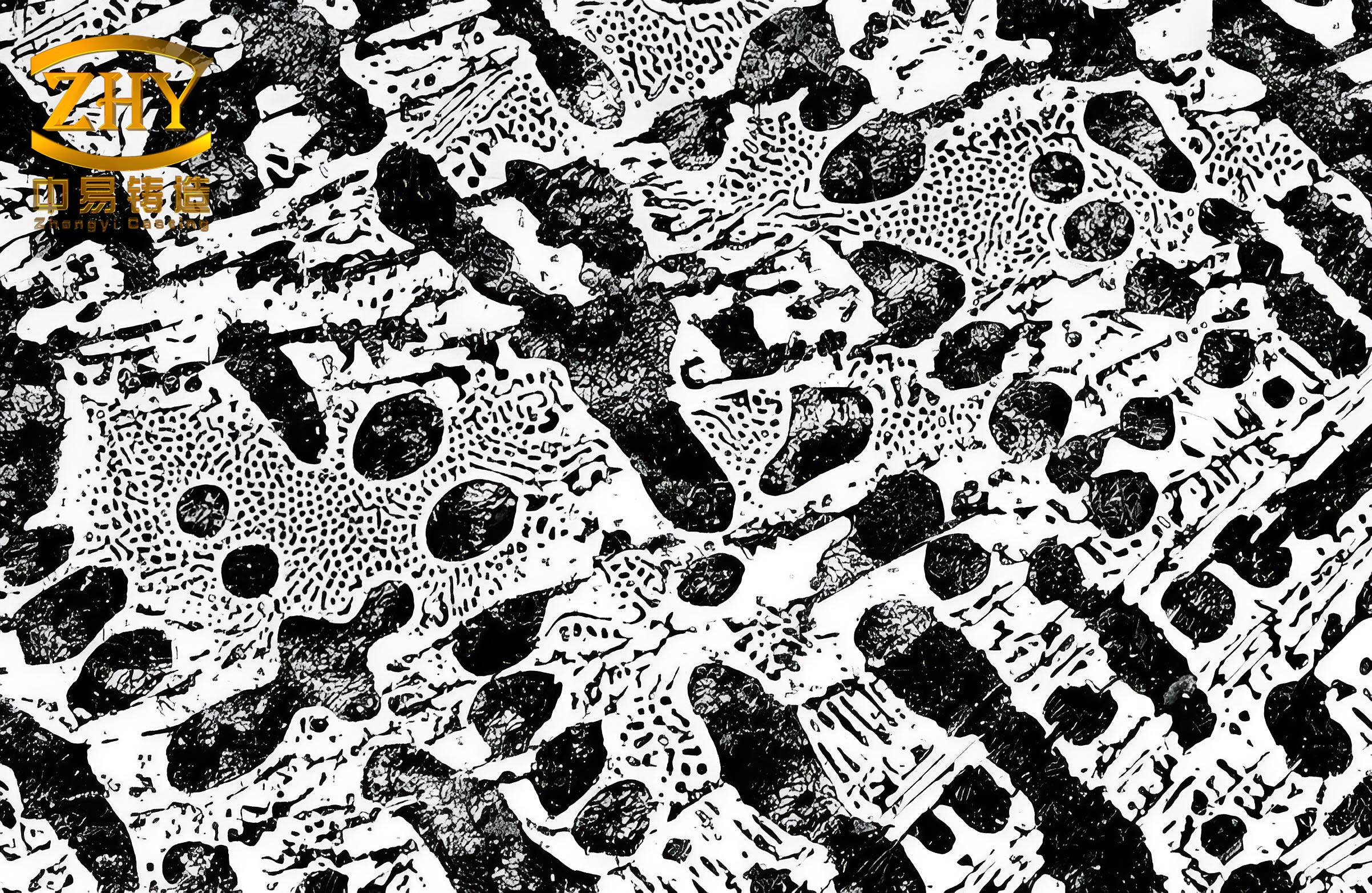
The image above illustrates a typical microstructure of white cast iron, highlighting carbide phases. In our study, metal mold casting resulted in a more uniform distribution of carbides, reducing the continuous network. This is critical for improving toughness in white cast iron. We quantified the carbide morphology using image analysis, calculating the aspect ratio and connectivity. The results show that metal mold casting decreases carbide connectivity by 40-60% compared to sand casting. This change directly impacts fracture resistance. The impact energy absorbed by the grinding balls was measured using Charpy tests, and the data is presented in the following table:
| Casting Method | Heat Treatment | Hardness (HRC) | Impact Toughness (J/cm²) | Breakage Rate in Service (%) |
|---|---|---|---|---|
| Sand Casting | As-cast | 58-62 | 3-5 | 12-18 |
| Sand Casting | Austenitized and Tempered | 56-60 | 4-6 | 10-15 |
| Metal Mold Casting | As-cast | 60-64 | 5-7 | 8-12 |
| Metal Mold Casting | Austenitized and Tempered | 58-62 | 6-9 | 4-7 |
The breakage rate is defined as the percentage of balls that fracture during a standard grinding operation over 1000 hours. The data clearly indicates that metal mold casting combined with heat treatment significantly reduces breakage. We attribute this to microstructural refinement and stress relief. The wear resistance was evaluated using a dry sand rubber wheel test, showing a 20-30% improvement in wear life for metal mold cast balls. This underscores the dual benefit of our approach: enhanced toughness and maintained hardness in white cast iron.
To further analyze the results, we developed a model linking microstructure to breakage rate. The breakage rate \(B\) can be expressed as a function of defect density \(D\), carbide connectivity \(C_c\), and residual stress \(\sigma_r\):
$$B = \alpha D + \beta C_c + \gamma \sigma_r$$
where \(\alpha\), \(\beta\), and \(\gamma\) are coefficients determined empirically. For our white cast iron, regression analysis yielded \(\alpha = 0.8\), \(\beta = 1.2\), and \(\gamma = 0.5\), with \(D\) in defects/mm², \(C_c\) as a connectivity index (0-1), and \(\sigma_r\) in MPa. Metal mold casting reduces \(D\) and \(C_c\), while heat treatment lowers \(\sigma_r\), collectively decreasing \(B\). This model helps optimize process parameters. For instance, we can estimate the effect of cooling rate \(R\) on \(C_c\) using:
$$C_c = C_{c0} \exp(-m R)$$
where \(C_{c0}\) is the connectivity at slow cooling and \(m\) is a constant. In our experiments, \(R\) for metal molds was approximately 50-100°C/s, compared to 10-20°C/s for sand molds, leading to a 50% reduction in \(C_c\). This aligns with the observed drop in breakage. Additionally, we studied the role of alloying elements in modifying carbide formation. Chromium and molybdenum promote the formation of M₇C₃ and M₆C carbides, which are harder but can be managed through processing. The equilibrium phase fractions were calculated using Thermo-Calc software, and the results for our white cast iron composition are summarized below:
| Phase | Temperature Range (°C) | Volume Fraction (%) | Effect on Properties |
|---|---|---|---|
| Austenite | > 800 | 60-70 | Ductile matrix |
| M₇C₃ Carbides | < 1200 | 20-25 | High hardness, wear resistance |
| M₆C Carbides | < 1000 | 5-10 | Thermal stability |
| Ferrite | < 800 | 5-10 | Toughness after transformation |
Heat treatment transforms austenite to martensite or bainite, depending on cooling rates, further enhancing strength. The tempering process reduces brittleness by precipitating fine carbides. We conducted dilatometry to study phase transformations, deriving continuous cooling transformation (CCT) diagrams for our white cast iron. The critical cooling rate to avoid pearlite formation was found to be around 30°C/s, which is achievable with metal mold casting. This ensures a hardened matrix without excessive cracking. The effectiveness of heat treatment is quantified by the tempering parameter \(P\):
$$P = T (\log t + 20)$$
where \(T\) is tempering temperature in Kelvin and \(t\) is time in hours. For optimal toughness, we aimed for \(P\) values between 18,000 and 20,000, corresponding to tempering at 350-450°C for 2-4 hours. This balanced hardness and toughness in the white cast iron grinding balls.
In service, grinding balls are subjected to complex stress states, including impact, abrasion, and corrosion. We simulated these conditions using finite element analysis (FEA) to predict stress distributions. The von Mises stress \(\sigma_v\) in a ball under impact can be calculated as:
$$\sigma_v = \sqrt{\frac{1}{2}[(\sigma_1 – \sigma_2)^2 + (\sigma_2 – \sigma_3)^2 + (\sigma_3 – \sigma_1)^2]}$$
where \(\sigma_1, \sigma_2, \sigma_3\) are principal stresses. Our FEA models showed that metal mold cast balls have lower maximum stresses due to finer microstructure and fewer defects. This correlates with reduced breakage. Additionally, we examined the wear mechanism using Archard’s equation:
$$W = k \frac{F_n L}{H}$$
where \(W\) is wear volume, \(k\) is a wear coefficient, \(F_n\) is normal load, \(L\) is sliding distance, and \(H\) is hardness. For white cast iron, high \(H\) reduces \(W\), but brittleness can cause fracture wear. Our modifications improve \(k\) by reducing brittle failure, thus enhancing overall wear resistance. Field trials in cement plants confirmed these findings, with metal mold cast balls lasting 15-20% longer than sand-cast counterparts.
The economic implications of reduced breakage are substantial. Lower breakage rates decrease maintenance costs and improve grinding efficiency. We performed a cost-benefit analysis, comparing the production costs of sand casting versus metal mold casting for white cast iron grinding balls. Metal mold casting has higher initial tooling costs but lower defect rates, leading to savings over time. The table below summarizes the cost factors:
| Cost Factor | Sand Casting (per ton) | Metal Mold Casting (per ton) |
|---|---|---|
| Material Cost | $500 | $500 |
| Labor Cost | $300 | $250 |
| Tooling/Mold Cost | $50 | $200 |
| Defect Repair/Scrap | $150 | $50 |
| Heat Treatment Cost | $100 | $100 |
| Total Cost | $1100 | $1100 |
| Breakage-Related Losses | $200 | $80 |
| Net Effective Cost | $1300 | $1180 |
Despite similar total costs, the lower breakage-related losses make metal mold casting more economical in the long run. This analysis reinforces the viability of our approach for industrial adoption. Moreover, the environmental benefit of reduced material waste aligns with sustainable manufacturing practices.
Future work could explore further alloy modifications or advanced heat treatment techniques to enhance white cast iron properties. For instance, adding niobium or vanadium may refine carbides, while cryogenic treatment could improve toughness. We also plan to investigate the effects of casting parameters, such as mold coating and pouring speed, on microstructure. The integration of computational materials science tools, like phase-field modeling, could provide deeper insights into carbide formation in white cast iron.
In conclusion, our research demonstrates that transitioning from sand casting to metal mold casting, along with appropriate heat treatment, significantly reduces the breakage rate of chromium-molybdenum-copper white cast iron grinding balls. This is achieved by refining the microstructure, reducing defect density, and altering carbide morphology. The improved toughness and wear resistance make white cast iron a more reliable material for grinding applications. Through detailed experimental analysis and modeling, we have established a framework for optimizing white cast iron performance. The repeated emphasis on white cast iron throughout this study underscores its importance in industrial contexts, and our findings contribute to the ongoing development of durable materials for harsh operating conditions.