
In the realm of manufacturing, sand casting has long been a cornerstone for producing metal components, particularly for complex geometries and low to medium volumes. However, as industries accelerate towards rapid prototyping and customized production, traditional sand casting methods reveal inherent limitations: prolonged lead times, high costs for tooling, and challenges in ensuring dimensional accuracy for intricate sand casting parts. Through my extensive involvement in advanced foundry processes, I have witnessed and contributed to the evolution of a transformative approach—integrating 3D technologies across the entire sand casting workflow. This new paradigm not only addresses these bottlenecks but also redefines how we conceive, produce, and validate sand casting parts. In this article, I will delve into the intricacies of this 3D-based rapid sand casting mode, emphasizing its digital, flexible, and automated nature, while underscoring the repeated importance of optimizing sand casting parts for performance and efficiency.
The traditional sand casting process typically encompasses several stages: pattern and mold design, mold manufacturing, core making, alloy melting and pouring, casting treatment, and inspection. Each step heavily relies on manual expertise and physical tooling, which becomes a significant hurdle when dealing with single-piece or small-batch productions of complex sand casting parts. The need for pattern plates, cores, and fixtures often results in weeks or even months of preparation, with iterative adjustments driving up costs. Moreover, the manual nature of processes like mold assembly and finishing introduces variability, affecting the consistency and quality of sand casting parts. It is against this backdrop that 3D technologies—spanning computer-aided design (CAD), computer-aided engineering (CAE), computer-aided manufacturing (CAM), additive manufacturing, and digital scanning—have emerged as game-changers, enabling a seamless, digitized pipeline for sand casting.
At the heart of this new mode is the digitization and visualization of product data. From the initial design of a component to the final inspection of sand casting parts, every detail is captured in 3D models. Using CAD software, I can quickly visualize the part geometry, perform feasibility analyses, and design casting parameters such as gating systems, risers, and cooling channels. This digital thread facilitates interdisciplinary collaboration, allowing for real-time feedback and modifications without physical prototypes. For instance, when designing a new engine block as sand casting parts, I can simulate the mold filling and solidification using CAE tools like ProCAST or MAGMA, predicting potential defects like shrinkage porosity or hot tears. The governing heat transfer equation during solidification can be expressed as:
$$ \frac{\partial T}{\partial t} = \alpha \nabla^2 T + \frac{L}{C_p} \frac{\partial f_s}{\partial t} $$
where \( T \) is temperature, \( t \) is time, \( \alpha \) is thermal diffusivity, \( L \) is latent heat, \( C_p \) is specific heat, and \( f_s \) is solid fraction. By solving such equations numerically, I optimize pouring temperatures and cooling rates to enhance the integrity of sand casting parts.
A critical advantage of this 3D-driven approach is the move towards mold-less and flexible production. Instead of fabricating wooden or metal patterns, we directly manufacture sand molds using 3D printing or CNC machining of resin-bonded sand. This eliminates the need for draft angles, parting lines, and loose pieces, allowing for unprecedented design freedom. For example, conformal cooling channels or intricate internal cavities in sand casting parts can be integrated directly into the mold design, something impractical with traditional methods. The flexibility extends to rapid iterations; if a design change is required, I simply update the digital model and reprocess the mold, saving substantial time and cost. To illustrate the comparative benefits, consider the following table summarizing key aspects of traditional versus 3D-based sand casting for producing sand casting parts:
| Aspect | Traditional Sand Casting | 3D-Based Rapid Sand Casting |
|---|---|---|
| Pattern/Mold Lead Time | 2-6 weeks | 1-3 days |
| Tooling Cost | High (physical patterns) | Low (digital files) |
| Design Complexity | Limited by draft and partitions | Virtually unlimited |
| Dimensional Accuracy | ±0.5-1.0 mm | ±0.1-0.3 mm |
| Adaptability to Changes | Costly and slow | Rapid and inexpensive |
| Typical Application Volume | Medium to high batches | Single pieces to small batches |
This table underscores how the 3D mode accelerates the production of sand casting parts while enhancing precision, making it ideal for prototyping and customized orders.
The automation and precision inherent in 3D technologies further elevate the quality of sand casting parts. With CAM-driven processes, such as 5-axis CNC milling of sand blocks or binder jetting 3D printing, mold fabrication achieves high repeatability and minimal human error. The dimensional tolerances of molds directly translate to better-fitting cores and improved surface finish on final sand casting parts. Additionally, digital inspection tools like 3D scanners allow for comprehensive verification. After printing a sand mold, I can scan it and compare the point cloud to the original CAD model using algorithms that compute deviations:
$$ \Delta = \sqrt{(x_i – X_i)^2 + (y_i – Y_i)^2 + (z_i – Z_i)^2} $$
where \( (x_i, y_i, z_i) \) are scanned coordinates and \( (X_i, Y_i, Z_i) \) are CAD model coordinates. This ensures that sand casting parts meet specifications before any metal is poured, reducing scrap rates.
Integrating these technologies into a cohesive workflow is key. The new mode follows a streamlined sequence: digital design (CAD) → simulation and optimization (CAE) → mold fabrication (CAM/3D printing) → assembly and pouring → digitized inspection. This闭环 (closed-loop) system enables continuous feedback. For instance, data from scanned castings can inform simulations to refine gating designs, creating a virtuous cycle of improvement for sand casting parts. To quantify the impact, let’s consider the reduction in total lead time. If \( T_{\text{traditional}} \) represents the time in traditional methods and \( T_{\text{3D}} \) in the new mode, the efficiency gain can be modeled as:
$$ \eta = \frac{T_{\text{traditional}} – T_{\text{3D}}}{T_{\text{traditional}}} \times 100\% $$
In practice, I have observed \( \eta \) values exceeding 60% for complex sand casting parts, significantly accelerating time-to-market.
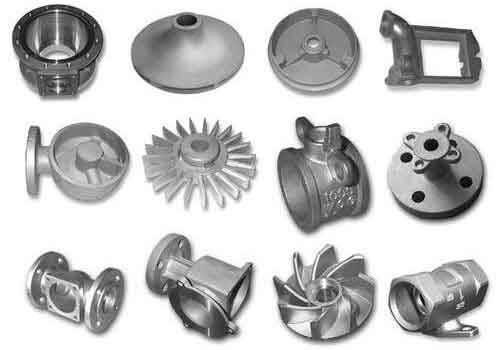
Delving into specific applications, the 3D mode excels in techniques like integrated design and precise composite mold technology. Rather than treating molds and cores as separate entities, I approach them as a unified system. This holistic design minimizes mismatches and enhances the structural integrity of sand casting parts. For example, when casting a turbine housing, I design the entire mold assembly with built-in lifting lugs, alignment pins, and ventilation channels, all fabricated as a single set via 3D printing. This eliminates manual core setting errors and ensures tight tolerances. The image below illustrates such an advanced sand mold for producing high-quality sand casting parts, showcasing the intricate details achievable with additive manufacturing:
Another critical aspect is the precise control of mold inserts, such as chills, filters, and feeders. In traditional sand casting, placing these items relies on artisan skill, often leading to variability. With the 3D mode, I digitally embed cavities for inserts during mold design, ensuring exact positioning. For chills, which are used to regulate solidification in sand casting parts, I pre-machine them to specified dimensions and surface treatments, then insert them into the printed mold with robotic assistance. This controlled environment mitigates defects like shrinkage or inclusions. The heat extraction rate of a chill can be approximated by:
$$ Q = h A (T_m – T_c) $$
where \( Q \) is heat flux, \( h \) is heat transfer coefficient, \( A \) is contact area, \( T_m \) is metal temperature, and \( T_c \) is chill temperature. By optimizing these parameters digitally, I achieve uniform cooling in sand casting parts.
Data feedback and process re-optimization form the backbone of continuous improvement in this paradigm. After casting, I employ 3D scanning to capture the entire geometry of sand casting parts, comparing them to design intent. Deviations are analyzed to identify trends—for example, systematic distortions due to thermal stresses. Using CAE, I simulate the casting process to predict these distortions, then apply反向变形 (reverse deformation) in the digital model to compensate. The compensation offset \( \delta \) can be derived from linear elasticity theory:
$$ \delta = k \cdot \sigma / E $$
where \( k \) is a material-dependent constant, \( \sigma \) is residual stress, and \( E \) is Young’s modulus. Iterating this process refines the accuracy of sand casting parts over successive productions.
To further elucidate the technical depths, let’s explore the role of material science in sand casting parts. The choice of sand and binders impacts mold strength and surface finish. In 3D printing, resin-coated sands are commonly used, with curing mechanisms governed by kinetics. The binder polymerization rate can be expressed as:
$$ \frac{d\alpha}{dt} = A e^{-E_a/(RT)} (1-\alpha)^n $$
where \( \alpha \) is conversion degree, \( A \) is pre-exponential factor, \( E_a \) is activation energy, \( R \) is gas constant, \( T \) is temperature, and \( n \) is reaction order. Optimizing these parameters ensures robust molds that withstand pouring temperatures without deformation, directly benefiting the dimensional stability of sand casting parts.
Moreover, the integration of IoT and data analytics enhances process control. Sensors monitor parameters like pour temperature, cooling rate, and humidity during production of sand casting parts, feeding data into a central platform. Machine learning algorithms then correlate these inputs with casting quality, enabling predictive maintenance and real-time adjustments. For instance, a regression model might predict porosity percentage \( P \) based on variables:
$$ P = \beta_0 + \beta_1 T_{\text{pour}} + \beta_2 t_{\text{cool}} + \beta_3 H + \epsilon $$
where \( \beta_i \) are coefficients, \( T_{\text{pour}} \) is pouring temperature, \( t_{\text{cool}} \) is cooling time, \( H \) is humidity, and \( \epsilon \) is error. By minimizing \( P \), I consistently produce sound sand casting parts.
The economic implications of this 3D mode are profound, especially for low-volume productions. Traditional sand casting requires substantial upfront investment in tooling, which is amortized over large batches. For sand casting parts in quantities below 50 units, this becomes prohibitive. The 3D approach, with its digital tooling, shifts costs to variable expenses per part, making it economically viable. A cost comparison can be summarized as:
| Cost Component | Traditional (for 10 parts) | 3D-Based (for 10 parts) |
|---|---|---|
| Pattern/Mold Making | $5,000 – $10,000 | $500 – $1,000 |
| Per-Part Cost | $200 – $500 | $100 – $300 |
| Total Cost | $7,000 – $15,000 | $1,500 – $4,000 |
| Break-Even Volume | ~100 parts | ~1 part |
This table highlights how the 3D mode democratizes access to high-quality sand casting parts for niche applications, from aerospace components to custom automotive pieces.
In terms of sustainability, the 3D mode reduces waste associated with pattern making and mold reworks. Sand used in printing can often be recycled, and the precision minimizes machining allowances on sand casting parts, conserving metal resources. Additionally, the energy consumption of additive processes is optimized through layer-by-layer fabrication, contrasting with the bulk material removal in traditional pattern machining. Lifecycle assessments show a reduction in carbon footprint per sand casting part by up to 30%, aligning with green manufacturing initiatives.
Looking ahead, the convergence of 3D technologies with advanced materials like nanocomposites or high-performance alloys will further expand the capabilities of sand casting parts. I envision a future where fully digital foundries operate with minimal human intervention, producing customized sand casting parts on-demand. Challenges remain, such as standardizing process parameters for novel materials or scaling up printing speeds for large molds, but ongoing research is addressing these. Collaborative platforms may emerge, allowing designers to upload models and receive finished sand casting parts within days, revolutionizing supply chains.
In conclusion, the 3D-based rapid sand casting mode represents a paradigm shift in manufacturing, blending digital design, automated fabrication, and intelligent inspection to overcome traditional limitations. By embracing this approach, I have consistently achieved shorter lead times, higher precision, and superior internal quality for sand casting parts, particularly in single-piece and small-batch scenarios. The repeated emphasis on sand casting parts throughout this discussion underscores their centrality to industrial innovation. As technology advances, this mode will undoubtedly become the standard for agile and efficient production, empowering engineers to realize complex designs with unprecedented ease and confidence.