
In my extensive experience with grey iron casting, particularly in green sand mold processes, the design of risers is a critical factor that determines the quality, integrity, and economic efficiency of the final castings. Based on the equilibrium solidification theory and the principle of limited feeding, I have developed and refined methods for selecting and designing risers that cater to various structural and weight requirements of grey iron castings. This article aims to share these insights, focusing on practical guidelines, design calculations, and real-world applications, all while emphasizing the importance of riser design in enhancing the performance of grey iron casting processes. The goal is to ensure defect-free castings while maximizing yield and minimizing operational costs.
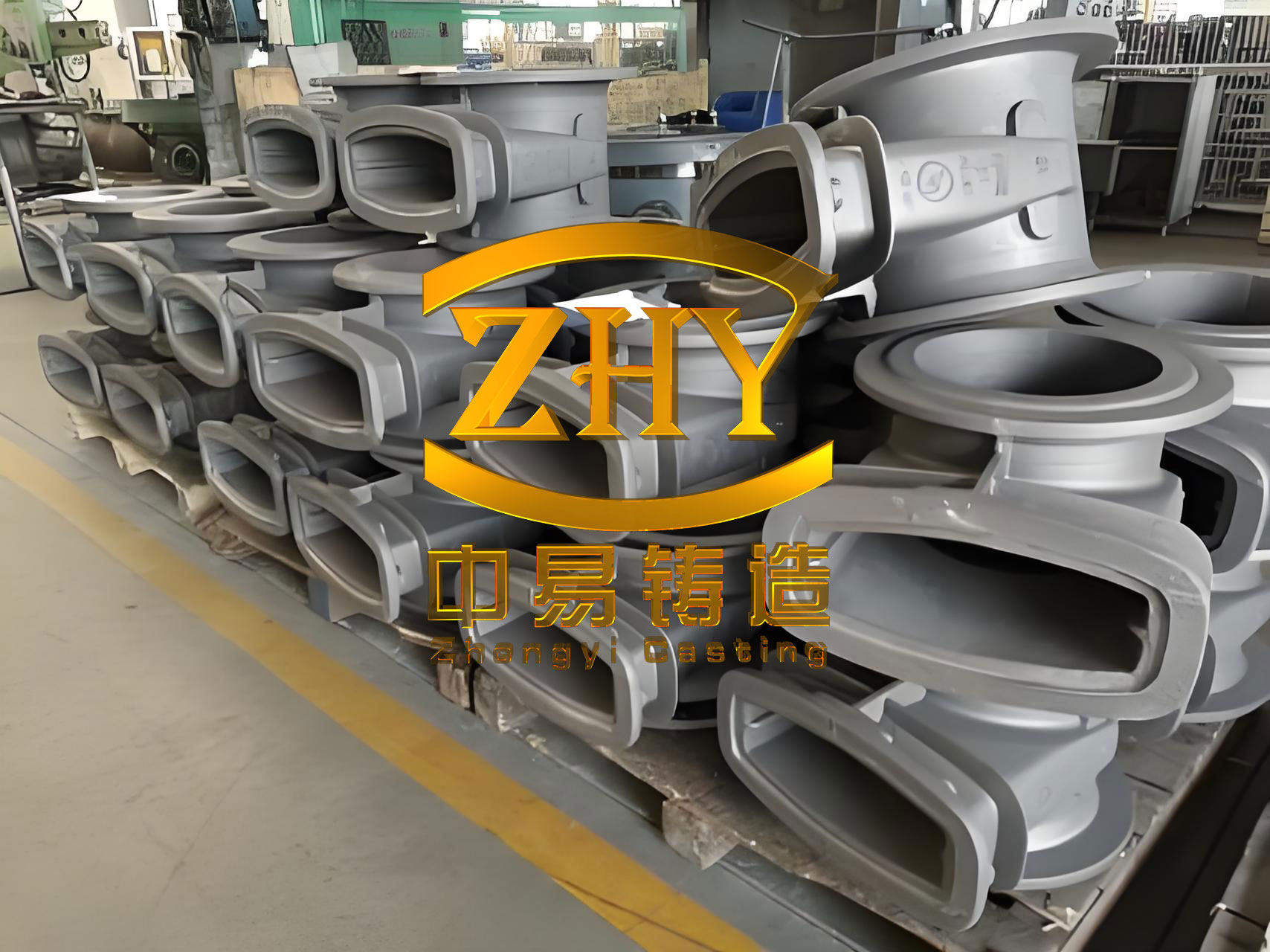
The foundation of my approach lies in the equilibrium solidification theory, which balances the contraction during liquid cooling and the expansion due to graphite precipitation in grey iron casting. This theory dictates that risers should provide just enough feed metal to compensate for shrinkage, without over-designing, thus improving the yield. For grey iron casting, the graphite expansion can often offset some shrinkage, especially in thick sections, but careful riser design is still essential to prevent defects like shrinkage porosity or voids. I have applied this theory across numerous projects, leading to significant improvements in quality and efficiency for grey iron casting production.
When it comes to selecting the type of riser for a grey iron casting, several factors must be considered: the casting’s geometry, wall thickness, weight, and the positioning in the mold. Below, I outline a systematic decision-making process that I use in practice for grey iron casting projects.
| Casting Type | Characteristics | Riser Requirement | Recommended Riser Type |
|---|---|---|---|
| Thin-walled, uniform thickness | Minimal shrinkage; feeding can be through gates | No riser or only vent riser | Vent riser or enlarged gate |
| Thin-walled with local hot spots | Concentrated shrinkage; strong feeding needed | High-efficiency riser | Pressed edge riser or side riser |
| Solid block castings (large) | Long solidification time; high graphite expansion utilization | Weak feeding; lower riser size coefficient | Dark hot riser or cold riser with medium coefficient |
| Solid block castings (small) | Rapid solidification; requires strong feeding | Strong feeding; higher riser size coefficient | Pressed edge riser or top riser |
In grey iron casting, the choice between dark (blind) and open risers is often dictated by the mold parting line. If the casting is entirely in the drag or middle mold, dark risers are preferable as they offer better feeding efficiency and reduce metal loss. However, if part of the casting is in the cope, open risers must be used. Therefore, when designing the mold for grey iron casting, I always consider the riser placement to optimize feeding. For single or small-batch production, multi-part molds can be employed to facilitate dark riser use.
Another key decision is between hot and cold risers. Hot risers, which are connected to the casting during pouring, provide the most economical feeding for grey iron casting in green sand molds, especially for castings weighing less than 500 kg and with heights under 300 mm. Beyond these limits, cold risers (separately made and placed) are more suitable. I prioritize hot risers when possible to enhance yield in grey iron casting processes.
For specific casting needs, I recommend the following riser types based on my experience with grey iron casting:
- Pressed Edge Hot Riser: Ideal for castings requiring strong feeding, such as those with local hot spots. It offers smooth filling, effective feeding, and ease in pattern making, molding, and cleaning. In grey iron casting, it can be adapted to feed multiple castings with one riser, boosting yield.
- Cold Flange Riser or Ear Riser: Best for plate-like castings with large upward-facing surfaces. The flange riser has better insulation and feeding, but the ear riser is simpler to mold. Both help in slag removal and cold metal overflow in grey iron casting.
- Duckbill Wedge Riser: Used for open top risers when feeding is needed. It avoids “back-suction” and is easy to clean, making it suitable for grey iron casting with complex geometries.
- Vent Riser: An economical choice for castings without feeding requirements; it serves as a vent and chill in grey iron casting.
To quantify riser dimensions, I rely on the “hot spot circle method,” which is straightforward and effective for grey iron casting. The riser size is determined by multiplying the hot spot diameter of the casting by a coefficient, as summarized in the table below. This method ensures adequate feeding while minimizing excess metal in grey iron casting.
| Riser Category | Riser Type | Coefficient \( k \) Range | Applicable Casting Weight |
|---|---|---|---|
| Dark Hot Riser | Pressed Edge Riser | 0.8 – 1.2 | < 500 kg |
| Dark Hot Riser | Side Riser (Ear or Flange) | 0.9 – 1.3 | < 500 kg |
| Cold Riser | Pressed Edge Riser | 1.0 – 1.5 | > 500 kg |
| Cold Riser | Side Riser (Ear or Flange) | 1.1 – 1.6 | > 500 kg |
| Open Cold Riser | Top Necked Riser | 1.2 – 1.7 | All weights |
| Open Cold Riser | Duckbill Wedge Riser | 1.0 – 1.4 | All weights |
| Vent Riser | Vent Riser | 0.8 – 1.0 | Light castings |
The riser dimensions are defined as follows for grey iron casting: let \( D_r \) be the riser diameter or inner circle diameter, \( D_c \) be the casting hot spot diameter, \( H_r \) be the riser height, \( L_n \) be the riser neck length, \( d_n \) be the neck diameter for necked risers, and \( h_f \) be the flange height for flange risers. The basic formula for riser diameter in grey iron casting is:
$$ D_r = k \times D_c $$
where \( k \) is the coefficient from Table 2. For solid block grey iron castings, I use the lower end of the coefficient range, while for thin-walled grey iron castings with local hot spots, I use the upper end. The riser height is typically derived from empirical relations; for example, for pressed edge risers in grey iron casting, I use:
$$ H_r = 1.5 \times D_r \quad \text{for } D_r < 100 \text{ mm} $$
$$ H_r = 2.0 \times D_r \quad \text{for } D_r \geq 100 \text{ mm} $$
Additionally, the riser neck area is critical for feeding efficiency in grey iron casting. I recommend that the total neck area for cold risers be greater than or equal to 30% of the gate area to ensure proper overflow and slag removal. The neck thickness, denoted as \( t_n \), is usually set as \( t_n = 0.6 \times D_c \) for hot risers and \( t_n = 0.8 \times D_c \) for cold risers in grey iron casting.
To ensure accurate placement of pressed edge risers in grey iron casting, especially without dedicated pattern plates, I have developed simple positioning plates. These plates are embedded in the drag mold during molding, aligning with the casting and riser. After molding, the plate is removed, and the cavity is filled with sand. This method guarantees precise gap dimensions, enhancing feeding capability in grey iron casting. The positioning plate dimensions vary based on riser size; for example, for a hot pressed edge riser with \( D_r = 80 \text{ mm} \), the plate width \( W_p \) can be calculated as:
$$ W_p = D_r + 20 \text{ mm} $$
and the length \( L_p \) as:
$$ L_p = 1.2 \times D_r $$
I categorize positioning plates into Type A and Type B for different grey iron casting scenarios, with detailed dimensions provided in Table 3.
| Plate Type | Riser Diameter \( D_r \) (mm) | Plate Width \( W_p \) (mm) | Plate Length \( L_p \) (mm) | Applicable Casting Type |
|---|---|---|---|---|
| Type A | 50 – 100 | \( D_r + 20 \) | \( 1.2 \times D_r \) | Small to medium grey iron casting |
| Type B | 100 – 200 | \( D_r + 30 \) | \( 1.5 \times D_r \) | Large grey iron casting |
Now, let me illustrate the riser design process with concrete examples from my work in grey iron casting.
Example 1: Hot Pressed Edge Riser for a Solid Block Grey Iron Casting
The casting is a solid block of grey iron, with a weight of 150 kg and a hot spot diameter \( D_c = 100 \text{ mm} \). The material is grade HT250, and it requires weak feeding due to its solid nature. For this grey iron casting, I select a hot pressed edge riser with a coefficient \( k = 0.8 \) (lower end for solid blocks). The riser diameter is calculated as:
$$ D_r = k \times D_c = 0.8 \times 100 = 80 \text{ mm} $$
Using the height formula for \( D_r < 100 \text{ mm} \):
$$ H_r = 1.5 \times D_r = 1.5 \times 80 = 120 \text{ mm} $$
The neck thickness \( t_n = 0.6 \times D_c = 0.6 \times 100 = 60 \text{ mm} \). The riser is placed as shown in the design sketch, ensuring adequate feeding for this grey iron casting. After pouring and cleaning, the casting was defect-free, with a riser yield of 85%, demonstrating the efficiency of this approach for grey iron casting.
Example 2: Cold Flange Riser for a Plate-like Grey Iron Casting
The casting is a slider plate of grey iron, weight 80 kg, with a large upward-facing surface. The material is HT200, and the top surface requires machining. The primary needs are slag removal, cold metal overflow, and some feeding. For this grey iron casting, I choose a cold flange riser with a coefficient \( k = 1.3 \) (upper end for thin-walled sections). The hot spot diameter \( D_c = 80 \text{ mm} \), so:
$$ D_r = k \times D_c = 1.3 \times 80 = 104 \text{ mm} $$
I round it to \( D_r = 100 \text{ mm} \) for practicality. The riser height \( H_r = 2.0 \times D_r = 200 \text{ mm} \), and the flange height \( h_f = 0.3 \times D_r = 30 \text{ mm} \). The neck area is designed to be 35% of the gate area to enhance overflow in this grey iron casting. The arrangement proved successful, with no defects and improved surface quality for the grey iron casting.
Beyond these examples, I have applied the equilibrium solidification theory to other grey iron casting components, such as couplings. In one case, a coupling grey iron casting initially had a rejection rate of 15% with a yield of 65%. By switching to a side ear riser based on equilibrium solidification, the rejection rate dropped to 5% and the yield increased to 80%. This highlights the versatility of these methods across different grey iron casting geometries.
The economic benefits of optimized riser design in grey iron casting are substantial. By using the principles outlined here, I have consistently achieved yield improvements of 10-20% and reduced cleaning labor by 30% in grey iron casting projects. The key is to tailor the riser to the specific needs of each grey iron casting, balancing feeding, overflow, and cost. For instance, in high-volume grey iron casting production, small adjustments in riser size coefficients can lead to significant material savings without compromising quality.
In conclusion, riser design is a pivotal aspect of grey iron casting that directly impacts quality and profitability. My experience, grounded in equilibrium solidification theory, shows that a methodical approach—using hot spot circle calculations, appropriate coefficients, and strategic riser selection—can yield excellent results for grey iron casting. I encourage foundries to adopt these practices for grey iron casting to enhance their competitiveness. The integration of positioning plates further ensures precision, making the process reliable for various grey iron casting applications. As the industry evolves, continuous refinement of these methods will drive advancements in grey iron casting technology.