
In modern manufacturing, the sand casting foundry process remains a cornerstone for producing complex aluminum alloy components, especially when high surface quality and internal integrity are demanded. This article presents a comprehensive sand casting foundry process design and simulation analysis for an aluminum alloy box casting. The casting material is ZAlSi7Mg0.3, with overall dimensions of 1003 mm × 223 mm × 608 mm. The box features a symmetrical structure, internal cavities, multiple external ribs, and varying wall thicknesses, making it a medium-to-large complex casting. Both sidewalls require stringent nondestructive testing and excellent surface finish, which guided the entire sand casting foundry process design.
1. Casting Structure and Process Requirements
The casting geometry was created using NX10.0 software. Due to the critical requirement of defect-free sidewalls and high surface quality, the sand casting foundry process must ensure smooth filling and directional solidification. The production type is small-batch, so cold box resin sand cores and molds are adopted to achieve high dimensional accuracy and strength. The key design decisions involve the pouring position, parting surface, gating system, risers, chill blocks, and sand core layout.
2. Selection of Pouring Position
Two pouring positions were evaluated:
- Horizontal orientation (casting laid flat): simplifies mold making but risks filling defects on the top surface due to large planar area.
- Vertical orientation (large area at bottom, key sidewalls vertical): better filling and solidification quality for critical surfaces. Although molding becomes more complex, the vertical layout allows for horizontal molding and vertical pouring, which is the adopted strategy.
3. Parting Surface Determination
The parting surface is chosen at the maximum cross-section of the casting to facilitate pattern removal. It is a flat plane, simplifying pattern plate construction and ensuring dimensional accuracy. Lateral grooves are formed using an additional side core.
4. Gating and Riser System Design
An open gating system is designed to ensure smooth and rapid filling. The sprue is placed at the parting line, with ingates parallel to a sloping surface to promote slag floating. A slag trap is added on the runner, and glass fiber filters are placed at both ends of the sprue for enhanced slag retention. The dimensions of the gating system are calculated using the choke area method:
$$ A_R = \frac{G}{t \cdot v \cdot \rho} $$
where \(A_R\) is the choke area (cm²), \(G\) is the casting weight (kg), \(t\) is the pouring time (s), \(v\) is the flow velocity (cm/s), and \(\rho\) is the density (g/cm³). Based on empirical data for aluminum alloys, the pouring time is set to 18–22 s. The calculated dimensions are summarized in Table 1.
| Component | Width | Height | Length |
|---|---|---|---|
| Sprue (top) | 40 | 40 | 200 |
| Runner | 30 | 25 | 120 |
| Ingate (each) | 20 | 8 | 50 |
Four open risers are placed on the top surface of the casting to provide feeding during solidification. The riser dimensions are 45 mm × 55 mm × 140 mm with a 5° taper. Additionally, two chill blocks are positioned in thick sections to enhance directional solidification. Table 2 lists the riser and chill specifications.
| Type | Dimensions (mm) | Quantity | Material |
|---|---|---|---|
| Open riser | 45×55×140 (taper 5°) | 4 | Insulated |
| Chill block | 80×80×20 | 2 | Gray iron |
5. Sand Core and Mold Design
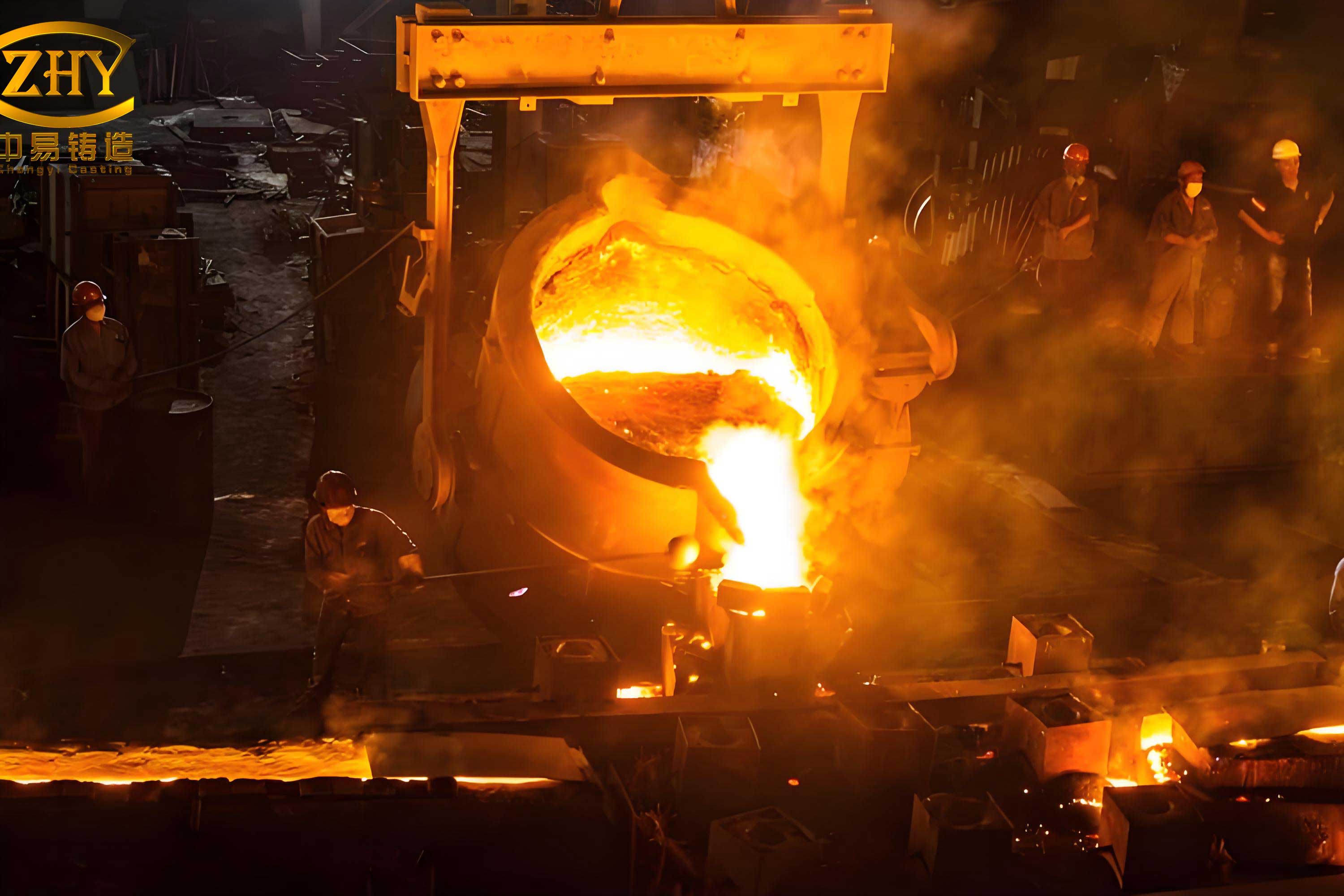
The mold assembly uses a horizontal parting with vertical pouring. A large central core forms the internal cavity; two through-holes are added to the core for handling and venting. A side core creates the external ribs and protrusions that would otherwise hinder pattern removal. The upper and lower molds complete the exterior. The riser mold and pouring cup are integrated. Figure shows a typical sand casting foundry setup for this box casting.
6. Casting Process Simulation
The entire sand casting foundry process was simulated using Anycasting software. The filling simulation shows a total filling time of 18.7 s, achieving rapid and stable filling. The liquid metal enters from the sloped ingate, rises smoothly, and forces slag and gases to float upward into the risers. No misruns or cold shuts are observed. The solidification simulation indicates that the last solidification region occurs at the lower right corner of the casting, which is a thick section. This region is predicted to be prone to shrinkage porosity.
Defect prediction analysis reveals significant shrinkage porosity in the lower right area, necessitating process modifications. To quantify the solidification behavior, the temperature gradient and solid fraction evolution were evaluated using the following criteria:
$$ G = \frac{\partial T}{\partial x} \quad \text{and} \quad f_s = \frac{T_L – T}{T_L – T_S} $$
where \(G\) is the thermal gradient, \(f_s\) is the solid fraction, \(T_L\) and \(T_S\) are the liquidus and solidus temperatures, respectively. The simulation results indicate a low gradient in the problematic region, leading to isolated liquid pools.
7. Process Optimization
To eliminate the predicted defects, the following modifications are implemented in the sand casting foundry design:
- Replace the four open risers with insulated (exothermic) risers to improve feeding efficiency.
- Add a blind riser at the lower right thick section, combined with additional chill blocks to create a stronger thermal gradient.
- Reposition the chill blocks to ensure directional solidification toward the risers.
The optimized riser and chill layout is shown in Table 3.
| Component | Type | Position | Remarks |
|---|---|---|---|
| Riser 1–4 | Insulated open riser | Top surface | Improved feeding |
| Blind riser | Insulated blind riser | Lower right | Φ60×100 mm |
| Chill A | Gray iron chill | Left thick corner | 80×80×25 mm |
| Chill B | Gray iron chill | Bottom thick area | 100×80×25 mm |
8. Simulation Results After Optimization
The revised sand casting foundry scheme is re‑simulated. The filling process remains stable and complete within 19.2 s. The solidification sequence now shows that the last solidifying regions are confined to the risers (both open and blind). The thermal gradient near the former defect area increases significantly, ensuring that the casting itself solidifies before the riser necks. Defect prediction indicates that all shrinkage porosity is shifted into the risers, which are subsequently removed by cutting. The final casting meets the quality requirements on both sidewalls and internal soundness.
Figure below shows a typical sand casting foundry part manufactured after optimization.
9. Conclusion
This case study demonstrates a systematic sand casting foundry process design for an aluminum alloy box. By carefully selecting pouring position, parting surface, and optimizing the gating and riser system with the aid of numerical simulation, defects are effectively eliminated. The use of insulating risers and strategically placed chill blocks ensures sound castings with high surface quality. The sand casting foundry approach described here is directly applicable to similar complex aluminum alloy castings, providing a reliable methodology for process engineers.
Key parameters and simulation results are summarized in Table 4.
| Parameter | Initial design | Optimized design |
|---|---|---|
| Filling time (s) | 18.7 | 19.2 |
| Pouring temperature (°C) | 720 | 720 |
| Last solidification location | Lower right corner (defect) | Risers only |
| Maximum shrinkage porosity (%) | 2.3 | <0.1 |
| Number of risers | 4 (open) | 5 (4 insulated open + 1 blind) |
| Chill blocks | 2 | 4 |
The successful application of sand casting foundry technology in this work verifies that numerical simulation is an indispensable tool for modern foundries aiming to reduce trial‑and‑error and achieve first‑time‑right production.