
In my experience working within a large-scale sand casting foundry, the production of center channels for scraper conveyors presents significant technical challenges. The center channel is the most critical and heaviest component of the conveyor, accounting for over 70% of the total mass. Traditionally, these parts are fabricated by welding cast side bars with a middle plate and a bottom plate. However, this conventional approach suffers from long production cycles, poor wear resistance, and frequent weld cracking. To address these drawbacks, I have developed a complete sand casting foundry process to produce the center channel as a single monolithic casting. This paper details my research on the casting process, material selection, molding methods, defect prevention, and final optimization, all within the framework of a modern sand casting foundry.
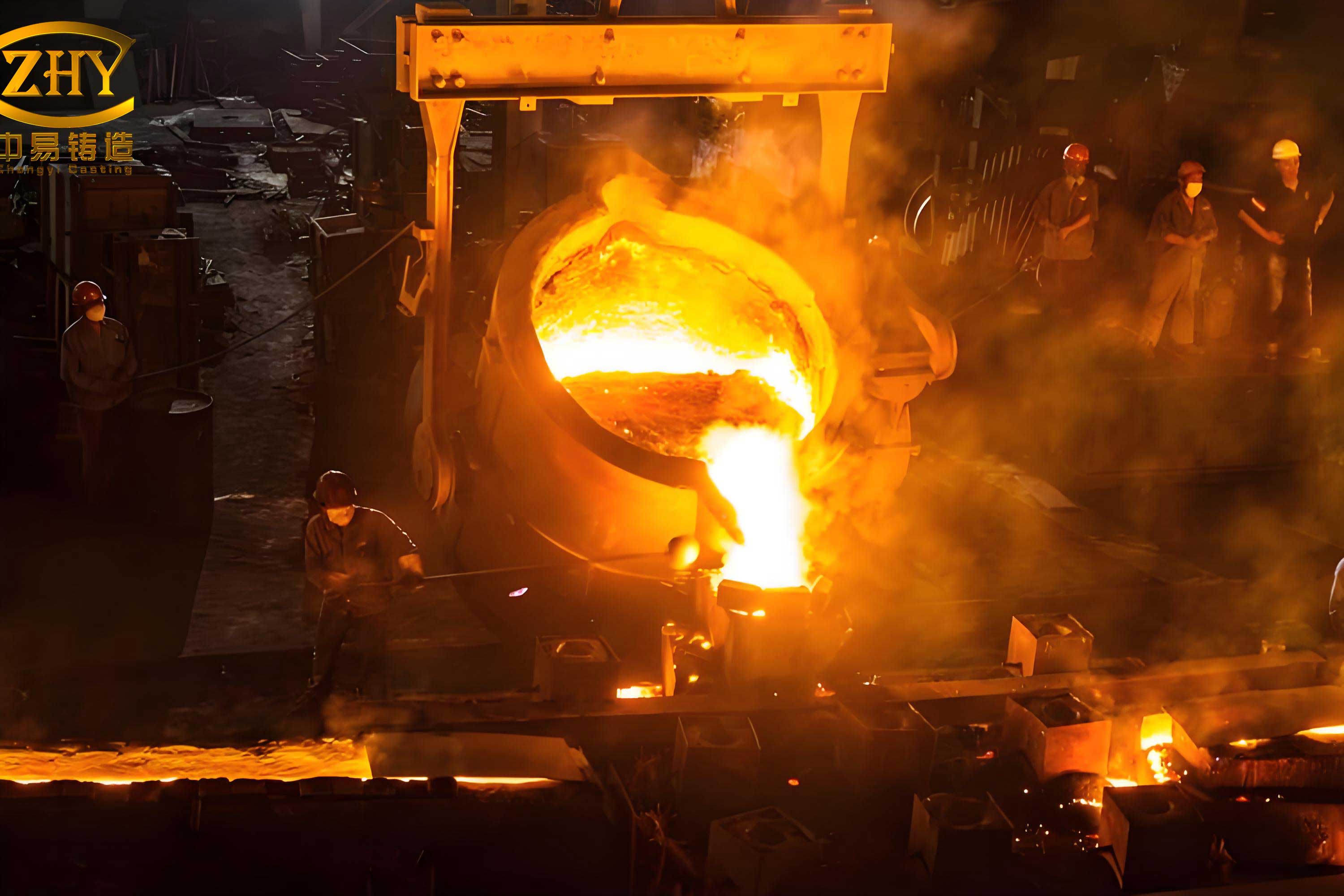
1. Structural Design Improvement for Castability
The original center channel had dimensions of 750 mm × 1330 mm × 377 mm. It exhibited complex geometry, uneven wall thickness, and numerous hot spots. In my sand casting foundry practice, such features are prone to localized sand adhesion, cracking at transitional regions, and deformation of the middle and bottom plates. To mitigate these issues without compromising functional performance, I modified three critical areas of the casting design.
First, I simplified the structure at the end connections (the so-called “dumb-bell” joints) to reduce stress concentration and improve the feeding channel for molten metal. Second, I reduced the mass at thick sections where hot spots were concentrated, while ensuring adequate strength. Third, I increased the transition thickness at a sharp corner to avoid casting cracks. These modifications, guided by simulation and foundry experience, significantly enhanced the castability of the part within my sand casting foundry.
2. Casting Material Selection
In a traditional welded center channel, the side bars use ZG30MnSi, while the middle and bottom plates use rolled steel such as Hardox400. For a monolithic sand casting foundry product, a single alloy must simultaneously satisfy the strength requirements of the side bars and the wear resistance of the plates. Therefore, I improved the base grade ZG30MnSi by adjusting the composition. The key alloying elements are silicon and manganese, with carbon content limited to ≤0.35% and combined Si+Mn ≤2.5%. I added micro-alloying elements such as Re, B, Ti, Zr, and V to enhance strength, wear resistance, and toughness. The carbon equivalent (CE) was kept below 0.68% to ensure weldability and repairability.
The target chemical composition (mass fraction, %) is summarized in the table below:
| Element | C | Si | Mn | P | S | Cr | Ni | Mo | Re | B | Ti | Zr | V |
|---|---|---|---|---|---|---|---|---|---|---|---|---|---|
| Content (wt%) | ≤0.35 | 0.7–1.2 | 1.4–1.8 | ≤0.035 | ≤0.035 | ≤0.3 | ≤0.3 | ≤0.1 | 0.05–0.15 | 0.002–0.005 | 0.02–0.05 | 0.02–0.05 | 0.05–0.10 |
$$CE = C + \frac{Si}{30} + \frac{Mn}{20} + \frac{Cr}{20} + \frac{Ni}{60} + \frac{Mo}{15} + \frac{V}{10} + \frac{Cu}{20} \leq 0.68$$
The material was developed to achieve a yield strength of ≥500 MPa, tensile strength of ≥750 MPa, elongation of ≥12%, and impact toughness (KV₂) of ≥40 J at room temperature, while maintaining surface hardness of at least 350 HB for wear resistance.
3. Molding Material and Process
For this center channel, I chose the ester-hardened water glass self-setting sand process. In my sand casting foundry, this process delivers dimensional accuracy and surface finish comparable to alkaline phenolic resin sand, but with significantly lower tendencies for cracking and gas porosity. Moreover, it produces no pungent fumes, and the used sand can be reclaimed by dry reclamation followed by water washing for reuse, making it environmentally friendly.
The key parameters of the ester-hardened water glass sand process are summarized below:
| Parameter | Value |
|---|---|
| Sand temperature | 10–35 °C |
| Modified water glass addition | 2.0%–3.0% by weight of sand |
| Organic ester hardener addition | 13%–15% of water glass weight |
| Target 24‑hour tensile strength of mold | 0.2–0.5 MPa |
| Target 24‑hour tensile strength of core | 0.4–0.6 MPa |
To prevent sand adhesion on the casting surface, I applied a layer of chromite sand (30–40 mm thick) at the root of the side bars, pocket-shaped structures, and thick hot spots before filling the rest of the mold with ester-hardened water glass sand. Prior to mold closing, I coated the entire mold cavity with three layers of alcohol-based zircon flour coating to further improve surface quality.
4. Riser Design and Solidification Simulation
The hot spots in the casting were mainly concentrated at four locations: the dumb-bell connection ends on both sides of the channel. I chose the bottom surface of the casting as the riser contact face because it is relatively flat and facilitates feeding of the middle and bottom plates. Both open risers and top risers were used. The riser size was determined by the modulus method: the modulus of the riser \(M_{\text{riser}}\) must be greater than the modulus of the part section being fed. The relationship is:
$$M_{\text{riser}} = 1.2 \times M_{\text{part}}$$
For a simple geometry, the modulus is defined as the volume-to-cooling-surface-area ratio:
$$M = \frac{V}{A}$$
Considering the available flask dimensions and the risk of incomplete filling of the two higher risers during tilt pouring, I designed four risers with dimensions Ø240 mm × 400 mm. I used the InteCast software (Huazhu CAE) to simulate solidification. The simulation indicated that the risers were adequate for feeding, but there was shrinkage porosity tendency in the concave dumb-bell pocket area, which required further attention.
The simulated shrinkage porosity distribution (indicated by darker areas in the simulation results) guided my later addition of chill material.
5. Gating System and Pouring Method
To avoid sand erosion, I built the gating system using refractory ceramic tube bricks. The sprue was Ø80 mm, the runner was Ø60 mm, and the metal was introduced through two ingates located at the bottom of the convex end face of the center channel. To prevent the large planar middle and bottom plates from causing mold expansion and cracking due to thermal radiation, I tilted the mold by 8° (raising the concave end) and poured the casting in an inclined position. The pouring temperature was controlled between 1560 °C and 1590 °C to avoid cold shuts on the large plate surfaces.
The details of the gating system are listed below:
| Component | Material | Diameter / size | Number |
|---|---|---|---|
| Sprue | Ceramic tube brick | Ø80 mm | 1 |
| Runner | Ceramic tube brick | Ø60 mm | 1 (divides into 2) |
| Ingates | Ceramic tube brick | Ø60 mm | 2 |
| Pouring temperature | — | 1560–1590 °C | — |
| Mold tilt angle | — | 8° | — |
6. Heat Treatment Procedure
After shakeout, I used a car-bottom resistance furnace for heat treatment. The schedule was:
- Normalizing (pre-treatment): Heat to 920 °C, hold for 240 minutes, then cool in air.
- Quenching: Reheat to 920 °C, hold for 240 minutes, then quench in water at 15–30 °C.
- Tempering: Heat to 560–600 °C, hold for 360 minutes, then cool in air.
This heat treatment regime ensures a fine-grain tempered martensitic structure that combines high strength with adequate toughness for mining applications.
7. Trial Casting Results and Defect Analysis
Initial trial castings were produced in my sand casting foundry, and subsequently sectioned, dimensionally inspected, and mechanically tested. The main issues identified were local deformation, cracking, and insufficient wear resistance. To address these, I implemented the following corrective measures:
- To prevent upward bowing of the middle plate and downward bowing of the bottom plate: I added three internal ribs (16 mm × 50 mm) at the centerline between the middle and bottom plates.
- To prevent cracks at the junction between the bottom plate and the side bars: I added triangular ribs (10 mm thick) on each side, three per side.
- To eliminate shrinkage porosity in the concave dumb-bell pocket: I placed a heavy charge of chromite sand at that location to act as a chill, increasing the local cooling rate.
- To enhance localized wear resistance at the chain passage on the middle plate: I deposited a wear-resistant hardfacing layer by welding on the finished casting.
The modifications are summarized in the table below:
| Defect type | Location | Root cause | Corrective action |
|---|---|---|---|
| Deformation | Middle and bottom plates | Uneven cooling and mold restraint | Add three 16 mm × 50 mm internal ribs |
| Cracks | Bottom plate to side bar junction | Stress concentration and uneven solidification | Add 10 mm thick triangular ribs (3 per side) |
| Shrinkage porosity | Concave dumb-bell pocket | Insufficient feeding and slow cooling | Apply chromite sand chill at that location |
| Insufficient wear resistance | Chain passage on middle plate | Base alloy hardness limit | Post-casting hardfacing weld overlay |
After these adjustments, the final castings met all dimensional, mechanical, internal quality, and surface quality requirements. The sand casting foundry process proved to be both economical and environmentally friendly, eliminating the need for machining and welding assembly required in the traditional method.
8. Conclusion
Through systematic research and iterative optimization in my sand casting foundry, I have successfully developed a full-scale sand casting process for the center channel of a scraper conveyor. The use of ester-hardened water glass sand, proper riser design based on modulus calculations, tilt pouring, and targeted defect prevention measures allowed the production of sound, high-quality castings. This monolithic casting approach significantly shortens the production cycle, reduces cost, and eliminates weld-induced failures. The methodology presented here provides a reliable technical pathway for similar large, complex steel castings in sand casting foundry applications.