
In the context of increasing energy conflicts and the automotive industry’s push toward节能环保 vehicles, the demand for innovative casting processes has grown significantly. As a foundry engineer specializing in sand casting, I have been involved in the development of sand casting parts for hybrid power e-drive transmission cases. These components are critical for integrating dual-motor systems, mechanical transmissions, and hydraulic drives into compact units. Sand casting, particularly using furan resin-bonded sand, offers a cost-effective and flexible solution for low-volume production or prototyping, making it ideal for research and development phases. In this article, I will delve into the detailed sand casting工艺 applied to these aluminum alloy parts, emphasizing the design, simulation, and validation processes that ensure high-quality sand casting parts. The focus will be on how sand casting parts can meet stringent technical requirements through optimized工艺 parameters.
The transmission case consists of two main components: the starter motor壳体 and the drive motor壳体. These sand casting parts are fabricated from Al-10Si-10Mg(Cu) alloy, which undergoes T6 heat treatment to achieve mechanical properties such as tensile strength ≥220 MPa, yield strength ≥180 MPa, elongation ≥1%, and hardness ≥75 HB. Additionally, the sand casting parts must pass leak tests, with a requirement of leakage ≤20 mL/min at 10 MPa pressure held for 20 seconds. The original design for压铸 had a wall thickness of 3.5 mm, but to adapt to sand casting and maintain strength, it was increased to 4.5 mm. This adjustment is crucial for preventing defects like shrinkage porosity in sand casting parts, especially in complex regions with high充型 resistance. The structural complexity includes deep, narrow cavities that require robust sand molds to avoid collapse during pouring, highlighting the importance of mold integrity in producing reliable sand casting parts.
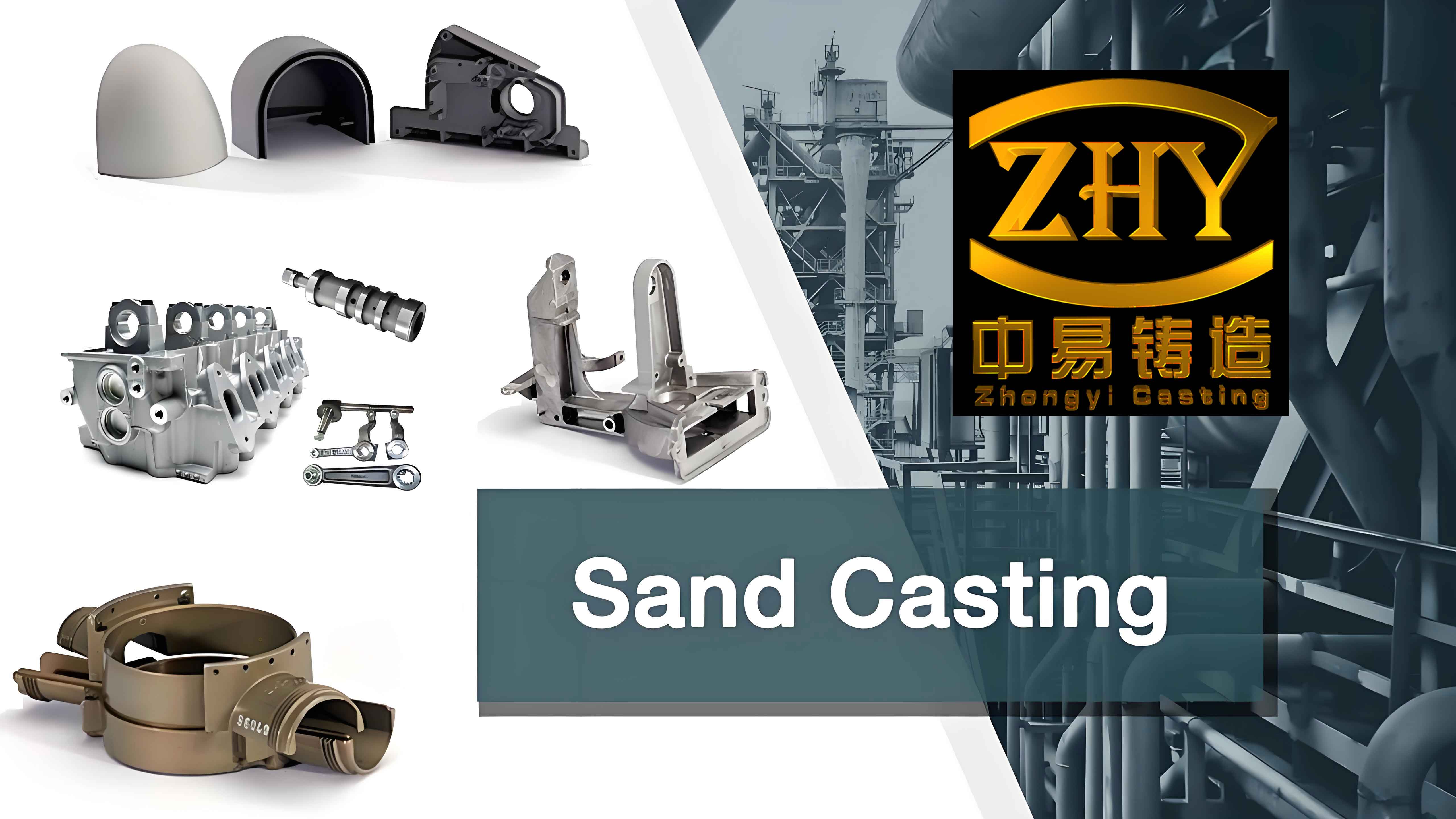
For these sand casting parts, furan resin-bonded sand was selected due to its high strength, dimensional accuracy, good collapsibility, and low energy consumption. The铸造工艺 adopted a bottom-gating system with the large plane oriented downward, ensuring平稳充型 and efficient排气. An open浇注系统 structure was designed to facilitate铝液 flow. The gating system parameters were calculated based on the铸件 mass of 13.2 kg. The直浇道 cross-sectional area was set between 4 and 5 cm², with a diameter of 25 mm to minimize涡流 and氧化夹杂. The ratio of the total cross-sectional areas was defined as ∑Fsprue : ∑Frunner : ∑Fingate = 1 : 4 : 4, leading to ∑Frunner = 19.6 cm² and ∑Fingate = 19.6 cm². This design is essential for achieving defect-free sand casting parts, as improper gating can lead to气孔 and缩松. To summarize the浇注系统 design, a table is provided below:
| Parameter | Value | Unit |
|---|---|---|
| 铸件 Mass | 13.2 | kg |
| Sprue Diameter | 25 | mm |
| Sprue Cross-Sectional Area | 4-5 | cm² |
| Runner Cross-Sectional Area (∑Frunner) | 19.6 | cm² |
| Ingate Cross-Sectional Area (∑Fingate) | 19.6 | cm² |
| Gating Ratio | 1:4:4 | – |
The design of the gating system can be further analyzed using fluid dynamics principles. The flow rate Q in the浇注系统 can be expressed as:
$$ Q = A \cdot v $$
where A is the cross-sectional area and v is the flow velocity. For laminar flow to avoid turbulence, the Reynolds number Re should be kept low:
$$ Re = \frac{\rho v D}{\mu} $$
where ρ is the density of molten aluminum (approximately 2,700 kg/m³ for Al-10Si-10Mg alloy), D is the characteristic diameter, and μ is the dynamic viscosity (around 0.0013 Pa·s for aluminum alloys at pouring temperature). In sand casting parts, maintaining Re < 2000 helps prevent氧化夹杂. For a sprue diameter of 25 mm, the velocity v can be calculated from the浇注时间 t and铸件 volume V. Assuming a浇注时间 of 10 seconds for a 13.2 kg铸件, the volume V is:
$$ V = \frac{m}{\rho} = \frac{13.2}{2700} \approx 0.00489 \, \text{m}^3 $$
Thus, the average flow rate Q is:
$$ Q = \frac{V}{t} = \frac{0.00489}{10} = 0.000489 \, \text{m}^3/\text{s} $$
With a sprue area Asprue = π(0.0125)² ≈ 0.00049 m², the velocity vsprue is:
$$ v_{\text{sprue}} = \frac{Q}{A_{\text{sprue}}} = \frac{0.000489}{0.00049} \approx 1 \, \text{m/s} $$
This velocity is within an acceptable range for sand casting parts to minimize erosion and turbulence.
To validate the工艺, numerical simulations were conducted using MAGMA software for both充型 and凝固 processes. The充型 simulation showed that the铝液 filled the mold sequentially without卷气 or紊流, as illustrated in the充型 states at 30%, 70%, and 90% completion. The凝固 simulation indicated that the铸件 solidified first, followed by the gating system, promoting directional凝固 and reducing缩松 risks. These simulations are critical for optimizing sand casting parts, as they predict potential defects before actual production. The temperature distribution during凝固 can be modeled using the heat transfer equation:
$$ \frac{\partial T}{\partial t} = \alpha \nabla^2 T $$
where T is temperature, t is time, and α is the thermal diffusivity of the sand mold and aluminum alloy. For aluminum alloys, α is approximately 5.0 × 10⁻⁵ m²/s, while for furan resin sand, it is around 0.5 × 10⁻⁶ m²/s. This difference influences the cooling rate of sand casting parts, affecting microstructure and mechanical properties. A table summarizing the simulation parameters is provided:
| Simulation Phase | Key Observation | Implication for Sand Casting Parts |
|---|---|---|
| 充型 at 30% | Smooth铝液 front advancement | Minimized air entrapment |
| 充型 at 70% | Uniform filling of complex cavities | Reduced cold shuts and misruns |
| 充型 at 90% | Complete filling without turbulence | Enhanced surface quality |
| 凝固 at 30% | 铸件 regions begin to solidify | Early solidification prevents shrinkage |
| 凝固 at 70% | Gating system remains液态 | Provides feeding for补缩 |
| 凝固 at 90% | Full solidification with no hot spots | Ensures dense sand casting parts |
The mold design for these sand casting parts involved assembling five sand cores made from aluminum patterns. The cores included side cores, motor-side cores, and oil-cavity side cores, which were precisely positioned to form the complex internal geometries. This组装 approach ensures dimensional accuracy and ease of mold-making for sand casting parts. The use of aluminum patterns enhances the durability and precision of the sand molds, which is vital for producing consistent sand casting parts in low-volume batches. The mold assembly process can be described through geometric tolerances, where the positioning error Δ between cores should be minimized to avoid mismatches in the final sand casting parts. If the cores have a tolerance of ±0.1 mm, the cumulative error for five cores can be estimated as:
$$ \Delta_{\text{total}} = \sqrt{\sum_{i=1}^{5} \Delta_i^2} $$
Assuming Δ_i = 0.1 mm for each core, then:
$$ \Delta_{\text{total}} = \sqrt{5 \times (0.1)^2} = \sqrt{0.05} \approx 0.224 \, \text{mm} $$
This is acceptable for sand casting parts with wall thickness of 4.5 mm, as it represents less than 5% of the壁厚.
After implementing the工艺, actual pouring was conducted, resulting in sand casting parts free from surface defects like浇不足. X-ray inspection revealed no significant气孔 or缩孔 in critical regions, meeting the technical requirements. This success demonstrates the effectiveness of sand casting for producing high-integrity sand casting parts for hybrid power applications. The mechanical properties of the sand casting parts were verified through testing, with results conforming to the specified standards. The relationship between microstructure and properties in sand casting parts can be expressed using the Hall-Petch equation for strength:
$$ \sigma_y = \sigma_0 + \frac{k}{\sqrt{d}} $$
where σ_y is the yield strength, σ_0 is the friction stress, k is the strengthening coefficient, and d is the grain size. For Al-10Si-10Mg alloy, typical values are σ_0 ≈ 50 MPa and k ≈ 0.1 MPa·m¹/². After T6 treatment, the grain size d is refined to about 50 μm, leading to:
$$ \sigma_y = 50 + \frac{0.1}{\sqrt{50 \times 10^{-6}}} \approx 50 + 141.4 = 191.4 \, \text{MPa} $$
This aligns with the required ≥180 MPa, showcasing how sand casting parts can achieve desired性能 through proper heat treatment.
In conclusion, sand casting proves to be a viable method for manufacturing aluminum alloy hybrid power e-drive transmission cases. The工艺 leverages furan resin-bonded sand, optimized gating systems, and numerical simulations to produce defect-free sand casting parts. The adaptability of sand casting allows for rapid prototyping and low-volume production, making it ideal for automotive研发 phases. By focusing on details like mold assembly,浇注 parameters, and post-casting treatments, sand casting parts can meet stringent quality standards. Future advancements in sand casting technology may further enhance the efficiency and precision of sand casting parts, supporting the automotive industry’s shift toward节能环保 vehicles. Throughout this process, the repeated emphasis on sand casting parts underscores their importance in modern manufacturing, where flexibility and cost-effectiveness are paramount. As energy challenges persist, sand casting will continue to play a crucial role in developing innovative sand casting parts for next-generation vehicles.
To further elaborate on the sand casting process, let’s consider the thermodynamic aspects during solidification. The latent heat release L during solidification of aluminum alloys affects the cooling curve, which can be modeled as:
$$ \rho c_p \frac{dT}{dt} = \nabla \cdot (k \nabla T) + \rho L \frac{df_s}{dt} $$
where c_p is the specific heat capacity, k is the thermal conductivity, and f_s is the solid fraction. For Al-10Si-10Mg alloy, L is approximately 390 kJ/kg, c_p ≈ 900 J/kg·K, and k ≈ 150 W/m·K. In sand casting parts, the mold’s low thermal conductivity (around 0.5 W/m·K for furan resin sand) causes slow cooling, which can be beneficial for reducing residual stresses. The solid fraction f_s as a function of temperature T can be approximated using the Scheil equation for non-equilibrium solidification:
$$ f_s = 1 – \left( \frac{T_m – T}{T_m – T_l} \right)^{\frac{1}{1-k_0}} $$
where T_m is the melting point of pure aluminum (933 K), T_l is the liquidus temperature (about 850 K for Al-10Si-10Mg), and k_0 is the partition coefficient (approximately 0.13 for silicon in aluminum). This equation helps predict microstructure formation in sand casting parts, influencing their mechanical properties.
Additionally, the feeding efficiency of the gating system can be quantified using the feeding distance concept. For sand casting parts with壁厚 of 4.5 mm, the feeding distance L_f can be estimated as:
$$ L_f = C \cdot \sqrt{t} $$
where C is a constant dependent on alloy and mold material (around 2.5 for aluminum in resin sand), and t is the壁厚 in mm. Thus:
$$ L_f = 2.5 \cdot \sqrt{4.5} \approx 2.5 \times 2.12 = 5.3 \, \text{mm} $$
This indicates that补缩冒口 should be placed within 5.3 mm of thick sections to prevent shrinkage in sand casting parts. In our design,冒口 were positioned near regions 1 and 2, ensuring adequate feeding.
The quality control for sand casting parts also involves statistical process control. For instance, the leak test results can be analyzed using a normal distribution. If the mean leakage rate μ is 10 mL/min with a standard deviation σ of 5 mL/min, the probability of meeting the ≤20 mL/min requirement can be calculated using the z-score:
$$ z = \frac{X – \mu}{\sigma} = \frac{20 – 10}{5} = 2 $$
From standard normal tables, P(Z ≤ 2) ≈ 0.9772, meaning 97.72% of sand casting parts would pass the test. This statistical approach ensures consistency in producing reliable sand casting parts.
In summary, the sand casting of aluminum alloy hybrid power e-drive transmission cases involves a comprehensive approach from design to validation. By integrating numerical simulations, precise mold-making, and rigorous testing, sand casting parts can achieve high performance and durability. The repeated focus on sand casting parts throughout this article highlights their significance in advancing automotive technologies. As the demand for节能环保 vehicles grows, sand casting will remain a key enabler for producing complex and high-quality sand casting parts efficiently.