
As an engineer specializing in metal forming technologies, I have extensively worked with sand casting, a historic yet vital process for producing complex structural components. Sand casting parts are widely used in mechanical manufacturing, automotive, aerospace, and heavy industries due to their cost-effectiveness and adaptability to intricate geometries. Despite these advantages, manufacturing high-quality sand casting parts for complex structures poses significant challenges, particularly in controlling defects and optimizing processes. In recent years, the rapid development of Computer-Aided Engineering (CAE) technologies, especially casting simulation software, has opened new avenues for enhancing the design and production of sand casting parts. In this article, I will delve into the detailed design and simulation analysis of sand casting parts, incorporating tables and formulas to summarize key aspects, with a focus on improving quality and efficiency.
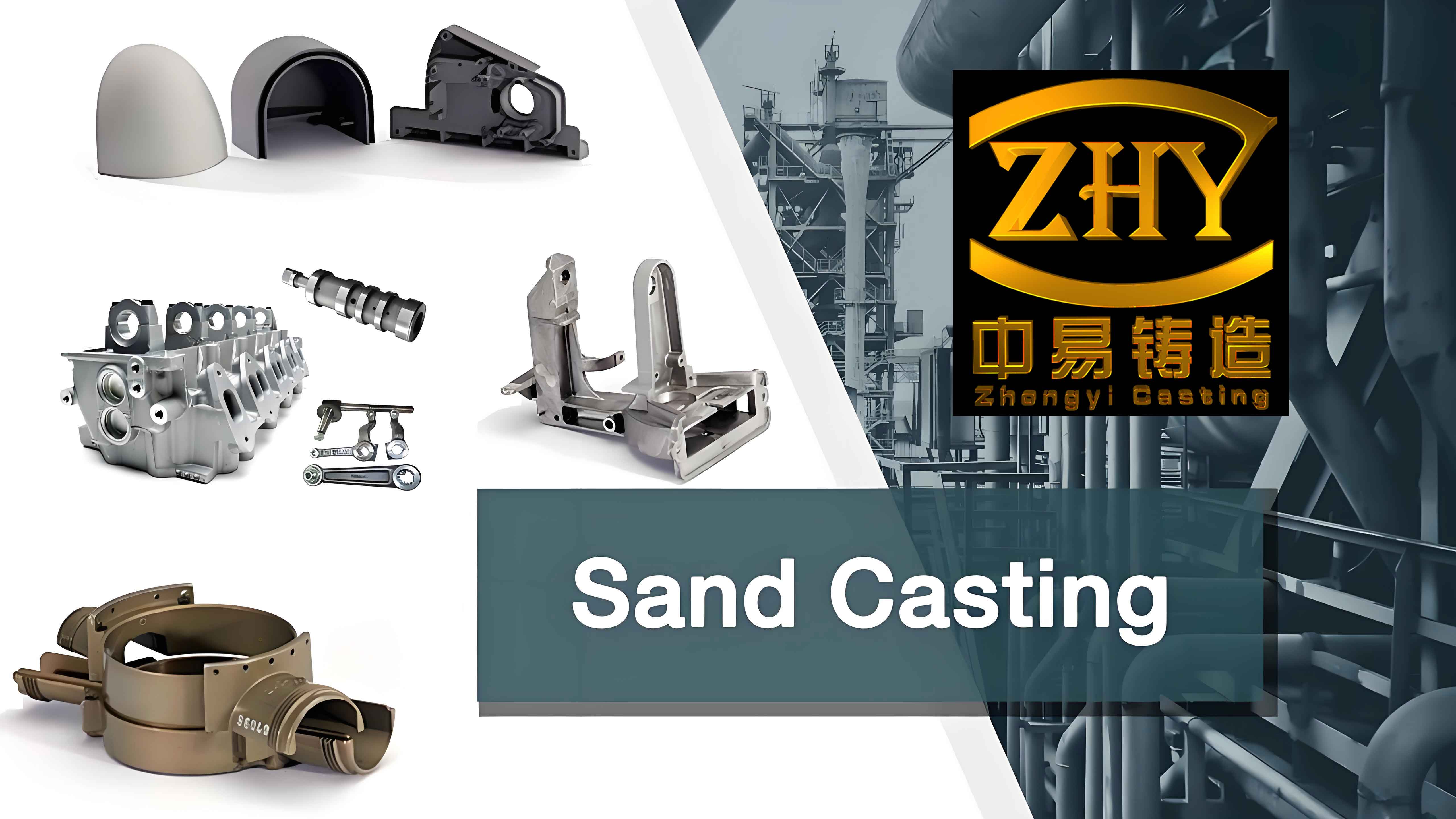
The production of sand casting parts begins with a thorough process design. For complex structural parts, this involves analyzing material properties, setting tolerances, and determining shrinkage rates. For instance, when using furan resin self-hardening sand, which reduces surface defects and enhances densification, the selection of dimensional and mass tolerances is critical. Typically, the dimensional tolerance level is set at CT11, accounting for free contraction during cooling, while the mass tolerance grade is MT10, ensuring consistency in weight with a range of ±4% of the part’s weight. The shrinkage rate for materials like HT250 is preset at 0.9%, reflecting volume reduction from liquid to solid states. This can be expressed with the shrinkage formula:
$$ \text{Shrinkage Rate} = \frac{V_{\text{liquid}} – V_{\text{solid}}}{V_{\text{liquid}}} \times 100\% $$
Where \( V_{\text{liquid}} \) is the volume at pouring temperature and \( V_{\text{solid}} \) is the volume after solidification. Proper setting of this parameter is essential to avoid cracks or deformations in sand casting parts. Below is a table summarizing common parameters for sand casting parts design:
| Parameter | Typical Value | Description |
|---|---|---|
| Dimensional Tolerance | CT11 | Accounts for free contraction during cooling of sand casting parts. |
| Mass Tolerance | MT10 (±4%) | Ensures weight consistency in sand casting parts. |
| Shrinkage Rate | 0.9% for HT250 | Prevents defects in sand casting parts due to volume reduction. |
| Sand Type | Furan Resin Self-Hardening | Improves surface quality and densification of sand casting parts. |
Selecting the pouring position and parting plane is another crucial step in designing sand casting parts. For complex geometries, I often orient the part with critical surfaces, such as dovetail guide surfaces, facing downward and large planes upward. This leverages gravity to promote metal flow, fill slender cavities, and minimize bubbles and slag inclusions. The fluid dynamics can be described using the Bernoulli equation for incompressible flow:
$$ P + \frac{1}{2} \rho v^2 + \rho gh = \text{constant} $$
Where \( P \) is pressure, \( \rho \) is density, \( v \) is velocity, \( g \) is gravity, and \( h \) is height. This principle aids in optimizing the filling process for sand casting parts. The parting plane should be simple to facilitate mold assembly and disassembly, reducing costs and improving accuracy for sand casting parts.
The gating system design is pivotal for ensuring defect-free sand casting parts. I typically employ a stepped inclined gating system, where inner gates are positioned to control metal entry speed and direction. This design enhances uniform filling and reduces thermal shocks. The gating ratio, which balances flow rates, can be calculated as:
$$ \text{Gating Ratio} = \frac{A_{\text{sprue}}}{A_{\text{runner}}} : \frac{A_{\text{runner}}}{A_{\text{gate}}} $$
Where \( A \) denotes cross-sectional areas. Risers are strategically placed to trap slag and gases while providing feed metal to compensate for shrinkage. For sand casting parts with thick sections, riser size can be determined using Chvorinov’s rule:
$$ t_s = B \left( \frac{V}{A} \right)^n $$
Here, \( t_s \) is solidification time, \( V \) is volume, \( A \) is surface area, \( B \) is a mold constant, and \( n \) is an exponent (typically 2). This helps optimize riser design for sand casting parts. Below is a table comparing different gating system configurations for sand casting parts:
| Gating System Type | Advantages | Disadvantages | Applicability to Sand Casting Parts |
|---|---|---|---|
| Stepped Inclined | Uniform filling, reduced turbulence | Complex design | High for complex sand casting parts |
| Top Gating | Simple, fast pouring | Risk of erosion and slag | Low for delicate sand casting parts |
| Bottom Gating | Minimizes oxidation | Slower filling | Medium for large sand casting parts |
Simulation analysis has revolutionized the optimization of sand casting parts. Using software like AnyCasting, I conduct preliminary simulations to visualize mold filling and solidification. The filling process is governed by the Navier-Stokes equations:
$$ \rho \left( \frac{\partial \mathbf{v}}{\partial t} + \mathbf{v} \cdot \nabla \mathbf{v} \right) = -\nabla P + \mu \nabla^2 \mathbf{v} + \rho \mathbf{g} $$
Where \( \mathbf{v} \) is velocity vector, \( \mu \) is dynamic viscosity, and \( \mathbf{g} \) is gravitational acceleration. This helps identify vortices, cold shuts, and gas entrapment in sand casting parts. Solidification simulations involve solving the heat conduction equation:
$$ \frac{\partial T}{\partial t} = \alpha \nabla^2 T $$
With \( T \) as temperature and \( \alpha \) as thermal diffusivity. These simulations predict shrinkage porosity and hot spots, enabling proactive adjustments for sand casting parts. For example, if a simulation reveals cold shuts in a region, I might modify gate positions or add chill to refine the process for sand casting parts.
Based on simulation results, I implement various optimization measures for sand casting parts. First, adjusting the gating system may involve recalibrating gate sizes or locations to improve flow dynamics. Second, adding risers enhances feeding for thick sections of sand casting parts, with riser volume calculated as:
$$ V_{\text{riser}} = \frac{V_{\text{casting}} \cdot \beta}{\eta} $$
Where \( \beta \) is shrinkage percentage and \( \eta \) is riser efficiency. Third, using chill accelerates cooling in specific zones, refining microstructure and reducing stresses in sand casting parts. The heat extraction rate by a chill can be modeled as:
$$ Q = h A (T_{\text{casting}} – T_{\text{chill}}) $$
With \( Q \) as heat flux, \( h \) as heat transfer coefficient, and \( A \) as contact area. Fourth, optimizing solidification sequence ensures that critical sections solidify first, improving integrity of sand casting parts. This can be achieved by controlling pouring temperature and speed, often summarized in process windows. The table below outlines key optimization strategies for sand casting parts:
| Optimization Measure | Purpose | Impact on Sand Casting Parts |
|---|---|---|
| Gating System Adjustment | Improve flow uniformity and reduce defects | Enhances surface quality and reduces scrap in sand casting parts |
| Riser Addition | Compensate for shrinkage and trap impurities | Minimizes porosity and improves mechanical properties of sand casting parts |
| Chill Application | Control cooling rates and refine grains | Increases strength and reduces cracking in sand casting parts |
| Solidification Sequence Control | Ensure directional solidification | Enhances dimensional accuracy and performance of sand casting parts |
To further quantify the benefits, I often use statistical models like Design of Experiments (DOE) for sand casting parts. For instance, response surface methodology can optimize multiple parameters, such as pouring temperature (\( T_p \)), mold temperature (\( T_m \)), and gating ratio (\( R \)), to minimize defects. A typical response function for defect rate (\( D \)) might be:
$$ D = k_0 + k_1 T_p + k_2 T_m + k_3 R + k_{12} T_p T_m + \epsilon $$
Where \( k_i \) are coefficients and \( \epsilon \) is error. This approach systematically enhances the production of sand casting parts.
In conclusion, the integration of advanced simulation tools with traditional sand casting processes significantly elevates the quality and efficiency of sand casting parts. Through detailed design and iterative optimization, I have observed substantial reductions in defects and costs for complex structural sand casting parts. Looking ahead, the incorporation of artificial intelligence and machine learning will further automate and refine simulations, enabling real-time adjustments and predictive analytics for sand casting parts. This progression promises to drive sustainability and innovation in the casting industry, ensuring that sand casting parts remain indispensable in modern manufacturing.
Throughout this discussion, I have emphasized the importance of a holistic approach—from initial design to simulation-based refinements—for producing high-performance sand casting parts. The tables and formulas provided serve as practical guides for engineers seeking to optimize their processes. As technology evolves, continuous learning and adaptation will be key to mastering the art and science of sand casting parts, ultimately contributing to more reliable and efficient industrial components.