
In modern manufacturing, the production of high-integrity sand casting parts, such as gearbox housings, presents significant challenges due to their complex geometries, varying wall thicknesses, and stringent quality requirements. As an engineer specializing in foundry processes, I have extensively studied the design and optimization of sand casting parts to mitigate defects like shrinkage porosity, cold shuts, and gas inclusions. This article details a comprehensive approach to the process design and simulation analysis for a medium-sized, thick-walled aluminum alloy gearbox lower housing—a quintessential example of sand casting parts. The methodology encompasses three-dimensional modeling, gating and riser system design, advanced simulation using AnyCasting software, and defect elimination strategies. Throughout this discussion, the term “sand casting parts” will be emphasized to underscore the relevance of these techniques to a broad range of cast components produced via sand molds.
The gearbox lower housing under consideration is fabricated from AlSi7Mg0.3 aluminum alloy, with overall dimensions of 751 mm × 400 mm × 291 mm and primary wall thicknesses ranging from 10 to 12 mm. Such sand casting parts are characterized by irregular external shapes, intricate internal cavities, ribs, bosses, and multiple holes, making them prone to solidification-related defects. To address this, we employed a sand casting process with resin sand cold-core box precision core assembly, which enhances dimensional accuracy and reduces waste. The design process began with creating a detailed three-dimensional model using UG software. This involved sketching the external profile, applying extrusion, rotation, and draft commands to form the outer shape, and using curve mesh functions to construct internal surfaces and cavities. The resultant model, as depicted below, served as the foundation for all subsequent process planning.
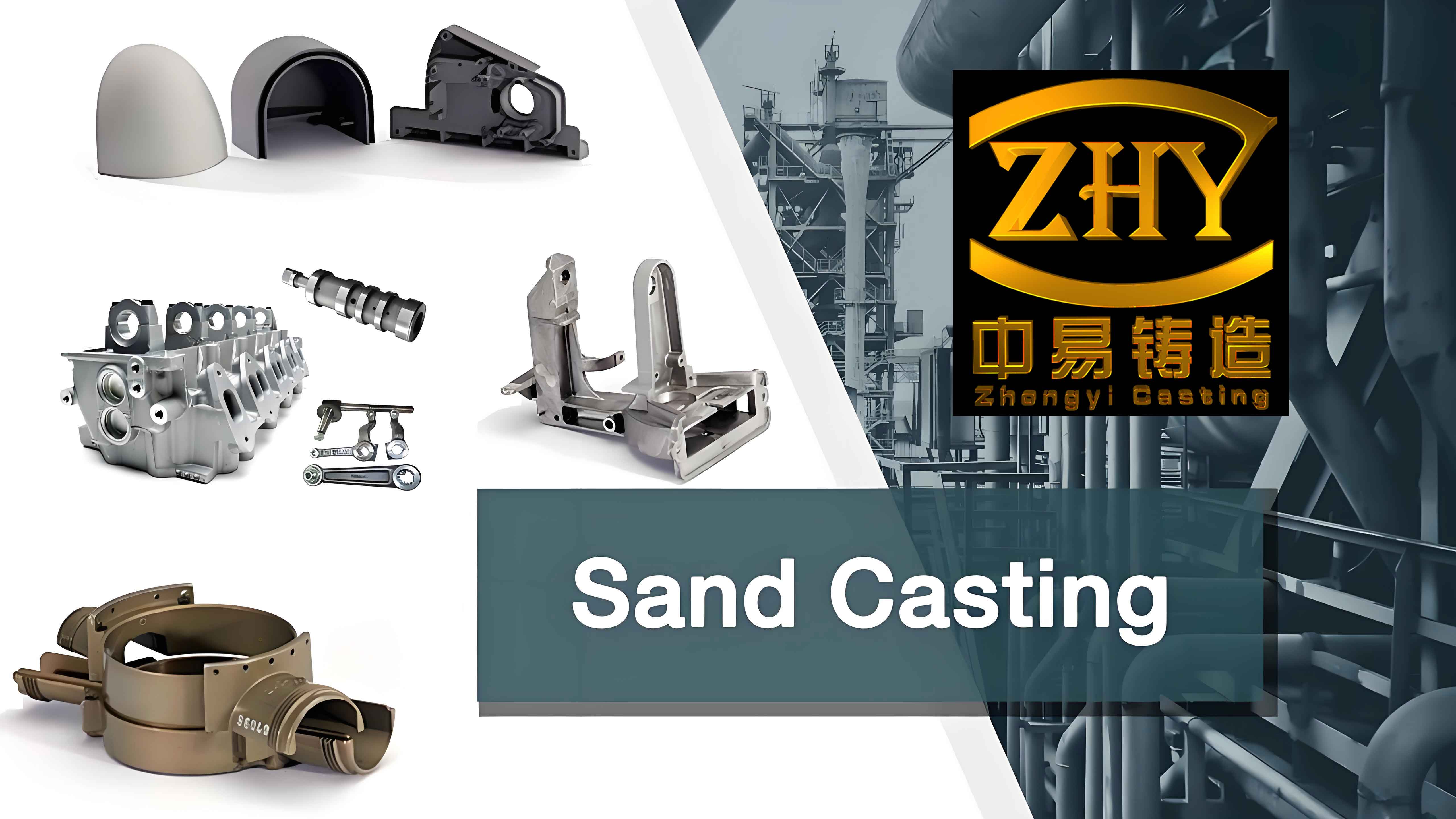
Sand casting parts often require meticulous process design to ensure quality. For this gearbox housing, we adopted a sand casting method suitable for batch production. The key steps include pattern making, sand preparation, molding, core making, mold assembly, melting, pouring, shakeout, cleaning, and inspection. Alkaline phenolic resin self-setting sand was used for manual molding, while alcohol-based coatings were applied to mold and core surfaces to form a refractory layer and seal surface pores. Any cracks or imperfections were repaired with patching compounds. Given the complexity of sand casting parts, we utilized a cold-core box precision core assembly technique, which eliminates the need for flasks and minimizes scrap sand. The mold was divided into cope and drag sections, with an internal core for the cavity and a side core for ribs on the left side. The assembly sequence was: drag → internal core → side core → cope. This approach is particularly beneficial for producing precise sand casting parts with intricate features.
The gating and riser system is critical for defect-free sand casting parts. Aluminum alloys like AlSi7Mg0.3 have high solidification shrinkage, oxidation tendency, and gas absorption, necessitating a well-designed system to ensure smooth filling and adequate feeding. We designed a gating system with a sprue, stepped runner, and two ingates positioned on machined surfaces for easy removal. To minimize turbulence and slag inclusion, a slag trap was placed near the ingates, and ceramic foam filters were installed at the sprue base and runner junctions. The minimum cross-sectional area of the gating system, typically at the sprue bottom, was calculated using the following formula, which is fundamental for sizing gating systems in sand casting parts:
$$ A_{smin} = \frac{G_L}{K t \sqrt{H_P}} $$
where \( A_{smin} \) is the minimum cross-sectional area (cm²), \( G_L \) is the pouring weight (kg), \( K \) is the flow factor (a constant dependent on alloy and mold conditions), \( t \) is the pouring time (s), and \( H_P \) is the average effective pressure head (cm). For this casting, with \( G_L \approx 15 \) kg (estimated from volume and density), \( K = 0.9 \) for aluminum alloys, \( t = 16 \) s (derived from empirical relations), and \( H_P = 15 \) cm, the calculation yields:
$$ A_{smin} = \frac{15}{0.9 \times 16 \times \sqrt{15}} \approx 4.1 \, \text{cm}^2 $$
Based on this, we selected a sprue diameter of 25 mm (cross-sectional area 4.9 cm²). The gating ratio was set at \( \sum F_{\text{sprue}} : \sum F_{\text{runner}} : \sum F_{\text{ingate}} = 1:2:2 \), resulting in a total runner area of 9.8 cm² and each ingate area of 4.9 cm². The dimensions were finalized as: ingate length = 223 mm, runner length = 382 mm, and sprue height = 270 mm. Pouring temperature was controlled between 700°C and 720°C to reduce hydrogen pickup and grain growth. The pouring time was estimated using an empirical formula for sand casting parts:
$$ \tau = B \delta^P m^n $$
where \( \tau \) is the pouring time (s), \( \delta \) is the wall thickness (mm), \( m \) is the casting mass (kg), and \( B \), \( P \), \( n \) are coefficients (typically \( B = 2.0 \), \( P = 0.5 \), \( n = 0.5 \) for aluminum). With \( \delta = 12 \) mm and \( m = 15 \) kg, we get:
$$ \tau = 2.0 \times 12^{0.5} \times 15^{0.5} \approx 2.0 \times 3.46 \times 3.87 \approx 26.8 \, \text{s} $$
This was adjusted to 16 s based on practical considerations, giving a mold filling velocity of 33 mm/s. Riser placement was designed to feed thermal centers, with chills added at hotspots to accelerate cooling. The table below summarizes key gating system parameters for this sand casting part.
| Parameter | Value | Unit |
|---|---|---|
| Sprue Diameter | 25 | mm |
| Sprue Cross-Sectional Area | 4.9 | cm² |
| Runner Cross-Sectional Area | 9.8 | cm² |
| Ingate Cross-Sectional Area (each) | 4.9 | cm² |
| Pouring Temperature | 700-720 | °C |
| Pouring Time | 16 | s |
| Mold Filling Velocity | 33 | mm/s |
To validate the design, we performed solidification simulation using AnyCasting software, a powerful tool for predicting defects in sand casting parts. The simulation modeled the filling and solidification processes, accounting for heat transfer, fluid flow, and phase change. The temperature distribution at different times (84 s, 1041 s, and 2613 s) revealed that the mold filled smoothly without mistruns, with risers filling last—confirming their effectiveness in trapping slag. The temperature scale ranged from 555°C to 700°C, and the initial temperature field was uniform. However, as solidification progressed, slower cooling in thicker sections, particularly within the internal cavities, indicated potential shrinkage defects. The total solidification time was approximately 48 minutes (2880 s). The probability defect map from the simulation, without chills, showed that while the riser locations and external surfaces were sound, internal regions exhibited shrinkage porosity and hot tears due to uneven cooling. This is a common issue in sand casting parts with complex cores.
The simulation results guided the placement of chills to eliminate these defects. Chills, typically made of iron or copper, are inserted into the mold to extract heat rapidly from hotspots, promoting directional solidification. For this sand casting part, chills were added at strategic locations within the internal cavity, as identified by the simulation. The modified design was re-simulated, and the probability defect map showed a significant reduction in internal shrinkage, confirming the efficacy of chills. The table below compares defect severity before and after chill addition, highlighting the improvement in quality for sand casting parts.
| Condition | Defect Location | Defect Type | Severity (Scale 1-10) |
|---|---|---|---|
| Without Chills | Internal Cavities | Shrinkage Porosity | 8 |
| Without Chills | Rib Junctions | Hot Tears | 6 |
| With Chills | Internal Cavities | Minor Porosity | 2 |
| With Chills | External Surfaces | None | 0 |
The integration of simulation into the design process for sand casting parts offers substantial benefits. By using AnyCasting, we could visualize temperature gradients, solidification sequences, and defect formation in real-time. The software solves the governing equations of heat transfer and fluid dynamics, such as the energy equation for solidification:
$$ \rho c_p \frac{\partial T}{\partial t} = \nabla \cdot (k \nabla T) + L \frac{\partial f_s}{\partial t} $$
where \( \rho \) is density, \( c_p \) is specific heat, \( T \) is temperature, \( t \) is time, \( k \) is thermal conductivity, \( L \) is latent heat of fusion, and \( f_s \) is solid fraction. This allows for accurate prediction of shrinkage defects in sand casting parts. Additionally, the simulation helped optimize riser size and placement. The riser design was validated by ensuring that it remained liquid longer than the casting, providing adequate feed metal. The riser volume \( V_r \) can be estimated using the modulus method, common for sand casting parts:
$$ V_r = \frac{V_c \times \beta}{1 – \beta} $$
where \( V_c \) is the casting volume and \( \beta \) is the volumetric shrinkage coefficient (approximately 0.06 for AlSi7Mg0.3). For \( V_c \approx 5000 \, \text{cm}^3 \), we get:
$$ V_r = \frac{5000 \times 0.06}{1 – 0.06} \approx \frac{300}{0.94} \approx 319 \, \text{cm}^3 $$
This guided the selection of cylindrical risers with sufficient volume. The use of simulation thus reduces trial-and-error, saving time and resources in producing sand casting parts.
Further analysis of the sand casting process for such parts involves evaluating the mechanical properties and microstructure. Aluminum alloys like AlSi7Mg0.3 are heat-treatable, and the cooling rate during solidification affects their tensile strength and hardness. The relationship between cooling rate \( \dot{T} \) and secondary dendrite arm spacing (SDAS) \( \lambda_2 \) is given by:
$$ \lambda_2 = a \dot{T}^{-n} $$
where \( a \) and \( n \) are material constants (typically \( a = 50 \, \mu\text{m} \cdot (\text{K/s})^n \), \( n = 0.33 \) for aluminum alloys). Faster cooling, as achieved with chills, reduces SDAS, leading to finer microstructure and improved mechanical properties in sand casting parts. This underscores the importance of controlled solidification for high-performance sand casting parts.
In practice, the production of sand casting parts requires attention to numerous factors. For this gearbox housing, we also considered machining allowances, draft angles, and core prints. Holes smaller than 20 mm were not cast but machined later to avoid core breakage. The draft angle was set at 2° to facilitate pattern removal. These details are summarized in the table below, which provides a holistic view of the process parameters for sand casting parts.
| Aspect | Specification | Remarks |
|---|---|---|
| Material | AlSi7Mg0.3 | Aluminum alloy with good castability |
| Casting Method | Sand Casting with Resin Sand | Cold-core box precision core assembly |
| Mold Type | Three-Part Mold (Drag, Cope, Cores) | Includes internal core and side core |
| Gating Ratio | 1:2:2 (Sprue:Runner:Ingate) | Ensures smooth filling |
| Riser Design | Cylindrical Riser with Chills | Feeds thermal centers, chills at hotspots |
| Pouring Parameters | Temperature 700-720°C, Time 16 s | Minimizes defects |
| Simulation Software | AnyCasting | For solidification and defect analysis |
| Machining Allowance | 3 mm on critical surfaces | For post-casting machining |
| Draft Angle | 2° | Eases pattern withdrawal |
The successful implementation of this process highlights the effectiveness of combining traditional foundry techniques with modern simulation tools for sand casting parts. By designing a robust gating system, employing precision core assembly, and leveraging simulation to optimize riser and chill placement, we achieved a defect-free gearbox lower housing. This approach is applicable to a wide variety of sand casting parts, from automotive components to industrial machinery. The key takeaway is that proactive design and simulation can significantly enhance the quality and reliability of sand casting parts, reducing scrap rates and improving productivity.
In conclusion, the sand casting process for complex aluminum alloy parts like the gearbox lower housing demands a systematic approach. Through three-dimensional modeling, careful gating and riser design, and advanced simulation analysis, we developed a complete and rational casting process. The use of AnyCasting software allowed us to predict and eliminate shrinkage defects by adding chills, ensuring the integrity of the sand casting part. This methodology not only validates the riser design but also provides a framework for optimizing other sand casting parts. As foundry technology evolves, the integration of simulation will continue to play a pivotal role in producing high-quality sand casting parts efficiently and cost-effectively. Future work could explore the use of additive manufacturing for mold and core making, further pushing the boundaries of what is possible with sand casting parts.