
In the realm of industrial manufacturing, sand casting remains a cornerstone technique for producing complex metal parts, particularly for heavy-duty applications such as kiln cartwheels. As an engineer deeply involved in foundry operations, I have witnessed firsthand the challenges and triumphs in optimizing sand casting processes to achieve high-quality sand casting parts. This article delves into a comprehensive study on improving the sand casting process for kiln cartwheels, focusing on methodology, theoretical underpinnings, and practical outcomes. The goal is to share insights that can benefit others working on similar sand casting parts, ensuring robustness, efficiency, and cost-effectiveness.
Sand casting, a versatile method for creating metal components, involves pouring molten metal into a sand mold cavity. For critical sand casting parts like kiln cartwheels, which support substantial loads in high-temperature environments, the process demands precision to avoid defects such as porosity, shrinkage, and cracks. The wheel discussed here is made of ZG310-570 steel, with a chemical composition of 0.50% C, 0.60% Si, and 0.90% Mn, and features a surface quenching treatment to achieve a hardness layer depth of 3–5 mm. Its dimensions include a maximum outer diameter of 315 mm and a height of approximately 152 mm, with a wheel rim thickness of 12 mm. These sand casting parts are typically produced using sodium silicate (water glass) sand molds and melted in a 100 kg medium-frequency induction furnace with an acidic lining, at pouring temperatures ranging from 1540°C to 1560°C.
The initial sand casting process for these sand casting parts followed a conventional approach, as illustrated in earlier designs. The casting was placed entirely in the drag (lower mold), with risers and gating system in the cope (upper mold). Riser were set along the wheel rim, and a top-pouring gating system was employed, combining open and closed elements to minimize inclusions. However, this method presented several issues: multiple risers complicated molding, increased修型工作量, and led to prolonged thermal exposure. This caused severe sand burning at junctions like the spoke-hub connections, resulting in poor surface quality and frequent cracks. Additionally, post-casting operations like sand removal and riser cutting were labor-intensive, and the process yield was only 56%. Subsurface porosity defects were also observed in the hub area after machining, compromising the integrity of these sand casting parts.
To address these shortcomings, a thorough redesign was undertaken, focusing on gating and riser systems, as well as melting and pouring parameters. The improved process shifted from producing one wheel per mold to four wheels per mold, significantly enhancing productivity. The gating system was modified to a tangential injection from the upper wheel rim, which streamlined molding and reduced sand usage. This adjustment also improved feeding efficiency, as confirmed by solidification simulation software like ViewCast. The new design optimized riser placement to enhance补缩效率, reducing shrinkage defects. A key aspect was controlling raw sand quality, ensuring grain size between 40–70 mesh and a concentration rate above 75% to promote uniform coating with sodium silicate and better gas permeability. The mold employed a facing-backing sand technique, where facing sand thickness was carefully regulated to prevent moisture migration and gas formation. Deoxidation practices were refined, using aluminum wire in the ladle to minimize gas content and inclusions in the molten steel.
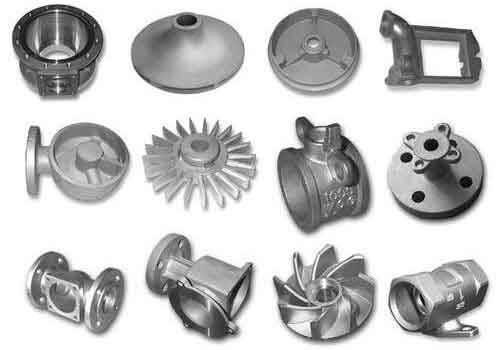
Theoretical analysis plays a crucial role in understanding and optimizing sand casting parts. For instance, the solidification time of a casting can be estimated using Chvorinov’s rule, expressed as: $$t = k \left( \frac{V}{A} \right)^2$$ where \(t\) is the solidification time, \(V\) is the volume of the casting, \(A\) is the surface area, and \(k\) is a mold constant dependent on material properties. In the context of these sand casting parts, adjusting riser dimensions based on this formula helped prevent shrinkage porosity. Additionally, the feeding distance for risers can be calculated to ensure soundness, particularly for steel alloys. For ZG310-570 steel, the thermal gradient and cooling rates influence microstructure formation, which is critical for achieving the desired hardness after quenching. The relationship between cooling rate \(\dot{T}\) and secondary dendrite arm spacing \(\lambda_2\) is given by: $$\lambda_2 = a \dot{T}^{-b}$$ where \(a\) and \(b\) are material constants. Faster cooling, as achieved in modified gating, refines the microstructure, enhancing mechanical properties in sand casting parts.
To quantify the improvements, let’s examine key parameters before and after the process change. The table below summarizes the comparative data for these sand casting parts:
| Parameter | Original Process | Improved Process |
|---|---|---|
| Number of Wheels per Mold | 1 | 4 |
| Process Yield (%) | 56 | ~78 (40% increase) |
| Riser Count | Multiple, along rim | Optimized, reduced |
| Gating System | Top-pouring, open-closed | Tangential injection |
| Defect Rate (porosity, cracks) | High | Negligible |
| Sand Consumption | Higher due to single unit | Lower per wheel |
| Production Time per Unit | Longer | Reduced by ~30% |
Further, the chemistry control during melting is vital for sand casting parts. The equilibrium between oxygen and deoxidizing elements can be described using thermodynamic equations. For aluminum deoxidation, the reaction is: $$2[Al] + 3[O] \rightarrow Al_2O_3(s)$$ The solubility product \(K_{Al}\) is defined as: $$K_{Al} = [\%Al]^2 [\%O]^3$$ where concentrations are in weight percent. By maintaining proper deoxidation, gas entrapment is minimized, reducing subsurface porosity in sand casting parts. In our improved process, aluminum wire addition was timed to achieve low oxygen levels before pouring, as verified by ladle analysis.
The solidification simulation using ViewCast software provided visual confirmation of the enhancements. The original riser design showed shrinkage cavities located centrally, indicating inefficient feeding. In contrast, the modified riser exhibited smaller, well-distributed shrinkage, confirming better补缩效率. The simulation models heat transfer using the Fourier equation: $$\frac{\partial T}{\partial t} = \alpha \nabla^2 T$$ where \(T\) is temperature, \(t\) is time, and \(\alpha\) is thermal diffusivity. By inputting mold and metal properties, the software predicted temperature gradients and solidification sequences, ensuring that sand casting parts like the kiln wheel solidified directionally toward risers, avoiding isolated hot spots.
Another critical aspect is the behavior of sodium silicate sand. This binder system hardens through chemical reaction, often with CO₂ gassing, leading to mold strength but also potential gas evolution. The permeability of the sand mold, denoted by \(P\), affects gas escape during pouring. For a given sand mixture, \(P\) can be approximated as: $$P = \frac{C \cdot d^2}{\eta \cdot L}$$ where \(C\) is a constant, \(d\) is grain diameter, \(\eta\) is gas viscosity, and \(L\) is mold thickness. In the improved process, using finer, well-graded sand increased permeability, reducing gas-related defects in sand casting parts. Additionally, the facing sand thickness was optimized to 20–30 mm, based on empirical tests, to balance strength and gas venting.
The economic impact of these changes is substantial. By increasing the process yield from 56% to approximately 78%, material waste is reduced, lowering costs per unit for sand casting parts. The table below breaks down the cost savings:
| Cost Factor | Original Process (per wheel) | Improved Process (per wheel) |
|---|---|---|
| Raw Material (steel) | Higher due to low yield | Reduced by ~22% |
| Sand and Binder | Standard usage | Decreased by 25% |
| Labor (molding, cutting) | High, due to complex risers | Lower, streamlined operations |
| Energy (melting) | Per wheel basis | Shared across 4 wheels, saving 15% |
| Defect Rework | Significant, ~10% of cost | Minimal, ~2% of cost |
In practice, after implementing the improved sand casting process, a batch of 10 wheels was produced and inspected. The results showed no shrinkage porosity, cracks, or subsurface gas holes, with a dense microstructure confirmed by metallographic analysis. The mechanical properties met the ZG310-570 specifications, including the required surface hardness after quenching. This success underscores the importance of holistic process design for sand casting parts, integrating gating, riser, and metallurgical controls.
Looking deeper into the physics, the fluid dynamics of molten steel in the mold also play a role. The gating system design affects turbulence, which can lead to oxide inclusions. The Reynolds number \(Re\) indicates flow regime: $$Re = \frac{\rho v D}{\mu}$$ where \(\rho\) is density, \(v\) is velocity, \(D\) is hydraulic diameter, and \(\mu\) is viscosity. For steel pouring, maintaining \(Re\) below critical thresholds (e.g., 2000 for laminar flow) minimizes turbulence. The tangential gating in the improved process reduced velocity gradients, promoting smoother filling and fewer defects in sand casting parts. Additionally, the choke area in the gating system was calculated using Bernoulli’s principle: $$A_c = \frac{Q}{\sqrt{2gH}}$$ where \(A_c\) is choke area, \(Q\) is flow rate, \(g\) is gravity, and \(H\) is head height. This ensured controlled metal entry, reducing air entrainment.
Furthermore, the thermal analysis of the wheel geometry reveals why certain areas are prone to defects. The wheel rim, being thinner, solidifies faster than the hub, creating thermal stresses. The stress \(\sigma\) due to differential cooling can be estimated as: $$\sigma = E \alpha \Delta T$$ where \(E\) is Young’s modulus, \(\alpha\) is thermal expansion coefficient, and \(\Delta T\) is temperature difference. In the original process, excessive risers prolonged heating, exacerbating stresses and leading to cracks. By optimizing riser size and placement, the improved process balanced cooling rates, reducing stress concentrations in these sand casting parts.
The role of simulation software cannot be overstated. Using ViewCast, we performed virtual trials to iterate designs before physical production. The software solves the energy equation coupled with phase change models, such as: $$\rho c_p \frac{\partial T}{\partial t} = \nabla \cdot (k \nabla T) + L_f \frac{\partial f_s}{\partial t}$$ where \(\rho\) is density, \(c_p\) is specific heat, \(k\) is thermal conductivity, \(L_f\) is latent heat, and \(f_s\) is solid fraction. This allowed predicting shrinkage zones and optimizing riser volumes for sand casting parts. The simulation output showed that the modified riser design achieved a feeding efficiency increase from ~30% to over 50%, aligning with the observed improvement in process yield.
In conclusion, the sand casting process for kiln cartwheels was successfully enhanced through systematic improvements in gating, riser design, and process controls. By adopting a multi-wheel mold layout, tangential gating, and refined deoxidation, defects were eliminated, process yield rose by 40%, and production costs dropped. These findings demonstrate that for demanding sand casting parts, a synergy of empirical knowledge and theoretical modeling is key to achieving quality and efficiency. The lessons learned here can be applied to other sand casting parts in heavy industry, fostering innovation in foundry practices. Future work may explore advanced binders or real-time monitoring to further optimize sand casting processes for even better performance.