
As a materials engineer deeply involved in the foundry industry, I have witnessed a significant evolution in iron-based alloys, particularly with the advent of solution-strengthened ductile iron. This material has revolutionized the production of large and heavy casting parts, offering unparalleled mechanical properties that enable lightweight design and enhanced performance. In this comprehensive discussion, I will delve into the science, standards, and applications of this innovative material, emphasizing its critical role in modern manufacturing. Throughout, the term “casting parts” will be frequently highlighted to underscore its relevance in sectors like energy, construction, and machinery.
Ductile iron, also known as nodular or spheroidal graphite iron, has long been favored for its combination of strength and ductility, derived from its unique graphite morphology. However, traditional grades often face limitations in heavy-duty casting parts due to inconsistent microstructures and mechanical properties across varying wall thicknesses. The introduction of solution-strengthened ductile iron addresses these challenges by leveraging solid solution strengthening, primarily through elevated silicon content. This advancement not only boosts tensile and yield strengths but also improves elongation, making it ideal for complex, large-scale casting parts such as those used in cement mills, wind turbines, and injection molding machines. The ability to produce reliable casting parts with wall thicknesses exceeding 300 mm has expanded the boundaries of casting technology, allowing designers to exploit the full potential of iron alloys in structural applications.
From a materials science perspective, the mechanical properties of ductile iron are governed by the matrix microstructure, typically a mixture of ferrite and pearlite. In traditional grades, elements like copper, molybdenum, or nickel are added to control the pearlite fraction, but this can lead to brittleness and non-uniform properties in thick casting parts. Solution-strengthened ductile iron, on the other hand, relies on silicon and manganese to stabilize and strengthen the ferritic matrix. The atomic radii of silicon (Si) and manganese (Mn) differ from that of iron (Fe), causing lattice distortions when they dissolve in the ferrite lattice. This solid solution strengthening effect can be modeled using the following formula for yield strength enhancement:
$$ \sigma_y = \sigma_0 + \Delta \sigma_{ss} $$
where \(\sigma_y\) is the overall yield strength, \(\sigma_0\) is the base strength of pure ferrite, and \(\Delta \sigma_{ss}\) represents the strengthening contribution from solute atoms. For silicon in ferrite, this contribution can be approximated by:
$$ \Delta \sigma_{ss} = k \cdot C_{Si}^{n} $$
Here, \(C_{Si}\) is the silicon concentration in weight percent, and \(k\) and \(n\) are material constants typically derived from experimental data. In practice, silicon content in solution-strengthened grades is elevated to 3.5–4.5%, compared to 2.0–2.5% in conventional ductile iron, leading to a significant increase in strength without compromising ductility. This mechanism ensures a more homogeneous microstructure across casting parts, even in sections with varying thicknesses, thereby enhancing the reliability of heavy-duty components.
The mechanical performance of solution-strengthened ductile iron is outstanding, as evidenced by extensive testing. Key properties include high tensile strength, improved yield strength, and a favorable yield-to-tensile ratio (Y/T ratio), which is crucial for lightweight design. The elongation values are superior to those of ferritic-pearlitic grades, allowing for greater deformation capacity in casting parts under load. To quantify these attributes, the table below summarizes typical property ranges for various grades, including both traditional and solution-strengthened types, based on standards like EN 1563:
| Material Grade | Tensile Strength (MPa) | Yield Strength (MPa) | Elongation (%) | Y/T Ratio | Typical Application in Casting Parts |
|---|---|---|---|---|---|
| EN-GJS-400-18 | 400 | 250 | 18 | 0.625 | General machinery casting parts |
| EN-GJS-500-7 | 500 | 320 | 7 | 0.64 | Automotive casting parts |
| EN-GJS-600-3 | 600 | 370 | 3 | 0.617 | Heavy-duty casting parts |
| EN-GJS-450-18 (Solution-Strengthened) | 450 | 300 | 18 | 0.667 | Large wind turbine casting parts |
| EN-GJS-500-14 (Solution-Strengthened) | 500 | 350 | 14 | 0.70 | Cement mill bearing housing casting parts |
| EN-GJS-600-10 (Solution-Strengthened) | 600 | 420 | 10 | 0.70 | High-pressure injection molding casting parts |
As shown, the solution-strengthened grades exhibit higher yield strengths and Y/T ratios, often exceeding 0.70, compared to around 0.62–0.64 for conventional grades. This improvement enables designers to reduce material usage in casting parts through lightweight optimization, without sacrificing safety or performance. Moreover, the elongation values remain high, ensuring good toughness for dynamic loading conditions. These properties make solution-strengthened ductile iron a preferred choice for critical casting parts in industries where reliability is paramount.
The solid solution strengthening mechanism is rooted in the crystalline structure of ferrite. Silicon atoms, with a covalent radius of approximately 111 pm, substitute for iron atoms (radius ~124 pm) in the body-centered cubic (BCC) lattice, creating localized strain fields that impede dislocation motion. This effect can be described using the Taylor equation for strengthening:
$$ \tau = \tau_0 + \alpha G b \sqrt{\rho} + \beta G \epsilon^{3/2} C^{1/2} $$
where \(\tau\) is the shear strength, \(\tau_0\) is the lattice friction stress, \(\alpha\) and \(\beta\) are constants, \(G\) is the shear modulus, \(b\) is the Burgers vector, \(\rho\) is the dislocation density, \(\epsilon\) is the misfit strain due to solute atoms, and \(C\) is the solute concentration. For silicon in iron, the misfit strain \(\epsilon\) is positive, leading to substantial strengthening. Additionally, manganese contributes to solid solution strengthening but also promotes pearlite formation if not controlled; thus, in solution-strengthened grades, manganese content is kept moderate to maintain a fully ferritic matrix. The interplay between silicon and manganese is critical for achieving consistent properties in casting parts, especially when wall thickness varies from thin sections to massive segments over 300 mm.
Recent updates to international standards, such as EN 1563, have formalized the classification of solution-strengthened ductile iron, introducing grades like EN-GJS-450-18, EN-GJS-500-14, and EN-GJS-600-10. These grades are characterized by high silicon content, typically in the range of 3.8–4.2%, and are designed for purely ferritic matrices. The table below compares the elemental composition limits for traditional and solution-strengthened grades, highlighting the key differences:
| Element | Traditional Ductile Iron (wt%) | Solution-Strengthened Ductile Iron (wt%) | Role in Casting Parts |
|---|---|---|---|
| Silicon (Si) | 2.0–2.5 | 3.5–4.5 | Ferrite stabilizer and solid solution strengthener |
| Manganese (Mn) | 0.1–0.4 | 0.1–0.3 | Moderate strengthening, controls pearlite |
| Copper (Cu) | 0–1.0 | 0–0.2 | Minimized to avoid pearlite formation |
| Magnesium (Mg) | 0.03–0.05 | 0.03–0.05 | Graphite nodulizing agent for casting parts |
| Carbon (C) | 3.5–3.9 | 3.5–3.8 | Provides graphite nodules in casting parts |
The increased silicon content expands the eutectoid transformation range, favoring ferrite formation even during rapid cooling in thin-walled casting parts. This results in a homogeneous microstructure throughout complex geometries, reducing hardness variations and improving machinability. For instance, in traditional grades, hardness differences across a casting part can be as high as 50 HB, whereas solution-strengthened grades often exhibit variations below 30 HB, enhancing the consistency of mechanical properties. This uniformity is vital for large casting parts, such as those used in heavy machinery, where performance must be predictable across all sections.
Microstructural analysis reveals stark differences between traditional ferritic-pearlitic ductile iron and solution-strengthened grades. In traditional casting parts, the matrix consists of a mixture of ferrite and pearlite, with pearlite fraction increasing in thicker sections due to slower cooling. This leads to a gradient in properties, with higher strength but lower ductility in core areas. In contrast, solution-strengthened casting parts display a fully ferritic matrix with finely dispersed graphite nodules, as silicon inhibits pearlite formation. The ferrite grains are strengthened by solute atoms, resulting in a fine, stable structure that resists deformation. This microstructural homogeneity can be quantified using the Hall-Petch relationship for grain boundary strengthening:
$$ \sigma_y = \sigma_0 + \frac{k_{HP}}{\sqrt{d}} $$
where \(d\) is the average grain diameter and \(k_{HP}\) is the Hall-Petch coefficient. In solution-strengthened ductile iron, grain refinement is often achieved through controlled cooling, further enhancing strength. The combination of solid solution and grain boundary strengthening yields a material with exceptional toughness, making it suitable for demanding casting parts like those in wind energy hubs or mining equipment.
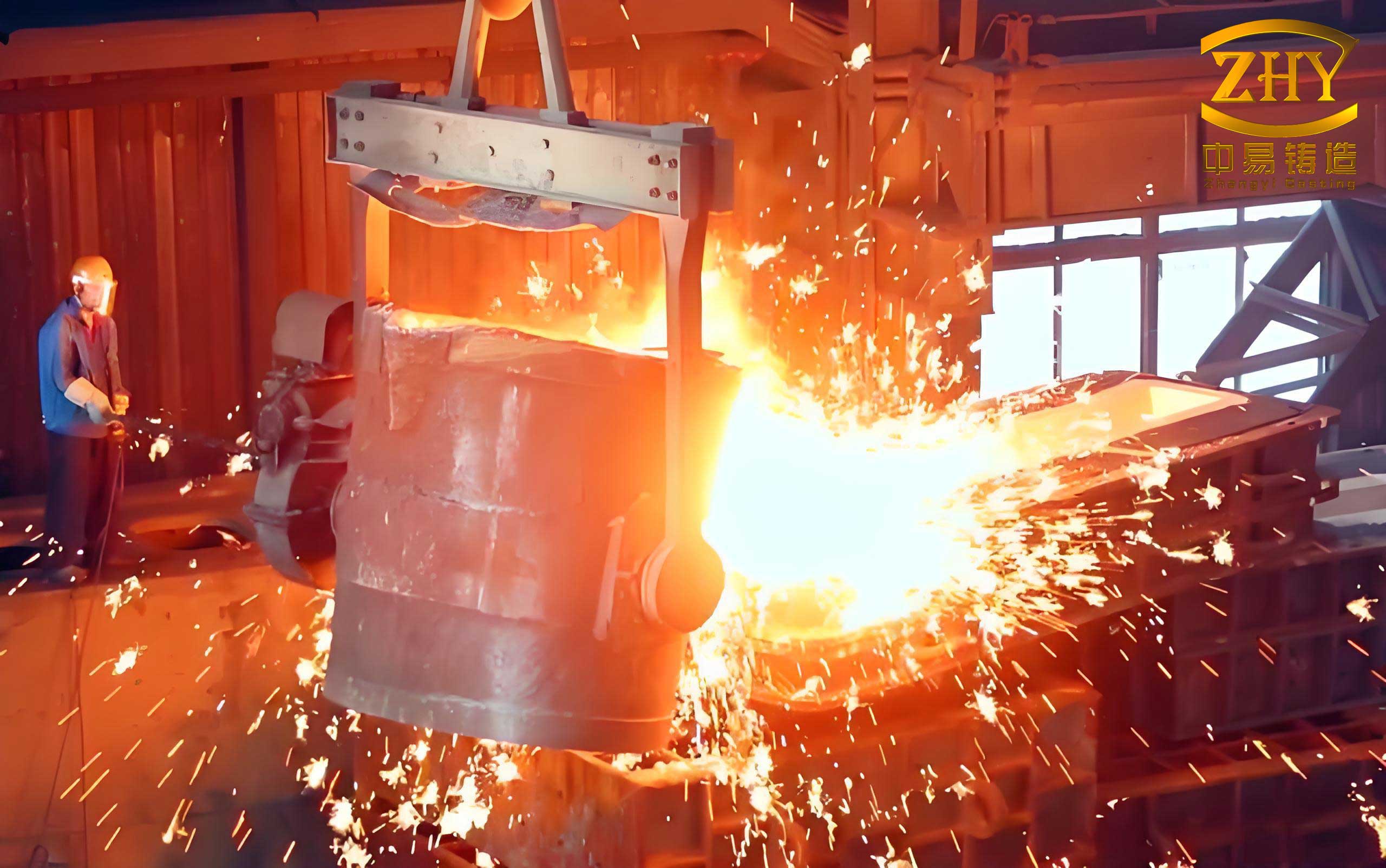
Manufacturing processes for solution-strengthened ductile iron casting parts require precise control over melting, alloying, and solidification. The foundry must maintain strict chemical composition limits, particularly for silicon, to avoid over-solutionizing, which can lead to embrittlement. Based on my experience, the optimal silicon content for most casting parts lies between 3.8% and 4.2%, as values above 4.5% may cause a sharp drop in toughness and strength due to excessive lattice strain. Melting practices often involve electric arc or induction furnaces, followed by magnesium treatment for nodularization and inoculation to ensure fine graphite formation. Cooling curves are meticulously monitored to achieve the desired ferritic matrix, especially in thick-section casting parts where slow cooling could otherwise promote pearlite. Advanced simulation tools are employed to predict microstructure evolution, ensuring that every casting part meets specifications.
Applications of solution-strengthened ductile iron are vast, spanning industries that rely on large, heavy-duty casting parts. In the cement and mining sector, components like mill bearing housings, which can weigh over 50 tons, benefit from the material’s high strength and wear resistance. For wind energy, hubs and frames require casting parts with excellent fatigue properties and lightweight potential. In plastic injection molding, machine beds and platens made from this material offer stability and durability. The versatility of solution-strengthened ductile iron extends to pressure vessels, drive technology components, and even architectural elements, demonstrating its adaptability across diverse casting parts. To illustrate, consider a cement mill bearing housing—a critical casting part that withstands immense loads and abrasive environments. The use of solution-strengthened grade EN-GJS-500-14 ensures a yield strength of 350 MPa and elongation of 14%, providing both robustness and damage tolerance.
Quality assurance for these casting parts involves rigorous testing, including tensile tests on samples from different wall thicknesses, Charpy impact tests, and microstructural examination. Data from preliminary trials show that solution-strengthened ductile iron consistently exceeds minimum standards, with tensile strengths often 10–15% above specified values and elongation improvements of 20–30%. This reliability is crucial for safety-critical casting parts, such as those in power generation or transportation. Moreover, the material’s enhanced machinability, due to its homogeneous ferritic matrix, reduces manufacturing costs and lead times for complex casting parts. Tools like finite element analysis (FEA) are used to optimize designs, leveraging the high Y/T ratio for weight reduction without compromising integrity.
The economic and environmental benefits of solution-strengthened ductile iron casting parts cannot be overstated. By enabling lightweight designs, the material reduces raw material consumption and energy usage during production and operation. For example, in automotive or aerospace applications, lighter casting parts contribute to lower fuel consumption and emissions. Additionally, the durability and longevity of these casting parts minimize replacement frequency, supporting circular economy principles. From a lifecycle perspective, the environmental impact of solution-strengthened ductile iron casting parts is often lower than that of alternatives like steel or aluminum, especially when considering recycling potential. Iron alloys are highly recyclable, and foundries can incorporate scrap metal into the melting process, further enhancing sustainability.
Future developments in solution-strengthened ductile iron focus on pushing the limits of wall thickness and property tailoring. Research is ongoing into hybrid strengthening mechanisms, combining solid solution with precipitation hardening or nano-scale modifications. For instance, additions of micro-alloying elements like vanadium or niobium could form carbides that enhance wear resistance in casting parts subjected to abrasive conditions. Computational materials science plays a key role in these advances, using models to predict the effects of new alloying strategies on performance. As digitalization transforms manufacturing, the integration of IoT sensors in casting processes will allow real-time monitoring and adjustment, ensuring consistent quality for every casting part. This evolution will open new markets, such as offshore wind turbines or next-generation industrial machinery, where reliability and efficiency are paramount.
In conclusion, solution-strengthened ductile iron represents a paradigm shift in the production of large and heavy casting parts. Its superior mechanical properties, driven by solid solution strengthening with high silicon content, offer designers unprecedented opportunities for lightweight and high-performance components. The material’s homogeneity across varying wall thicknesses ensures reliability in demanding applications, from cement mills to wind turbines. With standardized grades and advanced manufacturing techniques, it is poised to dominate the landscape of industrial casting parts. As we continue to innovate, the focus will remain on enhancing sustainability and adaptability, solidifying iron’s role as a cornerstone of modern engineering. Through collaborative efforts in research and industry, solution-strengthened ductile iron will undoubtedly shape the future of casting parts, enabling safer, greener, and more efficient technologies worldwide.