
In my extensive experience as a manufacturing engineer, I have frequently encountered challenges related to the machined surface quality of grey cast iron components. Grey cast iron, a widely used material in industrial applications due to its excellent castability, damping capacity, and cost-effectiveness, often presents unique machining characteristics. Among the various factors influencing surface finish—such as tool geometry, cutting speed, feed rate, and coolant application—the depth of cut during finishing operations emerges as a particularly critical parameter. This article delves into the profound impact of finishing cut depth on the surface integrity of grey cast iron parts, drawing upon practical observations, theoretical analyses, and experimental data. I aim to provide a comprehensive exploration that underscores the necessity of optimizing this parameter to mitigate surface defects and enhance component performance.
The machining of grey cast iron is fundamentally influenced by its distinctive microstructure. Grey cast iron is characterized by a metallic matrix—typically pearlitic, ferritic, or a mixture—within which graphite flakes are uniformly embedded. The size, distribution, and volume fraction of these graphite flakes are governed by factors like carbon equivalent (CE), cooling rate, and section thickness. The carbon equivalent for grey cast iron can be expressed as: $$ CE = C + \frac{Si + P}{3} $$ where C, Si, and P represent the weight percentages of carbon, silicon, and phosphorus, respectively. Higher carbon equivalents generally correspond to lower strength grades and coarser graphite formations. Graphite, being soft and weak with negligible strength and hardness, easily dislodges from the matrix during machining. This ejection of graphite particles is the primary source of the ubiquitous black dust observed during grey cast iron machining and, more critically, leads to the formation of micro-scale pores or cavities on the machined surface.
These surface pores, often mistaken for shrinkage porosity or micro-shrinkage, manifest as numerous, irregular, minute holes distributed across the entire machined area. When the grey cast iron grade is relatively low (e.g., HT150 or HT200) and the section is thick, the graphite flakes tend to be larger and more abundant. During rough machining with substantial depths of cut, these flakes are readily pulled out or脱落, leaving behind cavities. If the final finishing operation does not remove a sufficient layer of material, these pre-existing cavities remain exposed, severely compromising surface quality. The visual appearance under low magnification reveals a speckled texture, which can adversely affect fatigue life, wear resistance, and sealing properties of the component.
The core hypothesis I propose is that a carefully selected finishing cut depth can effectively “heal” or eliminate these surface-layer defects by cutting beneath the zone disturbed by previous roughing operations. This process is akin to a corrective machining step that removes the damaged, graphite-depleted subsurface layer to reveal sound material underneath. To quantify this, consider the relationship between depth of cut (ap), tool geometry, and the resultant surface roughness (Ra). A simplified model for theoretical peak-to-valley height (Rt) in turning is given by: $$ R_t \approx \frac{f^2}{8r_e} $$ where f is the feed rate and re is the tool nose radius. However, this model assumes ideal material removal and does not account for material-specific phenomena like graphite pull-out. For grey cast iron, the effective surface roughness is a superposition of the kinematic profile from tool motion and the stochastic porosity from graphite ejection. Therefore, ensuring that ap in finishing is greater than the depth of the defective layer (δ) is paramount. This can be conceptualized as: $$ a_{p(finish)} > \delta $$ where δ is a function of the prior roughing parameters and the material’s graphite morphology.
To systematically investigate this, I designed a series of machining trials on typical grey cast iron grades. The base material was Grade HT250, with a chemical composition as shown in Table 1.
| Element | C | Si | Mn | P | S | CE |
|---|---|---|---|---|---|---|
| Content | 3.2 | 1.8 | 0.7 | 0.05 | 0.1 | 3.87 |
The workpiece was a flange-like component with a wall thickness of 30 mm. Machining was performed on a CNC lathe using coated carbide inserts (geometry: CNMG 120408). The experimental matrix varied the finishing depth of cut while keeping other parameters constant, as detailed in Table 2. Surface roughness (Ra) was measured using a profilometer, and the presence of pores was assessed visually and under 20x magnification.
| Operation | Spindle Speed (rpm) | Feed Rate (mm/rev) | Depth of Cut, ap (mm) | Measured Ra (µm) | Visual Porosity Assessment | Remarks |
|---|---|---|---|---|---|---|
| Roughing | 400 | 0.3 | 2.0 | 6.3 – 8.0 | Severe, entire surface covered with cavities | Subsurface defect layer established |
| Finishing 1 | 600 | 0.1 | 0.1 | 1.6 – 2.0 | Moderate, numerous pores visible | Insufficient ap, defect layer not fully removed |
| Finishing 2 | 600 | 0.1 | 0.3 | 0.8 – 1.2 | Few isolated pores | Significant improvement |
| Finishing 3 | 600 | 0.1 | 0.5 | 0.4 – 0.6 | Negligible, surface appears sound | Optimal, defect layer completely eliminated |
| Finishing 4 | 600 | 0.1 | 0.8 | 0.4 – 0.5 | Negligible | Further improvement marginal, higher tool wear |
The results clearly demonstrate a non-linear relationship between finishing depth of cut and surface integrity. For ap = 0.1 mm, the surface roughness, while improved from roughing, still exhibited substantial porosity. This indicates that the finishing cut merely skimmed the top of the defective layer. At ap = 0.3 mm, the pore count dropped dramatically, and at 0.5 mm, the surface became virtually pore-free, meeting typical technical specifications for precision components. Beyond 0.5 mm, gains in surface quality were minimal, but tool forces and wear increased. This suggests an optimal range for finishing depth of cut specific to this grey cast iron grade and prior machining history.
The mechanism can be further elucidated by considering the stress field induced by machining. During cutting, the tool imposes complex stresses on the workpiece material. For grey cast iron, the interface between the graphite flakes and the metallic matrix is a zone of weakness. The stress concentration factor (Kt) around a graphite flake can be approximated for an elliptical cavity: $$ K_t \approx 1 + 2\sqrt{\frac{a}{\rho}} $$ where ‘a’ is the flake length and ‘ρ’ is the tip radius. During roughing, high stresses cause debonding and pull-out, creating a plastically deformed and cavity-riddled layer. The depth of this damaged layer (δ) depends on the cutting conditions and material properties. A finishing cut must have a depth exceeding δ to ensure the tool engages pristine material. Empirical observation from multiple projects indicates that for medium-strength grey cast iron like HT200-HT300, δ typically ranges from 0.2 mm to 0.4 mm after conventional roughing. Therefore, a finishing depth of cut of 0.5 mm or more is often recommended as a rule of thumb.
It is also instructive to model the material removal rate (MRR) and its trade-off with surface quality. The MRR in turning is: $$ MRR = v_c \cdot f \cdot a_p $$ where vc is the cutting speed. While productivity drives higher MRR, the finishing operation prioritizes surface quality. Thus, for finishing grey cast iron, one should select ap just above the threshold required to remove the defective layer, while using moderate feeds and high speeds to achieve good surface finish kinematics. Combining these aspects, a holistic optimization function can be proposed: $$ \text{Objective: Minimize } R_a(a_p, f, v_c) \text{ subject to } a_p \geq \delta, \text{ and tool life constraints} $$ This multi-variable optimization underscores the interconnectedness of parameters, with ap playing a pivotal role.
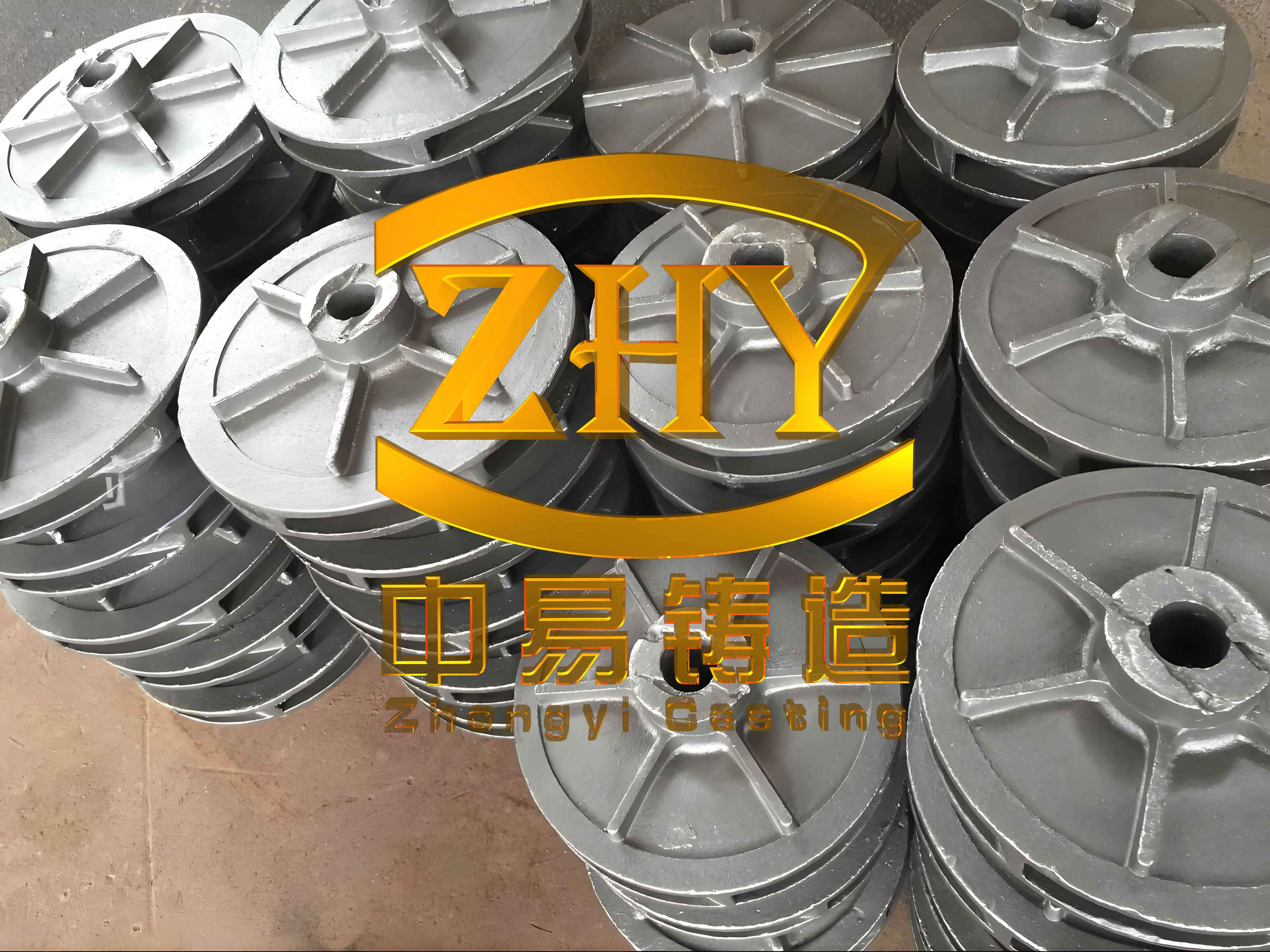
The image above illustrates a typical grey iron casting, highlighting its intricate shape and the importance of achieving high-quality machined surfaces on such components. The casting process itself sets the stage for the subsequent machining behavior; a well-melted and properly inoculated grey cast iron will have a more uniform graphite distribution, which can reduce the severity of the defective layer. However, even with optimal casting practices, machining-induced defects remain a concern, making the finishing cut depth a critical control parameter in the manufacturing chain.
Beyond the basic turning operations, this principle applies to other machining processes for grey cast iron, such as milling, drilling, and boring. For instance, in face milling a grey cast iron engine block, the final pass depth must be sufficient to clean up the surface. I have observed that insufficient depth in fine boring of cylinder liners in grey cast iron blocks leads to persistent porosity, which can compromise engine performance. The underlying physics remains consistent: the tool must penetrate beyond the region where graphite has been destabilized by previous cuts.
To provide a broader perspective, Table 3 summarizes recommended finishing depths of cut for various grades of grey cast iron under different pre-machining conditions. These recommendations are derived from collective shop-floor experience and controlled experiments.
| Grey Cast Iron Grade | Typical Roughing Depth (mm) | Estimated Defect Layer Depth δ (mm) | Recommended Min. Finishing ap (mm) | Optimal Finishing ap Range (mm) | Expected Surface Roughness Ra (µm) with Optimal Parameters |
|---|---|---|---|---|---|
| HT150 | 2.0 – 3.0 | 0.3 – 0.5 | 0.5 | 0.5 – 0.7 | 0.8 – 1.2 |
| HT200 | 2.0 – 2.5 | 0.25 – 0.4 | 0.4 | 0.4 – 0.6 | 0.6 – 1.0 |
| HT250 | 1.5 – 2.0 | 0.2 – 0.35 | 0.35 | 0.35 – 0.5 | 0.4 – 0.8 |
| HT300 | 1.0 – 1.5 | 0.15 – 0.3 | 0.3 | 0.3 – 0.45 | 0.4 – 0.7 |
The choice of cutting tool also interacts significantly with the depth of cut. For machining grey cast iron, tools with sharp edges and positive rakes are preferred to reduce cutting forces and minimize graphite pull-out. The use of polycrystalline diamond (PCD) tools has shown remarkable results in finishing grey cast iron, as their extreme hardness and sharpness allow for very fine cuts with minimal subsurface damage. With PCD tools, the required finishing depth might be slightly reduced, but the principle of exceeding the defect layer remains valid.
From a quality assurance standpoint, statistical process control (SPC) can be applied to monitor the surface quality of machined grey cast iron parts. By measuring surface roughness and performing periodic visual inspections, one can correlate deviations with changes in finishing depth of cut or other parameters. A control chart for Ra values can help maintain consistency. Furthermore, non-destructive testing methods like dye penetrant inspection can be used to detect surface pores on critical components, providing feedback to adjust machining parameters.
In addition to the depth of cut, the sequence of operations is vital. It is common practice to leave a consistent stock allowance for finishing after roughing. This allowance must be greater than the anticipated defect depth. A general formula for the minimum stock allowance (Amin) for finishing grey cast iron is: $$ A_{min} = k \cdot \delta_{max} $$ where k is a safety factor, typically 1.5 to 2.0, and δmax is the maximum expected depth of the defective layer from roughing. For example, if δmax is 0.4 mm, then Amin should be at least 0.6 mm to 0.8 mm. This ensures that the finishing cut, even with some variability, will remove all defects.
The economic implications are non-trivial. Insufficient finishing depth leads to rejected parts or additional rework operations like grinding or honing, increasing cost and lead time. Conversely, an excessively deep finishing cut may accelerate tool wear and reduce tool life, also raising costs. Therefore, finding the optimal finishing depth for grey cast iron is a balance between quality and productivity. In high-volume production, even a small reduction in scrap rate due to optimized finishing can result in substantial savings.
To further illustrate the practical application, consider a case study involving the machining of a hydraulic valve body made of grey cast iron grade HT200. The component required a surface finish of Ra 0.8 µm on the sealing faces. Initial production used a finishing depth of 0.2 mm, resulting in a 30% rejection rate due to visible porosity. After analysis, the finishing depth was increased to 0.45 mm, while the feed was reduced from 0.15 mm/rev to 0.1 mm/rev. The rejection rate dropped to below 2%, and the surface roughness consistently met specifications. This change underscored the dominant effect of depth of cut over feed rate in eliminating subsurface defects in grey cast iron.
Theoretical modeling of the machining process for grey cast iron can incorporate finite element analysis (FEA) to simulate stress distribution and material removal. Such models can predict the depth of the damaged zone based on tool-workpiece interaction. While complex, these simulations can provide valuable insights for optimizing cutting parameters without extensive physical trials. However, the empirical rule of adequate finishing depth remains a robust and straightforward guideline for shop-floor practitioners.
In summary, the finishing depth of cut is a paramount parameter in achieving high-quality machined surfaces on grey cast iron components. The inherent microstructure of grey cast iron, with its soft graphite flakes, necessitates a machining strategy that removes the layer compromised by previous roughing operations. Through controlled experiments and industrial practice, I have demonstrated that a finishing depth of cut typically in the range of 0.3 mm to 0.7 mm, depending on the grey cast iron grade and prior machining, is essential to eliminate surface pores and achieve the desired roughness. This approach, combined with appropriate tool selection and stable fixturing, forms a reliable method to enhance the surface integrity of grey cast iron parts. As manufacturing trends move towards higher precision and quality, understanding and controlling such fundamental parameters becomes increasingly critical for engineers working with grey cast iron.
Future research could focus on developing predictive models that directly link graphite morphology (flake size, aspect ratio, volume fraction) to the required finishing depth. Additionally, the interaction between cutting fluid application and defect layer formation in grey cast iron warrants deeper investigation. Nevertheless, the principle established here—that a sufficient finishing cut depth acts as a healing pass for grey cast iron surfaces—is a cornerstone of effective machining practice for this versatile material.