
For decades, the foundation of precision in manufacturing has been quite literally cast in iron. The familiar rumble of molten metal and the substantial weight of a finished machine tool casting have been constants on the factory floor. However, during major international exhibitions, a quiet revolution has been gaining momentum. A new generation of machining centers, including advanced 5-axis models, is showcasing a fundamental shift in base material technology. These machines utilize a high-strength, polymer-based composite often called mineral casting, artificial granite, or polymer concrete, presenting a compelling alternative to traditional cast iron for machine tool casting applications. This shift is driven by an industry-wide pursuit of higher precision, greater stability, and more sustainable manufacturing practices.
This innovative material is not merely a substitute; it represents a paradigm shift in how we conceive the structural heart of a machine tool. Engineered from a composite of carefully graded mineral aggregates bonded with a modified epoxy resin matrix, it offers a unique combination of properties that directly address limitations inherent to metallic machine tool casting. Its characteristics—exceptionally high damping capacity, superior thermal stability, excellent corrosion resistance, and great design flexibility—are unlocking new performance thresholds. Consequently, its application is expanding beyond precision machine tools into demanding fields such as semiconductor manufacturing, medical equipment, precision metrology, and aerospace, where enhancing equipment accuracy, speed, and long-term stability is paramount.
The core technology for this advanced machine tool casting originated in Europe and has undergone significant refinement. Today, the knowledge and proprietary expertise for formulating and processing high-quality polymer concrete are well-established within specialized supply chains. Numerous technology providers have mastered the intricacies of resin systems, aggregate grading, and casting processes, holding relevant intellectual property. This has enabled the creation of a robust ecosystem capable of supplying consistent, high-performance mineral castings. The adoption of this technology is growing steadily, favored not only for its technical merits but also for its economic and environmental benefits compared to the energy-intensive process of traditional iron machine tool casting.
The Science Behind the Cast: Composition and Curing
Understanding the superiority of polymer concrete begins with its fundamental composition and formation. Unlike metallic machine tool casting which relies on metallurgical bonding under extreme heat, mineral casting is a composite material formed through cold-curing polymer chemistry.
1. The Formulation Principle: A typical mineral casting compound is a three-phase material system. The primary components include:
- Aggregates: These form the bulk (typically 80-90% by weight) and provide compressive strength. They are precisely graded mixtures of hard, dense minerals like granite, basalt, quartz sand, or other silica-based materials. The particle size distribution (grading curve) is critical for achieving maximum packing density and strength.
- Matrix (Binder): This is a thermosetting polymer system, usually based on modified epoxy resins or, less commonly, polyester or acrylic resins. The resin coats the aggregates and, upon curing, forms a continuous, rigid three-dimensional network that binds everything together.
- Additives: These include curing agents (hardeners), catalysts, plasticizers, wetting agents, and pigments. They control the workability (viscosity), curing speed and profile, final color, and specific secondary properties of the cast.
The chemical reaction governing the transformation from a viscous mixture to a solid mass is the cross-linking (curing) of the epoxy resin with the hardener. This polyaddition reaction occurs at room temperature (RT) or slightly elevated temperatures and can be simplified as:
$$ \text{Epoxy Resin (with epoxide groups)} + \text{Hardener (e.g., amine)} \rightarrow \text{Cross-linked, Rigid Polymer Network} + \Delta H_{small} $$
A key advantage is the very low exothermic heat release ($\Delta H_{small}$) during this RT curing compared to the massive heat of fusion and subsequent cooling in metal casting. This virtually eliminates the internal thermal stresses and related distortions that plague traditional machine tool casting, leading to inherently stable geometries.
| Component | Primary Function | Typical Weight Percentage | Common Types |
|---|---|---|---|
| Mineral Aggregates | Load-bearing skeleton, provides compressive strength & mass | 80% – 92% | Granite chips, quartz sand, basalt, corundum |
| Filler/Powder | Fills micro-voids, improves surface finish, modifies viscosity | 5% – 15% | Quartz flour, calcium carbonate, fly ash |
| Epoxy Resin System | Binds aggregates, determines chemical & mechanical properties | 8% – 12% | Bisphenol-A/F epoxy, modified cycloaliphatic epoxy |
| Hardener/Curing Agent | Initiates cross-linking reaction to solidify the resin | Proportionate to resin (e.g., 20-40 phr*) | Polyamines, anhydrides, polymercaptans |
| Additives | Modifies processability, cure rate, color, or specific properties | < 1% | Wetting agents, plasticizers, pigments, accelerators |
| *phr = parts per hundred parts of resin | |||
The Manufacturing Workflow: From Raw Materials to Finished Casting
The production of a polymer concrete machine tool casting is a systematic process that emphasizes precision in preparation and execution over the brute-force approach of its metallic counterpart. The general workflow is illustrated below and detailed in the subsequent sections.
- Raw Material Preparation and Batching: This is the most critical step influencing final quality. Aggregates are dried to a precise moisture content (<0.1%) and batched according to a scientifically designed grading curve to achieve maximum density. The resin, hardener, and additives are precisely metered. The optimal ratio, developed through extensive R&D, dictates the mechanical, thermal, and dynamic properties of the final machine tool casting.
- Mixing: The dry aggregates and fillers are first mixed thoroughly to ensure homogeneity. The liquid resin system is then added, and mixing continues until every grain is perfectly coated with the binder. This is typically done in forced-action mixers. Undermixing leads to weak spots, while overmixing can introduce unwanted air. The goal is a homogeneous, lump-free mixture with consistent rheology.
- Mold Making and Embedment Integration: Here, a primary advantage of this machine tool casting method shines. Molds are commonly made from laminated wood, plastic, or metal. Crucially, during mold assembly, all functional metallic inserts, reinforcement structures, conduits, and piping are precisely positioned and fixed within the mold cavity. This includes:
- Steel reinforcement frames or interface plates for mounting guides and spindles.
- Precision ground steel inserts for threaded connections.
- Coolant channels, hydraulic lines, and cable conduits.
- Built-in chip chutes, forklift pockets, and leveling features.
This integration is a game-changer for design and assembly logistics.
- Casting and Compaction: The mixed compound is poured into the prepared mold. To eliminate air pockets and achieve maximum density, the mold is subjected to vigorous vibration or vacuum compaction. This step ensures the material flows into all mold details and intimately surrounds all embedded components, creating a monolithic, cohesive structure.
- Curing and Demolding: The cast part cures at room temperature or in a controlled climate chamber. The curing time depends on the resin system but typically allows demolding within 24-48 hours. After demolding, the part may undergo a post-cure cycle at elevated temperatures (e.g., 60-80°C) to achieve final full properties. The total lead time from mold closure to a machinable casting is often just 10-15 days, dramatically shorter than the several weeks or months required for a pattern-made iron machine tool casting.
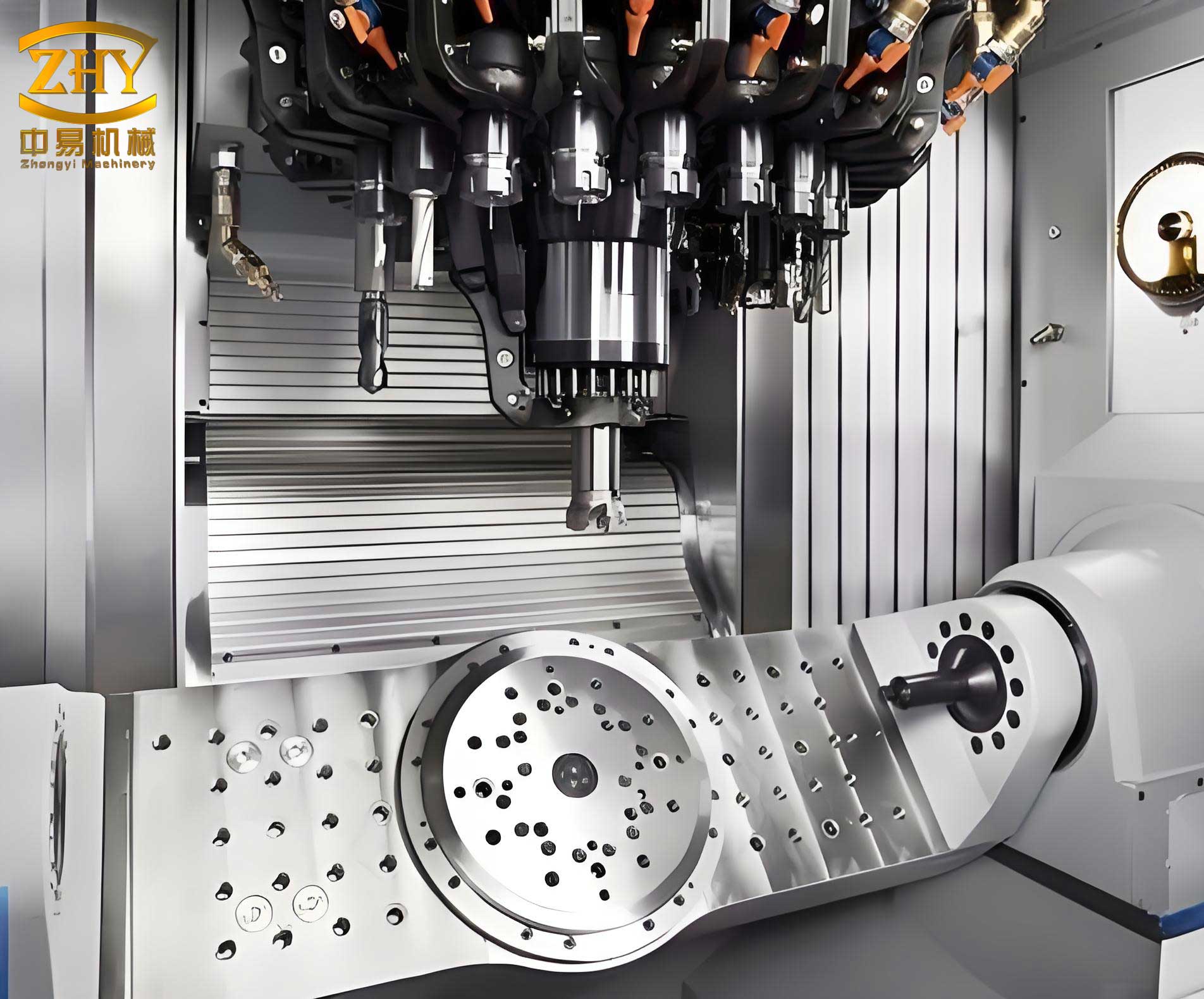
A Property-by-Property Comparison: Mineral Casting vs. Traditional Cast Iron
The true value of polymer concrete for machine tool casting becomes clear when its properties are compared directly with those of gray cast iron (GCI), the longstanding benchmark. The data reveals a trade-off but also highlights transformative advantages.
| Parameter | Polymer Concrete Casting | Gray Cast Iron (GCI) Casting | Natural Granite |
|---|---|---|---|
| Density, $\rho$ (g/cm³) | 2.3 – 2.45 | 7.0 – 7.3 | 2.6 – 3.0 |
| Compressive Strength (N/mm²) | 140 – 170 | 300 – 900 | 200 – 300 |
| Flexural/Tensile Strength (N/mm²) | 25 – 45 | 100 – 300 | 20 – 30 |
| Young’s Modulus, $E$ (kN/mm²) | 30 – 50 | 80 – 120 | 50 – 100 |
| Thermal Conductivity, $\lambda$ (W/m·K) | 1.0 – 3.0 | 40 – 52 | 2.5 – 3.5 |
| Coeff. of Thermal Expansion, $\alpha$ (10⁻⁶/K) | 10 – 20 | 10 – 15 | 5 – 7 |
| Damping Coefficient (Loss Factor), $\eta$ | 0.01 – 0.02 | 0.001 – 0.002 | 0.002 – 0.003 |
Analysis of Key Differentiators:
1. Dynamic Stiffness and Damping: This is the most significant advantage. While the static Young’s Modulus ($E$) of polymer concrete is lower, its dynamic performance is superior due to high internal damping. The damping coefficient ($\eta$) is an order of magnitude higher than that of cast iron. In practical terms, vibrations induced by cutting forces or external sources decay 5-10 times faster. This directly translates to better surface finish, improved tool life, and the ability to machine at higher speeds or with less rigid setups. The dynamic stiffness, a more relevant metric for machine tools, can be expressed as a complex quantity: $K_{dynamic} = K(1 + i\eta)$, where a higher $\eta$ improves vibration energy dissipation.
2. Thermal Characteristics: The low thermal conductivity ($\lambda$) is a double-edged sword. It makes the machine tool casting largely insensitive to ambient temperature fluctuations, preventing the creation of harmful thermal gradients within the structure. This promotes excellent geometric stability. However, it also means internally generated heat (e.g., from motors or spindle bearings embedded in the casting) must be carefully managed via design, as it dissipates more slowly than in a metallic casting.
3. Mechanical Strength and Design: The lower tensile/bending strength is acknowledged and compensated for in design. Walls are made thicker (typically 3-4 times the thickness of an equivalent iron casting), and steel reinforcements are strategically embedded in high-stress areas. Because the material’s density is about one-third that of iron, the overall weight of the optimized structure often remains comparable or even lower, while stiffness-to-weight ratio can be favorable. The bending deflection $\delta$ under a load $F$ is governed by: $$\delta \propto \frac{F L^3}{E I}$$ where $I$ is the area moment of inertia. By increasing wall thickness (greatly increasing $I$), designers can achieve the required static stiffness despite a lower $E$.
4. Corrosion and Chemical Resistance: Polymer concrete is virtually inert to water, coolants, lubricants, and mild chemical agents that would cause cast iron to rust. This eliminates the need for protective coatings and ensures long-term dimensional stability without corrosion-induced degradation.
Economic and Design Advantages: Beyond Material Properties
The benefits of adopting this advanced machine tool casting methodology extend well beyond the datasheet, impacting the entire product lifecycle from design to end-of-use.
Design Freedom and Part Consolidation: The ability to cast in complex shapes and embed components leads to profound design integration. What would be an assembly of dozens of separately machined and fastened parts in a traditional weldment or iron casting becomes a single, monolithic mineral casting. This simplifies Bill of Materials (BOM), reduces logistical overhead, and minimizes assembly time and error. The design is inherently more compact and elegant.
Reduced Manufacturing Lead Time and Cost: The absence of high-temperature melting, core-making, and lengthy cooling/solidification phases slashes the lead time for a machine tool casting. Furthermore, the excellent surface finish and dimensional accuracy from the mold mean significantly less machining is required post-casting—often limited to precision grinding or scraping of critical mounting surfaces. This reduction in machining hours and energy consumption directly lowers cost. A simplified total cost model might be:
$$ C_{total} = C_{material} + C_{processing} + C_{machining} + C_{assembly} $$
For polymer concrete, $C_{processing}$ (energy for casting) and $C_{machining}$ are dramatically lower, and $C_{assembly}$ is reduced due to part consolidation, often resulting in a favorable $C_{total}$ despite a potentially higher $C_{material}$.
Sustainability and Environmental Impact: The production of a mineral machine tool casting has a markedly lower carbon footprint. It consumes approximately 90% less energy during the forming process compared to melting iron. It generates no foundry fumes, slag, or sand waste associated with traditional metal casting. The material itself can potentially be recycled at end-of-life by crushing and using it as aggregate for new, lower-grade polymer concrete or construction fill.
Application Spectrum and Future Trajectory
The unique property profile of polymer concrete has led to its successful adoption across a diverse range of precision industries, as summarized below.
| Industry Sector | Typical Applications for Polymer Concrete Castings |
|---|---|
| Machine Tool & Manufacturing | Bases, beds, columns, crossrails, and saddles for machining centers (3-axis, 5-axis), grinders, gear hobbers, EDM machines, laser processing systems. |
| Precision Metrology & Inspection | Bases and bridges for Coordinate Measuring Machines (CMM), balancing machines, high-precision gauge fixtures, optical comparator stages. |
| Semiconductor & Electronics | Substrates for lithography equipment, wafer inspection systems, high-precision PCB drilling/routing machines, cleanroom equipment bases. |
| Medical & Analytical Equipment | Vibration-isolated bases for MRI/CT scanners, electron microscopes, mass spectrometers, and other sensitive analytical instruments. |
| General Precision Machinery | Frames for high-speed packaging machines, printing presses, textile machinery, and robotic system bases. |
The Path Forward: The future of this machine tool casting technology is bright and points toward continuous improvement and broader adoption. Research is focused on:
- Advanced Resin Systems: Developing formulations with higher toughness, higher temperature resistance, and faster or more controllable cure profiles.
- Optimized Aggregate Engineering: Exploring new mineral types, hybrid aggregates, and nano-scale fillers to push the boundaries of stiffness, damping, and thermal expansion coefficients. The goal is to tailor the property set for specific applications.
- Hybrid Structure Design: Sophisticated simulation-driven design (Topology Optimization, Finite Element Analysis) is being used to create intelligent lattice structures or optimized ribbing within the casting, often combined with strategic placement of steel or carbon fiber reinforcements, to achieve ultimate performance with minimal weight.
- Process Automation: Advancements in automated batching, mixing, and casting lines will further improve consistency, reduce costs, and enable the production of even larger, more complex machine tool casting components.
As global manufacturing trends emphatically move towards higher precision, energy efficiency, and environmental responsibility, the transition from traditional metal casting to advanced polymer composite casting represents a logical and impactful evolution. The initial adoption in high-end machine tools is proving the concept, demonstrating tangible gains in accuracy, surface finish quality, and operational stability. With ongoing material science innovation and growing design expertise, mineral casting is poised to move from a premium alternative to a mainstream solution, fundamentally reshaping the foundations upon which our most precise industrial equipment is built. The new paradigm for machine tool casting is not forged in fire, but meticulously composed and cast at room temperature, offering a quieter, more stable, and more sustainable path to manufacturing excellence.