
From my extensive experience in foundry research and development, I have consistently observed that the pursuit of precision in manufacturing begins at the foundational level: the castings that form the bedrock of machine tools. The long-term accuracy and stability of any machine tool are intrinsically linked to the material properties of its core cast components. In this comprehensive analysis, I will delve into why the traditional paradigm for machine tool casting materials is undergoing a necessary shift, focusing on the superior alternative offered by vermicular graphite iron (VGI). The performance of a machine tool casting is governed by a triad of critical properties: wear resistance, rigidity (or stiffness), and damping capacity. My research and practical applications strongly indicate that vermicular graphite iron presents a uniquely balanced profile that optimally satisfies these three pillars of precision retention, far surpassing the capabilities of conventional flake graphite gray irons.
The heart of any machine tool casting, such as a bed, column, or saddle, operates under conditions of continuous or intermittent sliding contact, often with lubrication. Therefore, its wear resistance is paramount for maintaining geometric accuracy over years of service. My investigations into the wear mechanisms of various cast irons reveal a significant advantage for VGI. The wear process can be conceptually modeled using the Archard wear equation:
$$ W = k \frac{F_N L}{H} $$
where \( W \) is the wear volume, \( k \) is a dimensionless wear coefficient, \( F_N \) is the normal load, \( L \) is the sliding distance, and \( H \) is the material hardness. While hardness is a factor, the microstructure plays a more dominant role. The unique graphite morphology in vermicular graphite iron—a compacted, interconnected form between flakes and spheres—creates a reinforced matrix. Even with a ferritic base, which is typically less wear-resistant than pearlite, the VGI matrix is strengthened by the lattice strain induced by dissolved rare-earth elements, following the Hume-Rothery rules for solid solution strengthening. This results in a matrix with a higher effective “H” in the wear equation. Comparative data from controlled tests unequivocally supports this. For instance, under lubricated rolling-sliding conditions, the performance differential is stark:
| Cast Iron Type | Average Wear Loss (mg / 400k cycles) | Relative Wear Ratio |
|---|---|---|
| HT200 Gray Iron | 6.05 | 3.27 |
| HT300 Gray Iron | 4.73 | 2.55 |
| Antimony (Sb) Alloyed Iron | 2.15 | 1.16 |
| High-Phosphorus Iron | 1.98 | 1.06 |
| Vermicular Graphite Iron | 1.7 – 2.0 | 1.0 |
This table demonstrates that the machine tool casting made from VGI can exhibit wear resistance over three times greater than standard gray iron. The presence of hard micro-phases like titanium carbonitrides (TiCN) further enhances this property. When such material is used for critical surfaces like guideways, the interval for re-machining or replacement is dramatically extended, directly contributing to the machine’s precision life.
The second pillar, rigidity, defines a machine tool casting‘s ability to resist elastic deformation under load. This static stiffness is crucial for maintaining the relative position between tool and workpiece during cutting operations. The key material property here is the Young’s Modulus of Elasticity (E), defined by the linear relationship in Hooke’s Law for the elastic region:
$$ \sigma = E \epsilon $$
where \( \sigma \) is stress and \( \epsilon \) is strain. Vermicular graphite iron possesses a significantly higher elastic modulus compared to high-grade gray irons. In the low-stress region (below ~80 MPa), the modulus of VGI is comparable to ductile iron and can be over 40% higher than that of HT200. This fundamental property translates directly into superior structural performance. Rigidity tests on simulated machine tool casting beds provide concrete evidence:
| Test Specimen Type | Material | Average Deflection under Load (mm or µε) | Reduction in Deformation vs. HT300 |
|---|---|---|---|
| Structure A (Simulated Bed) | HT300 Gray Iron | 0.113 mm | Baseline |
| Vermicular Graphite Iron | 0.063 mm | 44.2% | |
| VGI (with Thinner Walls) | 0.069 mm | 39.0% | |
| Structure B (Simulated Bed) | HT300 Gray Iron | 49 µε | Baseline |
| Vermicular Graphite Iron | 27 µε | 44.9% |
This data is compelling. It shows that a machine tool casting in VGI deforms significantly less under identical loads. More importantly, it highlights a revolutionary design opportunity: the high specific stiffness of VGI allows for the reduction of wall thicknesses while maintaining or even improving upon the rigidity of a heavier gray iron casting. This leads to weight savings, reduced material consumption, and lower inertial masses for moving components—a holistic advancement in machine tool casting design.
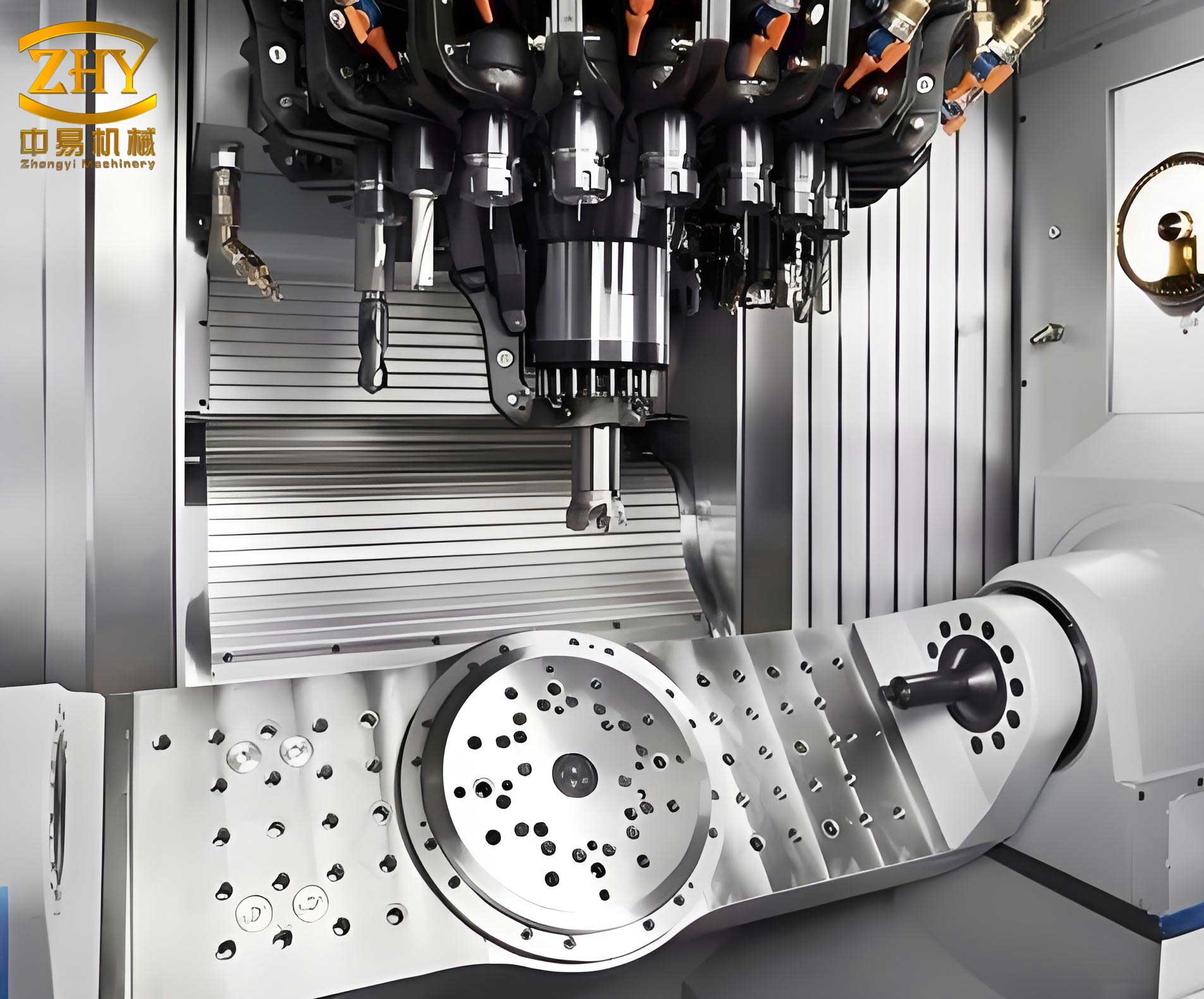
The third pillar, damping capacity or internal friction, is vital for dynamic stability. It determines how quickly vibrations from cutting forces or external sources decay within the structure. Excessive vibration leads to poor surface finish, reduced tool life, and chatter. The damping mechanism in cast irons is primarily governed by graphite morphology. Flake graphite provides high damping because the graphite tips act as stress concentrators, promoting micro-plastic deformation and interfacial sliding between graphite layers, which dissipates energy. The damping capacity \( \psi \) can be related to the logarithmic decrement or specific damping capacity measurements. Vermicular graphite iron offers a masterful compromise:
| Component / Specimen | Material | Relative Damping Capacity (HT200 = 1.0) |
|---|---|---|
| Standard Test Specimen | HT300 Gray Iron | 0.549 |
| Standard Test Specimen | Vermicular Graphite Iron | 0.647 |
| Simulated Bed Casting | HT300 Gray Iron | 0.549 |
| Simulated Bed Casting | Vermicular Graphite Iron | 0.674 |
While low-carbon equivalent gray irons like HT200 have the highest damping, they lack the necessary strength and rigidity for high-performance machine tool casting applications. High-strength gray irons (HT300+) see a marked drop in damping. Vermicular graphite iron, however, maintains a damping level superior to HT300, effectively bridging the gap between high static stiffness and acceptable dynamic vibration absorption. This balance is critical for modern high-speed and high-precision machining centers where both rigidity and stability are non-negotiable. The relationship between carbon equivalent (CE), wall thickness, and damping in pearlitic VGI can be expressed as an empirical observation: damping improves with thicker sections and is more sensitive to graphite form than to CE within typical ranges.
Beyond the core triad, the inherent manufacturability of vermicular graphite iron confers significant advantages for producing sound, reliable machine tool casting components. One key attribute is superior fluidity. In spiral fluidity tests under comparable pouring temperatures, VGI melt consistently achieves flow lengths nearly an order of magnitude greater than inoculated gray iron. This enhanced fluidity dramatically reduces the risk of misruns and cold shuts in complex, thin-walled sections of a machine tool casting. Another crucial factor is reduced section sensitivity. The hardness uniformity across varying wall thicknesses is exceptional in VGI. For a machine tool casting with drastic wall thickness variations—sometimes exceeding a 12:1 ratio—this uniformity ensures consistent mechanical properties throughout the component, minimizing weak zones and distortion during machining. Data confirms this:
| Step Block Thickness (mm) | Hardness of Cu-Inoculated Gray Iron (HB) | Hardness of Vermicular Graphite Iron (HB) |
|---|---|---|
| 20 | 230 | 183 |
| 40 | 217 | 179 |
| 60 | 210 | 174 |
| 80 | 207 | 172 |
| Hardness Drop (20-80mm) | 23 HB | 11 HB |
The lower and more consistent hardness of VGI across the section directly translates to better machinability and more predictable behavior for the finished machine tool casting. Furthermore, the as-cast residual stresses in VGI are intermediate between gray and ductile irons. For a machine tool casting with a vermicularity above 50%, the stress levels can be lower than those in high-strength gray iron, reducing the propensity for distortion during and after machining, which is another direct contributor to precision retention.
The synthesis of these properties unlocks a transformative potential for machine tool casting design. Historically, attempts to lightweight machine tool structures using conventional gray irons failed due to inadequate material properties. Vermicular graphite iron, with its excellent combination of strength, modulus, and toughness, provides the material assurance for such design revolutions. For instance, the application of VGI has enabled the redesign of critical castings like lathe beds, planer beds, and testing machine bases, achieving mass reductions of 7% to over 40% while simultaneously improving stiffness and wear performance. The total weight savings across a machine’s cast structure contribute to lower energy consumption for movement and reduced foundation requirements. The mechanical property spectrum of VGI compared to high-grade gray iron is summarized below, illustrating its comprehensive superiority for demanding machine tool casting applications:
| Property | Vermicular Graphite Iron (Pearlite+Ferrite) | High-Grade Gray Iron (Pearlitic) |
|---|---|---|
| Tensile Strength (MPa) | 350 – 450 | 200 – 400 |
| Yield Strength (MPa) | 250 – 350 | ~0 |
| Modulus of Elasticity, E (GPa) | 120 – 160 | 83 – 137 |
| Elongation (%) | 1 – 4 | 0 – 0.5 |
| Bending Fatigue Strength (MPa) | > 170 | < 140 |
| Damping Capacity | Moderate-High | Low (High-Strength Grades) |
Given these compelling advantages, a pertinent question arises: why hasn’t vermicular graphite iron been universally adopted for machine tool casting? From my analysis, the primary barrier is not technical but rather one of knowledge dissemination and specification practice. The design and specification of a machine tool casting are typically governed by historical standards and familiar material codes like HT250 or HT300. Foundries often lack the authority to change drawing specifications. Therefore, the pivotal step for widespread adoption is for machine tool designers and engineers to become fully cognizant of VGI’s property profile. They must recognize that specifying VGI is not merely a material substitution but an enabling decision that permits more aggressive, lightweight, and high-performance structural designs for machine tool castings, ultimately leading to machines with superior accuracy, longevity, and efficiency.
In the quest for an ideal machine tool casting material, one might envision a composite approach: a wear-resistant material for slideways bonded to a high-damping material for the body. This concept of “bimetallic” or layered casting has been explored. For example, attempts were made to pour a shell of vermicular iron for the guideways followed by a core of untreated, higher carbon-equivalent gray iron. The goal was to economize on the more expensive VGI while targeting properties locally. However, these trials largely failed due to fundamental metallurgical and process challenges. The fluidity and thermal properties of the two melts led to either complete mixing—diluting the vermicularizing elements below the critical threshold needed for structure formation—or to cold laps and lack of fusion at the interface. In cases where a thin VGI layer did form, it was often within the machining allowance, rendering it useless. This underscores a key point: the homogeneous, integral properties of a monolithic VGI machine tool casting are more reliable and manufacturable than attempting to engineer a discontinuous property gradient through such layered pouring techniques. The failure mode can be conceptually framed by considering the diffusion and mixing dynamics at the liquidus interface, where achieving a stable, sharp transition in graphite morphology is exceptionally difficult under typical foundry conditions.
In conclusion, my perspective, forged through research and practical observation, is that the future of high-precision, durable machine tool casting lies in the strategic adoption of vermicular graphite iron. Its unique microstructure delivers an optimal, synergistic balance of the three cardinal virtues: exceptional wear resistance derived from a strengthened matrix and favorable graphite morphology, high rigidity afforded by a superior elastic modulus, and adequate damping capacity for operational stability. These attributes are complemented by excellent casting characteristics that promote soundness and uniformity in complex castings. The material effectively decouples the traditional trade-offs faced by designers, enabling thinner, lighter castings without sacrificing—and often enhancing—performance. The path forward requires a concerted effort to educate the design community about this advanced material. When machine tool designers fully integrate the capabilities of VGI into their specifications, it will catalyze a new generation of machine tools with unprecedented precision retention, efficiency, and longevity. The machine tool casting, therefore, evolves from a passive structural element into an active, performance-defining component through the science of advanced ferrous metallurgy.