
The establishment and proliferation of intelligent foundries signify a profound transformation within the casting industry, marking a decisive shift from labor-intensive, traditional methodologies towards a modern, data-driven, and highly automated paradigm. This evolution is fundamentally centered on enhancing the quality, efficiency, and consistency of producing complex and heavy casting parts. By integrating advanced core-making systems like large-scale sand mold additive manufacturing (3D printing) with intelligent material handling, automated finishing, and closed-loop material recovery, these factories aim to create a seamless, smart production line. The primary objectives are unambiguous: a significant increase in mold yield and casting qualification rate, a drastic reduction in manual labor and associated costs, and the attainment of a new standard for high-mix, high-quality production. This article, drawing from firsthand experience in designing and implementing such systems, delves into the architectural principles, technological integrations, and operational benefits of an intelligent foundry specifically engineered for large-scale casting parts. We will explore optimized plant layout, agile AGV-based logistics, efficient sand reclamation, and streamlined melting practices, presenting a holistic framework that elevates the industry’s intelligence and paves the way for more sustainable and competitive manufacturing of critical casting parts.
1. The Architectural Paradigm: From Constrained Linear Flow to Dynamic Cellular Layout
Traditional foundry layouts, even those incorporating early automation, often suffer from inherent bottlenecks due to fixed-path material handling systems like Rail-Guided Vehicles (RGV). A common historical layout, which we can term the “Central Aisle Linear Layout,” typically splits the factory lengthwise. Key processes such as molding, core-making, and pouring are arranged sequentially along a central corridor, with supporting units like sand preparation and cooling placed on the opposite side. While this organizes related processes adjacently, the reliance on RGVs operating on fixed tracks imposes severe limitations. The system’s efficiency is capped by track congestion, the need for a large fleet of vehicles to mitigate wait times (leading to low asset utilization due to idle periods), and inflexibility in responding to dynamic production schedules or unexpected disruptions.
To overcome these limitations, a new architectural principle was adopted: the Enclosed Cellular Layout with Perimeter Circulation. This paradigm arranges all major process units—core making, assembly, melting, pouring, cooling, shakeout, and sand reclamation—within a central “production cell.” This cell is completely encircled by a wide, unobstructed perimeter aisle. This fundamental redesign yields several critical advantages, quantified in the comparison below:
| Feature | Traditional Linear Layout (RGV-based) | Intelligent Cellular Layout (AGV-based) |
|---|---|---|
| Layout Philosophy | Linear, process-oriented along a central spine. | Cellular, product-focused with a central core. |
| Primary Logistics | Fixed-track RGV vehicles. | Free-roaming, Autonomous Guided Vehicles (AGVs). |
| Path Flexibility | None. Paths are predetermined by rails. | High. AGVs can calculate dynamic, optimal paths. |
| Vehicle Utilization | Low to Medium. Prone to idling and congestion. | High. Centralized dispatch optimizes task assignment. |
| Flow Path Length | Longer, linear travel between distal units. | Minimized. Radial travel from perimeter to any cell. |
| Scalability/Reconfigurability | Difficult and costly. Requires physical track changes. | Easier. Layout changes require only software map updates. |
| Typical Max Transport Weight | Often limited by RGV & rail design. | Very High (e.g., 600t+ AGVs for heavy casting parts). |
The perimeter aisle acts as a high-speed logistical highway. Heavy-duty AGVs transport all major loads—printed core boxes, assembled molds (often called “mold packages”), poured molds, and cooled castings—from the exit point of one cell to the entrance point of the next via this shortest possible external path. This drastically reduces non-value-added travel time. Furthermore, the AGV fleet is managed by a central Fleet Control System (FCS) that dynamically assigns tasks based on vehicle proximity, battery level, and priority, ensuring high utilization rates and eliminating idle waiting. The logistical efficiency gain can be modeled as a reduction in the total material handling distance $D_{total}$:
$$D_{total} = \sum_{i=1}^{n} d_i(P_{source}, P_{dest})$$
where in the traditional layout, $d_i$ is often a long, indirect path constrained by tracks, while in the cellular layout, $d_i$ approximates the Euclidean distance between cell access points on the perimeter, minimized by the central dispatch of the FCS.
2. Deconstructing the Intelligent Foundry Cell: Unit Operations and Synergies
The efficiency of the cellular layout is fully realized through the specific configuration and integration of each unit operation. For the production of large casting parts (e.g., with a finished weight exceeding 100 tons), each cell is engineered for high throughput and minimal manual intervention.
| Process Unit | Key Equipment & Configuration | Function & Integration Purpose |
|---|---|---|
| 1. Additive Core Making Unit | Multiple large-format sand 3D printers, 50t AGVs, buffer conveyors. | Produces complex sand cores without patterns. AGVs remove finished boxes to buffer, enabling continuous printer operation. |
| 2. Core Finishing & Storage Unit | RGV-based transfer between stations, cleaning booth, coating station, drying oven, automated core storage (AS/RS). | Removes loose sand, applies refractory coatings, dries cores, and stores them for JIT delivery to assembly. RGVs used for precise line transfers. |
| 3. Molding & Assembly Unit | Mobile sand mixers, heavy-duty gantry robots (200t+), assembly area. | Creates the drag mold using conventional sand. Gantry robots retrieve cores from AS/RS for precise manual/automated assembly into the complete mold package. Co-locating molding and assembly minimizes heavy core movement. |
| 4. Melting & Charging Unit | Medium-frequency induction furnaces (e.g., twin-shell 40t), automated charging crane, pre-staging bins, pre-heated ladles. | Melts ferrous/alloy metal. Innovative pre-charging area standardizes charge weights into designated bins, drastically reducing melt-cycle time and improving consistency. |
| 5. Pouring Unit | Ladle transfer cranes (200t+), pouring stations. | Transfers molten metal from furnace to ladle, then to the waiting mold package in the assembly/pouring zone. |
| 6. Controlled Cooling Unit | Enclosed, environmentally controlled cooling chamber. | Receives poured molds via AGV. Accelerates and standardizes solidification/cooling, reducing cycle time from hours to a predictable schedule. |
| 7> Shakeout & Casting Extraction Unit | Vibratory shakeouts, unpacking crane, integrated sand collection pit. | AGVs deliver cooled molds. The casting is extracted, and sand is mechanically removed and funneled into the reclamation system via grates and vibratory feeders. |
| 8. Sand Reclamation Unit | Thermal sand reclaimer, cooling system, classified sand silos. | The heart of sustainability. Burns off binders from used sand, cools it, and returns it as “new” sand to the core printers and molding stations, closing the loop. |
| 9. Casting Finishing Unit | Shot blasting machines, scalable grinding booths, finishing cranes. | Cleans the extracted casting parts, removes gates and risers, and performs final inspection. |
3. The Pillars of Intelligence: Key Technological Sub-Systems
3.1. Agile Logistics: The Backbone of Flow
The AGV system is the circulatory system of the intelligent foundry. For large casting parts, a tiered approach is used: lighter AGVs (25-50t) handle cores and boxes, while ultra-heavy-duty motorized platforms (600t capacity) operate in synchronized pairs to transport the massive, poured mold packages. Their autonomy, granted by LiDAR and SLAM navigation, allows them to traverse the perimeter aisle and enter cells with precision. The system’s capacity $C_{logistics}$ to support production can be expressed as a function of AGV fleet size ($N$), average speed ($v$), average load/unload time ($t_{lu}$), and average transport distance ($\bar{d}$):
$$C_{logistics} = \frac{N \cdot v}{\bar{d} + v \cdot t_{lu}}$$
The cellular layout minimizes $\bar{d}$, while intelligent dispatch minimizes $t_{lu}$ and idle time, maximizing $C_{logistics}$ for a given $N$.
3.2. Closed-Loop Sand Economy: Reclamation and Reuse
Sand is the primary consumable in sand casting. An intelligent foundry must address its cost and environmental impact. The integrated system from shakeout to reclamation is critical. Sand from shakeout, often in large lumps, is broken up by vibratory conveyors and transported to the thermal reclaimer. Here, the key performance metric is the Sand Reclamation Rate (SRR) and the resulting reduction in virgin sand demand. The system’s efficiency can be analyzed by tracking the mass balance of sand $m_s$ through one production cycle for a batch of casting parts:
$$m_{s, virgin} + m_{s, reclaimed} = m_{s, mold} + m_{s, loss}$$
$$SRR = \frac{m_{s, reclaimed}}{m_{s, mold}} \times 100\%$$
where $m_{s, loss}$ accounts for system inefficiencies and degraded sand removed from the cycle. A well-designed thermal system can achieve an SRR >95%, making the operation highly sustainable and cost-effective. The economic benefit $B_{sand}$ per ton of castings is:
$$B_{sand} = (m_{s, virgin, traditional} – m_{s, virgin, intelligent}) \times C_{sand} – C_{reclaim}$$
where $C_{sand}$ is the cost of virgin sand and $C_{reclaim}$ is the operating cost of the reclamation system.
3.3. Optimized Melting and Charging: Precision and Speed
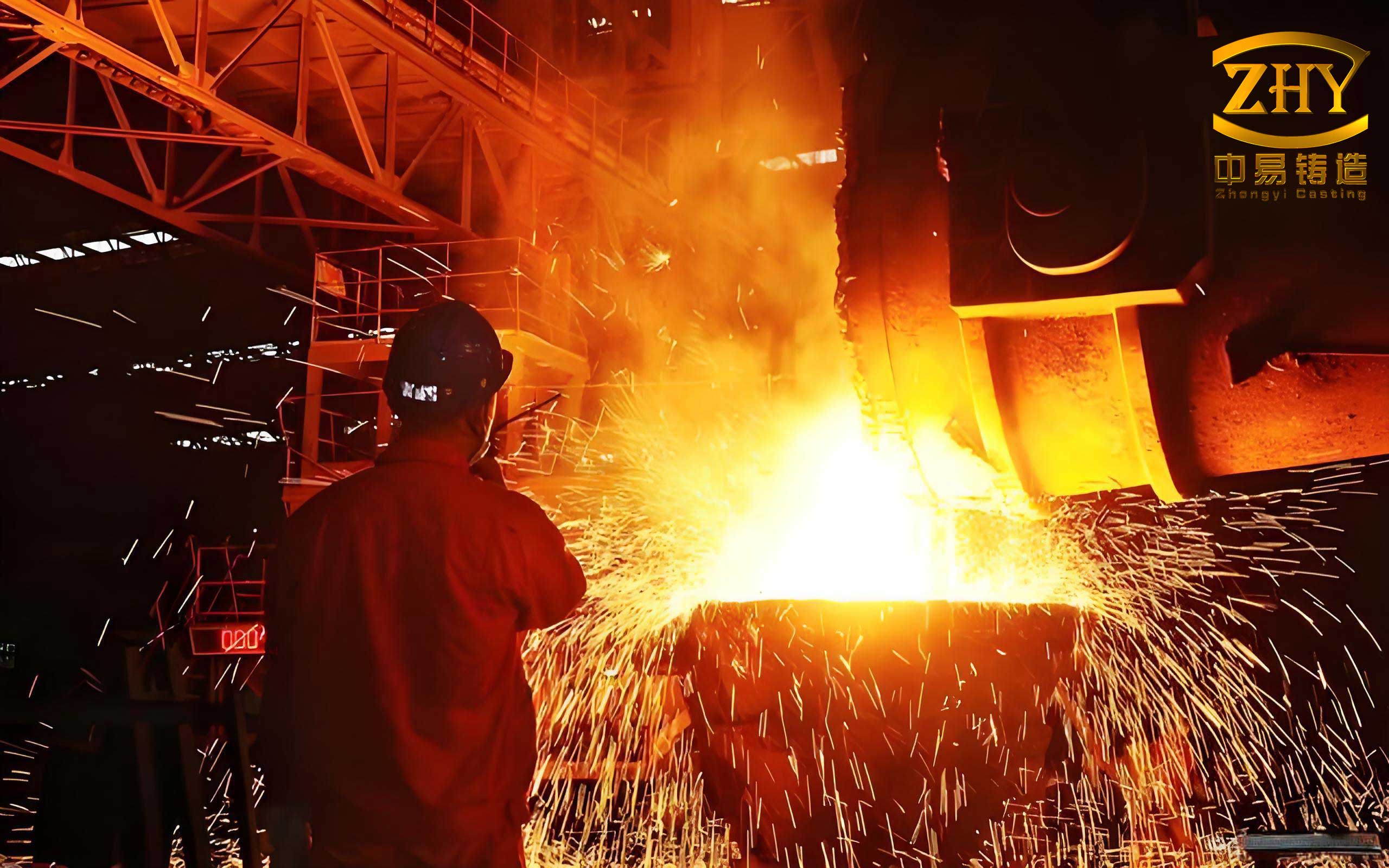
Melting is a major energy consumer. Intelligent foundries optimize it not just with efficient furnaces, but with smart charge preparation. The dedicated Pre-Charging Area is a game-changer. Instead of the crane making multiple trips with a grapple to collect different charge materials (pig iron, scrap steel, returns) for a single heat, these materials are pre-weighed and loaded into standardized bins during the previous melt cycle. When the furnace is ready, the crane simply transports and discharges 2-3 pre-prepared bins. This reduces furnace lid-open time, minimizing heat loss, and improves charge accuracy. The energy savings $\Delta E$ can be approximated by the reduction in heating time $\Delta t_{melt}$ needed to compensate for heat loss during charging:
$$\Delta E = P_{furnace} \cdot \Delta t_{melt}$$
where $P_{furnace}$ is the average power rating of the furnace. Faster, more precise charging also improves metallurgical consistency for the casting parts.
4. Synthesis and Quantified Impact: The Intelligent Foundry Advantage
The integration of the cellular layout, AGV logistics, closed-loop sand reclamation, and optimized melting creates a synergistic system whose whole is greater than the sum of its parts. The benefits are not theoretical but are quantifiable across key performance indicators (KPIs) for manufacturing large, high-value casting parts.
| Performance Indicator | Traditional Foundry Baseline | Intelligent Foundry Outcome | Primary Driver |
|---|---|---|---|
| Logistics Path Length | Long, fixed (e.g., 500-800m per major move) | Minimized, dynamic (e.g., 150-300m per major move) | Cellular Layout + AGV Routing |
| Material Handling Time | High (Prone to delays and congestion) | Reduced by 40-60% | AGV Fleet Management & Perimeter Aisle |
| Mold Assembly Efficiency | Lower (Cores moved between distant shops) | High (Cores & molding co-located) | Integrated Molding/Assembly Unit |
| Sand Consumption | 100% Virgin + Disposal Cost | <5% Virgin, 95%+ Reclaimed | Integrated Thermal Reclamation System |
| Melting Cycle Time | Baseline (t0) | Reduced by 15-25% (≈0.75t0) | Pre-Charging System & Reduced Lid-Open Time |
| Casting Lead Time | Weeks (Variable, manual-dependent) | Days (Predictable, process-controlled) | Synchronized, Automated Flow |
| Labor Intensity | High, especially for handling | Drastically Reduced (Focused on skilled tasks) | Comprehensive Automation (AGV, Robots, AS/RS) |
| Casting Quality Consistency | Variable (Process drift, manual errors) | High and Predictable | Process Standardization & Reduced Human Intervention |
The overall operational efficacy $O_e$ of the foundry can be conceptualized as a multi-variable function of its subsystems’ performance:
$$O_e = f(\eta_{logistics}, \eta_{reclaim}, \eta_{melt}, \eta_{assembly}, A)$$
where $\eta$ terms represent the efficiency coefficients (0 to 1) of each subsystem, and $A$ represents the level of data integration and AI-driven analytics for predictive maintenance and dynamic scheduling. The intelligent foundry framework pushes each $\eta$ towards 1 and maximizes $A$.
5. Conclusion: Charting the Future of Heavy Casting Manufacturing
The transition to the intelligent foundry model, as detailed through its layout philosophy, technological pillars, and quantified outcomes, represents a fundamental upgrade for the production of large-scale casting parts. It moves the industry from a craft reliant on skilled labor and tolerant of variability to a precision engineering discipline governed by data, automation, and closed-loop control. The AGV-based cellular layout ensures the shortest and most flexible material flow. The integration of additive sand molding with automated finishing and storage creates unprecedented agility in core production. The synergistic combination of efficient melting and near-total sand reclamation delivers both economic and environmental sustainability. Ultimately, this holistic framework not only shortens production cycles and lowers costs but, most importantly, elevates the quality, reliability, and manufacturability of the most complex and mission-critical casting parts. It establishes a scalable blueprint for the future of foundries, where intelligence is embedded in every process, driving the industry toward uncharted levels of productivity and excellence.