
The development and refinement of high-speed rail networks are pivotal engines driving national economic growth. As China’s economy has advanced, its high-speed rail system has experienced rapid expansion, with trains across many lines undergoing “gear-shifting and speed increases.” This progress places increasingly stringent demands on train comfort, reliability, and, most critically, safety. The damper, a crucial suspension component for high-speed trains, is now subject to higher performance requirements than ever. Particularly after multiple major speed upgrades, the role of the damper has become indispensable. Without a high-performance damper to eliminate harmful vibrations generated during operation, critical speeds can be reached, and resonance may even occur. This scenario not only accelerates wear on related components but can also lead to their failure, potentially resulting in major transportation accidents.
Historically, the railway vehicle industry has relied on damper products from leading international manufacturers, such as those from the Netherlands, France, Germany, the United States, Russia, Japan, and Sweden, alongside several domestic Chinese variants. While these are top-tier products, they are predominantly based on a double-cylinder design. This architecture tends to be structurally complex, costly, and offers limited performance, struggling to meet the practical requirements of railway vehicles after significant speed increases.
As a key component of high-speed trains, the hydraulic damper’s importance grows with increasing operational speeds. To maintain safe and efficient running, railway operators demand stable performance and long service life from these dampers. However, performance stability has been a weak point for domestically produced high-speed train hydraulic dampers. The root cause lies in the lagging development of manufacturing technologies for the damper’s internal components within China. A lack of in-depth research into casting and machining processes has resulted in domestic damper parts often failing to meet the performance and lifespan requirements of high-speed train applications.
To transform this landscape, we undertook a project focused on the development and application of advanced manufacturing technology for a key damper component: the ZG25MnCrNiMo high-speed rail damper housing. The goal was to elevate the performance of this critical housing component, thereby enhancing the overall stability and service life of the complete damper assembly. This article provides a detailed analysis from my first-person perspective as a project lead, exploring the implementation of the lost foam casting process for this specific component.
The ZG25MnCrNiMo high-speed rail damper housing is one of the essential supporting products for high-speed rail damper systems. It is subjected to complex forces during operation, bearing both static and dynamic loads from the traction motor, as well as dynamic and static loads transmitted from the wheel-rail interface. Under various alternating stresses, fatigue cracks can gradually initiate. Early housings utilized normalized ZG230-450 plain carbon cast steel. To improve strength, stiffness, and lifespan, materials evolved to include low-alloy steels like ZG16Mn, ZG25Mn, and eventually ZG25MnCrNiMo. Currently, ZG25MnCrNiMo is the material of choice domestically. However, the qualification rate for housings produced via the lost foam casting process hovers around only 50%, with a yield rate of approximately 70%. Only a few foundries can consistently achieve the mechanical properties mandated by the relevant standards.
Introduction to the Lost Foam Casting Process
The lost foam casting process (LFC) is an advanced, precision casting method well-suited for complex geometries like the damper housing. The core of the process involves creating a foam pattern of the desired part, assembling it with a gating system into a cluster, coating it with a refractory slurry, drying it, and then embedding it in unbonded sand within a flask. Molten metal is then poured directly onto the foam cluster. The heat of the metal vaporizes and decomposes the foam pattern, precisely replacing it to form the casting. The advantages for our application are significant: excellent dimensional accuracy, minimal need for drafting angles, reduced machining allowance, and a smooth surface finish.
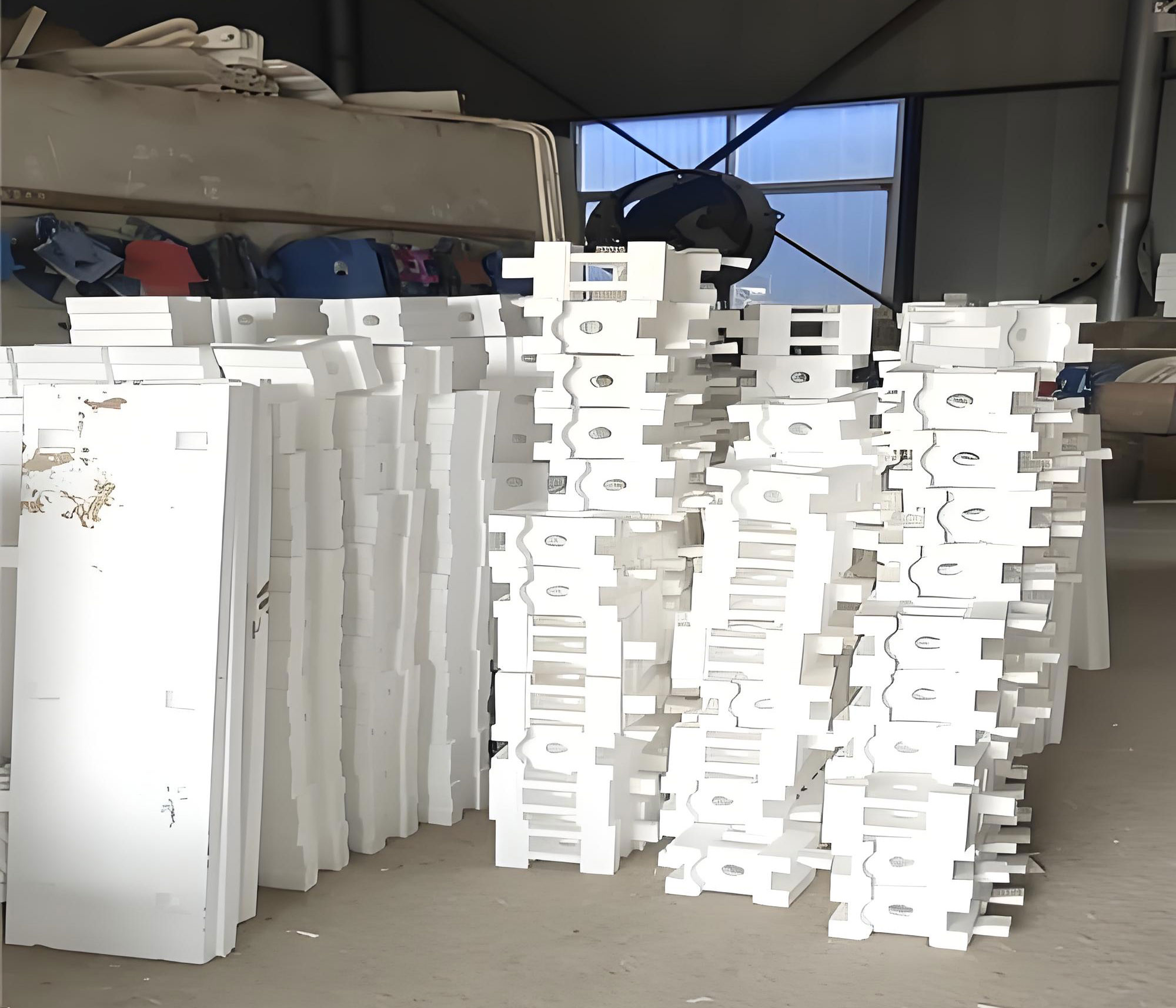
Key Technical Developments for ZG25MnCrNiMo Housing
Based on the structural analysis of the damper housing, our company selected the lost foam casting process followed by machining on a CNC center. The success of this approach hinged on several critical technological developments.
1. Foam Pattern and Cluster Design (Gating/Riser System)
We initiated the process with finite element analysis (FEA) of the housing. Creating a digital model allowed us to simulate the solidification process, observe potential changes in the microscopic structure, and identify locations prone to defects such as shrinkage porosity or hot tears. This digital prototyping was instrumental in optimizing the casting geometry and the gating/riser system before any physical pattern was made.
The design of the gating and riser system is paramount. Risers must be positioned at the thermal centers (hot spots) of the casting to feed shrinkage effectively. Their size is calculated based on Chvorinov’s rule and the modulus of the section they are intended to feed. The gating system design ensures smooth, controlled filling to minimize turbulence and slag entrainment.
We employed a bottom-gating system to promote laminar flow of the molten metal upwards through the mold, as opposed to a top-pouring method which can cause erosion and oxide formation. The dimensions of the sprue, runners, and ingates are calculated based on the total weight of the casting cluster and the desired fill time to prevent mistrust and cold shuts.
For a casting of mass $m_c$ (kg), the required choke area $A_c$ (at the base of the sprue) can be estimated using the Bernoulli equation and accounting for friction losses:
$$ A_c = \frac{m_c}{\rho_m \cdot t_f \cdot C_d \cdot \sqrt{2 g H_p}} $$
where:
$\rho_m$ = density of molten metal (kg/m³)
$t_f$ = desired fill time (s)
$C_d$ = discharge coefficient (typically 0.7-0.9 for sand molds)
$g$ = acceleration due to gravity (m/s²)
$H_p$ = effective metallostatic pressure head (m)
The riser volume $V_r$ must be sufficient to compensate for the shrinkage of the feeding region it serves:
$$ V_r \geq \frac{V_c \cdot \beta}{\eta – \beta} $$
where:
$V_c$ = volume of the casting region fed by the riser (m³)
$\beta$ = volumetric solidification shrinkage of the alloy (for steel, ~3-6%)
$\eta$ = riser efficiency (typically 10-25% for side risers in sand casting)
The table below summarizes the key design parameters we optimized for the ZG25MnCrNiMo housing cluster:
| Parameter | Symbol/Unit | Optimized Value / Method | Purpose |
|---|---|---|---|
| Pattern Material | – | Expandable Polystyrene (EPS) | High density for better surface finish |
| Gating System Type | – | Pressurized, Bottom Gating | Promote laminar fill, reduce turbulence |
| Pouring Time | $t_f$ (s) | < 60 s | Prevent mistruns, control heat loss |
| Number of In-gates | – | 4 (strategically located) | Ensure balanced filling of complex shape |
| Riser Type & Location | – | Exothermic Side Riser at Top Thick Sections | Feed thermal centers effectively |
2. Coating Application and Drying
The coating applied to the foam pattern is a critical element in the lost foam casting process. It serves multiple functions: it provides a barrier between the sand and the metal, ensuring a smooth surface finish; it strengthens the pattern assembly; and it allows the gaseous products from foam decomposition to escape through its permeability.
For the ZG25MnCrNiMo housing, we implemented a four-layer coating strategy:
- First & Second Layers (Face Coats): Zircon flour + silica sol binder. We opted for high-purity, imported zircon flour with uniform particle size and minimal impurities. This choice was crucial to achieve high coating strength and, more importantly, to prevent chemical reactions between impurities in the coating and the reactive elements in the ZG25MnCrNiMo melt (like Mn, Cr), which could cause surface pitting and severe deterioration of surface quality.
- Third & Fourth Layers (Back-up Coats): Refractory aggregates (e.g., mullite) with clay-based binders. These layers build up thickness and enhance overall coating strength and permeability.
The viscosity of the slurry for the first two layers was strictly controlled between 30 to 50 seconds (as measured by a Zahn cup #4). The drying process is equally critical. The temperature and time in the drying oven must be meticulously controlled. Excessive temperature or overly rapid drying can cause the coating to crack or craze, which not only ruins the surface finish but also makes subsequent cleaning operations extremely difficult. We established a slow, controlled drying cycle to ensure uniform moisture removal without inducing stress cracks.
| Coating Layer | Primary Composition | Viscosity Range (Zahn #4) | Key Function | Drying Temp. Range (°C) |
|---|---|---|---|---|
| Layer 1 & 2 (Face) | Zircon Flour + Silica Sol | 30 – 50 s | Create smooth interface, prevent metal penetration & reaction | 25 – 35 (Controlled Humidity) |
| Layer 3 & 4 (Back-up) | Refractory Aggregate + Clay Binder | 50 – 80 s | Provide structural strength, control permeability | 35 – 45 |
3. Melting and Pouring Practice
The quality of the molten metal is foundational. We used a medium-frequency induction furnace for melting ZG25MnCrNiMo. Charge composition, including the ratio of revert material, and charging sequence were strictly controlled to achieve precise chemistry and minimize oxidation. The target chemical composition for ZG25MnCrNiMo is shown below:
| Element | C | Mn | Si | Cr | Ni | Mo | P | S |
|---|---|---|---|---|---|---|---|---|
| Content (wt.%) | 0.22-0.28 | 1.20-1.60 | 0.20-0.45 | 0.30-0.50 | 0.30-0.50 | 0.08-0.15 | ≤0.020 | ≤0.020 |
Effective deoxidation practice was employed using aluminum and/or calcium silicide to reduce dissolved oxygen and minimize oxide inclusions. The pouring practice in the lost foam casting process is unique. The mold is under a vacuum (negative pressure), which helps draw the metal into the mold cavity and evacuates the foam decomposition products through the coating and sand. We adhered to a “slow-fast-slow” pouring sequence:
- Slow initial pour: To gently start the replacement of the foam at the base of the sprue, minimizing back-pressure of gases.
- Fast main fill: To rapidly fill the mold cavity before the foam degradation front advances too far, ensuring complete replication.
- Slow end of pour: To reduce turbulence when topping off the risers.
The key thermal parameters were tightly controlled:
- Tap Temperature: $1685 \pm 10\,^{\circ}\mathrm{C}$
- Pouring Temperature: $1610$ – $1625\,^{\circ}\mathrm{C}$
- Pouring Time: $< 60$ seconds
- Vacuum Hold Time after Pour: $60$ – $120$ seconds
The negative pressure, typically in the range of 0.02 to 0.04 MPa, is maintained during and after pouring to ensure cavity integrity and assist in feeding. The relationship between foam degradation rate, metal advance velocity ($v_m$), and vacuum pressure ($P_v$) is complex but can be simplified for control purposes. A sufficient pressure differential ($\Delta P$) must be maintained to overcome gas generation:
$$ \Delta P = P_{atm} – P_v > \frac{\dot{m}_g R T}{A_p \cdot \kappa} $$
where $\dot{m}_g$ is the mass rate of gas generation from the foam, $R$ is the gas constant, $T$ is the gas temperature, $A_p$ is the pattern cross-sectional area being consumed, and $\kappa$ is the permeability of the coating/sand system.
Results and Technical-Economic Comparison
The implementation of the optimized lost foam casting process for the ZG25MnCrNiMo high-speed rail damper housing yielded transformative results. The table below provides a comprehensive comparison between the state before and after the project’s implementation.
| Aspect | Before Project Implementation | After Project Implementation |
|---|---|---|
| Product Quality | Cast surface roughness ~12.5 μm Ra. Mechanical properties sporadically met standards TB/T2427 & TB/T1464. | Cast surface roughness ~6.5 μm Ra. Mechanical properties (tensile strength, yield strength, impact energy) consistently exceed standards TB/T2427 & TB/T1464. Non-destructive testing (NDT) reveals no cracks, subsurface porosity, or internal inclusions. |
| Casting Technology | Reliance on traditional methods like precision investment casting or sand casting. High unit cost and long lead times. | Adoption of the advanced lost foam casting process. Excellent appearance, reduced lead time, and lower production cost per unit. |
| Process Parameters | Top-pouring gating systems common, leading to low product qualification rate (~50%) and low yield rate (~70%). Machining on standard CNC lathes without dedicated fixtures, resulting in low dimensional accuracy. | Optimized bottom-pouring gating system. Product qualification rate >90%. Process yield (casting yield) >75%. Machining performed on machining centers using custom-designed fixtures, doubling efficiency and significantly improving dimensional accuracy ($\pm0.05$ mm on critical features). |
| Key Metrics |
|
|
Conclusion
The successful development and application of the lost foam casting process for the ZG25MnCrNiMo high-speed rail damper housing represent a significant technological advancement in domestic manufacturing for critical railway components. By systematically addressing the key stages of the process—from digital simulation and cluster design, through the application of high-purity refractory coatings with controlled drying, to precise melting and vacuum-assisted pouring practices—we have overcome the historical limitations of domestic production.
The outcomes are clear: a dramatic increase in product qualification rate and process yield, superior and consistent mechanical properties that meet stringent railway standards, and excellent dimensional accuracy and surface finish. This optimized lost foam casting process not only enhances the performance and longevity of the damper housing itself but, by extension, contributes to the overall stability, safety, and reliability of the high-speed train damper system. It provides a viable, high-quality, and cost-effective manufacturing solution that is fully capable of satisfying the demanding requirements of modern high-speed rail operations, marking a substantial step forward in the independence and capability of the domestic supply chain for critical high-speed rail components.