
My research and development work has long been focused on the strengthening and toughening of alloys, particularly within the domain of abrasion-resistant materials. A significant portion of this effort has been dedicated to advancing the capabilities of high-chromium white cast iron, a material renowned for its excellent wear resistance derived from hard (Cr,Fe)₇C₃ carbides embedded in a supportive matrix. While effective, conventional high-chromium white cast iron can face limitations in balancing extreme wear resistance with adequate toughness, and often requires energy-intensive high-temperature heat treatments. To transcend these limitations, I have systematically investigated the profound effects of vanadium alloying. This journey, supported by national innovation funding, has led to the development of a superior vanadium-multi-alloyed white cast iron that offers exceptional performance without the need for traditional quenching, fundamentally altering the processing and property paradigm for this class of materials.
The core philosophy behind this new alloy design is to engineer a superior microstructure from the solidification stage itself. In a standard high-chromium white cast iron, the primary wear-resistant phases are the hard but often brittle and interconnected (Cr,Fe)₇C₃ eutectic carbides. My approach introduces a high percentage of vanadium (V), which radically modifies this microstructure through two key mechanisms. First, vanadium is a powerful grain refiner for austenite, leading to a finer overall grain structure. Second, and more critically, vanadium has a very strong affinity for carbon, leading to the formation of a different type of carbide: vanadium-rich MC-type carbides (where M is predominantly V). The transformative impact of this addition is summarized in the comparison below.
| Feature | Conventional High-Cr White Cast Iron | Vanadium-Enhanced High-Cr White Cast Iron |
|---|---|---|
| Primary Carbides | (Cr,Fe)₇C₃ (M₇C₃) | (Cr,Fe)₇C₃ (M₇C₃) + Vanadium-rich MC |
| Carbide Morphology | Mostly rod-like, interconnected networks | MC: Blocky/globular particles; M₇C₃: Refined, less continuous |
| Typical Carbide Hardness (HV) | 1,200 – 1,800 | M₇C₃: 1,200 – 1,800; MC: ~2,800 |
| Key Alloying Addition | Chromium (Cr), Molybdenum (Mo) | Chromium (Cr), Vanadium (V), Mo, Ni, Cu |
| Typical As-Cast Matrix | Austenite + some martensite | Mostly martensite + retained austenite |
The hardness differential is particularly striking. The vanadium carbide (VC) possesses a microhardness approaching 2800 HV, which is approximately twice that of the M₇C₃ carbide. Therefore, even if the macro-hardness (measured in HRC) of two white cast iron samples is similar, the one containing a significant volume fraction of MC carbides will inherently have a much higher abrasive wear resistance. The formation of these carbides is governed by thermodynamic principles during solidification. The stability of MC over M₇C₃ in the presence of sufficient vanadium can be considered through the driving force for precipitation, related to the Gibbs free energy of formation. While complex for multi-component systems, the strong negative free energy of formation for VC drives its precipitation:
$$ \Delta G_f(VC) \ll 0 $$
This dictates that vanadium will preferentially bind carbon, forming MC carbides early in the solidification sequence, often as fine, discrete primary particles, before the remaining liquid solidifies into the eutectic mixture containing M₇C₃.
The chemical composition is, therefore, critical. Through extensive laboratory experimentation, an optimal range was identified. The carbon content must be sufficient to ensure an adequate total carbide volume fraction (typically >20%) for wear resistance, but balanced to maintain toughness. The chromium level is set to ensure corrosion/oxidation resistance and the formation of M₇C₃, while the vanadium content is pushed high enough to generate a substantial volume of MC carbides. Auxiliary elements like molybdenum, nickel, and copper are added not for carbide formation, but to enhance hardenability, ensuring that the matrix, even in moderately thick castings, suppresses pearlite formation and transforms to a martensitic structure upon cooling. A target composition is shown below:
| Element | Target Weight % (wB) | Primary Function |
|---|---|---|
| C | 2.9 – 3.2 | Controls total carbide volume fraction and matrix hardness. |
| Cr | 9 – 11 | Forms M₇C₃ carbides; provides oxidation resistance. |
| V | 8 – 10 | Forms ultra-hard MC carbides; refines austenite grains. |
| Si | ~1.0 | Deoxidizer; influences graphite formation (suppressed in white iron). |
| Mn | 1.0 – 1.2 | Austenite stabilizer; enhances hardenability. |
| Mo | 0.4 – 0.5 | Powerful hardenability agent; suppresses pearlite. |
| Ni, Cu | 0.4 – 0.5, 0.8 – 1.0 | Austenite stabilizers; improve hardenability and corrosion resistance. |
The melting and casting of this vanadium-enriched white cast iron requires specific care. Vanadium has a tendency to oxidize, forming V₂O₅, which has a low melting point (679°C) and can lead to excessive metal loss and poor slag cover if not managed. In practice, the melt is first superheated to around 1500°C. Pre-deoxidation is performed using aluminum to create a reducing environment before the ferrovanadium, preheated and wrapped in steel foil, is plunged into the melt. After dissolution, a final deoxidation is conducted prior to tapping. A key step is the addition of a proprietary inoculant/modifier, which promotes the spheroidization and uniform distribution of the MC carbides, further improving toughness. Castings are typically poured into sand molds, where the cooling rate is controlled to achieve the desired as-cast structure.
The most significant advantage of this vanadium-alloyed white cast iron manifests in its heat treatment response. In conventional high-chromium white cast iron, the as-cast structure contains a large amount of metastable retained austenite. To achieve high hardness, a destabilization heat treatment at 950-1050°C is required. This treatment promotes the precipitation of secondary carbides from the austenite, lowering its carbon and alloy content and raising its martensite start (Ms) temperature. Subsequent air cooling or quenching then transforms this “destabilized” austenite into martensite. This process is energy-intensive and can cause distortion and oxidation.
The vanadium-enriched alloy changes this completely. The strong carbide-forming tendency of vanadium already drives extensive carbide precipitation during solidification and cooling. This depletes the matrix of carbon and alloying elements, effectively performing an in-situ destabilization. Consequently, the as-cast matrix is predominantly martensitic with a significantly reduced amount of retained austenite. This allows for the use of a subcritical heat treatment. The casting is simply reheated to a temperature below the austenite transformation start point (Ac1), typically between 500°C and 600°C, held, and then air-cooled. This subcritical treatment serves multiple purposes: it tempers the as-cast martensite, relieving internal stresses and improving toughness; it promotes further fine precipitation of secondary carbides; and it facilitates the final transformation of any remaining retained austenite. The entire process can be summarized and contrasted below:
| Process | Conventional High-Cr White Iron | Vanadium-Enhanced White Iron | Advantage of V-Alloy |
|---|---|---|---|
| As-Cast Matrix | High Retained Austenite | Predominantly Martensite | Near-final hardness achieved post-casting. |
| Key Heat Treatment | High-Temp Destabilization (980°C+) + Quench | Subcritical Treatment (500-600°C) | ~50% energy saving; less distortion/oxidation. |
| Primary Goal | Convert Austenite to Martensite | Temper Martensite; Eliminate Residual Stresses | Simpler, more robust process. |
The transformation kinetics can be conceptually described. The amount of retained austenite (γR) after treatment is a critical parameter. For the vanadium alloy, the as-cast retained austenite is already low. The subcritical treatment further reduces it. The final volume fraction of martensite (α’) is thus high, contributing to high macro-hardness. The relationship between hardness (H), carbide volume (Vc), and matrix hardness (Hm) can be approximated by a rule-of-mixtures for composite materials, highlighting why both ultra-hard carbides and a hard matrix are essential:
$$ H \approx H_m (1 – V_c) + H_c V_c $$
where \( H_c \) is the effective hardness of the carbide mixture, which is drastically increased by the presence of VC.
Laboratory data unequivocally demonstrates the superiority of this material. Tests were conducted comparing a vanadium-enriched white cast iron (Alloy 1: ~3.0%C, 10.2%Cr, 8.9%V) with a standard high-chromium white cast iron (Alloy 2: ~3.0%C, 18.4%Cr). The results are compelling.
| Property | Alloy 1 (V-Enriched) – As-Cast | Alloy 1 – Subcritical Treated | Alloy 2 (High-Cr) – Hardened & Tempered |
|---|---|---|---|
| Macro Hardness (HRC) | 60.0 | 64.0 | 62.0 |
| Impact Toughness, αk (J/cm²) | 8.6 | 12.0 | 5.0 |
| Relative Abrasive Wear Resistance, β* | 4.3 | 5.9 | 1.0 (Baseline) |
| Carbide Volume % (Total) | ~27.1% (MC: 13.5%, M₇C₃: 13.6%) | ~27% (Almost entirely M₇C₃) | |
* β = (Weight loss of baseline alloy) / (Weight loss of test alloy). Higher β indicates better wear resistance.
The data tells a clear story. Even in the as-cast state with a lower hardness (60 HRC), Alloy 1 was 4.3 times more wear-resistant than the fully heat-treated standard alloy at 62 HRC. After a simple subcritical treatment, its hardness increased to 64 HRC and its wear resistance soared to 5.9 times that of the baseline. Remarkably, this phenomenal wear resistance is achieved alongside superior toughness—the impact toughness of the treated vanadium white cast iron is more than double that of the conventional material. This synergy of extreme wear resistance and good toughness is the holy grail for abrasion-resistant white cast iron components.
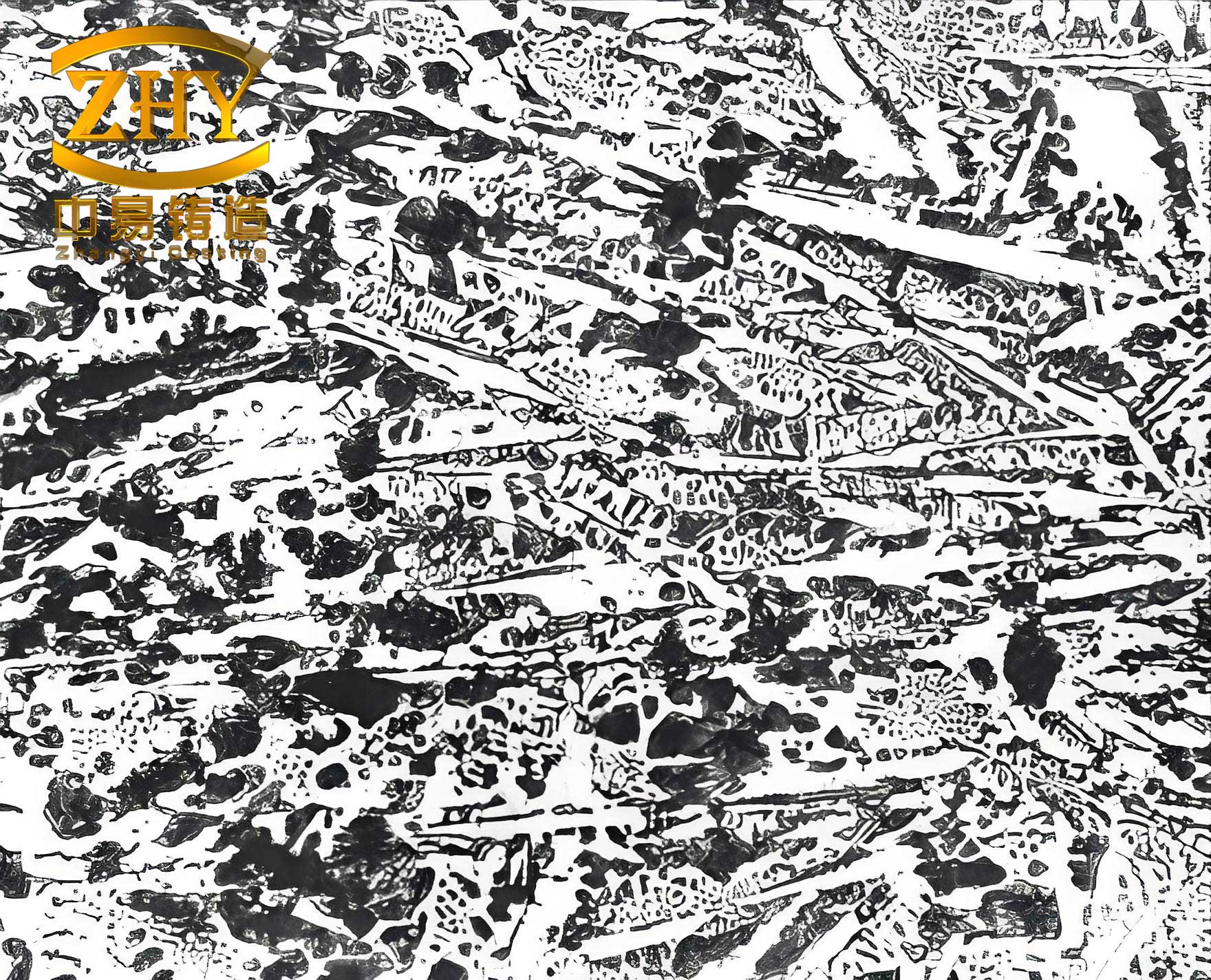
The microstructural basis for this performance is clear. Quantitative image analysis confirms nearly equal volumes of blocky MC and refined M₇C₃ carbides. The blocky MC particles are far less detrimental to toughness than the continuous network of M₇C₃, as they blunt propagating cracks rather than providing an easy path. The matrix, due to the vanadium’s effect, is a fine-grained, tempered martensite with minimal retained austenite. Electron probe microanalysis (EPMA) confirms that vanadium is heavily concentrated in the MC carbides, while chromium is primarily in the M₇C₃ and the matrix, optimizing the use of each alloying element.
The ultimate validation comes from field application. Based on the laboratory success, industrial-scale castings were produced. A prime example is the hammer head for an LPC-III type crusher, used for pulverizing highly abrasive cement clinker. Hammers made from the vanadium-multi-alloyed white cast iron, subjected only to the 560°C for 3 hours subcritical treatment, were installed alongside standard high-chromium white cast iron hammers. The service life results were transformative: while a set of standard hammers processed approximately 8,000 tonnes of clinker, the vanadium-enriched hammers processed over 24,800 tonnes—a threefold increase in service life. This dramatic improvement directly translates to reduced downtime, lower maintenance costs, and increased operational efficiency for the plant, perfectly illustrating the real-world impact of this advanced material.
In conclusion, the alloying of high-chromium white cast iron with significant amounts of vanadium represents a fundamental advancement in abrasion-resistant material technology. It engineers a superior microstructure from solidification, featuring ultra-hard, well-dispersed vanadium carbides alongside refined chromium carbides in a inherently hard, transformable matrix. This unique structure enables the use of a low-energy subcritical heat treatment to achieve a final state that combines exceptional abrasive wear resistance—often several times greater than conventional alloys—with significantly improved impact toughness. The successful industrial application in demanding environments like cement crushing validates this approach. Future work may explore optimizing the balance of carbide formers like niobium or tungsten alongside vanadium, or tailoring compositions for specific wear mechanisms like impact-abrasion or erosion. Nevertheless, vanadium-enhanced high-chromium white cast iron has firmly established itself as a next-generation material, offering a compelling combination of performance, processing economy, and reliability for the most challenging abrasive service conditions.