
As a casting engineer involved in the development of diesel engine components, I recently participated in a trial production project for a cylinder block made of ductile cast iron. Cylinder blocks are critical parts in diesel engines, and their quality directly impacts engine performance. Traditionally, high-grade gray cast iron or alloy cast iron has been used for such applications. However, these materials often suffer from thermal fatigue cracks due to their near-zero elongation, and their wide solidification range leads to shrinkage defects like porosity and leakage. In contrast, ductile cast iron, particularly ferritic ductile cast iron, offers superior strength, higher elongation, and better fatigue resistance under harsh conditions. This makes it an ideal material for cylinder blocks that require both toughness and durability. In this article, I will detail the trial production process for a ductile cast iron cylinder block, emphasizing key aspects such as casting design, melting, and process optimization.
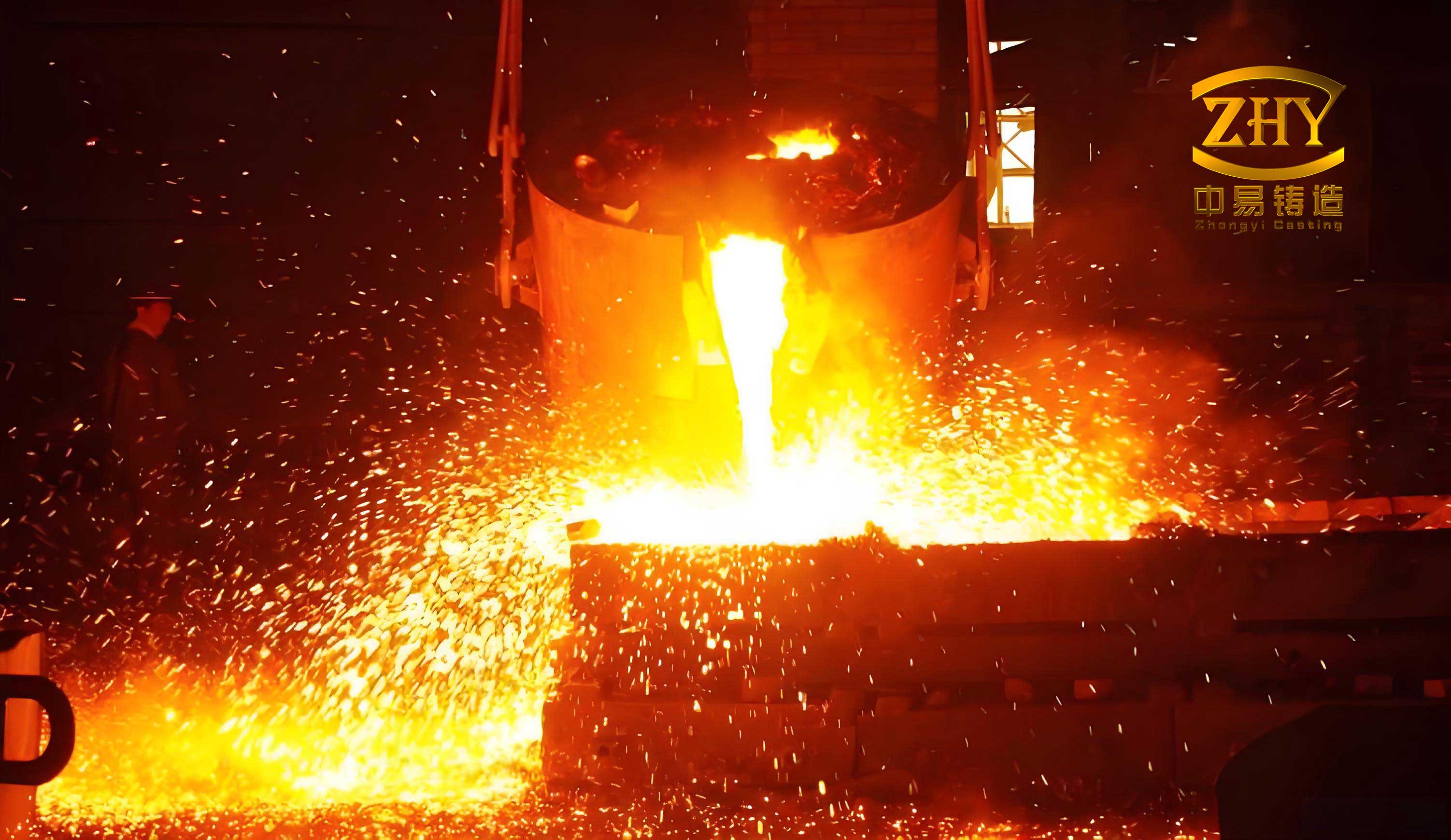
The cylinder block in question, designated as C500, was designed for military applications. It is made of ferritic ductile cast iron with a grade equivalent to QT400-18A. The casting has overall dimensions of 2,650 mm × 1,160 mm × 870 mm and a rough weight of 3.2 tons. It features 20 cylinder holes arranged in a V-configuration, with wall thicknesses ranging from 8 mm to 62 mm. This variation in thickness poses significant challenges in achieving uniform solidification and avoiding defects. To provide a visual reference, here is an image of a typical ductile iron casting:
The technical requirements for this ductile cast iron cylinder block were stringent. They included specific chemical compositions, mechanical properties, metallurgical structure, and pressure tightness. Below is a summary in table form:
| Parameter | Requirement |
|---|---|
| Chemical Composition | S ≤ 0.02%, P ≤ 0.05% |
| Impact Toughness | Average of three specimens: 14 J/cm², individual not below 11 J/cm² |
| Metallurgical Structure | Nodularity grade 1-2, graphite size 5-6, ferrite volume fraction ≥ 90% |
| Pressure Testing | Hydraulic test at 0.5 MPa for 10 min, oil pressure test at 1.2 MPa for 15 min, no leakage |
| Internal Defects | No shrinkage defects in critical areas like cylinder holes and bolt holes |
Meeting these requirements necessitated careful control over the entire production process, from melting to casting. The use of ductile cast iron was central to achieving the desired performance.
The melting process employed a duplex method involving a cupola furnace and a holding furnace. This approach ensures consistent iron quality and temperature control. The charge composition consisted of 78% Q10 pig iron and 22% steel scrap, selected for high purity and low residual elements. The target chemical composition for the ductile cast iron was as follows:
| Element | Weight Percentage (%) |
|---|---|
| C | 3.51 |
| Si | 2.7 |
| Mn | 0.2 |
| P | 0.03 |
| S | 0.009 |
| Mg | 0.052 |
| RE | 0.041 |
Key to producing high-quality ductile cast iron is the nodularization and inoculation process. For this trial, the treatment was done using a conventional sandwich method in a ladle. The amount of nodularizer added was 1.7% of the total iron weight, which was 4.3 tons. This can be expressed as:
$$ \text{Nodularizer weight} = 4300 \, \text{kg} \times 0.017 = 73.1 \, \text{kg} $$
The nodularizer, along with a cover of inoculant (0.1% of total iron weight, with 5-15 mm grain size), was placed at the bottom of the ladle. When about two-thirds of the iron was tapped, the reaction commenced, lasting approximately 60 seconds. As the reaction neared completion, an additional 0.4% inoculant was added at the tapping stream, and the remaining iron was poured to fill the ladle. After slag removal, another 0.4% inoculant was added onto the molten surface. Finally, during pouring, a stream inoculant (0.1% with 0.2-0.7 mm grain size) was used. This multi-stage inoculation enhances graphite nucleation, refines graphite nodules, and improves nodularity, which are critical for the properties of ductile cast iron.
The temperature control was precise: the tapping temperature from the holding furnace was 1,480–1,490°C, and the pouring temperature was maintained at 1,360–1,380°C. These ranges ensure proper fluidity and reduce the risk of defects. The effectiveness of inoculation in ductile cast iron can be related to the cooling rate and undercooling. For instance, the number of graphite nodules per unit area, N, can be estimated using an empirical formula:
$$ N = k \cdot \Delta T^n $$
where \( \Delta T \) is the undercooling, and \( k \) and \( n \) are constants dependent on inoculation practice. In this trial, the intensive inoculation aimed to maximize N, leading to finer graphite and better mechanical properties.
The casting process was designed to address the challenges posed by the complex geometry and varying wall thicknesses of the ductile cast iron cylinder block. A three-part mold (top, middle, and bottom) was used, which facilitated the placement of cores and gating systems. The gating system was of a closed type, with a ratio of sprue, runner, and ingate areas set to:
$$ \Sigma F_{\text{sprue}} : \Sigma F_{\text{runner}} : \Sigma F_{\text{ingate}} = 1.18 : 1.04 : 1 $$
A stopper-controlled pouring cup was employed. Initially, the lower ingates introduced molten iron, and when about 75% of the metal was poured, the stopper was opened to allow the upper ingates to feed simultaneously. This two-layer gating ensures smooth filling and minimizes turbulence. The runners were U-shaped: the lower runner had a cross-section of 80/70 mm × 75 mm, and the upper runner was 65/55 mm × 65 mm. The ingates consisted of 22 ceramic tubes (φ25 mm) at the lower level and 16 flat gates (55/50 mm × 9 mm) at the upper level. This design promotes directional solidification and reduces shrinkage defects in the ductile cast iron.
Given the significant wall thickness variations, effective feeding was crucial. Ductile cast iron exhibits graphitic expansion during solidification, but this alone may not compensate for shrinkage in heavy sections. Therefore, risers were used to provide liquid feed. To enhance riser efficiency, eight φ180 mm exothermic insulating risers were placed evenly on the top surface. The efficiency of a riser, η, can be defined as:
$$ \eta = \frac{V_{\text{feeding}}}{V_{\text{riser}}} \times 100\% $$
For ordinary risers, η is about 6–10%; for insulating risers, it reaches 20–25%; and for exothermic insulating risers, it can be as high as 45%. The exothermic reaction maintains a high temperature gradient, ensuring that the riser remains liquid longer than the casting, thus improving feed metal availability. This is particularly important for ductile cast iron, where late shrinkage can occur.
In addition, chilling was applied to thick sections like cylinder holes and bolt holes using shaped chills. This accelerates cooling, refines the microstructure, and increases density, preventing internal shrinkage. The heat transfer during chilling can be described by Fourier’s law:
$$ q = -k \frac{dT}{dx} $$
where \( q \) is the heat flux, \( k \) is thermal conductivity, and \( \frac{dT}{dx} \) is the temperature gradient. By increasing the gradient, chills promote faster solidification in critical areas.
After casting, the ductile cast iron cylinder blocks were subjected to rigorous testing. Specimens were taken from the castings for metallurgical and mechanical evaluation. The results are summarized below:
| Property | Result | Requirement |
|---|---|---|
| Tensile Strength | 442 MPa | ≥ 400 MPa |
| Yield Strength | 305 MPa | ≥ 250 MPa |
| Elongation | 22% | ≥ 18% |
| Impact Toughness | 15 J, 15 J, 16 J (avg 15.3 J/cm²) | Avg ≥ 14 J/cm² |
| Hardness | 160 HBW | Typically 130-180 HBW |
| Nodularity | 90% (Grade 1-2) | Grade 1-2 |
| Graphite Size | 6 | 5-6 |
| Ferrite Fraction | >90% | ≥ 90% |
The metallurgical structure showed well-formed spheroidal graphite in a ferritic matrix, confirming the success of the nodularization and inoculation processes for ductile cast iron. Non-destructive testing included ultrasonic inspection according to standard JB/T 5439-1991, which revealed no significant defects in critical areas. Pressure tests (hydraulic and oil) were passed without leakage, indicating soundness of the ductile cast iron casting.
The trial production demonstrated that ductile cast iron is a viable material for high-performance cylinder blocks. The key factors in achieving the desired properties were: stringent control of chemical composition, particularly low sulfur and phosphorus; intensive inoculation to refine graphite and enhance nodularity; and optimized casting design with effective gating, risering, and chilling. The use of exothermic insulating risers proved crucial in managing shrinkage, while the two-layer gating system ensured smooth filling. This project highlights the advantages of ductile cast iron over traditional gray iron, including better elongation, fatigue resistance, and overall reliability.
In conclusion, the production of ductile cast iron components like cylinder blocks requires a holistic approach encompassing metallurgy, casting design, and process control. The trial successfully met all technical specifications, paving the way for mass production. Future work could focus on further optimizing the riser design using simulation software or exploring advanced inoculation techniques for even better graphite morphology. Regardless, ductile cast iron remains a cornerstone material for demanding applications, and this experience reinforces its value in the casting industry.
Throughout this article, the term “ductile cast iron” has been emphasized to underscore its importance. From melting to final testing, every step was tailored to harness the unique properties of ductile cast iron, resulting in a high-quality cylinder block that meets rigorous standards. The integration of tables and formulas, as shown, helps summarize complex data and theoretical aspects, making the process more understandable and reproducible for others in the field.