
In recent years, the rapid expansion of rail transit systems has created a strong demand for ductile iron casting components that can operate reliably in extremely cold environments. High-speed trains, intercity locomotives, and urban rail vehicles travel across wide latitudes, where winter temperatures frequently fall below -40 °C. For safety and performance, the low-temperature impact toughness of ductile iron casting parts such as gearbox housings must be strictly controlled. Our work has therefore focused on the production process control of -40 °C ultra-low temperature ductile iron casting grades QT400-18L and QT500-7L, and on further investigation of the effects of silicon, manganese, phosphorus, and sulfur on the impact toughness of -60 °C ultra-low temperature ductile iron casting. Through systematic process design, standardized operation, and institutionalized quality management, we have achieved a stable comprehensive yield above 92% for -40 °C ultra-low temperature ductile iron casting products.
1. Production Process Control of -40 °C Ultra-Low Temperature Ductile Iron Casting
1.1 Product Technical Requirements
Two representative products were selected for this study: an urban rail gearbox and a locomotive gearbox. The urban rail gearbox is made of EN-GJS-400-18LT, while the locomotive gearbox is made of EN-GJS-500-7LT. Both are produced as ductile iron casting components with demanding low-temperature impact requirements. The mechanical property requirements are summarized in Table 1.
| Material grade | Rm (MPa) | A (%) | Rp0.2 (MPa) | KV2 at -40 °C (J) |
|---|---|---|---|---|
| EN-GJS-400-18LT | ≥400 | ≥18 | ≥240 | ≥12 average, ≥9 single |
| EN-GJS-500-7LT | ≥500 | ≥8 | ≥320 | ≥4 average, ≥3 single |
The urban rail gearbox has an approximately circular overall structure. Its main wall thickness is about 8–12 mm, and its weight ranges from 130 to 170 kg. The surface quality of critical areas must meet class 1–2 according to EN 1369:1997, and the internal quality must meet class 2 according to ASTM E 446 or ASTM E 186. The locomotive gearbox has a main wall thickness of 10–16 mm, a maximum wall thickness of 88 mm, and a weight of 290–390 kg. Its surface quality must be no lower than class 2 according to EN 1369:1997, and its internal quality must be evaluated according to class 3 of ASTM E 446 or ASTM E 186.
1.2 Casting Process
For the urban rail gearbox, we adopted a semi-closed gating system. The cross-sectional area ratio of the inner gates, runner, and sprue was designed as follows:
$$ \sum A_{\text{inner}} : \sum A_{\text{runner}} : \sum A_{\text{sprue}} = 0.8 : (1.2 \sim 1.5) : 1 $$
The choke section was placed at the inner gates, while the runner had the largest cross-sectional area. Because of the large runner section, the flow velocity of the molten metal in the runner is reduced, and the filling stability and scouring resistance to the mold cavity are better than those of a fully closed system. Through simulation, the static pressure head was set to 200 mm, which provided stable filling without jetting, splashing, or iron droplet defects. This effectively avoided secondary oxidation and gas entrapment. Risers were placed at the upper and lower flanges and the upper bearing bore, and chills were placed at the parting line and lower bearing area, effectively solving shrinkage porosity and shrinkage cavity problems.
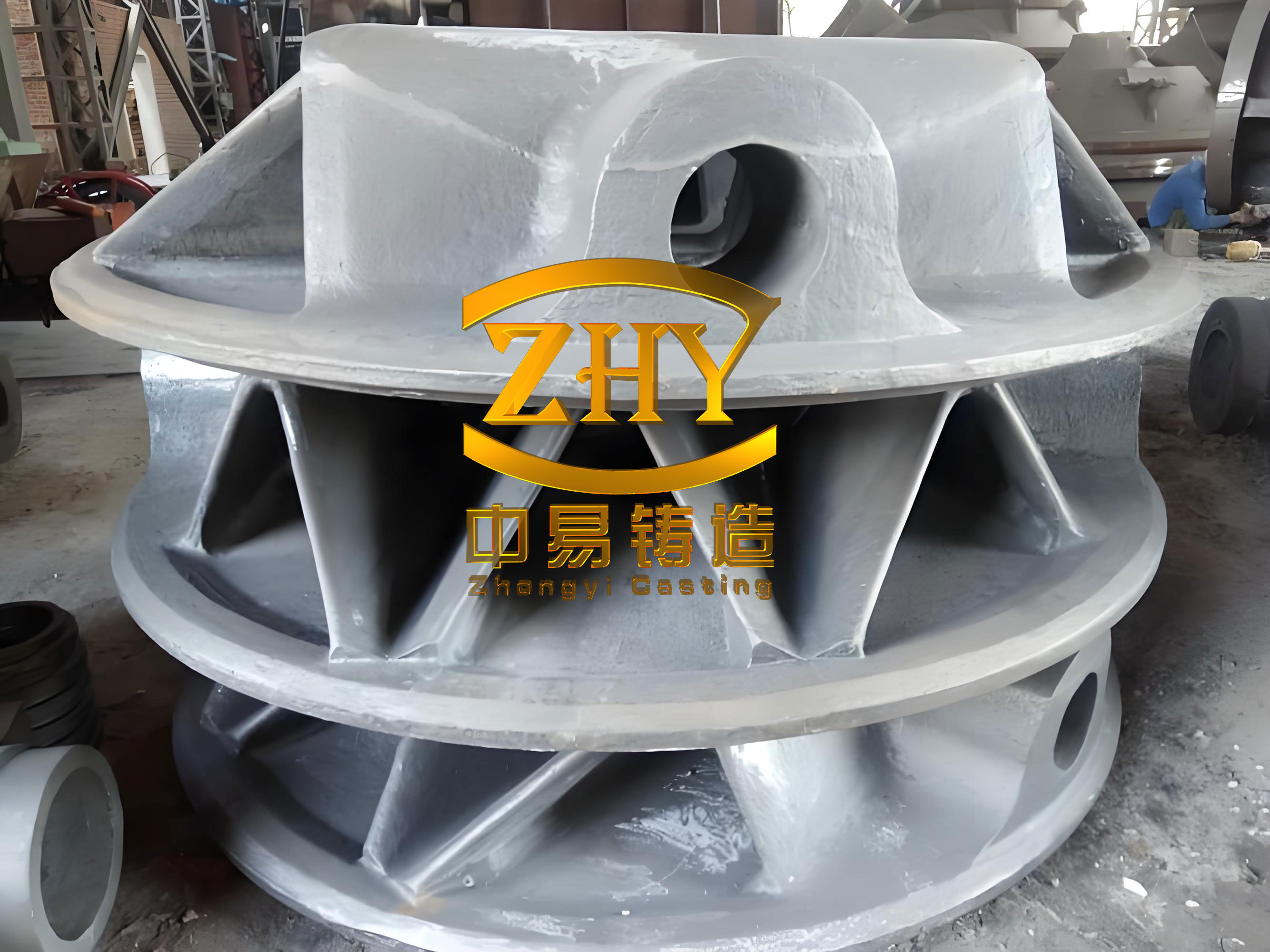
For the locomotive gearbox, we used a double-sided bottom pouring process on the parting line. The filling was stable, and the temperature field in the thin-walled region was more balanced. The molten iron tended to fill the motor flange ribs simultaneously, avoiding the risk of cold shuts on the far side of the gating system. At the same time, through reasonable design of risers and chills, feeding of the bearing bore on one side of the motor flange and the local cross hot spots of the side reinforcing ribs was achieved, solving shrinkage porosity and shrinkage cavity defects in critical positions. Two layers of inner gates were opened on the casting: four on the upper layer and six on the lower layer. The inner gates were thin and wide and evenly distributed. The molten metal first filled the mold through the lowest inner gates, and as the liquid level rose, it flowed through each layer from bottom to top. This design provided stable filling and smooth gas discharge. After filling, the upper molten metal temperature was higher than that of the lower part, which was favorable for directional solidification and riser feeding, resulting in a dense structure. During experimental development, casting defects such as shrinkage cavities, shrinkage porosity, cold shuts, and misruns were avoided. Multiple inner gates were used to reduce local overheating near the gates. Exothermic insulating risers were used for thick sections, and external chills were used for moderately thick sections.
1.3 Molding Process
The molds were produced by manual molding with no-nitrogen furan resin sand. The base sand was Dalin sand with high SiO2 content, a grain size concentration of 95% for 40–70 mesh three-sieve sand, and zero micropowder content. The binder was a modified furan resin, namely an environmentally friendly wood-flavored resin. The curing agent was a low-sulfur type. The resin addition was 0.9–1.1% of the sand weight, and the curing agent addition was 30–40% of the resin. Because the strength of wood-flavored resin sand fluctuates little with increasing curing agent content within 1–24 h, high strength can be achieved at low curing agent content. This reduced curing agent consumption and sulfur compound emissions. The basic performance parameters of the wood-flavored resin are given in Table 3, and the technical indices of the low-sulfur curing agent are given in Table 4. The mold was coated with two layers of paint: a corundum powder primer and a graphite alcohol topcoat.
| Property | Value |
|---|---|
| SiO2 content (%) | >95 |
| Micropowder content (%) | 0 |
| Angularity coefficient | 1–1.2 |
| Property | Value |
|---|---|
| Density (g·cm-3) | 1.15–1.22 |
| Viscosity (mPa·s) | 38–42 |
| Free formaldehyde (%) | ≤0.03 |
| Nitrogen content (%) | ≤0.07 |
| pH value | 6.0 |
| Water content (%) | 1.50 |
| Property | Value |
|---|---|
| Density (g·cm-3) | 1.3–1.6 |
| Viscosity (mPa·s) | ≤40 |
| Total acidity (% as H2SO4) | 40–44 |
| Free acid (%) | ≤18 |
1.4 Melting Process
1.4.1 Chemical Composition
The main chemical composition of the -40 °C ultra-low temperature ductile iron casting materials is shown in Table 5. For QT400-18L, the carbon content is controlled at 3.3–3.9%, silicon at 1.7–2.3%, manganese below 0.2%, phosphorus below 0.035%, sulfur below 0.02%, magnesium at 0.02–0.05%, copper at 0–0.3%, and nickel at 0.3–1.2%. For QT500-7L, the carbon and silicon ranges are similar, while nickel is increased to 0.5–1.5% to provide solid-solution strengthening while maintaining low-temperature toughness.
| Ductile iron type | C | Si | Mn | P | S | Mg | Cu | Ni |
|---|---|---|---|---|---|---|---|---|
| QT400-18L | 3.3–3.9 | 1.7–2.3 | <0.2 | <0.035 | <0.02 | 0.02–0.05 | 0–0.3 | 0.3–1.2 |
| QT500-7L | 3.3–3.9 | 1.7–2.3 | <0.2 | <0.035 | <0.02 | 0.02–0.05 | 0–0.3 | 0.5–1.5 |
1.4.2 Melting Procedure
The charge was prepared according to the target chemical composition of the corresponding ultra-low temperature ductile iron casting. The raw materials included special Q10 pig iron, low-temperature ductile iron scrap, crystalline graphite recarburizer, low-temperature ductile iron return material, pure copper, pure nickel, and ferrosilicon. The return material addition was 0–50%. The chemical composition of the charge materials is given in Table 6.
| Charge type | C | Si | Mn | P | S | V | Ti |
|---|---|---|---|---|---|---|---|
| Q10 pig iron | 4.39 | 0.54 | 0.06 | 0.022 | 0.013 | 0.01 | 0.03 |
| High-purity pig iron | 4.21 | 0.09 | 0.04 | 0.031 | 0.005 | 0.01 | 0.01 |
| Scrap steel | 0.16 | 0.17 | 0.61 | 0.015 | 0.009 | 0 | 0 |
The melting process was carried out in a medium-frequency induction furnace. First, scrap steel and recarburizer were added to the furnace, followed by pig iron, return material, and pure nickel plate. After all charge materials were melted, a slagging agent was sprinkled to remove slag. When the melting temperature reached 1530–1560 °C, high-temperature holding and deslagging were performed. Then pure copper and ferrosilicon were added. When the molten iron temperature reached 1500–1530 °C, it was ready for tapping, nodulizing, and inoculation.
For nodulizing and inoculation, the nodulizer, inoculant, and covering agent were sequentially added into the nodulizing pocket and compacted. The addition amounts were 1.1–1.3 wt%, 0.5–0.7 wt%, and 0.4–1.0 wt%, respectively. A tundish cover nodulizing and inoculation process by the sandwich method was used. The molten iron was tapped twice. First, part of the molten iron was directly poured into the ladle, and then the ladle was covered with a lid for nodulizing and bottom inoculation. After the nodulizing reaction in the ladle was completed, the lid was removed, and the in-ladle inoculant was added. The in-ladle inoculant addition was 0.7–0.9 wt% of the total molten iron. Then the remaining molten iron was tapped. After tapping, the molten iron was stirred and deslagged. When the molten iron temperature reached 1390–1420 °C, pouring was performed.
After nodulizing and inoculation, the surface of the molten iron was covered with asbestos for slag blocking during pouring. In-stream inoculation was used during pouring with an addition of 0.1–0.2%. After pouring, the mold was naturally cooled to 300 °C or below, then shaken out, and the casting was cleaned. The chemical composition of the nodulizer and inoculant is given in Table 7.
| Item | Si | Mg | Ca | Al | RE | Ba | MgO |
|---|---|---|---|---|---|---|---|
| Nodulizer | 44–47 | 4.5–5.5 | 0.8–1.2 | 1.0 | 0.6–1.0 | — | 0.4 |
| Inoculant | 65–75 | — | 1–1.2 | 0.6–1.0 | — | 1.8–2.5 | — |
1.5 Process Quality Control
1.5.1 Standardized Operation
The entire casting process was divided into 29 operations. First-article inspection, control plans, PFMEA, process flow cards, work instructions, and other standard operating documents were prepared. These documents were issued under control and strictly recorded and executed. Every step, from raw material receiving to final inspection, was traceable. For ductile iron casting production, this level of standardization is essential for stable low-temperature impact toughness.
1.5.2 Institutionalized Management
We established and improved quality management systems covering raw and auxiliary materials, mold management, batch management, and abnormality management. A mass production quality control plan was implemented. The plan defined inspection points, frequencies, responsibilities, and reaction plans for nonconforming products. For ductile iron casting, the control of sulfur and phosphorus was especially important because these elements strongly affect low-temperature toughness. Therefore, incoming material inspection and furnace charge verification were performed for every batch.
1.6 Production Quality
From 2018 to 2021, we statistically analyzed the production quality of -40 °C low-temperature ductile iron casting gearboxes. A total of 43,789 pieces were produced. Magnetic particle inspection passed 100%. Radiographic inspection passed more than 97%. Material qualification passed more than 99%. The comprehensive yield was above 92%. The detailed statistics are shown in Table 8.
| Production quantity (pieces) | CT qualification (%) | Material qualification (%) | RT qualification (%) | Comprehensive yield (%) |
|---|---|---|---|---|
| 43,789 | 100 | 99.85 | 97.87 | 92.75 |
The comprehensive yield can be expressed as:
$$ \text{Comprehensive yield} = \frac{N_{\text{qualified}}}{N_{\text{total}}} \times 100\% \approx 92.75\% $$
2. Technical Research on Impact Toughness of -60 °C Ultra-Low Temperature Ductile Iron Casting
2.1 Effects of Silicon, Manganese, Phosphorus, and Sulfur on Impact Toughness
Based on QT400-18LT and QT500-7LT, we further studied the effects of silicon, manganese, phosphorus, and sulfur on low-temperature impact toughness at -60 °C. Three test materials were used: QT400-18L, QT500-7L, and QT600-7L. Their chemical composition ranges are shown in Table 9, and their material states are shown in Table 10. The matrix structures were more than 95% ferrite for QT400-18LT, and ferrite plus pearlite mixed matrices for QT500-7LT and QT600-7LT. A 100 kg medium-frequency resistance furnace was used for melting. The test blocks were standard Y-block with a wall thickness of 25 mm. Furan resin sand was used for molding. To avoid impurities from the molding sand affecting the experimental results, new sand was used, and a sulfur-proof coating was applied. The nodularity of the test blocks was above 95%, the nodule size was above grade 5, and the nodule count was 100–300 per mm2.
| Material | C | Si | Mn | P | S | Mg | Cu | Ni |
|---|---|---|---|---|---|---|---|---|
| QT400-18L | 3.3–3.9 | 1.6–2.3 | 0.05–0.25 | 0.03–0.18 | 0.003–0.02 | 0.02–0.05 | 0–0.3 | 0.5–1.5 |
| QT500-7L | 3.3–3.9 | 1.6–2.3 | <0.2 | <0.03 | 0.003–0.02 | 0.02–0.05 | 0–0.5 | 0.5–1.5 |
| QT600-7L | 3.3–3.9 | 1.6–2.3 | <0.2 | <0.03 | 0.003–0.02 | 0.02–0.05 | 0–0.5 | 0.5–1.5 |
| Material | State | Metallographic structure |
|---|---|---|
| QT400-18LT | Annealed | >95% F + minor P (mainly ferrite) |
| QT500-7LT | As-cast | >60% F + P (ferrite dominant, ferrite + pearlite mixed) |
| QT600-7LT | As-cast | >60% P + F (pearlite dominant, pearlite + ferrite mixed) |
2.2 Analysis and Discussion
2.2.1 Effect of Silicon
As shown in the experimental results, the impact toughness of ferritic ductile iron casting QT400-18L decreases with increasing silicon content. When the silicon content exceeds 1.9%, the low-temperature impact toughness drops sharply as silicon increases. The lower the test temperature, the greater the decrease. The experimental data show that to achieve an impact energy greater than 12 J at -60 °C, the silicon content must be controlled below 2.0%. For the mixed-matrix QT500-7L, the impact toughness first increases and then decreases with increasing silicon. The experimental data indicate that the optimal silicon content for -60 °C impact toughness is 1.9–2.0%.
Silicon exhibits two types of segregation in cast iron. One is solute redistribution between the first solidified region and the later solidified region due to changes in the distribution coefficient during solidification. This is unstable segregation and is a result of non-equilibrium solidification. It can be eliminated by high-temperature diffusion annealing and has little effect on toughness. The other type is silicon segregation at grain boundaries. This segregation occurs because silicon can reduce grain boundary energy, so it spontaneously segregates at grain boundaries due to energy reasons. This segregation is stable and cannot be eliminated by high-temperature diffusion. Therefore, the silicon content must be strictly controlled to prevent excessive silicon segregation at grain boundaries. For ultra-low temperature ductile iron casting, this is a critical point.
$$ KV_2(-60^\circ C) > 12 \text{ J} \quad \Rightarrow \quad w_{\text{Si}} < 2.0\% $$
A summary of the silicon effect is given in Table 11.
| Si content (%) | QT400-18L KV2 at -60 °C | QT500-7L KV2 at -60 °C |
|---|---|---|
| 1.6 | >12 J | Lower, increasing |
| 1.8 | >12 J | Increasing |
| 1.9 | ~12 J | Optimal |
| 2.0 | <12 J | Optimal |
| 2.1 | Rapid decrease | Decreasing |
| 2.3 | Very low | Low |
2.2.2 Effect of Manganese
For ferritic QT400-18L, the impact properties show little correlation with manganese content in the tested range, and the impact toughness slowly increases with increasing manganese content. This differs significantly from some literature and previous understanding. It is generally believed that manganese reduces the toughness of low-temperature ductile iron casting. However, according to our experimental results, this is not always the case. Manganese promotes pearlite formation in the as-cast state, but manganese is not a strong carbide-forming element. Therefore, high-temperature graphitizing annealing can completely decompose manganese carbides, eliminating their effect on mechanical properties. Manganese can combine with sulfur to form high-melting-point MnS particles distributed in the matrix. Within a certain range, increasing manganese content weakens the tendency to form FeS in the structure, thereby reducing the harmful effect of sulfur on properties. Because the lower the test temperature, the more significant the effect of sulfur on impact toughness, the beneficial effect of manganese on low-temperature impact properties becomes more obvious at -60 °C. In the production of ultra-low temperature ductile iron casting, manganese content can be appropriately increased to improve the stability of impact toughness.
$$ \text{Mn} + \text{S} \rightarrow \text{MnS (high melting point)} $$
Table 12 summarizes the manganese effect.
| Mn content (%) | QT400-18L KV2 at -60 °C |
|---|---|
| 0.05 | Baseline |
| 0.10 | Slightly higher |
| 0.15 | Higher |
| 0.20 | Higher |
| 0.25 | Highest in tested range |
2.2.3 Effect of Phosphorus
When the phosphorus content varies from 0 to 0.15%, the impact properties of ferritic QT400-18L decrease with increasing phosphorus content. When phosphorus is below 0.07%, the material impact toughness remains at a high level. The test material reached more than 12 J at -60 to -40 °C. When phosphorus exceeds 0.07%, the impact toughness drops rapidly. The maximum solubility of phosphorus in solid α-Fe is 2.6%. As temperature decreases, its solubility also decreases, and at room temperature it is about 1.2%. Moreover, the solubility of phosphorus in iron decreases with increasing carbon content. When carbon content is 3.5%, the solubility of phosphorus is only about 0.3%. In the current composition system, carbon, silicon, nickel, and other elements all reduce the solubility of phosphorus. Therefore, when phosphorus exceeds its solubility, a new phase Fe3P forms. Fe3P has a phosphorus content of 15.6%, an iron content of 84.4%, and a melting point of 1166 °C. Fe3P can co-crystallize with Fe3C and γ-Fe containing carbon and phosphorus to form a low-melting-point ternary phosphide eutectic at 953 °C. This is a hard and brittle structure that can form strong barriers inside the material, hinder dislocation slip, cause uneven plastic deformation, and lead to high stress concentration and microcrack nucleation, resulting in local cleavage fracture. It can be inferred that as long as the phosphorus content in low-temperature ductile iron casting does not exceed the critical point, no phosphorus eutectic structure will form, and the impact toughness will not be greatly affected. Based on the experimental results, this critical value is about 0.07%.
$$ \text{Fe}_3\text{P} + \text{Fe}_3\text{C} + \gamma\text{-Fe} \rightarrow \text{ternary phosphide eutectic at } 953^\circ C $$
Table 13 gives the phosphorus effect.
| P content (%) | QT400-18L KV2 at -60 °C |
|---|---|
| 0.03 | >12 J |
| 0.05 | >12 J |
| 0.07 | ~12 J |
| 0.10 | Rapid decrease |
| 0.15 | Low |
2.2.4 Effect of Sulfur
When the sulfur content varies from 0.004 to 0.02%, the low-temperature impact toughness of ferritic QT400-18L decreases with increasing sulfur content. When sulfur is 0.012% or less, the material impact toughness remains at a high level. The test material had an absorbed impact energy above 12 J at -60 to -40 °C. When sulfur is 0.012% or more, the impact toughness drops rapidly. At 0.015%, it falls below 12 J. From the experimental results, the sulfur content of ferritic ultra-low temperature ductile iron casting should be controlled at 0.015% or below. For mixed-matrix QT500-7L, the ultra-low temperature impact properties also decrease with increasing sulfur content. A preferable sulfur content should be controlled at 0.015% or below to achieve an impact energy of 4 J or more. Except for a small amount of desulfurization and deoxidation products removed as slag, the sulfur remaining in the molten iron after nodulizing mainly exists in the form of FeS. FeS and Fe can form a low-melting-point eutectic and distribute as a film at austenite grain boundaries. Because FeS has extremely poor plasticity, when iron-based materials contain more sulfur, their toughness decreases significantly. This makes the material properties more sensitive to grain boundary segregation. Because sulfur is extremely sensitive to the impact toughness of materials at low temperatures, the production of -60 to -40 °C ultra-low temperature ductile iron casting should strictly limit the sulfur content in the base molten iron. In addition, strict control is required for raw materials, melting equipment, molding materials, and other links that may introduce sulfur into the material.
$$ \text{FeS} + \text{Fe} \rightarrow \text{low-melting eutectic film at austenite grain boundaries} $$
Table 14 summarizes the sulfur effect.
| S content (%) | QT400-18L KV2 at -60 °C | QT500-7L KV2 at -60 °C |
|---|---|---|
| 0.004 | >12 J | >4 J |
| 0.008 | >12 J | >4 J |
| 0.012 | >12 J | >4 J |
| 0.015 | <12 J | ~4 J |
| 0.020 | Low | <4 J |
3. Conclusions
(1) Through strict control of the casting process, molding process, and melting process, as well as standardized operation and institutionalized management, the comprehensive yield of -40 °C ultra-low temperature ductile iron casting products QT400-18L and QT500-7L has exceeded 92% over three years of production. The magnetic particle inspection qualification rate of castings was 100%, and the radiographic qualification rate remained above 97%. This demonstrates that the production process control system is effective for ductile iron casting with stringent low-temperature impact requirements.
(2) Silicon, manganese, phosphorus, and sulfur have significant effects on the impact toughness of -60 °C ultra-low temperature ductile iron casting. The experimental data show that the silicon content of -60 °C ultra-low temperature ferritic ductile iron casting should be controlled below 1.9%, while that of mixed-matrix ultra-low temperature ductile iron casting should be 1.9–2.0%. Phosphorus and sulfur both have critical points. When phosphorus exceeds 0.07% and sulfur exceeds 0.012%, the material toughness decreases rapidly. The impact toughness of fully graphitized and annealed QT400-18LT material shows an increasing trend with increasing manganese content.
(3) On the basis of stable production of -40 °C ultra-low temperature ferritic and mixed-matrix ductile iron casting, further optimization of the chemical composition can achieve the technical conditions of QT400-18L with single impact energy KV2 greater than 9 J and average greater than 12 J at -60 °C, and QT500-7L with single impact energy KV2 greater than 3 J and average greater than 4 J at -60 °C.
The key chemical composition control targets for -60 °C ultra-low temperature ductile iron casting can be summarized as follows:
$$ w_{\text{Si}} \leq 1.9\% \text{ for ferritic} \quad \text{or} \quad 1.9\% \leq w_{\text{Si}} \leq 2.0\% \text{ for mixed matrix} $$
$$ w_{\text{P}} \leq 0.07\% $$
$$ w_{\text{S}} \leq 0.012\% \text{ for optimal toughness, and } \leq 0.015\% \text{ for acceptable toughness} $$
$$ KV_2(-60^\circ C) \geq 12 \text{ J (average) and } \geq 9 \text{ J (single) for QT400-18L} $$
$$ KV_2(-60^\circ C) \geq 4 \text{ J (average) and } \geq 3 \text{ J (single) for QT500-7L} $$
These results provide a practical basis for the production of ultra-low temperature ductile iron casting used in rail transit gearboxes and other safety-critical components. The combination of optimized gating and feeding design, low-sulfur molding materials, controlled melting and nodulizing practice, and strict traceability has proven to be a robust route for achieving stable low-temperature impact toughness in ductile iron casting.