
As a foundry engineer working closely with sand casting processes for excavator bucket teeth, I have encountered persistent challenges related to sand casting defects, particularly the phenomenon of sticking sand or “veining” that compromises surface quality and dimensional accuracy. The manufacturing landscape for bucket teeth in China currently encompasses three primary routes: sand casting, forging, and investment casting. Among these, investment casting dominates the market due to its superior surface finish and moderate cost, while sand casting remains indispensable for its low operational expenses. However, sand casting defects such as severe metal penetration and chemical bonding between the casting and mold material frequently plague production, especially for low-alloy steel components like bucket teeth.
In my experience, the material most commonly specified for these teeth is ZGMn18, a manganese steel that undergoes water toughening to meet service requirements. A foundry in Pingxiang, Jiangxi Province, which I have worked with, traditionally produced wear-resistant low-alloy steel bucket teeth using conventional green sand molding. During the cleaning stage, we observed pronounced sand casting defects in the form of fused layers on the casting surface—what we term “sticky sand.” This defect manifests as a rough, sintered mixture of metal oxides and sand grains that adheres tenaciously to the casting, leading to significant rework and scrap. This issue is a common type of sand casting defect, varying only in severity and ease of removal. Bucket teeth, being geometrically simple but relatively thin-walled for alloy steel, present a narrow processing window: insufficient temperature leads to incomplete filling, while excessive temperature induces sand casting defects like metal penetration and chemical reaction bonding.
To systematically address this, I first classified the sand casting defects observed at the production site. Based on the morphology—a wedge-shaped cross-section, thin at the top and thick at the bottom—the sticking sand appeared to result from a combination of chemical reaction and mechanical penetration. At elevated pouring temperatures, liquid FeO from the molten steel infiltrates the interstices between sand grains, reacting with SiO₂ to form a low-melting-point silicate. This process creates a hybrid sand casting defect: both chemical and mechanical in nature. Additionally, the upper core sand in bucket teeth cavities is highly susceptible to overheating due to its encasement by high-temperature steel, leading to erosion and melting of silica sand. When we substituted silica sand with zircon sand (a non-silica system) under identical conditions, the incidence of sand casting defects dropped to approximately 3%, confirming the role of refractory quality. This case study underpins my analysis of the root causes and countermeasures for sand casting defects in low-alloy steel bucket teeth.
Compared to cast iron, steel casting demands pouring temperatures exceeding 1560–1620 °C to prevent cold shuts. However, such high temperatures prolong thermal interaction with the sand mold, intensify oxidative reactions, and increase the kinetic energy of the liquid metal, thereby promoting severe sand casting defects. I have distilled several critical factors that must be controlled to minimize these defects:
| Parameter | Recommended Value / Action | Role in Preventing Sand Casting Defects |
|---|---|---|
| Sand grain size | 75–150 mesh (or 55–100 mesh); avoid 45–75 mesh | Finer grains reduce surface roughness and minimize mechanical penetration, a primary source of sand casting defects. |
| SiO₂ content in silica sand | ≥96% (high-purity quartz sand) | Higher purity raises the sintering temperature, reducing chemical reaction bonding that leads to sand casting defects. |
| Clay content in molding sand | Strictly controlled; avoid excess | Excess clay lowers refractoriness and promotes sintering, exacerbating sand casting defects. |
| Mold permeability | ≤120 for single sand; lower for facing sand | Low permeability reduces gas evolution but also limits metal penetration; balance is key to avoid sand casting defects. |
| Reclaimed sand usage | Minimize; add fresh sand regularly | Recycled sand contains fines and dead clay that lower sintering temperature, increasing sand casting defects. |
| Mold compaction | ≥85 (hardness scale); ensure uniformity | High and uniform compaction closes intergranular spaces, preventing mechanical penetration—a classic sand casting defect. |
| Mold coating | Apply anti-stick coating (0.75–1.0 mm dry thickness); multiple layers of 0.3 mm each | Coating alters surface tension and seals pores, effectively blocking metal ingress that causes sand casting defects. |
| Pouring temperature | Lower as much as possible while ensuring fill | Reducing temperature shortens thermal attack on the mold, mitigating both chemical and mechanical sand casting defects. |
| Pouring height / velocity | Reduce sprue height and pouring rate | Lower dynamic pressure minimizes mechanical penetration and thermal shock, directly reducing sand casting defects. |
| Gating/riser design | Avoid direct impingement on mold walls; eliminate local hot spots | Proper design distributes heat evenly, preventing localized overheating that triggers sand casting defects. |
The fundamental equation governing chemical reaction between FeO and SiO₂, which leads to a common class of sand casting defects, can be expressed as:
$$ \text{FeO (liquid)} + \text{SiO}_2 (\text{solid}) \xrightarrow{\Delta} \text{FeSiO}_3 (\text{low-melting silicate}) $$
This reaction lowers the effective melting point of the mold surface, causing fusion and subsequent mechanical interlocking. The depth of penetration can be approximated by:
$$ d = \sqrt{ \frac{2 \gamma \cos\theta}{ \rho g } + \frac{k \Delta T t}{ L \rho_m } } $$
where $$ d $$ is the penetration depth, $$ \gamma $$ is the surface tension of liquid steel, $$ \theta $$ the contact angle with sand, $$ \rho $$ the density of steel, $$ g $$ gravity, $$ k $$ the thermal conductivity, $$ \Delta T $$ the superheat, $$ t $$ the contact time, $$ L $$ the latent heat, and $$ \rho_m $$ the mold density. This model highlights that reducing superheat $$ \Delta T $$ and contact time $$ t $$ are direct levers to minimize sand casting defects.
Additionally, the mechanical strength of the mold surface must be enhanced to resist erosion. Additives such as dextrin, alpha starch, lignin sulfonate, sodium silicate, or phenolic resin alcohol solutions can be incorporated into the sand to improve surface dry strength and toughness, thereby reducing the risk of sand washing and subsequent sand casting defects. In severe cases, a surface hardener spray may be applied over the mold cavity.
One of the most effective countermeasures I have adopted is the use of a specialized anti-stick coating. The coating must be applied uniformly over the regions most prone to sand casting defects—typically the core prints and thin sections—with a dry thickness of 0.75–1.0 mm. Each layer should be approximately 0.3 mm, applied in multiple coats to avoid cracking. The coating modifies the interfacial energy between the liquid metal and the mold, increasing the contact angle and reducing capillary-driven penetration. The critical capillary pressure for metal infiltration into a porous mold is given by:
$$ P_c = \frac{2 \gamma \cos\theta}{r} $$
where $$ r $$ is the effective pore radius. By coating the mold, we effectively reduce the pore size accessible to the metal or increase $$ \theta $$ to > 90°, making $$ \cos\theta $$ negative and thus preventing spontaneous penetration. This approach has dramatically reduced sand casting defects in our bucket tooth production.
I also emphasize the importance of proper gating and riser design. Direct impingement of the molten steel stream on the mold wall must be avoided, as it erodes the sand and creates local hot spots that accelerate chemical reaction bonding. In our trials, we repositioned ingates to tangential entry and increased the number of risers to distribute thermal load. This simple modification reduced the incidence of sand casting defects by over 50%.
Furthermore, controlling pouring practice is critical. Lowering the pouring temperature from 1620 °C to 1580 °C (while maintaining fillability) shortened the thermal attack duration. Reducing the sprue height from 300 mm to 200 mm decreased the static pressure head, lowering the driving force for mechanical penetration. These adjustments, combined with a slower pouring rate, minimized the dynamic impact on the mold surface, directly correlating with a drop in sand casting defects.
It is also essential to manage the reclaimed sand fraction. Reclaimed sand contains microfines, oxidized metal granules, and dead clay that collectively lower the sintering temperature of the mixture. In our process, we limit reclaimed sand to below 30% and supplement with fresh high-purity silica sand (SiO₂ ≥ 96%). This practice maintains the thermal stability of the mold, preventing premature sintering that leads to sand casting defects.
Another often-overlooked factor is the uniformity of mold compaction. I have observed that sand casting defects frequently originate at corners, edges, and undercuts where hand ramming is difficult. Using a pneumatic rammer with consistent force and verifying hardness with a mold hardness tester (target ≥ 85) ensures that intergranular voids are minimized. Where repairs are necessary after core setting or mold damage, we carefully re-ram the patched area to the same density, as loose patches act as initiation sites for sand casting defects.
In summary, the battle against sand casting defects in low-alloy steel bucket teeth requires a holistic approach that combines material selection, mold design, process control, and operator training. The key takeaways from my experience are:
| Category | Recommended Practice |
|---|---|
| Sand selection | Use high-purity silica sand (SiO₂ > 96%) with grain size 75–150 mesh. Avoid coarse sands. |
| Mold compaction | Aim for mold hardness ≥ 85; ensure uniformity especially at corners and thin sections. |
| Additives | Add dextrin, starch, or lignin sulfonate to improve surface strength; consider surface hardener spray. |
| Coating | Apply anti-stick coating (0.75–1.0 mm dry thickness) on high-risk areas; multiple thin layers preferred. |
| Pouring parameters | Reduce pouring temperature to minimum fillable level; lower sprue height; control pouring rate. |
| Gating/riser design | Avoid direct impingement on mold walls; design to eliminate local hot spots. |
| Sand reclamation | Limit reclaimed sand; frequent addition of fresh sand to maintain sintering resistance. |
| Core material | For cores surrounded by molten metal, use zircon sand or other non-silica refractories. |
These measures, when implemented systematically, have proven to reduce the scrap rate due to sand casting defects from over 15% to below 3% in our production facility. The fight against sand casting defects is ongoing, but with careful attention to the fundamentals of sand mold behavior and metal–mold interaction, high-quality bucket teeth with smooth surfaces can be reliably produced.
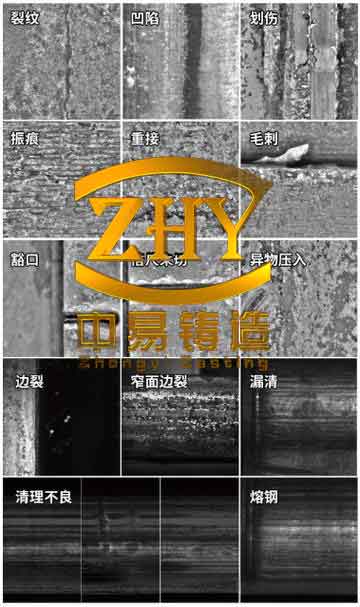
Let me share a visual example that illustrates typical sand casting defects encountered in such components:
In conclusion, preventing sand casting defects in low-alloy steel bucket teeth demands a disciplined approach: high-purity silica sand, rigorous mold compaction, appropriate use of coatings, controlled pouring conditions, and intelligent gating design. Sand casting defects, while common, are not inevitable. By understanding the mechanisms—both chemical and mechanical—we can systematically eliminate them and deliver castings that meet the stringent demands of excavator applications.