
As a casting engineer specializing in heavy machinery components, I’ve dedicated my career to optimizing production processes for critical excavator casting parts. The SWE18U excavator balance weight exemplifies the challenges we face: 445kg mass, minimum wall thickness of 20mm, and stringent export-quality requirements for dimensional accuracy (±1.5mm) and surface finish (Ra 6.3-12.5μm). Traditional resin sand casting delivered inconsistent results with low reclamation rates (below 60%), driving our transition to vacuum-sealed molding (V-process) technology at Zhengzhou Huichang Machinery.
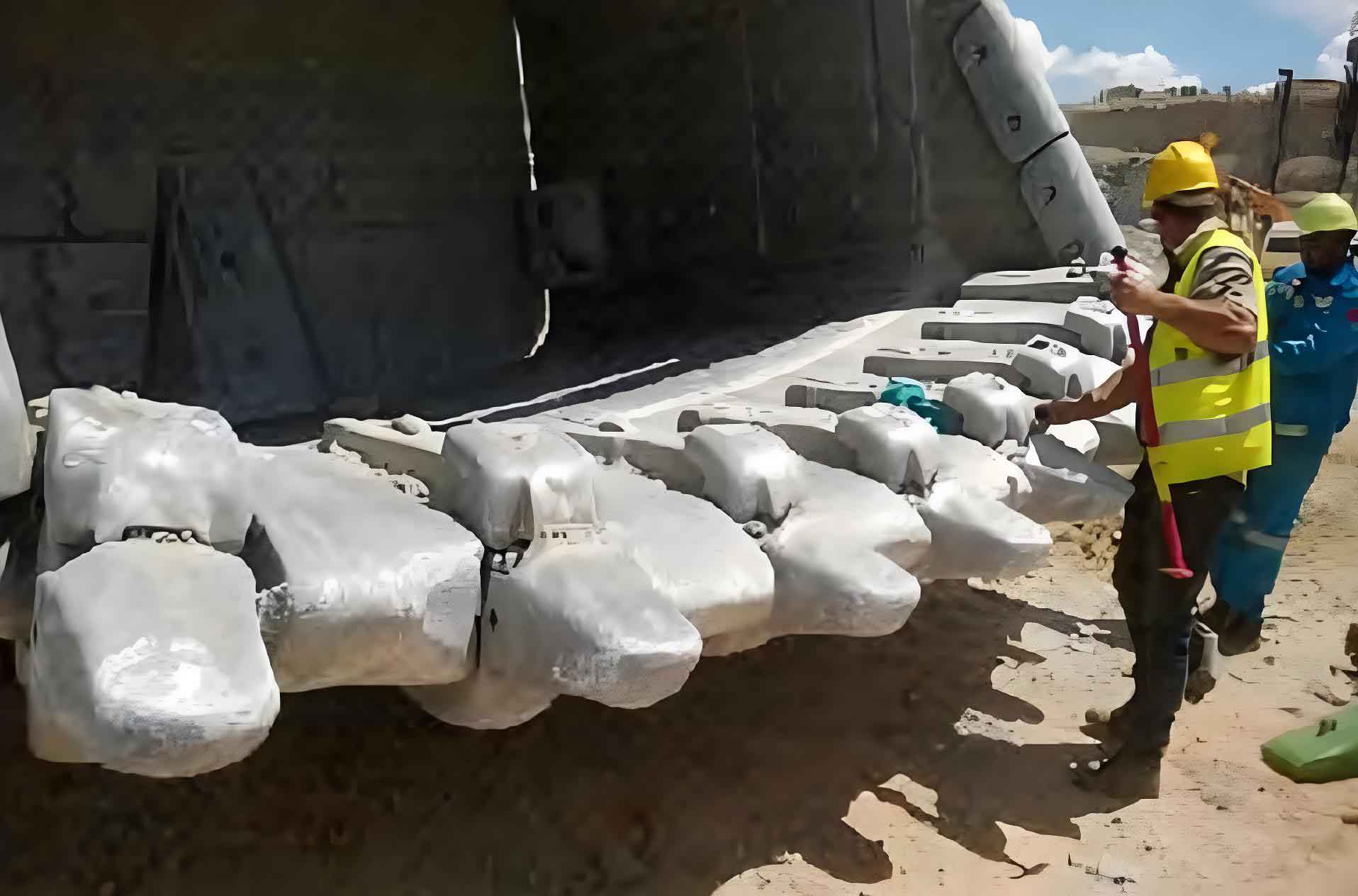
Our production system integrates specialized equipment configured for high-volume excavator casting part manufacturing:
| Equipment | Specification | Function |
|---|---|---|
| V-Process Molding Machine | Automated plastic film sealing | Mold cavity formation |
| Vacuum System | ≥55kPa operating pressure | Mold integrity maintenance |
| Specialized Flasks | 2500×1500×300/600mm (upper/lower) | Sand containment |
| 2-ton Induction Furnace | ≥1320°C pouring temperature | HT150 alloy melting |
The gating system design proved critical for defect-free excavator casting parts. We implemented a semi-choked system with cross-sectional area ratios governed by:
$$F_{\text{choke}} : F_{\text{runner}} : F_{\text{ingate}} = 1.2 : 1.4 : 1.0$$
With total ingate area = 16cm² distributed across 4 gates (4.0cm² each). Pouring time optimization followed the mass-flow relationship:
$$t = \frac{W}{\rho \cdot A \cdot v}$$
Where W=445kg, ρ=7100kg/m³ (iron density), A=total ingate area, v=flow velocity (0.5m/s empirically determined). Calculated pouring time: 35-40 seconds – crucial for minimizing turbulence in these large excavator casting parts.
Pattern design incorporated 1% shrinkage allowance (empirical value for HT150) and strategic parting line placement at maximum cross-section. Machining allowances (4mm on critical surfaces) and symmetric two-cavity layout doubled productivity while maintaining vacuum integrity. Core production used sodium silicate-bonded sand with vent tubes integrated into flask bars to prevent core lift during pouring – a critical innovation for thin-section excavator casting parts.
Process parameter control ensured metallurgical quality:
| Parameter | Value | Measurement Method |
|---|---|---|
| Vacuum Level | ≥55kPa | Digital manometer |
| Pouring Temperature | 1320-1350°C | Pyrometer |
| Solidification Time | 120 min minimum | Thermal simulation |
| Cooling Rate | ≤30°C/hour | Embedded thermocouples |
Mold coating application required precise moisture control to prevent gas defects. We monitored coating viscosity (35-45 seconds in Zahn cup #4) and implemented infrared drying (120°C for 15 minutes) achieving moisture reduction from 8.2% to 0.7% measured by:
$$\text{Moisture Content} = \frac{W_{\text{wet}} – W_{\text{dry}}}{W_{\text{dry}}} \times 100\%$$
For process stability, we adopted statistical process control from clay sand management practices. Daily measurement of 20 samples established key correlations for our V-process silica sand:
| Parameter Pair | Correlation Coefficient (R²) | Regression Equation |
|---|---|---|
| Compactability vs Moisture | 0.92 | C = 12.37M – 4.18 |
| Permeability vs LOI | -0.87 | P = 184 – 15.6L |
Where C=compactability (%), M=moisture content (%), P=permeability number, LOI=loss on ignition (%). These relationships proved equally valid for V-process sand when producing heavy-section excavator casting parts.
Production results from 20 trial castings demonstrated significant improvements over resin sand:
- Surface roughness improved by 1-2 grade (Ra 5.2μm average)
- Dimensional consistency: 99.3% within ±1.2mm tolerance
- Defect rate reduction: 0.5% vs 6.8% historically
- Sand reclamation rate: 92% vs 58% with resin sand
The economic impact for excavator casting part production was substantial. V-process reduced pattern costs by 40% (no specialized tooling required) and energy consumption by 28% (elimination of resin curing). Return on investment was achieved in 5.2 months based on:
$$\text{ROI} = \frac{\text{Annual Savings}}{\text{Implementation Cost}} \times 100\% = \frac{¥386,500}{¥185,000} \times 100\% = 209\%$$
This technology now forms our standard for complex excavator casting parts requiring superior surface finish and dimensional precision. The methodology has since been extended to eleven additional counterweight designs, consistently achieving export-quality standards while reducing production costs by 18-22% across all excavator casting part families.