
In the study of solidification and feeding mechanisms for cast iron parts, I often find myself drawing parallels with simpler physical systems to gain deeper insights. The behavior of water during cooling and freezing presents a fascinating analogy. Water contracts upon cooling from higher temperatures to around 4°C and then expands upon freezing at 0°C. This sequence of contraction followed by expansion mirrors the complex volume changes observed during the solidification of cast iron parts, where liquid shrinkage and solidification shrinkage are counteracted by graphitic expansion. This paper explores, from my perspective, how simulating water freezing under controlled conditions can inform and optimize feeding strategies for gray and ductile cast iron parts. By manipulating the proportions of cooling, freezing, and保温 sections in a water volume, we can minimize external feeding requirements—a principle directly transferable to designing efficient gating and risering systems for cast iron parts.
The foundational step in this analogical study is to understand the precise relationship between temperature, density, and specific volume for water. These properties dictate the magnitude of contraction and expansion at different stages. The data below comprehensively captures this relationship, serving as the basis for all subsequent calculations and simulations regarding volume changes.
| Temperature (°C) | Density (g/cm³) | Specific Volume (cm³/g) |
|---|---|---|
| -0 (Ice) | 0.917000 | 1.090 |
| +0 (Water) | 0.999840 | 1.0002 |
| 1 | 0.99998 | 1.0002 |
| 2 | 0.99940 | 1.0001 |
| 3 | 0.99964 | 1.0001 |
| 4 | 0.99972 ≈ 1.0 | 1.0000 |
| 5 | 0.99964 | 1.0001 |
| 10 | 0.9969 | 1.0004 |
| 20 | 0.99800 | 1.0020 |
| 30 | 0.995 | 1.0050 |
| 40 | 0.992 | 1.0080 |
| 50 | 0.988 | 1.0120 |
| 60 | 0.983 | 1.0170 |
| 70 | 0.977 | 1.0240 |
| 80 | 0.971 | 1.0300 |
| 90 | 0.965 | 1.0360 |
| 100 | 0.958 | 1.0440 |
This data can be mathematically represented. The specific volume, $v(T)$, is the reciprocal of density, $\rho(T)$. For a given mass $m$, the volume $V$ at temperature $T$ is:
$$ V(T) = m \cdot v(T) = \frac{m}{\rho(T)} $$
The volume change $\Delta V$ when cooling from an initial temperature $T_i$ to a final temperature $T_f$ (without phase change) is:
$$ \Delta V_{\text{cooling}} = m \left( v(T_f) – v(T_i) \right) = m \left( \frac{1}{\rho(T_f)} – \frac{1}{\rho(T_i)} \right) $$
For the phase change from water at 0°C to ice at 0°C, the expansion volume is:
$$ \Delta V_{\text{freezing}} = m \left( v_{\text{ice}} – v_{\text{water at 0°C}} \right) = m \left( \frac{1}{0.917} – \frac{1}{0.99984} \right) \approx m \times 0.0898 \, \text{cm}^3/\text{g} $$
This fundamental understanding is crucial for modeling the behavior of cast iron parts during solidification, where similar property changes occur.
Let’s consider a standard example: a cup containing 100 cm³ of water at 100°C. Its mass is:
$$ m = V(100^\circ \text{C}) \times \rho(100^\circ \text{C}) = 100 \, \text{cm}^3 \times 0.958 \, \text{g/cm}^3 = 95.8 \, \text{g} $$
If this water were to completely freeze, the final ice volume would be:
$$ V_{\text{ice}} = m \times v_{\text{ice}} = 95.8 \, \text{g} \times 1.09 \, \text{cm}^3/\text{g} = 104.4 \, \text{cm}^3 $$
This represents an overall expansion of 4.4 cm³ from the initial state. However, the path to this final state—the mode of cooling and freezing—dramatically affects the intermediate liquid level and the required external feeding, much like the solidification path affects shrinkage defects in cast iron parts.
Modes of Water Cooling and Freezing: Implications for Feeding
I will analyze two distinct modes to illustrate how process control influences feeding demand. The first mode represents an uncontrolled, simultaneous process, while the second demonstrates controlled, sequential stages.
Mode 1: Overall Simultaneous Cooling and Freezing
In this scenario, the entire water volume cools uniformly from 100°C to 4°C and then freezes uniformly at 0°C. This is analogous to a casting where all sections cool and solidify at the same rate, a situation often leading to significant feeding requirements for cast iron parts. The volume changes are summarized below.
| Condition | Initial State (100°C) | At 4°C (Before Freezing) | Final State (Ice at 0°C) |
|---|---|---|---|
| Without Feeding | Volume: 100 cm³ Mass: 95.8 g |
Volume: $m/\rho(4^\circ C)=95.8/1.0=95.8$ cm³ Mass: 95.8 g Liquid level drop: 4.2 cm³ |
Volume: 104.4 cm³ Mass: 95.8 g Expansion from initial: +4.4 cm³ |
| With Feeding to Maintain Liquid Level | Volume: 100 cm³ Mass: 95.8 g |
To maintain 100 cm³ at 4°C, mass needed: $100 \, \text{cm}^3 \times 1.0 \, \text{g/cm}^3 = 100$ g. Additional mass required: 100 – 95.8 = 4.2 g (4.4% of initial mass). Volume remains 100 cm³. |
This 100 g of water at 4°C freezes to: $100 \times 1.09 = 109$ cm³. Mass: 100 g. Final expansion: +9 cm³ from initial volume. |
The key finding is that to prevent a liquid level drop during the cooling phase, an external addition of 4.2 g (4.4% of initial mass) is mandatory. This added liquid is ultimately expelled during freezing, leading to increased final mass and potential deformation. This “process over-feeding” is highly inefficient. In the context of cast iron parts, this mode translates to requiring large risers to feed the initial liquid shrinkage, which may not be fully utilized if graphitic expansion occurs later, potentially causing swell or mold wall movement.
Mode 2: Sequential Partial Cooling, Freezing, and保温
This mode strategically staggers the cooling and freezing of different portions of the water volume. By ensuring that the expansion from freezing in one part occurs simultaneously with the contraction from cooling in another, the net volume change at the macro-scale can be minimized. This is the core principle of “balanced solidification” that can be applied to cast iron parts. I will explore two progressive examples.
Example A: Reducing Feeding Requirement
Consider dividing the initial 100 cm³, 95.8 g of water at 100°C into three controlled segments with a volume ratio of approximately 1:2:4.
- Segment 1: 14 cm³ (13.4 g)
- Segment 2: 29 cm³ (27.8 g)
- Segment 3: 57 cm³ (54.6 g)
The process is controlled in three stages:
- Stage 1: Only Segment 1 cools from 100°C to 4°C. Segments 2 & 3 remain at 100°C.
- Contraction of Segment 1: $\Delta V_1 = 13.4 \times (1.0000 – 1.0440) \approx -0.59 \, \text{cm}^3$.
- To keep the overall liquid level constant, we add 0.59 cm³ of water at 4°C (mass ~0.59 g). This is a feeding requirement of only ~0.6% of initial mass.
- After feeding, Segment 1 is 14 cm³, 14 g at 4°C.
- Stage 2: Segment 1 freezes (from 4°C to ice), while Segment 2 cools from 100°C to 4°C. Segment 3 remains at 100°C.
- Expansion of Segment 1 upon freezing: $\Delta V_{1f} = 14 \times (1.09 – 1.0000) = 14 \times 0.09 = 1.26 \, \text{cm}^3$.
- Contraction of Segment 2 upon cooling: $\Delta V_2 = 27.8 \times (1.0000 – 1.0440) \approx -1.22 \, \text{cm}^3$.
- The expansion (1.26 cm³) and contraction (1.22 cm³) occur concurrently and nearly cancel out, maintaining a stable liquid level without additional feeding.
- Stage 3: Segment 2 freezes, while Segment 3 cools from 100°C to 4°C.
- Expansion of Segment 2: $\Delta V_{2f} \approx 29 \times 0.09 = 2.61 \, \text{cm}^3$ (using volume approx.).
- Contraction of Segment 3: $\Delta V_3 = 54.6 \times (1.0000 – 1.0440) \approx -2.40 \, \text{cm}^3$.
- Again, concurrent expansion and contraction balance, maintaining liquid level.
- Finally, Segment 3 freezes, causing expansion, but no further cooling contraction exists to offset it. However, the liquid level does not drop at this final stage; it only rises due to the final expansion.
The total external feeding required was only the initial 0.59 g (0.6%), a drastic reduction from the 4.2 g needed in Mode 1. The final mass increase and potential deformation are correspondingly smaller. This staged control mimics an ideal feeding strategy for cast iron parts where graphitic expansion is harnessed to feed liquid shrinkage in adjacent sections.
Example B: Approaching Minimum Feeding
We can theoretically push this concept further by initiating the process with an infinitesimally small cooling portion. Suppose we divide the 95.8 g of water into $n$ equal microscopic parcels. Let the first parcel, with mass $\Delta m$, cool from 100°C to 4°C. Its contraction is:
$$ \Delta V_{\text{cont,1}} = \Delta m \left( v(4^\circ C) – v(100^\circ C) \right) = \Delta m (1.0000 – 1.0440) = -\Delta m \times 0.044 \, \text{cm}^3/\text{g} $$
To maintain the liquid level, we feed an equal volume of liquid at 4°C, mass $\Delta m_{feed} = |\Delta V_{\text{cont,1}}| \times \rho(4^\circ C) = \Delta m \times 0.044 \, \text{g}$. This represents a feeding requirement of $0.044 \Delta m / 95.8 \approx 0.046\%$ of the total mass if $\Delta m$ is very small.
Subsequently, when this first parcel freezes, its expansion is:
$$ \Delta V_{\text{exp,1}} = (\Delta m + \Delta m_{feed}) \times (v_{ice} – v_{water@0C}) \approx (\Delta m + 0.044\Delta m) \times 0.09 \approx 1.044\Delta m \times 0.09 = 0.094\Delta m \, \text{cm}^3 $$
This expansion can be designed to occur simultaneously with the cooling contraction of the next $k$ parcels from 100°C to 4°C. The total contraction of $k$ parcels is:
$$ \Delta V_{\text{cont,k}} = k \Delta m \times (-0.044) = -0.044k\Delta m \, \text{cm}^3 $$
For balance, we set $|\Delta V_{\text{cont,k}}| = \Delta V_{\text{exp,1}}$, solving for $k$:
$$ 0.044k\Delta m = 0.094\Delta m \Rightarrow k \approx 2.14 $$
This confirms the earlier observation: the freezing expansion of one unit mass can offset the cooling contraction of approximately two units of mass. By meticulously controlling the sequence so that at every moment the freezing expansion in one region balances the cooling contraction in another, the need for external feeding can be reduced to a theoretical minimum, approaching zero for the initial condition if the first cooling step is infinitesimal. This is the essence of the balanced feeding or均衡凝固 mode for cast iron parts. The governing principle can be expressed as a condition for self-feeding within a rigid container:
$$ \sum \left( \dot{V}_{\text{expansion}}(t) \right) \approx \sum \left( |\dot{V}_{\text{contraction}}(t)| \right) $$
where the sums are over all regions undergoing phase change and cooling, respectively, at time $t$.
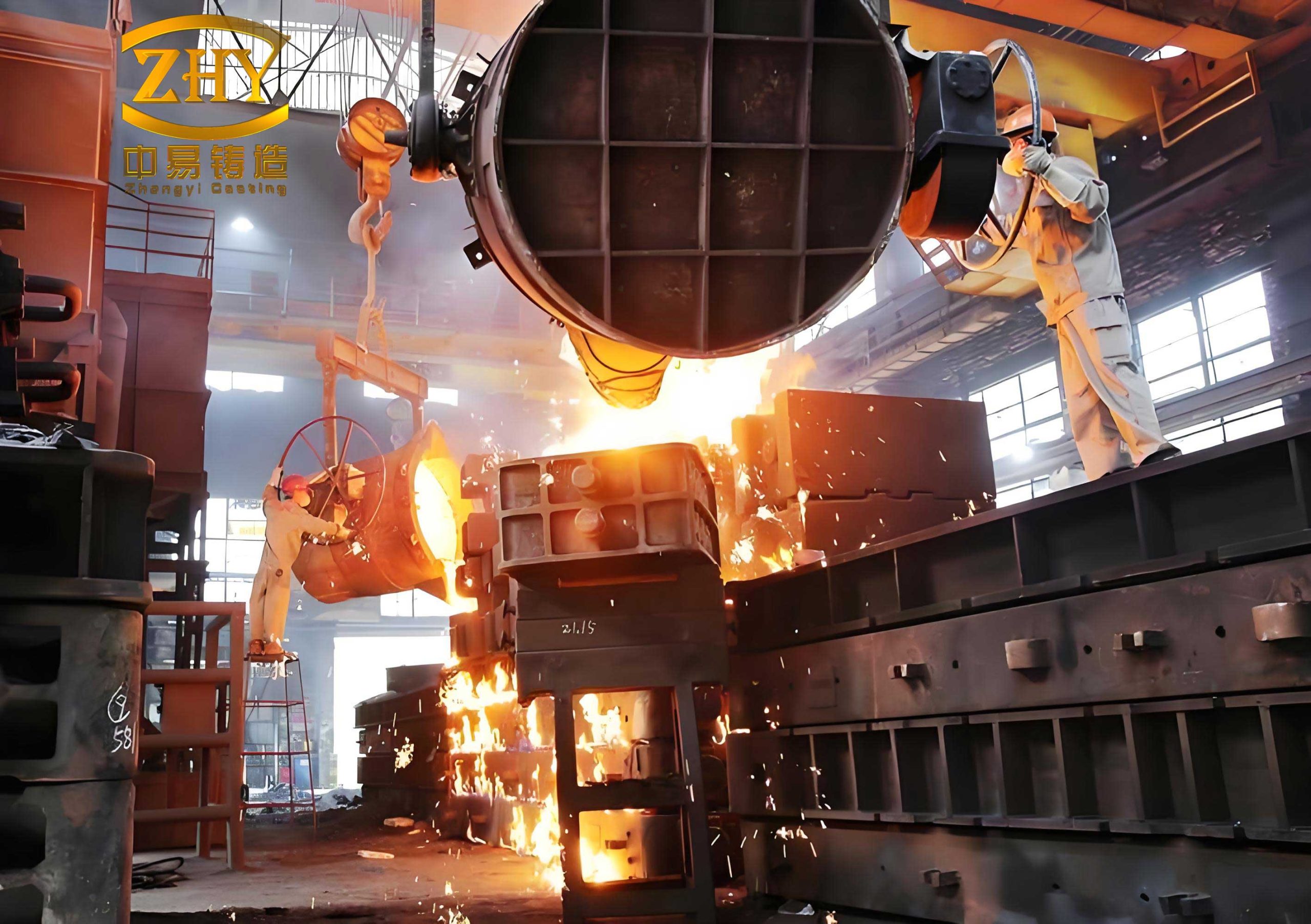
The visual above represents the intricate geometry and potential soundness achievable in well-fed cast iron parts. Achieving such quality requires translating the water simulation logic to the foundry floor for cast iron parts.
Translating Water Simulation Principles to Feeding of Cast Iron Parts
The analogy provides powerful directives for optimizing the casting of gray and ductile cast iron parts. The primary takeaway is that feeding efficiency is not solely about the total volume change but about the synchronization of contraction and expansion events during solidification.
For cast iron parts, the sequence involves:
- Liquid Cooling Contraction: The metal contracts as it cools from pouring temperature to the liquidus.
- Solidification with Graphitic Expansion: During eutectic solidification, the precipitation of graphite causes volumetric expansion, which can counteract shrinkage.
The net effect depends on timing. If graphitic expansion occurs after significant thermal contraction has already created isolated liquid pockets, shrinkage defects form. The goal is to orchestrate the process so that expansion feeds contraction in real-time.
The water model suggests several critical control parameters for cast iron parts:
1. Control of Cooling/Heating Zones (Analogous to保温): In the water model, maintaining parts of the volume at high temperature (保温) is essential for creating a reservoir of contracting liquid to balance freezing expansion. For cast iron parts, this translates to using insulating sleeves, exothermic riser toppings, or heated chills to create thermal gradients. These tools keep certain sections of the casting, or the feeding system itself, liquid longer. This ensures that when graphitic expansion begins in an early-solidifying zone, there is still adjacent liquid undergoing cooling contraction that can be fed by that expansion. Proper application of these materials directly around critical sections of cast iron parts can dramatically reduce the riser size needed.
2. Sequential Solidification Control (Analogous to Staged Freezing): The casting process must be designed to promote directional solidification, but one that is carefully modulated. Chills are used to accelerate cooling and initiate solidification at specific locations in cast iron parts. The water model shows that initiating solidification (freezing) in a small section first is beneficial if its expansion can be harnessed. Therefore, strategic placement of chills can trigger graphitic expansion in a controlled manner, using that expansion to draw liquid from still-molten areas rather than relying solely on external risers. The design challenge is to balance the chilling power to avoid premature total solidification in a section before its expansion can be utilized.
The required balance can be conceptualized with a formula for local volume balance in a casting. For a small volume element $\delta V$ of a cast iron part solidifying, the net volume change rate is:
$$ \frac{d(\delta V)}{dt} = \beta_s \cdot \dot{f_s} \cdot \delta V – \alpha_l \cdot \dot{T} \cdot \delta V + \nabla \cdot \vec{q} $$
Where $\beta_s$ is the solidification expansion coefficient (positive for graphitic cast iron), $f_s$ is the solid fraction, $\alpha_l$ is the liquid thermal contraction coefficient, $\dot{T}$ is the cooling rate, and $\nabla \cdot \vec{q}$ represents the net inflow of liquid from feeding. The ideal, self-feeding condition occurs when the first two terms cancel locally or across adjacent regions, minimizing $\nabla \cdot \vec{q}$.
3. The Paramount Importance of Mold Rigidity: The water simulation assumes a rigid container that does not yield under the pressure of freezing expansion. If the container walls expand, the internal volume increases, and the expanding ice simply fills this new space without pressurizing the remaining liquid to feed contraction. This is directly analogous to mold wall movement in sand casting of cast iron parts. If the sand mold lacks sufficient rigidity, the powerful graphitic expansion will push the mold walls outward instead of compensating for internal shrinkage. This leads to dimensional inaccuracy and internal shrinkage porosity despite the presence of expansion. Therefore, achieving high mold hardness through proper sand compaction, use of rigid mold aggregates, or even using metal molds (dies) for cast iron parts is a fundamental prerequisite for implementing the balanced feeding principle derived from the water model.
4. Metallurgical Quality as an Enabler: Water freezes at a precise 0°C. For cast iron parts, the onset, amount, and kinetics of graphitic expansion are not fixed; they depend on metallurgical factors. To maximize useful expansion:
- Carbon Equivalent (CE): A higher CE generally promotes more graphite formation and greater expansion. However, it must be optimized to avoid other defects like graphite flotation.
- Effective Inoculation: A fine, uniform distribution of graphite nodules (in ductile iron) or flakes (in gray iron) ensures that expansion occurs early and uniformly during eutectic solidification. Poor inoculation leads to undercooling, carbide formation, and reduced expansion.
- Charge Materials and Melting Practice: The presence of “inherited graphite” from high-quality pig iron or well-dissolved carbon additives can provide nucleation sites, promoting earlier and more consistent graphite precipitation, enhancing the self-feeding capability of the cast iron parts.
The efficacy of the feeding strategy for cast iron parts is therefore multiplied by good metallurgical practice, which ensures the predicted expansion actually materializes.
Practical Implementation Framework and Calculations for Cast Iron Parts
To move from analogy to practice, I propose a conceptual design framework. The water model’s variables have direct counterparts in casting process design for cast iron parts.
| Water Freezing Simulation Variable | Analogous Variable in Cast Iron Parts Solidification | Process Control Tool for Cast Iron Parts |
|---|---|---|
| Volume of water cooling from 100°C to 4°C | Volume of liquid metal undergoing thermal contraction | Gating system design; Insulating certain casting sections. |
| Volume of water freezing at 0°C | Volume of eutectic solidifying with graphitic expansion | Use of chills to initiate solidification; Control of cooling rates. |
| Volume of water kept at 100°C (保温) | Volume of hot metal kept liquid (thermal reservoir) | Insulating risers, exothermic sleeves, heated padding. |
| Rigid container walls | High rigidity mold (high hardness sand, metal die) | Sand compaction, use of additives, die design. |
| Mass of added water at 4°C | Mass of liquid metal fed from external risers | Riser size and placement calculation. |
| Ratio of freezing expansion to cooling contraction (~1:2) | Ratio of graphitic expansion volume to liquid contraction volume | Depends on CE, inoculation; typically expansion is 2-4%, contraction is 4-6%. |
Based on this, a simplified calculation for estimating the required external feed metal for cast iron parts can be derived. Let:
- $V_c$ = Volume of casting (cast iron parts)
- $\alpha_{l}$ = Volumetric liquid contraction coefficient from pouring temp to liquidus
- $\beta_{g}$ = Volumetric graphitic expansion coefficient during eutectic solidification
- $f_{sync}$ = Fraction of the casting volume where expansion and contraction are synchronized due to process control (0 ≤ $f_{sync}$ ≤ 1).
The net volume deficit requiring external feeding, $V_{feed}$, is:
$$ V_{feed} = V_c \cdot \alpha_{l} – V_c \cdot \beta_{g} \cdot f_{sync} $$
This must be positive. The mass to be fed is $M_{feed} = V_{feed} \cdot \rho_{liquid}$.
In the worst case (Mode 1 analogy, $f_{sync}=0$): $V_{feed} = V_c \cdot \alpha_{l}$. This is the traditional approach assuming no useful expansion.
In the best case (approaching Mode 2, $f_{sync} \rightarrow 1$): $V_{feed} = V_c (\alpha_{l} – \beta_{g})$. For many cast iron parts, $\beta_{g}$ can be 2-4% and $\alpha_{l}$ ~4-6%, so $V_{feed}$ could be as low as 1-2% of casting volume, or even zero if $\beta_{g} \geq \alpha_{l}$ for the synchronized portion.
The key is maximizing $f_{sync}$ through the control tools listed. This formula underscores why a one-size-fits-all riser calculation fails for cast iron parts; the effective feeding requirement is process-dependent.
Furthermore, the timing is encapsulated in the solidification profile. Modern simulation software for cast iron parts can track the solid fraction $f_s(x,y,z,t)$ and the associated shrinkage/expansion sources. The ideal process design aims to make the integral of the expansion source term over time and space match the integral of the contraction source term in adjacent regions, minimizing the need for long-range liquid flow from risers. This is computationally intensive but is the digital equivalent of the staged water experiment.
Conclusion: A Paradigm for Efficient Production of Cast Iron Parts
The simple act of observing and controlling how a cup of water freezes has yielded profound insights for the feeding design of cast iron parts. The central lesson is that the total volume change is less important than the spatiotemporal distribution of shrinkage and expansion events. By consciously designing the casting process to promote the simultaneous occurrence of graphitic expansion in one region and liquid cooling contraction in another—through the strategic use of chills, insulation, and a rigid mold—the dependence on large, inefficient external risers for cast iron parts can be drastically reduced. This leads to cast iron parts with higher yield, reduced weight gain from over-feeding, minimal distortion, and superior internal soundness.
The water model provides a clear mental framework: strive for the “partial cooling, partial freezing, partial保温” mode rather than the “simultaneous” mode. Achieving this in practice for complex cast iron parts requires a synergistic approach combining robust mold design, controlled thermal management, and impeccable metallurgical quality to ensure predictable and potent graphitic expansion. As foundries continue to seek efficiency and quality improvements, these principles derived from nature’s simple analogies will remain vital for advancing the science and art of producing sound cast iron parts.