
In the automotive industry, the crankshaft is a critical component responsible for converting reciprocating motion into rotational torque, thereby enabling power output in internal combustion engines. As such, it must withstand significant mechanical stresses, including torsional and bending fatigue, as well as impacts from connecting rods. To meet these demands, manufacturing processes must ensure high integrity and reliability. Among various methods, wet sand casting has emerged as a cost-effective and efficient technique for producing ductile iron crankshafts. This article delves into the wet sand casting process for automotive crankshafts, focusing on material selection,工艺 optimization, and defect mitigation. Throughout this discussion, the term “sand casting parts” will be frequently emphasized, as understanding the nuances of producing such components is key to enhancing quality and reducing costs in mass production.
The choice of material for crankshafts is pivotal, balancing mechanical properties with economic feasibility. Ductile iron, specifically grade QT900-2, is widely adopted due to its excellent combination of strength, ductility, and wear resistance. Compared to cast steel, ductile iron offers superior damping capacity and fatigue resistance, making it ideal for high-stress applications. The microstructure of ductile iron is characterized by spheroidal graphite nodules embedded in a ferritic or pearlitic matrix, which imparts enhanced toughness. The material’s performance can be tailored through alloying elements such as silicon, manganese, and copper. For instance, increasing silicon content improves fluidity and graphitization, while copper enhances hardness and strength. The chemical composition typically targets a carbon equivalent (CE) range of 4.2% to 4.6%, with carbon content between 3.6% to 3.9% and silicon from 1.8% to 2.2%. This optimization ensures that sand casting parts like crankshafts achieve the necessary mechanical properties, as described by the relationship for tensile strength (σ) and elongation (ε):
$$ \sigma = f(C, Si, Mg) \quad \text{and} \quad \varepsilon = g(\text{graphite nodularity}) $$
where C, Si, and Mg represent carbon, silicon, and magnesium contents, respectively. The nodularity of graphite, influenced by inoculation and cooling rates, directly affects ductility. In practice, rare-earth magnesium alloys are used as nodularizing agents to promote graphite spheroidization, with residual magnesium kept low (typically below 0.04%) to minimize shrinkage tendencies.
The wet sand casting process for crankshafts involves two main stages: sand mold preparation and pouring. The sand mixture, crucial for mold integrity, consists of a blend of new and recycled sand. A typical formulation includes 5% new sand by mass, with the remainder being reclaimed sand that has been conditioned to maintain consistency. Additives such as bentonite clay (4-6%) and water (3-5%) are incorporated to enhance green strength and plasticity. The properties of the sand mixture can be summarized in the following table:
| Component | Mass Percentage (%) | Function |
|---|---|---|
| New Sand | 5 | Provides fresh silica grains for surface finish |
| Reclaimed Sand | 95 | Reduces cost and environmental impact |
| Bentonite Clay | 4-6 | Binds sand particles for mold strength |
| Water | 3-5 | Activates clay and controls moisture |
| Carbonaceous Additives | 0.5-1 | Prevents burning-on and improves surface quality |
The mold is prepared using pattern plates that define the crankshaft’s geometry, with cores inserted to form internal passages. Compaction techniques, such as jolting or squeezing, ensure uniform hardness (typically 70-90 on the B-scale) to resist metal pressure during pouring. For crankshafts, a directional solidification approach is employed to facilitate feeding and reduce defects. The gating system is designed to promote progressive solidification from the extremities toward the feeders. A common scheme involves a bottom gating arrangement with filters at the ingates to trap inclusions, as illustrated in process layouts. The pouring temperature is critical, usually maintained between 1350°C to 1400°C for ductile iron, to ensure proper fluidity without excessive thermal shock. The solidification time (t) can be estimated using Chvorinov’s rule:
$$ t = k \left( \frac{V}{A} \right)^2 $$
where V is the volume of the casting, A is the surface area, and k is a constant dependent on mold material and metal properties. For sand casting parts, controlling this parameter is essential to avoid defects like shrinkage.
Defects in sand casting parts, particularly crankshafts, can compromise performance and lead to failures. The primary defects encountered in wet sand casting include sand inclusions, porosity, shrinkage cavities, and misruns. Each defect has distinct causes and requires targeted control measures. For sand casting parts, defect prevention starts with mold quality and extends through the entire pouring and solidification process.
Sand inclusions, often manifesting as sand holes or scabs on the casting surface, result from mold erosion or loose sand particles. This is prevalent in sand casting parts due to the abrasive flow of molten metal. To mitigate this, filters made of ceramic or refractory materials are placed in the gating system to capture debris. Additionally, secondary pouring practices involve严格控制 sand moisture and temperature uniformity. The sand’s compactness should be consistent, with a recommended green compression strength of 120-150 kPa. The risk of sand inclusion can be quantified by the erosion potential (E), given by:
$$ E = \frac{\rho_m v^2}{\sigma_s} $$
where ρ_m is the metal density, v is the flow velocity, and σ_s is the sand’s shear strength. Reducing flow velocity through enlarged gates and minimizing turbulence are effective strategies.
Porosity defects, primarily gas pores, arise from entrapped gases during solidification. In ductile iron, nitrogen from charge materials or air ingestion can form bubbles that become trapped. This reduces the load-bearing area and induces stress concentrations. For sand casting parts, controlling gas sources is paramount. Using low-nitrogen raw materials and ensuring adequate venting in the mold are crucial. The solubility of nitrogen in iron follows Sieverts’ law:
$$ [N] = k_N \sqrt{P_{N2}} $$
where [N] is the nitrogen concentration, k_N is a temperature-dependent constant, and P_{N2} is the partial pressure of nitrogen. By maintaining a reducing atmosphere and adding inoculants that act as gas scavengers, porosity can be minimized. Vent channels, especially in thick sections, facilitate gas escape.
Shrinkage cavities and micro-shrinkage (also known as shrinkage porosity) occur due to inadequate feeding during solidification. In sand casting parts like crankshafts, thermal gradients create hot spots that solidify last, leading to voids. These defects are often observed in junctions and heavy sections. To address this, chills and risers are strategically placed. Chills, made of iron or copper, extract heat locally to promote directional solidification, while risers supply molten metal to compensate for shrinkage. The feeding efficiency (η) of a riser can be expressed as:
$$ \eta = \frac{V_f}{V_r} \times 100\% $$
where V_f is the volume of feed metal required and V_r is the riser volume. For ductile iron, which exhibits graphitic expansion, increasing mold rigidity can counteract shrinkage by utilizing this expansion pressure. A summary of defect control measures for sand casting parts is provided in the table below:
| Defect Type | Primary Causes | Control Measures | Key Parameters |
|---|---|---|---|
| Sand Inclusions | Mold erosion, loose sand, high turbulence | Use of filters, controlled pouring speed, sand compaction | Flow velocity < 0.5 m/s, mold hardness > 80 B-scale |
| Porosity (Gas) | High nitrogen content, inadequate venting, moisture in sand | Low-nitrogen charges, vent design, sand drying | Nitrogen < 80 ppm, vent area = 1-2% of mold surface |
| Shrinkage Cavities | Poor feeding, thermal hot spots, low carbon equivalent | Risers and chills, high mold rigidity, optimized CE | Riser diameter = 1.5x section thickness, CE = 4.2-4.6% |
| Misruns | Low pouring temperature, inadequate gating | Increased superheat, enlarged gates, mold preheating | Pouring temperature > 1350°C, gating ratio 1:2:1.5 |
In practice, implementing these controls requires a holistic approach. For sand casting parts, process stability is achieved through rigorous monitoring of variables such as sand properties, metal chemistry, and cooling rates. Statistical process control (SPC) tools can be applied to track key indicators like defect rates and dimensional accuracy. The interaction between parameters can be modeled using response surface methodology (RSM) to optimize the process. For instance, the combined effect of pouring temperature (T) and mold hardness (H) on shrinkage can be represented by a quadratic equation:
$$ S = \beta_0 + \beta_1 T + \beta_2 H + \beta_3 T^2 + \beta_4 H^2 + \beta_5 TH $$
where S is the shrinkage volume, and β coefficients are determined empirically. Such models enable predictive control for sand casting parts, reducing trial-and-error adjustments.
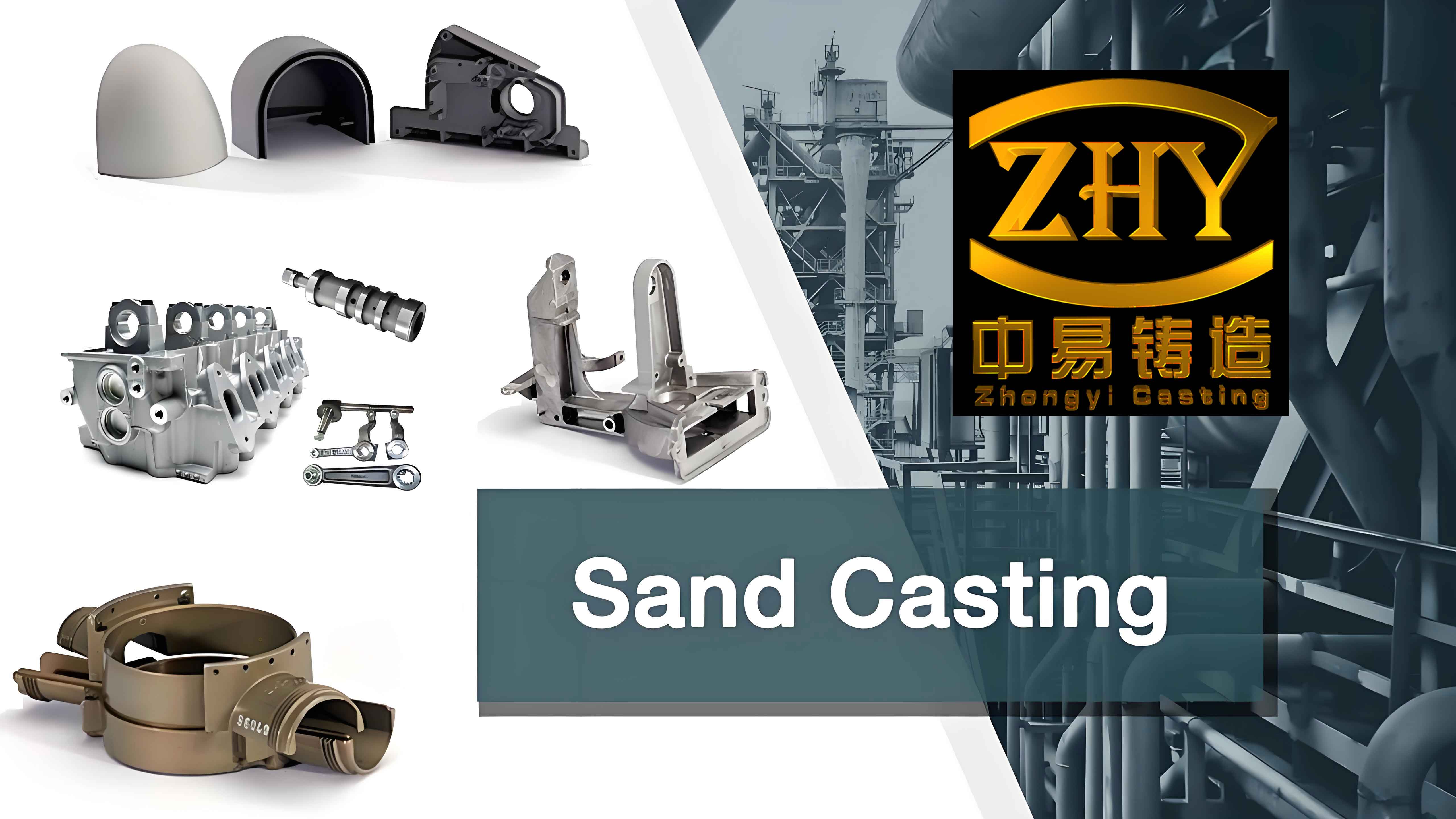
To visualize the typical appearance of sand casting parts, including surface features and potential defects, consider the following representation of a cast component. This image illustrates the complex geometry and finish achievable through wet sand casting, highlighting the importance of process refinement.
The integration of advanced technologies further enhances defect control in sand casting parts. Simulation software, such as finite element analysis (FEA), allows for virtual testing of mold filling and solidification, identifying potential defect zones before physical production. For crankshafts, simulations can predict thermal gradients and optimize riser placement. Additionally, real-time monitoring systems using infrared cameras track temperature distributions during pouring, enabling immediate corrections. The economic benefits of these advancements are significant, as they reduce scrap rates and improve the consistency of sand casting parts.
In conclusion, wet sand casting remains a viable and efficient method for manufacturing automotive crankshafts from ductile iron. By carefully selecting materials, optimizing工艺 parameters, and implementing robust defect control strategies, high-quality sand casting parts can be produced with minimal defects. The key lies in understanding the interplay between mold properties, metal behavior, and process dynamics. Through continuous improvement and adoption of modern technologies, the production of sand casting parts can achieve higher yields and lower costs, meeting the stringent demands of the automotive industry. This comprehensive approach ensures that crankshafts exhibit the necessary mechanical performance and durability, contributing to reliable engine operation.