
In our work at a sand casting foundry, we have deeply investigated the application of 3D sand printing technology for sand casting foundry operations. This technology, also known as Patternless Casting Manufacturing (PCM), integrates rapid prototyping into traditional resin sand casting processes. The mainstream approach is based on the 3DP (three-dimensional printing) process using micro-droplet jetting, which offers high efficiency, relatively low cost, and is suitable for large sand molds. In this article, we present a comprehensive analysis of the principles, processes, performance metrics, and selection criteria for 3D sand printers, all from the perspective of a sand casting foundry seeking to adopt this transformative technology. We will emphasize key terms such as sand casting foundry, and provide numerous tables and formulas to support our analysis.
1. Principle and Process of 3D Sand Printing for Sand Casting Foundry
The core principle of 3D sand printing in a sand casting foundry is to build up a sand mold layer by layer using a binder jetting mechanism. We start with a CAD model of the final casting part, then design the mold model, convert it to STL format, slice the STL file into thin cross-sectional layers, and use the slicing data to control the printer. During printing, a mixture of sand and catalyst is first spread evenly by a recoater. A print head then selectively jets a binder (typically low-nitrogen furan resin) onto the sand bed according to the slice pattern. The binder reacts with the catalyst, hardening the sand in the desired regions. After one layer is cured, the platform descends by one layer thickness, and the process repeats until the entire mold is formed. Unbound sand remains loose and can be easily removed, leaving a cavity that replicates the final casting shape. The mold is then coated, dried, and assembled for metal pouring.
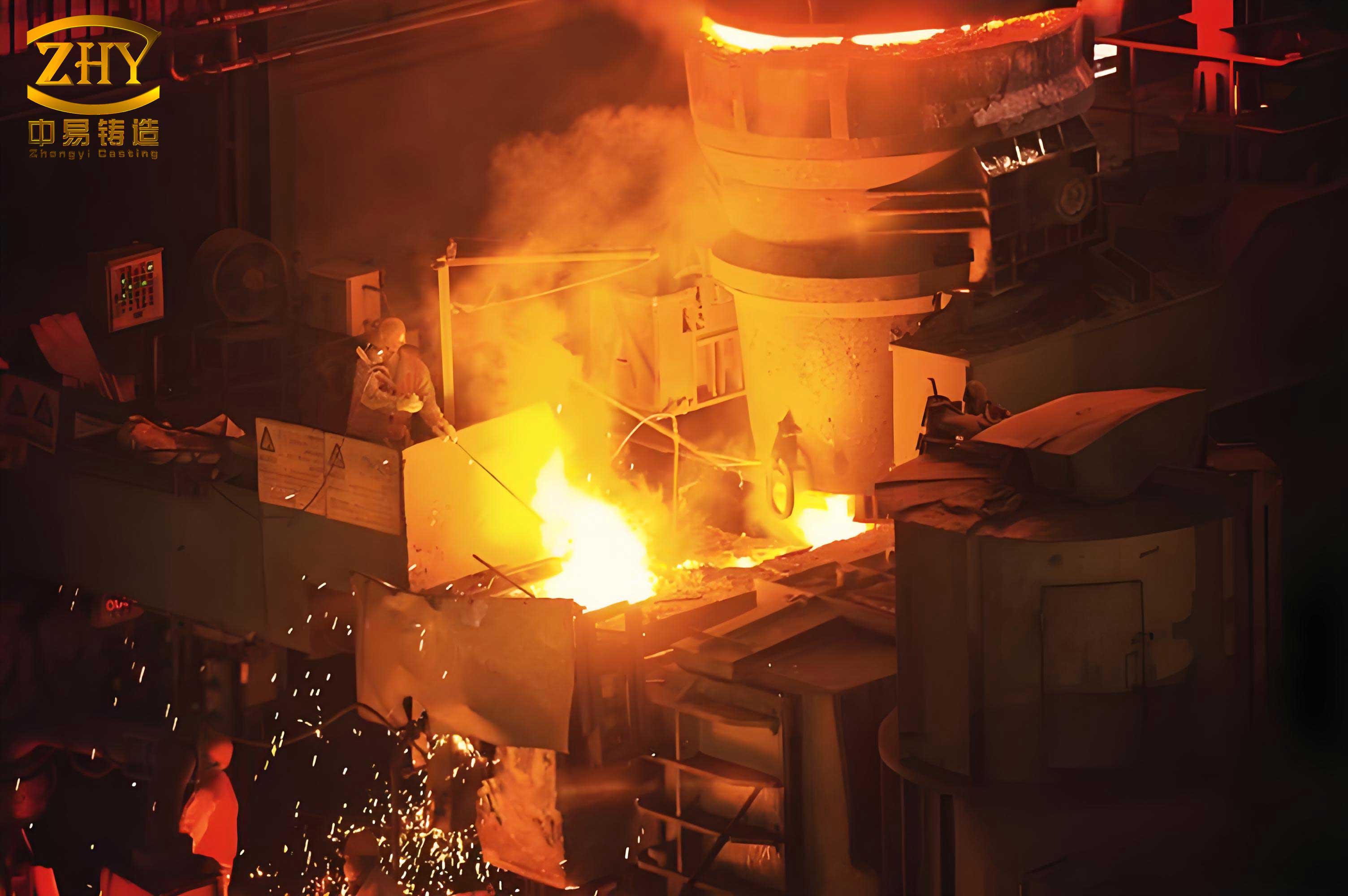
Figure below illustrates a typical 3D printed sand mold in a sand casting foundry:
We have summarized the key steps of the 3D sand printing workflow for a sand casting foundry in the following table:
| Step | Description |
|---|---|
| 1 | CAD modeling of the final casting part |
| 2 | Design of the casting pattern (mold model) |
| 3 | Conversion of mold model to STL format |
| 4 | Slicing of STL file into layers (generating layer files) |
| 5 | Printing of sand mold (layer-by-layer binder jetting) |
| 6 | Cleaning loose sand from the mold |
| 7 | Coating (e.g., spraying or dipping with refractory coating) |
| 8 | Drying and baking the coated mold |
| 9 | Clamping and assembling the mold halves (if needed) |
| 10 | Pouring molten metal into the mold |
| 11 | Cooling and shakeout (removing cast part) |
| 12 | Cleaning and inspection of the final casting |
2. Comparison Between 3D Sand Printing and Traditional Sand Casting Foundry Methods
To demonstrate the advantages of 3D sand printing in a sand casting foundry, we compare it with conventional resin sand molding (using patterns). The following table highlights key differences:
| Aspect | 3D Sand Printing (Patternless) | Traditional Pattern-Based |
|---|---|---|
| Mold making process | No physical pattern required; mold is printed directly from CAD | Requires a pattern (wood, metal, plastic) to form the mold |
| Lead time | Very short (3–5 days from CAD to casting) | Long (weeks to months depending on pattern fabrication) |
| Total cost (low volume) | Low for small batches or prototypes | High due to pattern cost and setup |
| Complexity freedom | Unlimited: undercuts, internal channels, complex geometries can be printed without draft angles | Limited: must have draft angles, undermines design flexibility |
| Worker skill requirement | Low: automated operation, minimal training needed (1 week) | High: requires skilled pattern makers and molders |
| Environmental impact | Low: less waste, less binder fume, cleaner workspace | Higher: sand and binder waste, emissions from pattern production |
| Dimensional accuracy | Typically ±0.1–0.3 mm (depends on sand and machine) | ±0.3–0.5 mm (pattern wear and manual variation) |
| Surface finish | Good, but may show layer steps (can be improved by coating) | Good if pattern is well-made |
In a sand casting foundry, the elimination of pattern storage and maintenance is a major benefit. Also, design modifications can be implemented quickly by simply updating the CAD model, without creating a new pattern. This flexibility is especially valuable for prototype development and small-batch production.
3. Key Performance Indicators of 3D Sand Printers for Sand Casting Foundry
When selecting a 3D sand printer for a sand casting foundry, we must evaluate several critical performance parameters. We list them in the next table along with typical values and units:
| Parameter | Description | Typical Range/Unit |
|---|---|---|
| Maximum build size (X × Y × Z) | Largest sand mold dimensions that can be printed | e.g., 1000×600×400 mm; up to 2500×1500×1000 mm |
| Layer thickness | Height of each printed layer | 0.2 – 0.5 mm (common: 0.28–0.3 mm) |
| Print head resolution (DPI) | Number of droplets per inch in X/Y direction | 300–1200 DPI (typical: 600 DPI) |
| Print speed (s/layer) | Time to complete one layer (including sand spreading, jetting, and auxiliary actions) | 15 – 60 s/layer (depends on area and complexity) |
| Build rate (L/h) | Volume of mold produced per hour | $$ V_{rate} = L_{max} \times W_{max} \times \Delta z \times N_{layers/hr} $$ where Nlayers/hr = 3600 / (time per layer in seconds) |
| Tensile strength of sand mold (MPa) | Measured on standard 8‑shaped test specimens | 0.8 – 2.5 MPa (depends on binder content and sand type) |
| Permeability (AFA) | Ability of mold to allow gases to escape | 100 – 300 AFA units (for resin sand) |
| Gas evolution (mL/g) | Volume of gas released when mold is heated | 5 – 15 mL/g (at 850°C) |
To compute the actual productivity for a given job in a sand casting foundry, we use the following formulas. The total printing time for one full build box (sand mold) is:
$$ T_{box} (hours) = \frac{H_{total}}{\Delta z} \times t_{layer} \times \frac{1}{3600} $$
where:
- \( H_{total} \) = total height of mold (mm)
- \( \Delta z \) = layer thickness (mm)
- \( t_{layer} \) = time per layer (seconds)
Then, the number of boxes printed per day (assuming \( T_{run} \) hours per day of operation) is:
$$ N_{boxes} = \frac{T_{run}}{T_{box}} $$
The volume of sand in one box is:
$$ V_{box} = L_{box} \times W_{box} \times H_{box} $$
But not all sand in the box becomes useful mold; we define a utilization factor \( \eta_{mold} \) (typically 30%–70% depending on mold geometry). The useful mold volume per box is:
$$ V_{mold,box} = V_{box} \times \eta_{mold} $$
Finally, the daily mold output (in liters) is:
$$ V_{daily} = N_{boxes} \times V_{mold,box} $$
To estimate daily metal cast production, we need the sand-to-metal ratio (e.g., for aluminum, sand:metal is typically 3:1 to 5:1; for iron, it can be 5:1 to 8:1). The daily casting weight is:
$$ W_{casting} (kg) = \frac{V_{daily} \times \rho_{sand}}{R_{sand/metal}} $$
where \( \rho_{sand} \approx 1.5 \text{ g/cm}^3 \) (1500 kg/m³) and \( R_{sand/metal} \) is the sand-to-metal ratio by mass.
4. Selection Criteria for 3D Sand Printer in a Sand Casting Foundry
Choosing the right 3D sand printer for a sand casting foundry requires balancing multiple factors. We suggest the following systematic approach based on our experience.
4.1 Productivity Evaluation
The printer’s speed and build rate directly affect throughput. For a sand casting foundry with high production demand, we should prioritize machines with high build rate (L/h). However, speed must not compromise quality. Compare build rates across different machines using a standard benchmark mold.
4.2 Economic Considerations
We list economic factors in the table below:
| Factor | Description |
|---|---|
| Consumable cost | Cost of sand (local silica vs. ceramic), binder (furan or inorganic), catalyst. Look for printers that accept locally sourced sand. |
| Material recycling | Ability to reuse unused sand (e.g., closed-loop sand handling, recovery of catalyst-treated sand). |
| Print head cost and lifespan | Print heads are the most expensive consumable. Prefer printers with fewer heads if they still meet speed requirements, or heads with longer lifespan. |
| Energy consumption | Power required for heating (if any), recoaters, and vacuum systems. |
| Maintenance complexity | Simplicity of replacing parts, availability of service from manufacturer. |
4.3 Automation and Ease of Use
In a modern sand casting foundry, we value features such as:
- One-click job setup: quick parameter selection (layer thickness, binder ratio, print speed) for different casting alloys.
- Automatic sand replenishment and recirculation.
- Remote monitoring and diagnostic capabilities.
- User-friendly software for STL repair, scaling, and slicing.
4.4 Special Requirements
Some sand casting foundries require advanced capabilities:
- Partial printing: ability to print only a section of the build box for small molds (large machine, small job).
- Enhanced local strength: printing with higher binder density in thin sections or cores.
- Multi-material printing: e.g., printing core with different sand than the mold.
4.5 Manufacturer Reputation and Support
Given that 3D sand printers are non-standardized equipment, we recommend choosing a manufacturer with:
- Proven track record in the sand casting foundry industry.
- Own intellectual property and continuous development.
- Responsive after-sales service and spare parts availability.
5. How to Determine the Right Machine Size for Your Sand Casting Foundry
We recommend analyzing your product portfolio: collect the dimensions of all typical sand molds (including cores) for your castings. Plot a histogram of maximum mold length, width, and height. Then select a machine whose build volume covers at least 80%–90% of your molds. If a few very large molds are needed occasionally, consider outsourcing or using a larger machine. The build volume should be matched to your typical batch sizes; for a sand casting foundry making large engine blocks, a big format machine (e.g., 2.5×1.5×1.0 m) may be essential, whereas a job shop making small valves can use a compact machine (e.g., 1.0×0.6×0.4 m).
6. Productivity Calculation Example for a Sand Casting Foundry
Let us present a concrete example to illustrate the formulas. Suppose we have a sand casting foundry that uses a 3D sand printer with the following specs:
- Build box: 1200 mm × 800 mm × 600 mm (length × width × height)
- Layer thickness: 0.3 mm
- Time per layer: 20 seconds
- Machine runs 20 hours per day (2 shifts)
- Mold utilization factor (η_mold): 50% (typical for a complex mold with cavities)
- Sand-to-metal ratio: 4:1 (by mass) for aluminum castings
- Sand density: 1.5 g/cm³ = 1500 kg/m³
First, total layers per box:
$$ N_{layers} = \frac{H_{box}}{\Delta z} = \frac{600\ \text{mm}}{0.3\ \text{mm}} = 2000\ \text{layers} $$
Print time per box:
$$ T_{box} = 2000\ \text{layers} \times 20\ \text{s} = 40000\ \text{s} = 11.11\ \text{hours} $$
Boxes per day:
$$ N_{boxes} = \frac{20\ \text{h}}{11.11\ \text{h}} \approx 1.8\ \text{boxes/day} $$
Volume of sand in one box (full):
$$ V_{box} = 1.2 \times 0.8 \times 0.6 = 0.576\ \text{m}^3 = 576\ \text{L} $$
Useful mold volume per box:
$$ V_{mold,box} = 576 \times 0.5 = 288\ \text{L} $$
Daily useful mold volume:
$$ V_{daily} = 1.8 \times 288 = 518.4\ \text{L} $$
Mass of sand used daily:
$$ M_{sand} = 518.4\ \text{L} \times 1.5\ \text{kg/L} = 777.6\ \text{kg} $$
Metal casting output (assuming 4:1 sand-to-metal ratio):
$$ M_{casting} = \frac{777.6}{4} = 194.4\ \text{kg} $$
This example shows that even a moderate-sized printer can produce nearly 200 kg of aluminum castings per day. For a sand casting foundry producing larger parts, the numbers scale accordingly.
7. Environmental and Sustainability Aspects in Sand Casting Foundry
3D sand printing aligns well with green casting initiatives in a sand casting foundry. Traditional resin sand casting generates waste sand, binder fumes, and used patterns. With 3D printing, we can:
- Reduce sand usage by printing only the mold walls (hollow cores reduce waste).
- Recycle loose sand: up to 90% of the unbound sand can be reused after sieving.
- Eliminate pattern storage and disposal.
- Use environmentally friendly binders: inorganic binders (e.g., water-glass or cement-based) are being developed for 3D printing to completely avoid organic emissions.
The following table compares emission levels in a sand casting foundry:
| Parameter | Traditional Resin Sand Casting | 3D Sand Printing (Furan Binder) | 3D Sand Printing (Inorganic Binder) |
|---|---|---|---|
| Binder VOC emissions (g) | 2–5 | 1–3 | Negligible |
| Waste sand (kg) | 0.5–1.0 | 0.1–0.3 (recycled) | 0.1–0.3 |
| Pattern material waste | 0.1–0.5 kg (wood/plastic) | 0 | 0 |
| Energy consumption (kWh) | 1–2 (pattern making + molding) | 1.5–3 (printing + curing) | 1.0–2.0 (no thermal curing needed) |
8. Future Trends in 3D Sand Printing for Sand Casting Foundry
Based on our observations, the following developments will further strengthen 3D sand printing in sand casting foundry:
- Higher productivity: Multi-head printing arrays and faster recoating mechanisms (target: < 10 seconds per layer for large areas).
- Inorganic binders: Commercial availability of stable inorganic binder systems that are corrosion-free and environmentally benign.
- Integrated lines: Fully automated production cells combining 3D printing, coating, drying, and pouring in a sand casting foundry.
- Digital twin integration: Real-time simulation of mold filling and solidification to optimize mold design before printing.
9. Conclusion
We have shown that 3D sand printing technology brings significant advantages to the sand casting foundry, especially for prototyping, complex geometries, and small-to-medium batch production. The technology is already mature enough for reliable daily use. When selecting a 3D sand printer, a sand casting foundry must carefully evaluate productivity, economic factors, automation, manufacturer support, and most importantly, match the printer size to its typical mold dimensions. We have provided formulas and tables to assist in quantitative analysis. As the technology evolves, we expect even wider adoption across the sand casting foundry industry, driven by cost reduction, environmental benefits, and design freedom.
In summary, we recommend that any sand casting foundry considering 3D sand printing should first perform a comprehensive analysis of its product mix, then select a printer that offers the best balance of speed, cost, and flexibility. With proper implementation, 3D sand printing can transform a traditional sand casting foundry into a highly efficient, sustainable, and innovative manufacturing hub.