
The structural complexity of vacuum wheel rim castings for commercial and engineering vehicles demands high precision in wall thickness uniformity, surface quality, and mechanical properties. This article details the implementation of lost foam casting (LFC) technology to address these challenges while optimizing production efficiency and cost-effectiveness. Through systematic process design, numerical simulation validation, and empirical verification, we demonstrate how LFC achieves superior results compared to conventional sand casting methods.
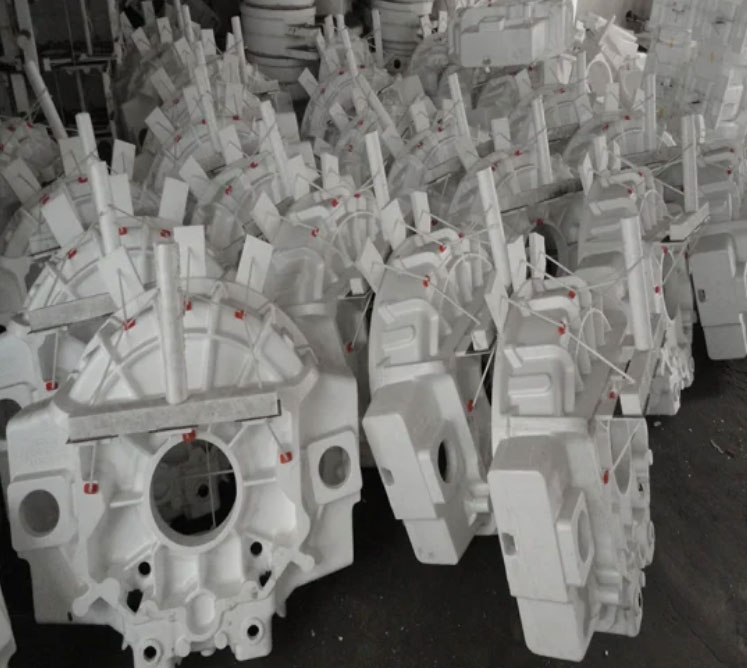
1. Process Design Fundamentals
For the QT450-15 nodular iron vacuum wheel rim (mass: 60 kg, wall thickness: 10-15 mm), the lost foam casting process eliminates traditional core-making requirements through strategic pattern design. Key features include:
| Feature | Conventional Casting | Lost Foam Casting |
|---|---|---|
| Peripheral groove formation | Requires sand cores | Direct pattern replication |
| Venting holes | Post-cast machining | As-cast formation |
| Dimensional tolerance | CT12-14 | CT8-10 |
The EPS pattern density optimization follows the relationship:
$$ \rho_{EPS} = \frac{m}{V} \times k_t $$
Where \( \rho_{EPS} \) = expanded polystyrene density (26-32 g/L), \( m \) = bead mass, \( V \) = mold volume, and \( k_t \) = thermal expansion coefficient (1.15-1.25).
2. Critical Process Parameters
Through numerical simulation and physical experiments, we established optimal process windows:
| Parameter | Value Range | Optimized Value |
|---|---|---|
| Pouring temperature | 1,420-1,480°C | 1,450±10°C |
| Vacuum pressure | 0.03-0.07 MPa | 0.05±0.01 MPa |
| Pattern coating thickness | 0.8-1.5 mm | 1.2±0.2 mm |
The vacuum-assisted filling velocity follows:
$$ v = \sqrt{\frac{2(P_v – P_a)}{\rho}} $$
Where \( P_v \) = vacuum pressure, \( P_a \) = atmospheric pressure, and \( \rho \) = molten iron density (7,000 kg/m³).
3. Solidification Control Strategy
Using MagmaSoft simulations, we optimized the feeding system to prevent shrinkage defects:
| Location | Niyama Criterion (℃·min¹/²/mm) | Optimized Value |
|---|---|---|
| Rim section | >1.0 | 1.25-1.45 |
| Bolt holes | >0.8 | 0.95-1.15 |
The solidification time differential between adjacent sections must satisfy:
$$ \Delta t = t_{feeder} – t_{casting} \geq 25\% $$
Ensuring proper directional solidification throughout the casting.
4. Quality Validation
Final product testing confirmed the effectiveness of the lost foam casting approach:
| Property | Requirement | Actual Result |
|---|---|---|
| Tensile strength | ≥450 MPa | 485-510 MPa |
| Elongation | ≥15% | 18-22% |
| Surface roughness | Ra ≤25 μm | Ra 12-18 μm |
This comprehensive development of lost foam casting technology demonstrates significant advantages in producing complex safety-critical automotive components, achieving both technical superiority and economic benefits through reduced machining requirements and improved material utilization.