
This article presents an optimized lost foam casting process for manufacturing ultra-high chromium alloy impellers under acid corrosion environments. Through alloy composition refinement, advanced gating system design, and grain refinement strategies, defect-free castings with enhanced wear-corrosion resistance were achieved.
1. Chemical Composition Optimization
The alloy design focuses on achieving balanced carbide distribution and matrix stability. Key elements were selected based on their metallurgical functions:
| Element | Function | Content Range (wt%) |
|---|---|---|
| C | Carbide formation | 2.5–3.2 |
| Cr | Corrosion resistance | 33.0–45.0 |
| Mo | High-temperature stability | 0.5–3.0 |
| Ni | Austenite stabilization | 3.0–6.0 |
| Cu | Corrosion potential enhancement | 1.0–3.5 |
| Ce | Grain refinement | 0.03–0.1 |
The phase composition after heat treatment follows:
$$ V_{carbide} = 30\%,\ V_{ferrite} = 45\%,\ V_{austenite} = 25\% $$
where carbide morphology consists of M23C6 with limited M7C3 phases.
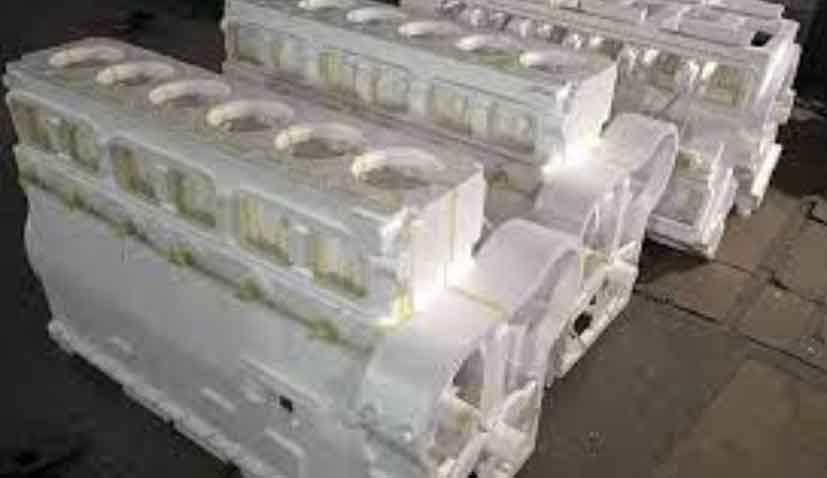
2. Lost Foam Casting Process Design
2.1 Gating System Configuration
The bottom-gating system was designed using rapid filling theory for lost foam casting:
- Cross-sectional area ratio: 1.3–2.2× conventional sand casting
- Pouring temperature: 1,440°C ± 10°C
- Vacuum pressure: 0.04–0.06 MPa
The filling velocity (v) follows:
$$ v = \frac{Q}{A} = \frac{\sqrt{2gH}}{\sqrt{1 + f\frac{L}{D}}} $$
where Q = flow rate, A = gating area, H = metallostatic head, f = friction factor.
2.2 Riser Design Strategy
Multi-riser system addresses shrinkage and thermal stresses:
| Parameter | Value |
|---|---|
| Riser neck ratio | 1.05–1.15× hot spot |
| Riser diameter | 3.5–5× hot spot |
| Riser height | 1.2–1.5× diameter |
Solidification control equation:
$$ t_f = B\left(\frac{V}{A}\right)^2 $$
where tf = solidification time, B = mold constant, V/A = modulus.
3. Grain Refinement Techniques
3.1 Embedded Chilling System
Precision-designed steel sleeves (45#淬火态) were incorporated as internal chills:
- Wall thickness: 15–20 mm
- Contact surface roughness: Ra 6.3–12.5 μm
- Cooling capacity: 2.3–3.5× conventional sand mold
3.2 Inoculation Treatment
Two-stage inoculation was implemented:
- Ce-based rare earth (0.08–0.12 wt%) bottom inoculation
- High-carbon FeCr (0.6–1.2 mm granules) stream inoculation
Grain size refinement follows Hall-Petch relationship:
$$ \sigma_y = \sigma_0 + \frac{k}{\sqrt{d}} $$
where σy = yield strength, d = grain diameter, σ0 and k = material constants.
4. Process Validation
The lost foam casting process demonstrated:
| Parameter | Value |
|---|---|
| Surface roughness | Ra 12.5–25 μm |
| Dimensional accuracy | CT8–CT9 |
| Defect rate | < 0.8% |
| Service life | > 6,000 hrs (pH=1–2) |
The success of this lost foam casting development lies in synergistic optimization of:
- Alloy chemistry for corrosion-wear balance
- Gating/riser design addressing foam decomposition effects
- Multi-stage grain refinement mechanisms
This approach establishes a technical foundation for manufacturing complex corrosion-resistant components via lost foam casting, particularly suitable for mining and metallurgical applications requiring combined erosion and chemical resistance.