
In modern foundry practice, the lost foam casting process has emerged as a transformative technology, often hailed as a “green revolution” in the industry due to its minimal environmental impact and ability to produce near-net-shape components with exceptional dimensional accuracy. As a practitioner deeply involved in advancing this methodology, I have witnessed firsthand its evolution and the specific challenges associated with scaling it for large, intricate castings. This article delves into a detailed, first-person account of our extensive work in refining the lost foam casting process, focusing on critical aspects such as coating formulation, gating system design, and molding techniques. Our goal is to share insights that demonstrate the robustness and viability of the lost foam casting process for heavy-section components, moving beyond theoretical discourse into practical, proven applications.
The foundational principle of the lost foam casting process is deceptively simple: a foam pattern, typically made of expanded polystyrene (EPS), is coated with a refractory layer, embedded in unbonded sand, and then replaced by molten metal during pouring. However, for large castings weighing several tons, this simplicity belies a complex interplay of thermal, mechanical, and chemical factors. The successful implementation of the lost foam casting process at this scale requires a meticulous, systems-based approach. Failures such as collapse (often called ‘crush’ or ‘cave-in’), shrinkage defects, sand penetration, and surface imperfections like folds or lustrous carbon formation are common pitfalls. Our journey has been one of systematic problem-solving, where each element—from foam selection to post-casting cooling—was analyzed and optimized. The lost foam casting process, when mastered, offers unparalleled advantages: significant reduction in machining allowances, consolidation of assembled parts into a single casting, and drastic improvements in production efficiency and floor space utilization compared to traditional resin sand or green sand methods.
Before delving into the technical specifics, it is crucial to understand the type of component that drove our innovations. We focused on a large, structurally complex ductile iron casting (similar to QT400-5), with variable wall thicknesses, internal passages, and integrated features that would traditionally require separate fabrication and assembly. The sheer mass and geometry presented a perfect testbed for pushing the boundaries of the lost foam casting process. Redesigning the component for this process was a collaborative effort, aiming to exploit its unique capability to cast intricate details directly, thereby eliminating several downstream manufacturing steps. This synergy between design and process is a hallmark of advanced lost foam casting process applications.
Pattern Manufacturing: The First Critical Pillar of the Lost Foam Casting Process
The integrity of the final casting in the lost foam casting process is fundamentally tied to the quality and stability of the foam pattern. For large castings, pattern manufacturing is not merely a replication step but a precision engineering task.
EPS Material Selection: The density of the EPS foam is a primary variable. Through extensive experimentation, we evaluated a spectrum of densities. Higher density foams (e.g., above 20 g/L) offer superior mechanical strength, reducing the risk of distortion during handling, coating, and sand filling. However, they come with a significant drawback: a higher gas evolution rate during metal pouring. This excessive pyrolysis gas can overwhelm the coating’s permeability and the vacuum system, leading to violent reactions, casting defects like severe folds, and increased lustrous carbon defects. Conversely, very low-density foams (below 16 g/L) minimize gas generation but lack the structural rigidity needed for large patterns, making them prone to warping and handling damage. Our empirical data led us to a optimum range of 17 to 18.5 g/L. This balance provides sufficient pattern strength for the rigors of the lost foam casting process while keeping gas evolution at a manageable level. The relationship between foam density ($\rho_{EPS}$) and gas volume ($V_{gas}$) at a given pouring temperature ($T_{pour}$) can be conceptually modeled, though it is complex and dependent on specific polymer composition:
$$ V_{gas} \propto \rho_{EPS} \cdot f(T_{pour}, t) $$
where $t$ represents time. Controlling this variable is the first step in ensuring a stable lost foam casting process.
Pattern Fabrication and Assembly: Given the component’s complexity and size, monolithic pattern production was impossible. We employed a strategic segmentation approach. Using 3D CAD software (e.g., Solidworks), the digital model was decomposed into a logical assembly of manageable sub-sections—three primary blocks further divided into over a dozen smaller pieces. Each segment was then translated into 2D cutting paths for a computer-numerical-control (CNC) foam cutting machine. This technology ensures dimensional accuracy and excellent surface finish, which is critical for the final casting quality in the lost foam casting process. Assembly of these segments is a skilled operation. We utilized a specially formulated hot-melt adhesive, a blend of microcrystalline wax and EVA copolymer, applied by experienced technicians. The adhesive must set rapidly, provide strong bonding strength, and leave minimal residue that could affect the coating or metal flow. Critical areas susceptible to deformation, such as long, thin sections or large flat planes, were reinforced with internal polystyrene ribs or external plastic/metal braces. This reinforcement is essential to maintain geometric fidelity during the subsequent coating and sand compaction stages of the lost foam casting process.
Coating Technology: The Engineered Barrier in the Lost Foam Casting Process
Perhaps no element is more critical to the success of the lost foam casting process for large castings than the refractory coating. It serves multiple, often conflicting functions: it must be impermeable enough to prevent sand penetration, yet permeable enough to allow the rapid escape of foam pyrolysis gases; it must have sufficient green strength to handle, yet high dry and hot strength to resist metal static and dynamic pressure; it must adhere perfectly to the foam and sinter appropriately at metal temperatures. For our large-scale application, standard commercial coatings were insufficient. We therefore developed a proprietary, water-based coating system whose formulation is central to our successful lost foam casting process.
Coating Composition and Rationale: Our coating is based on a blend of refractory fillers, binders, and additives. The key innovation lies in the binder system and the inclusion of specific functional materials. The primary refractory filler is a 200-mesh calcined alumina (Al$_2$O$_3$), chosen for its high refractoriness and stability. To this, we add a significant proportion of 200-mesh graphite powder. The graphite serves two vital purposes: First, it dramatically increases the coating’s thermal shock resistance and refractoriness, effectively solving the problem of metal penetration and burn-on (sand sintering) on thick sections. Second, graphite provides a degree of lubricity and may help in reducing lustrous carbon defects by altering the carbon potential at the metal-coating interface. The binder system is dual-purpose: an organic temporary binder (a styrene-acrylic copolymer) provides green strength for handling, and an inorganic permanent binder (a phosphate-based compound) develops high-temperature strength. The inorganic phosphate binder undergoes chemical reactions upon heating, forming strong ceramic bonds that give the coating exceptional resistance to erosion and mechanical failure during the intense thermal and mechanical stresses of the lost foam casting process. Additives such as sodium carboxymethyl cellulose (CMC) and bentonite control rheology, suspension, and crack resistance, while a wetting agent ensures complete and uniform coverage of the hydrophobic EPS surface.
The precise composition by weight percentage is summarized in Table 1. It’s important to note that these ranges allow for adjustment based on specific pattern geometry and alloy.
| Component | Function | Weight Percentage Range (%) | Key Property Influenced |
|---|---|---|---|
| Calcined Alumina (200 mesh) | Primary Refractory | 55 – 65 | Refractoriness, Stability |
| Graphite Powder (200 mesh) | Secondary Refractory/Lubricant | 15 – 20 | Thermal Shock, Anti-penetration |
| Inorganic Phosphate Binder | High-Temp Binder | 3 – 7 | Hot Strength, Erosion Resistance |
| Organic Polymer Binder | Green Strength Binder | 1.5 – 4 | Handleability, Adhesion |
| CMC | Thickener/Stabilizer | 1 – 2 | Viscosity, Crack Prevention |
| Bentonite | Rheology Modifier | 1.5 – 3 | Suspension, Plasticity |
| Wetting Agent | Surfactant | 1 – 2 | Coating Uniformity |
| Water | Carrier | Balance | Vehicle for Application |
Coating Preparation and Application: The preparation protocol is rigorous. The CMC and bentonite are pre-hydrated in a portion of the water for at least 24 hours to achieve full gelation. The refractory powders (alumina and graphite) are then added to the mixer with the remaining water, followed by the pre-gelled additives. This slurry is mixed at high shear for a minimum of 60 minutes to achieve perfect de-agglomeration and homogenization. Finally, the inorganic phosphate binder is introduced and mixed for an additional 45 minutes. The completed slurry is then aged for 24 hours; this aging period allows for complete hydration and stabilization of rheological properties, which is critical for consistent performance in the lost foam casting process.
Coating application is performed via a controlled flow or “rain” dipping method. The large pattern is placed on a dedicated fixture, and the coating is poured over it, ensuring all surfaces, including deep recesses, are coated without air entrapment. Drainage holes are strategically placed in the pattern’s base to prevent pooling. We apply multiple layers—typically four—with thorough drying between each. Drying is conducted in a temperature-controlled chamber at 45-50°C. The final dried coating thickness is a critical parameter. For large castings, a thicker coating might seem beneficial for strength, but it can impede gas permeability. Our formulation allows for a relatively thinner coating (1.0-1.5 mm) while maintaining exceptional strength, thanks to the phosphate binder. The relationship between coating thickness ($\delta$), permeability ($k$), and hot strength ($S_h$) can be considered a key performance indicator (KPI) for the lost foam casting process:
$$ \text{Coating Performance Index (CPI)} \approx \frac{S_h \cdot k}{\delta} $$
We aim to maximize this index. After the final coat and a prolonged drying cycle (e.g., 24 hours), any drainage holes are plugged with EPS pieces and spot-coated.
Gating System Design and Molding: Orchestrating the Lost Foam Casting Process
The design of the gating and feeding system in the lost foam casting process is fundamentally different from conventional casting. It must account for the gradual, endothermic decomposition of the foam and the resulting gas dynamics. For our large, horizontally oriented casting with a thick base section, the primary risk was a phenomenon akin to “cascade collapse.” If the metal front advances too slowly, a large area of foam is simultaneously heated to its decomposition point, generating a massive volume of gas that can instantaneously depressurize the mold cavity, leading to a catastrophic sand collapse (‘crush’ or ‘cave-in’), even with a strong coating and applied vacuum.
Innovative Gating Strategy: To mitigate this, we abandoned single-sprue designs in favor of a multiple-sprue system. Specifically, we employed a dual-sprue configuration. Both sprues share a common pouring basin for operator convenience. Each sprue feeds into its own distributed runner network, which then connects to strategically placed ingates along the length of the casting’s base. This design serves to increase the total metal flow rate into the cavity, effectively shortening the fill time and reducing the volume of foam being pyrolyzed at any given instant. The fill time ($t_{fill}$) can be approximated using a modified Bernoulli’s equation, considering the reduced pressure in the mold due to foam decomposition:
$$ t_{fill} \approx \frac{V_{cavity}}{A_{eff} \cdot \sqrt{2gH_{eff}} \cdot C_d} $$
where $V_{cavity}$ is the cavity volume, $A_{eff}$ is the effective total ingate area, $H_{eff}$ is the effective metallostatic head (adjusted for vacuum assist), and $C_d$ is a discharge coefficient accounting for the viscous flow through the decomposing foam. By doubling the sprue count, we effectively increase $A_{eff}$, thereby reducing $t_{fill}$ and the associated gas generation load. Furthermore, we incorporated carefully sized and placed blind risers (or overflow vents) at the extremities and high points of the mold. These serve not as feeders for shrinkage but as exits for cold, oxidized metal and trapped gases, effectively preventing cold shuts and improving surface finish—a crucial refinement in the lost foam casting process for complex geometries.
Molding and Pouring Protocol: The molding procedure is a carefully choreographed sequence. We use a large flask (approximately 2m in dimension) equipped with a vibration table and vacuum connections. A base layer of dry, unbonded silica sand (AFS 55-60) is placed and compacted. The coated pattern assembly, complete with the attached gating system made from bonded EPS runners and sprues, is then lowered into the flask. Reinforcement is added at critical points: resin-sand cores or ceramic fiber boards are placed behind thin, tall sections (like deep ribs) to provide additional mechanical support against sand pressure. Chills (external iron plates) are positioned against isolated heavy sections to promote directional solidification and prevent shrinkage porosity. The entire assembly is then carefully backed up with sand, employing simultaneous vibration to achieve a uniform, high-density sand pack without distorting the pattern—a delicate balance in the lost foam casting process. A plastic film is laid over the top of the sand to create a seal, and a final layer of sand covers it.
A critical innovation involves protecting the gating system from erosion. The points of highest fluid velocity and turbulence—the base of the sprue (where it meets the runner) and the connection between the sprue and the pouring cup—are particularly vulnerable. Even our advanced coating could erode over the extended pour time of a large casting. To solve this, we employ custom-designed ceramic tubes. A U-shaped ceramic sleeve cradles the junction between the sprue bottom and the runner, and a socket-type ceramic connector links the sprue top to the pouring cup. This completely eliminates the risk of ‘burn-in’ or sand erosion at these critical junctures, a common failure point in the lost foam casting process for heavy castings.
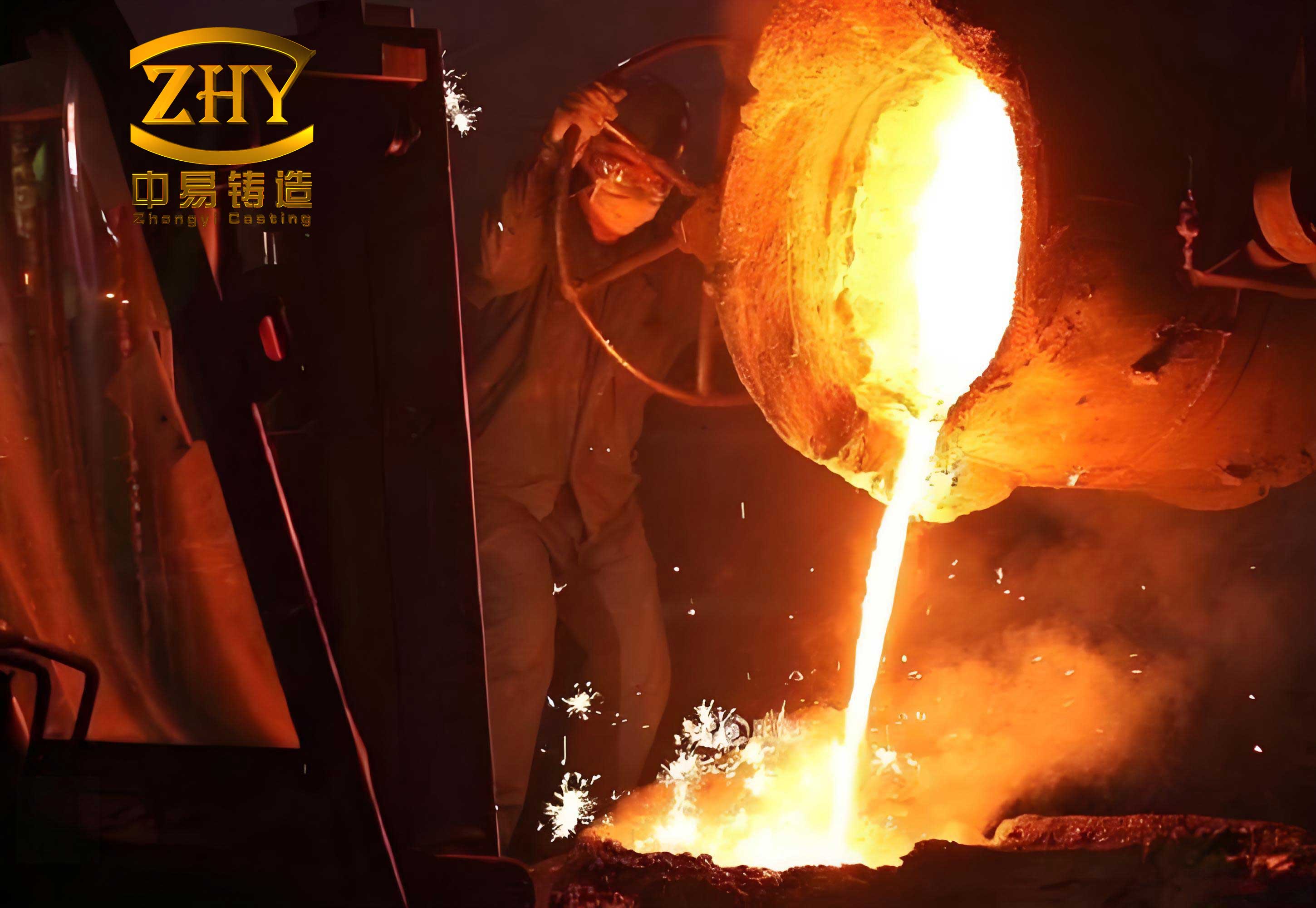
Vacuum is applied to the flask throughout the pouring and initial cooling phases. We maintain a consistent vacuum level of approximately -0.06 MPa (about 450 mmHg). This vacuum serves multiple purposes: it stabilizes the sand mold, enhances the flow of metal by reducing back-pressure from decomposed gases, and helps draw those gases through the coating and out of the mold. The molten metal is prepared using a duplex melting process (e.g., cupola + induction furnace) and treated with a pure magnesium alloy for spheroidization in the case of ductile iron. Pouring temperature is tightly controlled between 1350°C and 1380°C. A higher temperature improves fluidity and pattern decomposition but increases thermal loading on the coating; our chosen range represents an optimal compromise for this lost foam casting process application.
After pouring is complete, the vacuum is maintained for a sustained period (e.g., 30 minutes) to ensure the casting solidifies under stable conditions and all pyrolysis products are fully evacuated. The casting is then allowed to cool in the flask for an extended period—often 48 hours or more—to minimize thermal stresses and prevent cracking during shakeout, a necessary precaution for large, complex geometries produced via the lost foam casting process.
Performance Analysis and Quantitative Outcomes of the Lost Foam Casting Process
The true measure of any process refinement lies in its consistent, reproducible results. Implementing the described comprehensive protocol for the lost foam casting process yielded transformative outcomes. Over a production run encompassing several dozen castings, the defect rate plummeted. Only a minimal number of pieces were scrapped, primarily for issues unrelated to the core lost foam casting process itself (e.g., metallurgical deviations). The surface finish of the castings was remarkably clean, free from sand inclusions, gas holes, and significant shrinkage defects. Dimensional accuracy was excellent, validating the precision of the CNC-pattern-making and stable molding process.
We can quantify the benefits through several Key Performance Indicators (KPIs), comparing our advanced lost foam casting process to the previous conventional sand casting method used for similar components. These are summarized in Table 2.
| Performance Metric | Traditional Sand Casting (Baseline) | Advanced Lost Foam Casting Process | Improvement / Change |
|---|---|---|---|
| Process Yield (Good Castings) | ~92% | >98% | +6 percentage points |
| Metal Yield (Casting Weight / Poured Weight) | ~80% | ~88% | +8 percentage points |
| Average Casting Weight (for same function) | Base Weight (W) | W – 220 kg | ~8% Weight Reduction |
| Labor Productivity (Casting/man-hour) | 1.0 (Baseline Index) | ~2.0 | Approximately 100% increase |
| Typical Lead Time (Pattern to Casting) | Weeks | Days | Reduction by factor of 2-3 |
| Surface Finish (Ra, μm) | 25 – 50 | 12 – 25 | Approximately 50% smoother |
| Required Machining Allowance (mm) | 5 – 10 | 2 – 4 | Reduction by 50-60% |
The increase in metal yield (often called ‘casting yield’ or ‘pouring yield’) from 80% to 88% is particularly significant. This 8% absolute improvement directly translates to substantial savings in melting energy, raw material (metal), and slag generation. It is achieved because the lost foam casting process naturally allows for more efficient gating and feeding layouts, and the absence of parting lines and cores eliminates associated metal mass in runners and overflows. The weight reduction of the casting itself (over 200 kg) is a direct result of design optimization for the lost foam casting process, where features were integrated, and walls could be made more uniform and thinner due to the excellent filling capability.
The dramatic boost in labor productivity stems from the simplification of operations: no core making, core setting, or mold assembly in the traditional sense. The sand is dry, reusable, and requires no binding agents, eliminating mixing and reclamation complexities associated with resin sands. This makes the lost foam casting process not only technically superior but also economically compelling for large-scale production.
In-Depth Theoretical Considerations and Future Directions for the Lost Foam Casting Process
To fully appreciate the advancements, it’s valuable to delve deeper into the underlying physics and chemistry that our practical modifications address. The lost foam casting process is a coupled thermo-fluid-decomposition problem.
Foam Decomposition Kinetics: The rate at which EPS decomposes upon contact with molten metal is not constant. It involves several stages: glass transition, softening, liquefaction, vaporization, and finally, thermal cracking of the hydrocarbon vapors. The rate-limiting step often depends on temperature and pressure. A simplified model for the decomposition front velocity ($v_f$) can be expressed as a function of the heat flux from the metal ($q”$), the effective heat of decomposition of EPS ($\Delta H_{dec}$), and its density ($\rho_{EPS}$):
$$ v_f \approx \frac{q”}{\rho_{EPS} \cdot \Delta H_{dec}} $$
Our gating strategy directly increases $q”$ per unit area of the foam front by bringing more hot metal into contact with it faster, thereby controlling the decomposition rate and the associated gas pressure build-up ($P_{gas}$) behind the coating, which is given by an ideal gas law approximation considering gas generation rate and permeability:
$$ P_{gas} \approx \frac{\dot{m}_{gas} \cdot R \cdot T_{gas}}{k \cdot A_{coat} / \delta} $$
where $\dot{m}_{gas}$ is the mass flow rate of gas, $R$ is the gas constant, $T_{gas}$ is the gas temperature, $k$ is the coating permeability, $A_{coat}$ is the area, and $\delta$ is the thickness. Our coating development aimed to maximize $k$ and strength while minimizing $\delta$, and our gating aimed to manage $\dot{m}_{gas}$.
Coating Permeability and Strength Modeling: The permeability ($k$) of a coating is a complex function of its pore structure, which is influenced by particle size distribution, binder type, and drying conditions. The inorganic phosphate binder in our coating likely forms a reticulated, strong network that maintains high porosity even at elevated temperatures. Its hot strength ($S_h$) can be related to the degree of ceramic bond formation, which is temperature-dependent:
$$ S_h(T) = S_0 \cdot \exp\left(-\frac{E_a}{R_g T}\right) \cdot f(\text{binder concentration}) $$
where $S_0$ is a pre-exponential factor, $E_a$ is an activation energy for bond strengthening, $R_g$ is the universal gas constant, and $T$ is the absolute temperature. Our formulation empirically maximizes $S_h$ in the critical 800-1200°C range encountered during iron pouring.
Future Enhancements to the Lost Foam Casting Process: The journey of optimizing the lost foam casting process is continuous. Potential future areas of research and development include:
- Alternative Pattern Materials: Investigating co-polymers like MMA (polymethyl methacrylate) or starch-based foams that produce less liquid residue and different gas compositions, potentially reducing lustrous carbon and improving surface finish for certain alloys.
- Smart Coatings: Developing coatings with functionally graded properties—higher permeability in some zones, higher strength in others—using advanced application techniques like robotic spraying with multi-component feeds.
- Advanced Simulation: Employing coupled Computational Fluid Dynamics (CFD) and Discrete Element Method (DEM) simulations to model not just metal flow and solidification, but also the granular sand behavior during filling and the detailed pyrolysis chemistry of the foam. This would allow for virtual optimization of the entire lost foam casting process cycle.
- Process Automation: Integrating robotics for pattern handling, coating application, sand filling, and flask movement to further enhance consistency, productivity, and worker safety in high-volume applications of the lost foam casting process.
- Sustainability Metrics: Quantifying the full lifecycle environmental benefits of the lost foam casting process compared to other methods, including reduced energy consumption per kilogram of salable casting, lower emissions from sand systems, and the recyclability of both sand and metal.
Conclusion
The successful production of large, complex castings via the lost foam casting process is not merely possible; it is a highly efficient and economically superior alternative to traditional methods when approached with a deep understanding of its underlying mechanisms. Our experience, detailed in this account, underscores that the key lies in a holistic strategy. This strategy integrates careful pattern engineering with optimized density, a robust coating system engineered for high-temperature strength and controlled permeability, an aggressive gating design that manages foam decomposition dynamics, and a meticulous molding and pouring protocol supported by vacuum technology. The quantitative results—exceeding 98% yield, achieving 88% metal yield, and doubling labor productivity—provide compelling evidence of the maturity and capability of the modern lost foam casting process. As foundries worldwide seek more sustainable, precise, and cost-effective manufacturing solutions, the lost foam casting process stands out as a versatile and powerful technology. Its continued refinement and adoption, particularly for challenging large-scale applications, will undoubtedly play a central role in the future of metal casting, driving innovation and competitiveness across numerous industrial sectors. The lost foam casting process has truly evolved from a novel technique into a cornerstone of advanced manufacturing.