
In the landscape of modern industrial manufacturing, the production of critical flow control components like valve bodies presents a unique set of challenges, particularly as scale increases. Traditional casting methods often struggle with dimensional accuracy, surface finish, and yield rates for large components such as a DN1000 valve body. My extensive research and practical engagement have led me to focus on the lost foam casting process as a transformative solution. This article details a comprehensive study into the adaptation and refinement of the lost foam casting process for producing high-integrity, large-diameter valve bodies, synthesizing process parameters, defect mitigation strategies, and theoretical underpinnings into a cohesive guide.
The fundamental advantage of the lost foam casting process lies in its use of a foam pattern that vaporizes upon contact with molten metal. This eliminates the need for conventional cores and parting lines, granting unparalleled design freedom and exceptional surface finish. For a massive component like a DN1000 valve body—with complex internal passages and stringent sealing requirements—this process offers a viable path to overcome the limitations of sand casting. The core challenge, however, translates to perfecting every step: from creating a dimensionally stable foam replica of the final part to managing the complex physics of foam decomposition and metal filling within a dry sand mold.
The complete lost foam casting process chain for a large valve body can be visualized as a sequence of interdependent stages, as summarized in the flowchart below:
1. Pattern Assembly: The Foundation of Dimensional Integrity
The process begins with the creation of an expandable polystyrene (EPS) foam pattern. For a DN1000 valve body, monolithic molding is often impractical due to size constraints. Therefore, a segmented approach is adopted. Key considerations include:
- Material Selection: EPS beads with a controlled pre-expansion density are used. The density range is critical: too low, and the pattern lacks strength; too high, and it increases gas generation during pouring. A target range of 13.5–24.0 g/L is optimal for large patterns.
- Segmentation & Assembly: The complex 3D geometry is broken down into moldable segments. After molding, these segments are meticulously assembled using specialized hot-melt adhesives. A predetermined shrinkage allowance (e.g., 1.0%) must be incorporated into the tooling dimensions to compensate for both foam shrinkage and metal contraction.
- Surface Finish & Reinforcement: The assembled “white” pattern requires extensive finishing. Seam lines must be filled and sanded flush. Surface imperfections like bead fusions or voids are repaired. Internal cavities, especially sealing surfaces, must be perfectly smooth. To prevent distortion during handling and coating, internal foam supports or “gating” are integrated. Strategic placement of steel nails or rods in thin sections can later act as chilling points to control solidification.
| Process Parameter | Target Specification | Rationale & Impact |
|---|---|---|
| EPS Bead Density | 13.5 – 24.0 g/L | Balances pattern strength and gas load during decomposition. |
| Shrinkage Allowance | 1.0% (Tooling) | Compensates for foam shrinkage (molding) and metal contraction (solidification). |
| Surface Defect Tolerance | < 1 mm depth/height | Prevents defect replication on final casting surface. |
| Pattern Assembly Adhesive | Low-residue, fast-curing type | Minimizes gas evolution and ensures joint strength during coating. |
2. Coating Application: Managing the Metal-Foam Interface
The refractory coating applied to the foam pattern is the most critical element in the lost foam casting process. It serves multiple functions: providing a barrier between sand and casting, allowing gas permeability for pyrolysis products to escape, and maintaining mold cavity integrity. For a large valve body:
- Coating Composition & Rheology: The coating is typically a water-based slurry containing refractory fillers (e.g., zircon, alumina), binders, and suspending agents. Its viscosity must allow for complete, even coverage without sagging on vertical surfaces.
- Application & Drying: Dipping is the preferred method. The pattern is immersed slowly and withdrawn at a controlled rate to achieve a uniform layer. Complex geometries may require manual touch-ups. Multiple coats (typically 3-4) are applied to build up the necessary thickness. Each coat must be thoroughly dried (30–60°C with good airflow) before the next is applied to prevent cracking or trapping moisture.
- Coating Thickness Control: The final dry coating thickness is paramount. A general target for a heavy-section iron casting is 1.1–1.8 mm. This thickness is a compromise: too thin, and the coating may fracture, leading to sand penetration; too thick, and gas evacuation becomes impeded, risking lustrous carbon defects or porosity.
The drying process can be modeled as a diffusion-controlled removal of solvent (water). The approximate time required for drying a coating layer can be related to its thickness by a simplified equation:
$$ t_d \propto \frac{\delta_c^2}{D_{eff}} $$
where \( t_d \) is the drying time, \( \delta_c \) is the coating thickness, and \( D_{eff} \) is the effective diffusivity of the solvent through the coating matrix.
| Stage | Parameter | Control Range / Target |
|---|---|---|
| Slurry Preparation | Density (Baumé) | 1.65 – 1.85 g/cm³ |
| Viscosity | As per dip-coating flow cup (e.g., 25-35 s) | |
| Particle Size | < 200 mesh (74 μm) | |
| Application | Immersion/Withdrawal Speed | Slow and steady (~10 cm/min) |
| Coats Applied | 3 to 4 | |
| Drying | Temperature | 30 – 60 °C |
| Final Dry Film Thickness | 1.1 – 1.8 mm |
3. Gating System Design and Molding: Directing the Thermal Flow
The design of the gating and feeding system is arguably the most technically demanding aspect of the lost foam casting process for a heavy, complex casting. Two primary orientations were investigated for the DN1000 valve body:
| Aspect | Horizontal (Tilted) Gating | Vertical Gating |
|---|---|---|
| Orientation | Valve body laid flat, tilted ~10°. | Valve body stood upright on one flange. |
| Gating Position | Gates attached to side (inlet/outlet) ports. | Bottom gating through the lower flange or port. |
| Feeding Strategy | Risers placed on highest and lowest thick sections. | Multiple risers on top flange and upper port. |
| Observed Defects | Severe shrinkage porosity in side ports; carbon defects on top surfaces. | Eliminated porosity in ports; minimal, controllable distortion in body. |
| Key Modification | N/A | Internal steel reinforcement bar to prevent pattern distortion during molding. |
| Conclusion | Inadequate thermal gradient for directional solidification. | Promotes directional solidification from bottom-up and top-fed; superior for this geometry. |
The vertical system proved vastly superior. It establishes a strong thermal gradient, promoting directional solidification from the bottom (gated end) upwards towards the risers. This is a classic principle in feeding design, where the thermal gradient \(G\) and the solidification rate \(R\) must satisfy the condition for sound metal:
$$ \frac{G}{R} \geq \Delta T / D $$
for a given solidification temperature range \(\Delta T\) and diffusion length \(D\). The vertical orientation naturally enhances \(G\). Furthermore, the use of internal steel supports within the foam assembly was crucial to maintaining the circularity of the large body during sand filling and vibration.
4. Sand Filling and Compaction
The coated pattern assembly is placed in a flask, and unbonded, dry silica sand is filled around it. Sand properties and compaction are vital for mold stability.
- Sand Characteristics: Rounded grain sand (AFS 40-70) is preferred for its high flowability. A well-distributed grain size ensures good packing density and permeability.
- Vibration Compaction: Sand is added in layers, typically 250-300 mm deep, with systematic vibration after each layer. Vibration parameters (frequency, amplitude, time) must be optimized to achieve uniform compaction around the pattern without causing distortion. The goal is to achieve a bulk density that supports the mold cavity during foam collapse and metal filling.
5. Pouring and Solidification: The Crucible Moment
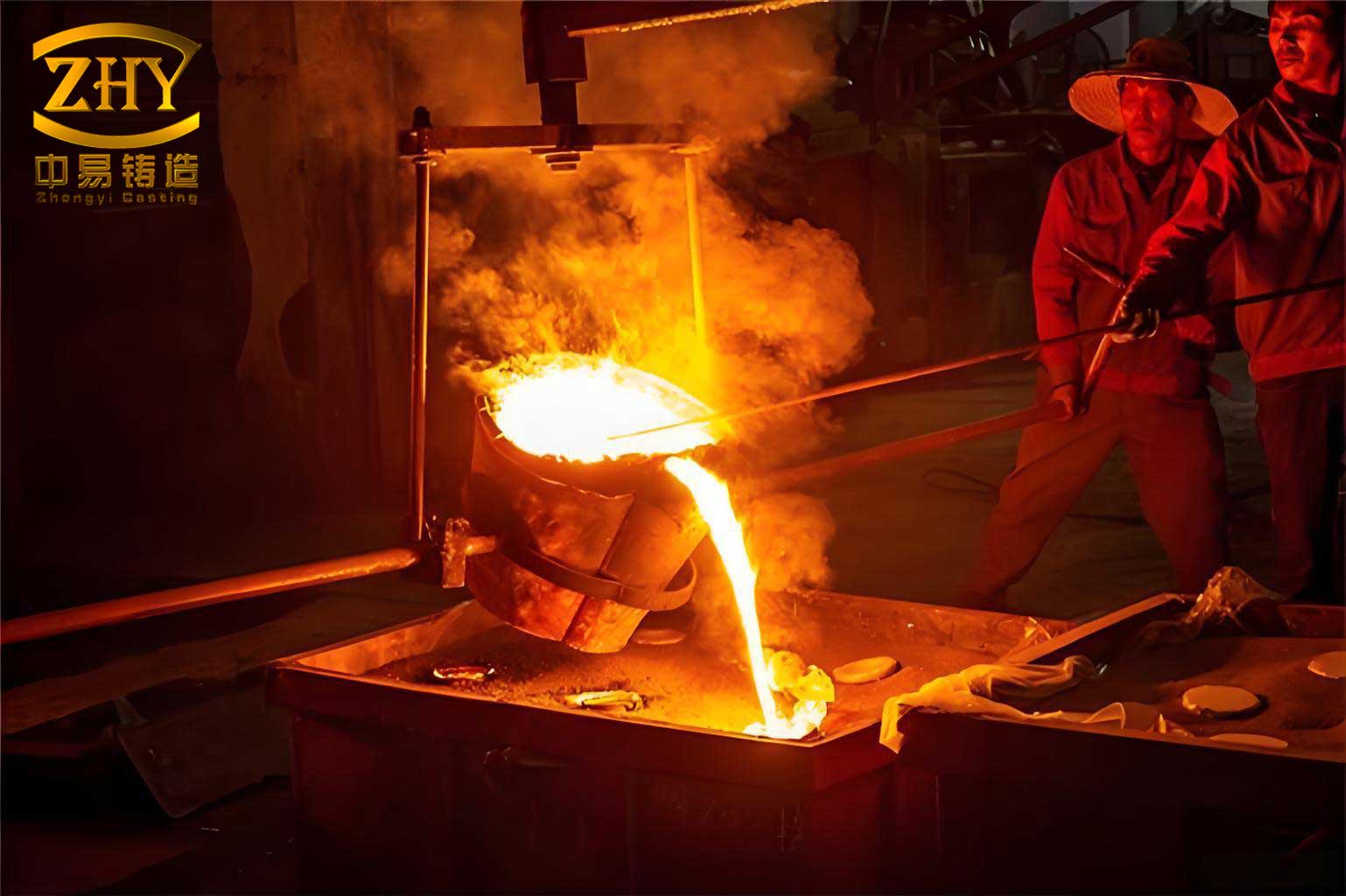
This is where the lost foam casting process manifests its unique physics. The molten metal (ductile iron QT420-10 in this case) progressively vaporizes the foam pattern, replacing its volume.
- Pouring Temperature: A critical balance must be struck. For ductile iron, a temperature of 1460–1490°C is typical. Higher temperatures improve fluidity but increase the rate of foam decomposition, potentially overwhelming the coating’s permeability and leading to gas-related defects. Lower temperatures risk mistruns and cold shuts. The pouring temperature \(T_p\) must satisfy:
$$ T_p > T_{liquidus} + \Delta T_{superheat} + \Delta T_{loss\_foam} $$
where \(\Delta T_{loss\_foam}\) accounts for the heat absorbed to decompose the foam. - Pouring Rate: The pour must be rapid and continuous to maintain a steady metal front that supports the sand mold. A controlled pour rate of 5–10 kg/s helps achieve this.
- Inoculation: For ductile iron, late stream inoculation is essential to ensure a high nodule count and prevent chilling. An addition of 0.1–0.2% FeSi inoculant is standard.
- Riser Design: Risers are sized using modulus calculations. The modulus \(M\) of a riser must exceed that of the casting section it feeds:
$$ M_{riser} = \frac{V_{riser}}{A_{riser}} > M_{casting\_section} $$
For the vertical setup, four risers were used: two large ones on the top main flange and two smaller ones on the upper port, sized accordingly.
| Parameter | Target Value / Range | Purpose & Consequence |
|---|---|---|
| Metal Grade | Ductile Iron QT420-10 | Provides required strength, toughness, and castability. |
| Pouring Temperature | 1460 – 1490 °C | Balances fluidity with manageable foam gas generation. |
| Pouring Rate | 5 – 10 kg/s | Ensures swift cavity fill and stable metal front. |
| Gating Diameter | 45 mm | Provides sufficient flow area for the required metal mass. |
| Inoculant Addition | 0.1 – 0.2% (Stream) | Promotes graphite nodulization, prevents carbides. |
| Riser Count & Location | 4 (2 top flange, 2 upper port) | Feeds thermal centers to prevent shrinkage. |
6. Defect Analysis and Mitigation Strategies
Despite careful control, defects can arise. A systematic analysis is key to continuous improvement in the lost foam casting process.
| Defect Type | Possible Causes in Lost Foam Process | Corrective & Preventive Measures |
|---|---|---|
| Shrinkage Porosity/Cavity | Inadequate feeding (riser size/location), poor thermal gradient (wrong orientation), low pouring temperature. | Adopt vertical gating for better gradient. Increase riser modulus \(M_{riser}\). Ensure proper pouring temperature. Use chills (steel nails) in thin-to-thick junctions. |
| Lustrous Carbon (Folds/Sheens) | Excessive foam pyrolysis gases trapped at metal front due to low coating permeability, high foam density, or slow pour. | Optimize coating thickness and permeability. Use lower density EPS. Ensure swift, non-turbulent pour. Improve mold venting. |
| Sand Inclusions / Penetration | Coating fracture or erosion due to thermal shock or mechanical damage during sand filling. | Increase coating strength/bonding. Ensure gentle, multi-stage sand filling and vibration. Repair any coating cracks pre-pour. |
| Pattern-Related Distortion | Foam pattern warping during coating/drying or sand compaction. | Incorporate internal foam supports/gating. Use rigid reinforcement bars in large cavities. Control drying temperature and humidity. |
| Cold Shut / Mistrun | Low metal superheat, slow pouring rate, excessive gas pressure slowing metal advance. | Increase pouring temperature within optimal band. Increase pour rate. Check coating permeability is not too low. |
7. Theoretical Considerations and Process Modeling
The lost foam casting process is governed by coupled phenomena: transient heat transfer, foam pyrolysis kinetics, gas flow through porous media, and fluid dynamics. Simplified models can inform practice. The energy balance at the advancing metal front involves heat for raising foam temperature, pyrolysis, and heating pyrolysis products:
$$ \rho_m C_{p,m} v \frac{dT}{dx} = k_m \frac{d^2T}{dx^2} – \dot{q}_{pyrolysis} $$
where \( \rho_m, C_{p,m}, k_m \) are metal density, specific heat, and conductivity, \(v\) is front velocity, and \( \dot{q}_{pyrolysis} \) is the heat sink term from foam decomposition. The pressure of gases generated must be less than the metallostatic pressure to avoid backward deformation of the metal front:
$$ P_{gas}(x,t) < \rho_m g h(t) $$
This underscores the need for highly permeable coatings and sand to vent gases quickly.
8. Conclusion and Industrial Significance
This detailed investigation confirms that the lost foam casting process is not only feasible but highly advantageous for manufacturing large, complex valve bodies like the DN1000 size. The key to success is a holistic approach that views the process as an integrated system. The major conclusions are:
- Pattern Integrity is Paramount: A dimensionally accurate, robust, and smooth foam pattern, assembled with precision and reinforced against distortion, is the non-negotiable foundation. Strategic use of internal chills (steel nails) is crucial for solidification control.
- Coating is the Critical Interface: The refractory coating’s thickness, strength, and permeability must be meticulously controlled to manage the gas-metal-sand interaction, preventing defects like sand penetration and lustrous carbon.
- Gating Dictates Soundness: For a valve body geometry, a vertical bottom-gated system with adequately sized top risers is essential to establish a favorable thermal gradient for directional solidification, effectively eliminating shrinkage porosity.
- Process Parameters are Interdependent: Pouring temperature, rate, sand compaction, and coating properties are not independent variables. They must be optimized as a set to ensure smooth foam replacement and complete cavity fill.
Mastering the lost foam casting process for such applications elevates manufacturing capabilities, enabling the production of near-net-shape, high-quality large castings with improved yield, reduced machining, and greater design flexibility. It represents a significant step forward in foundry technology for critical infrastructure components.