
The lost foam casting process represents a significant advancement in near-net-shape manufacturing, characterized by its utilization of a disposable foam pattern embedded in unbonded sand. During the critical lost foam casting process, molten metal is poured into a mold containing the foam pattern. The metal front progressively vaporizes and replaces the foam, occupying the cavity left behind. This fundamental mechanism, while elegant, introduces a layer of immense complexity not present in conventional cavity casting. At the advancing metal-foam interface, intense heat transfer triggers the thermal degradation of the foam polymer. This leads to intricate physical and chemical phenomena, including gas generation, liquid pyrolysis product formation, and subsequent mass transfer of these decomposition products through the interface and a permeable coating layer into the surrounding sand medium. The efficiency of this evacuation process is paramount; any impediment can lead to defects such as carbon films (lustrous carbon) or fold/wrinkle defects on the final casting surface, particularly in ferrous alloys. Given that the entire lost foam casting process unfolds within a sealed sand mold, direct observation or conventional physical experimentation is exceedingly challenging.
This is where numerical simulation technology becomes an indispensable tool. By creating a virtual model of the lost foam casting process, we can probe the underlying flow dynamics, heat transfer, and mass transfer phenomena. Simulation allows for the prediction of potential filling-related defects and solidification shortcomings before any metal is poured. It serves as a reliable and rapid analytical method to optimize gating system design, process parameters, and ultimately, enhance casting quality and yield. In this detailed analysis, I will delve into a comprehensive case study involving the production of a gray iron box cover, employing numerical simulation to scrutinize its lost foam casting process. The goal was to derive a robust set of process parameters, validate them through simulation, and subsequently confirm their efficacy in actual production.
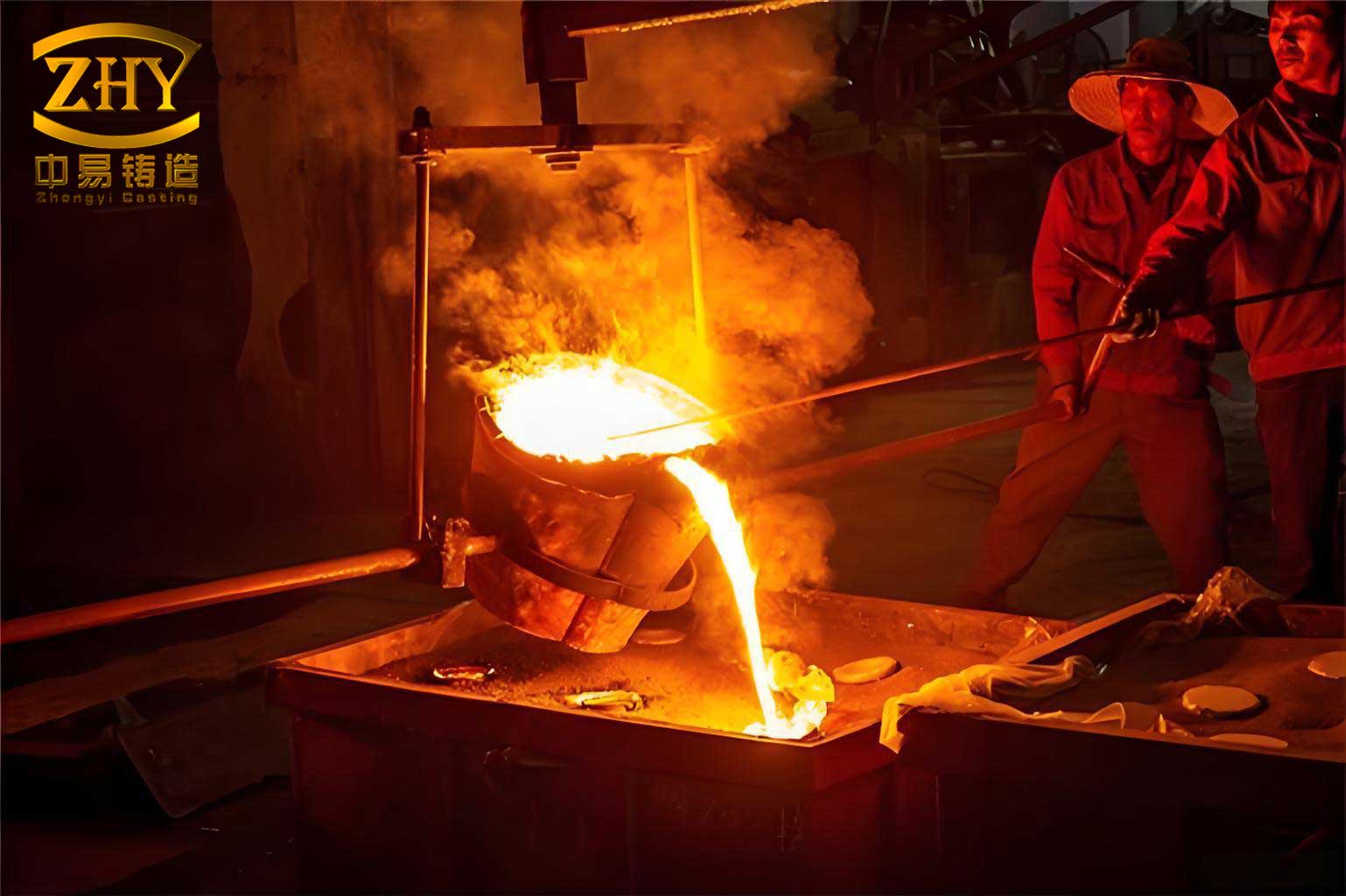
1. Foundry Process Design for the Box Cover
The initial step in any successful lost foam casting process is a sound gating system design. While the presence of the foam alters fluid dynamics, foundational hydraulic principles from sand casting can be adapted. For the box cover, with nominal dimensions of 584 mm × 385 mm × 10 mm and a target material of HT200 gray iron, a bottom-gating system was selected to promote smooth, non-turbulent filling. The key design calculations proceeded as follows.
The total cross-sectional area of the ingates (∑F_ingate) was determined using the hydraulic formula:
$$\sum F_{\text{ingate}} = \frac{G}{0.31 \mu t \sqrt{H_p}}$$
where $G$ is the casting mass (kg), $\mu$ is the flow coefficient (typically 0.3-0.4 for lost foam), $t$ is the pouring time (s), and $H_p$ is the effective metallostatic pressure head (mm).
For larger iron castings, the pouring time can be estimated by:
$$t = K_t \sqrt[3]{G}$$
Here, $K_t$ is a correction factor, approximately 0.85 for vacuum-assisted lost foam casting.
Once the ingate area is calculated, the cross-sectional areas for the runner (∑F_runner) and sprue (∑F_sprue) are sized based on established proportional relationships to control filling velocity and pressure:
$$\sum F_{\text{ingate}} : \sum F_{\text{runner}} : \sum F_{\text{sprue}} = 1 : 1.2 : 1.4$$
Applying these formulas with appropriate mass and head estimates yielded the initial gating dimensions: ingates at 70 mm × 15 mm, runner at 70 mm × 25 mm, and a sprue base diameter of 48 mm. The full 3D assembly, including casting, gating system, and foam pattern volume, was modeled for simulation.
2. Establishing Simulation Parameters and Material Properties
Accurate numerical simulation of the lost foam casting process hinges on defining correct material properties and process conditions. The parameters used for this study were derived from prior simulation work on plate-shaped gray iron castings, which identified an optimal window. The core set of parameters for the virtual process is summarized below:
| Parameter Category | Symbol/Name | Value | Unit |
|---|---|---|---|
| Process Conditions | Pouring Temperature | 1400 | °C |
| Foam Pattern Density | 13 | kg/m³ | |
| Vacuum Pressure (Sand Mold) | 0.04 | MPa | |
| Coating Thickness | 0.5 | mm | |
| Coating Permeability | 9.5 × 10⁻⁹ | m²/(Pa·s) | |
| Foam Material (EPS) | Thermal Conductivity | 0.15 | W/(m·K) |
| Specific Heat Capacity | 3.7 | kJ/(kg·K) | |
| Latent Heat of Decomposition | 100 | kJ/kg | |
| Liquidus/Solidus Decomposition Temp. | 350 / 330 | °C | |
| Sand Mold (Unbonded Silica) | Thermal Conductivity | 0.53 | W/(m·K) |
| Specific Heat Capacity | 1.22 | kJ/(kg·K) | |
| Interfacial Heat Transfer Coefficient (Metal/Sand) | 500 | W/(m²·K) |
The metal properties (HT200) were defined using the simulation software’s internal database, including its solidification range, latent heat, and thermal conductivity as a function of temperature. The foam decomposition was modeled as a temperature-dependent process where the foam transitions to gaseous and liquid products, with the associated latent heat absorption acting as a significant heat sink at the metal front.
3. Analysis and Discussion of Numerical Simulation Results
The simulation of the lost foam casting process for the box cover provided a detailed, time-resolved view of filling and solidification, impossible to obtain physically.
3.1 Mold Filling Analysis
The sequence of filling vividly illustrates the unique characteristics of the lost foam casting process. Upon entering the mold cavity through the bottom ingates, the molten metal does not flow freely as in an empty cavity. Instead, it advances in a relatively flat, convex front, progressively decomposing the foam pattern ahead of it. The metal-foam interface is separated by a thin layer of gaseous and liquid pyrolysis products. The simulation tracked this front progression, with key timestamps shown below:
| Simulation Time (s) | Stage of Fill | Observed Metal Front Characteristics |
|---|---|---|
| 22.75 | Early Stage | Metal has filled the lower region, front is convex and uniform. |
| 27.21 | Mid Stage | Front continues upward and radial spread, maintaining stability. |
| 32.02 | Near Complete | Cavity is nearly full; last region to fill is the top, farthest from ingates. |
The simulated fill time was approximately 32-34 seconds. The most critical observation was the absence of any “hesitation” or “stop-and-go” behavior in the metal front. This indicates a good balance among the selected parameters: the foam density and decomposition characteristics, coating permeability, and applied vacuum. This balance ensures that the rate of foam gas/product removal through the coating keeps pace with the metal advance, preventing the buildup of back-pressure that can distort the flow or lead to defect formation. The bottom-gating design successfully promoted this steady, upward filling mode.
3.2 Solidification and Cooling Analysis
Following the filling phase, the simulation computed the cooling and solidification of the casting. The thermal history revealed a solidification pattern that was directional, proceeding from the thin sections and outer surfaces in contact with the sand towards the thicker central regions and the feeder (sprue/runner system). The gating system itself solidified prior to the main casting body, which is generally desirable as it allows the feeder to act as a liquid metal reservoir for feeding shrinkage during the critical liquid-to-solid transition. The temperature distribution at various times post-pour confirmed there were no isolated hot spots that could become centers for shrinkage porosity. The thermal gradient was managed effectively by the geometry and the chilling effect of the unbonded sand mold.
3.3 Defect Prediction Analysis
A primary objective of simulating the lost foam casting process is to predict internal quality. The software’s shrinkage porosity prediction module, often based on the Niyama criterion or a mass continuity function, was applied. The Niyama criterion $N_y$ is given by:
$$N_y = \frac{G}{\sqrt{\dot{T}}}$$
where $G$ is the temperature gradient and $\dot{T}$ is the cooling rate at the end of solidification. Regions where this value falls below a critical threshold are prone to microporosity. The simulation output for the box cover showed a uniform, high value of this criterion throughout the casting volume, with no indications of isolated areas prone to significant shrinkage porosity or voids. This was a strong numerical indicator that the combined effect of the casting geometry, the thermal properties of the mold, and the absence of excessive thermal centers would yield a sound casting under the simulated conditions.
The interplay of key parameters in the lost foam casting process can be conceptually framed to understand defect formation. For instance, the pressure balance at the metal front is crucial. If pyrolysis gas pressure ($P_{gas}$) exceeds the sum of local metallostatic pressure ($P_{metal}$) and vacuum pressure ($P_{vac}$), flow instability can occur. The condition for stable flow can be simplified as:
$$P_{metal} + P_{vac} > P_{gas} + P_{\text{coating resistance}}$$
Our simulation parameters, particularly the 0.04 MPa vacuum and the defined coating permeability, were optimized to maintain this stability.
4. Production Trial and Validation
Encouraged by the positive simulation results, a production trial was conducted using the optimized parameters as a blueprint. The process steps were meticulously followed:
- Pattern and Coating: EPS patterns with a density of 13 kg/m³ were produced and assembled. A refractory coating was applied by dipping to achieve a target dry thickness of approximately 0.5 mm. The coating slurry formulation was controlled to target the permeability used in the simulation (≈9.5×10⁻⁹ m²/(Pa·s)). Patterns were dried thoroughly.
- Molding and Vacuum Setup: Coated pattern clusters (10 castings per mold) were placed in a flasks and surrounded by dry, unbonded silica sand with adequate sand compaction (minimum side wall thickness of 150 mm, bottom thickness of 100 mm). The flask was connected to a vacuum system with a 20 m³/min capacity pump.
- Pouring: HT200 iron was superheated and tapped at a temperature of 1400°C. As pouring commenced, the vacuum system was activated. The initial vacuum was set high (near 0.096 MPa) to quickly establish a pressure differential and was then maintained at a steady 0.04 MPa throughout the pour and a subsequent 8-minute stabilization period.
- Cooling and Shakeout: The mold was allowed to cool under vacuum for about 5 hours before the vacuum was released and shakeout performed.
The actual pouring time recorded was around 60 seconds, longer than the simulated 34 seconds. This discrepancy is common and attributable to simplifications in the simulation’s fluid dynamics model, real-world variations in foam properties, and the practical dynamics of ladle pouring. Despite this timing difference, the flow characteristics—smooth, bottom-up filling—were confirmed by the quality of the resultant castings.
The produced box cover castings were fully formed, with sharp dimensional accuracy replicating the foam pattern. Critically, visual inspection revealed no signs of surface defects such as folds, wrinkles, or gross carbonaceous deposits. Non-destructive testing (penetrant or radiographic inspection as applicable) did not detect any internal shrinkage cavities or gas porosity clusters. The castings met all specified quality benchmarks, validating the process parameters derived from the numerical simulation.
5. Conclusions and Process Insights
This integrated exercise in simulation and production of a gray iron box cover through the lost foam casting process yielded several important conclusions and generalized insights:
- Simulation as a Reliable Guide: Numerical simulation proved highly effective in modeling the unique coupled physics of the lost foam casting process, successfully predicting stable filling patterns and a sound solidification profile for the given geometry and parameters.
- Optimized Parameter Set: For this class of thin-walled gray iron casting, a robust parameter window was confirmed:
- Gating: Bottom-filled system with area ratios ~1:1.2:1.4 (ingate:runner:sprue).
- Pouring Temperature: 1400°C.
- Foam Pattern Density: 13 kg/m³.
- Process Vacuum: 0.04 MPa.
- Coating: ~0.5 mm thickness with high permeability (~10⁻⁸ m²/(Pa·s) order).
- Key to Stability: The synergy between foam decomposition rate (controlled by density and metal temperature), coating permeability, and applied vacuum is critical. This synergy maintains a favorable pressure differential at the flow front, ensuring steady advancement and complete evacuation of decomposition products, thereby preventing carbon and fold defects.
- Quantitative Design: While empirical rules provide a starting point, simulation allows for the quantitative assessment of interrelated parameters. For future work, the simulation model can be used to perform sensitivity analyses, such as examining the effect of varying coating permeability ($k$) on the internal pressure at the metal front ($P_{interface}$):
$$P_{\text{interface}} \propto \frac{\dot{m}_{gas} \cdot \mu \cdot \delta}{k \cdot A}$$
where $\dot{m}_{gas}$ is the gas generation rate, $\mu$ is gas viscosity, $\delta$ is coating thickness, and $A$ is interfacial area. This allows for more precise, physics-based optimization.
In summary, the marriage of numerical simulation technology with practical foundry engineering provides a powerful methodology for mastering the complex lost foam casting process. It moves the development cycle from one based largely on trial-and-error to a more predictive, efficient, and scientifically grounded practice, ensuring higher quality, reduced scrap, and accelerated development times for new castings.