
My research focuses on the application and implications of the lost foam casting process for magnesium alloys, specifically AZ91. This environmentally conscious casting technique, characterized by its use of a vaporizable foam pattern, presents unique challenges and opportunities for microstructural development and resultant material properties. While its advantages in shape complexity and reduced machining are well-documented for ferrous and some non-ferrous alloys, its specific impact on the corrosion behavior of magnesium alloys remains a critical area for systematic exploration. In this comprehensive analysis, I will detail my methodology, present extended findings on microstructure, and provide a deepened discussion on corrosion mechanisms, employing quantitative models and comparative data to elucidate the effects intrinsic to the lost foam casting process.
1. Foundational Principles and Experimental Methodology of the Lost Foam Casting Process
The core of the lost foam casting process (LFC) involves replacing a traditional refractory mold with a pattern made of expandable polystyrene (EPS) or similar polymer. This pattern is an exact replica of the desired final part, including the gating system. The foundational steps I employed are as follows:
- Pattern Fabrication: The initial pattern for my AZ91 test bars (dimensions: 260 mm × 60 mm × 10 mm) was cut from a foam slab using a heated resistance wire. The foam density was a critical parameter, set at 15 kg/m³, as it influences pattern strength and the volume of gaseous decomposition products during pouring.
- Coating Application: The bare foam pattern is fragile and permeable. To create a barrier, a refractory coating is applied. I submerged the pattern in a ceramic slurry, ensuring complete coverage. After the excess drained off, the coated pattern was dried in a controlled oven at 55°C to achieve a hard, gas-permeable shell. This coating is vital for maintaining dimensional stability, preventing metal penetration, and allowing pyrolysis gases to escape.
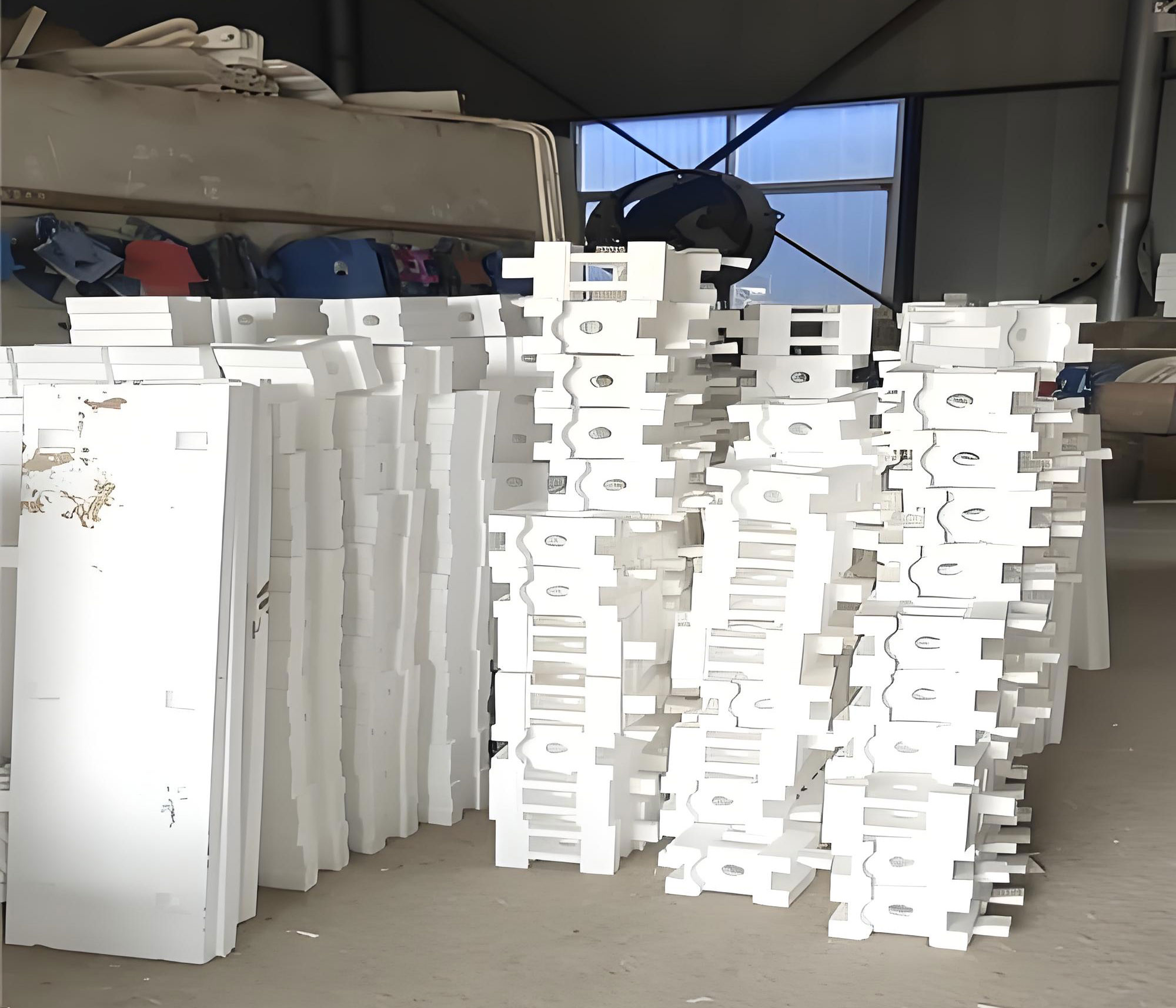
- Molding and Compaction: The dried, coated pattern was placed in a flask, which was then filled with unbonded, dry silica sand. Compaction was achieved using a three-dimensional vibration table. This step ensures the sand fully surrounds the pattern, providing support to the coating and minimizing mold wall movement during metal filling.
- Melting and Pouring: AZ91 magnesium alloy ingots were melted in a 3 kW resistance furnace under a protective atmosphere of SF₆ and CO₂ mixed gas to prevent violent oxidation. The melt composition, verified by Inductively Coupled Plasma Optical Emission Spectroscopy (ICP-OES), is detailed in Table 1. The alloy was superheated to 740°C before being poured directly into the foam pattern’s gating system.
- Decomposition and Filling: Upon contact with the molten metal, the foam pattern thermally degrades, retreating ahead of the advancing metal front. The metal replaces the volume once occupied by the foam. The gaseous byproducts permeate through the coating and into the sand interstices.
- Solidification and Shakeout: After solidification, the casting is removed by simply inverting the flask and allowing the unbonded sand to flow away, leaving a clean casting requiring minimal post-processing.
The thermal dynamics during the lost foam casting process are distinct from conventional metal or sand casting. The endothermic decomposition of the foam and the presence of decomposition gases at the metal front create a slightly slower and more insulated cooling environment. This difference is a fundamental variable influencing the final microstructure. The heat flux, $q$, during solidification can be conceptually described by a modified equation accounting for the foam’s thermal barrier effect:
$$ q = -k_{eff} \frac{dT}{dx} $$
where $k_{eff}$ is the effective thermal conductivity of the mold-coating-foam gas layer system, which is generally lower than in a direct metal-mold interface scenario.
| Element | Al | Zn | Mn | Fe | Si | Cu | Ni | Be |
|---|---|---|---|---|---|---|---|---|
| Weight % | 9.6 | 0.82 | 0.17 | 0.016 | 0.031 | <0.01 | 0.0031 | 0.0003 |
2. Comprehensive Microstructural Analysis of LFC AZ91 Alloy
The microstructure of AZ91 magnesium alloy is primarily characterized by an α-Mg matrix and the intermetallic β-phase (Mg₁₇Al₁₂). However, the specific morphology, distribution, and presence of secondary phases are highly sensitive to solidification conditions, making the lost foam casting process a significant determining factor.
My metallographic examination revealed a typical as-cast structure for AZ91, but with notable features attributable to the LFC method. The α-Mg grains exhibited a larger average grain size compared to samples produced via high-pressure die-casting or even conventional permanent mold casting. This can be directly correlated to the relatively slower cooling rates inherent to the lost foam casting process. The relationship between cooling rate ($\dot{T}$) and grain size ($d$) often follows a power-law relationship:
$$ d = B \cdot \dot{T}^{-n} $$
where $B$ and $n$ are material-dependent constants. The lower $\dot{T}$ in LFC results in a larger value for $d$.
The most critical microstructural observation was the morphology and constitution of the secondary phases:
- β-phase (Mg₁₇Al₁₂): The β-phase manifested in two distinct forms, consistent with the solidification path of AZ91. Firstly, a divorced eutectic β-phase appeared as discrete, white blocky particles predominantly located at the α-Mg grain boundaries. Secondly, a lamellar or script-like β-phase was observed, resulting from the discontinuous precipitation from the supersaturated α-Mg solid solution during cooling. The continuity of the β-phase network along grain boundaries was less pronounced in the LFC sample compared to rapidly solidified counterparts.
- Al-Mn-Fe Ternary Intermetallic Phase: A pivotal finding was the identification of globular or polygonal particles within the α-Mg matrix. Energy-dispersive X-ray spectroscopy (EDX) confirmed these to be an intermetallic compound rich in Al, Mn, and Fe. The formation of this phase is thermodynamically favored under the specific solidification kinetics and local solute segregation of the lost foam casting process. The potential reaction can be conceptualized as:
$$ \text{Al (in melt)} + \text{Mn (in melt)} + \text{Fe (impurity)} \xrightarrow[\text{Slow Cooling}]{\text{LFC Conditions}} \text{Al-Mn-Fe (Intermetallic)} $$
This phase is not typically reported as a major constituent in AZ91 produced by faster-cooling methods, where Mn often exists as separate Al-Mn compounds or in solid solution.
The lower cooling rate also influences micro-porosity. The prolonged solidification time and the need to vent decomposition gases can lead to a slightly higher degree of micro-shrinkage or gas porosity within the casting, which is another characteristic fingerprint of the lost foam casting process for magnesium alloys.
3. Corrosion Behavior: Quantitative Assessment and Mechanism
The corrosion resistance of magnesium alloys is notoriously poor and is intricately linked to microstructure. To quantitatively assess the impact of the lost foam casting process, I conducted immersion corrosion tests in a 3.5 wt.% NaCl solution, following ASTM standards. The corrosion rate was calculated using the mass loss method, comparing LFC specimens against control specimens produced via permanent mold casting (PMC).
The corrosion rate $CR$ in millimeters per year (mm/y) was calculated using the formula:
$$ CR = \frac{K \cdot W}{A \cdot T \cdot D} $$
where:
- $K = 8.76 \times 10^4$ (a constant),
- $W$ = mass loss (g),
- $A$ = exposed surface area (cm²),
- $T$ = exposure time (h),
- $D$ = material density (g/cm³).
The results were striking and are summarized in Table 2. The AZ91 alloy produced by the lost foam casting process exhibited a corrosion rate approximately double that of the same alloy produced by permanent mold casting.
| Casting Process | Average Corrosion Rate (mm/y) in 3.5% NaCl | Relative Corrosion Rate (Normalized to PMC) | Key Microstructural Features |
|---|---|---|---|
| Lost Foam Casting (LFC) | ~4.8 | 2.0 | Coarse α-Mg grains, discontinuous β-phase, presence of Al-Mn-Fe phase, higher micro-porosity. |
| Permanent Mold Casting (PMC) | ~2.4 | 1.0 | Finer α-Mg grains, more continuous β-phase network, absence of prominent Al-Mn-Fe phase, lower porosity. |
4. Integrated Discussion: Linking the LFC Process to Corrosion Performance
The significant degradation in corrosion resistance observed in the lost foam casting process specimen can be mechanistically explained by a confluence of factors stemming from the unique solidification environment. I propose a multi-variable model where the overall corrosion susceptibility $S$ is a function of several microstructurally-dependent variables:
$$ S_{LFC} = f(d_{grain}, C_{\beta}, P_{AlMnFe}, V_{porosity}) $$
where:
- $d_{grain}$ is the α-Mg grain size,
- $C_{\beta}$ is a factor describing the continuity and cathodic activity of the β-phase network,
- $P_{AlMnFe}$ is the potency and population density of the Al-Mn-Fe intermetallic particles,
- $V_{porosity}$ is the volumetric fraction of micro-porosity.
4.1 Role of Grain Size and β-Phase Distribution: The coarser microstructure resulting from the slower cooling in the lost foam casting process reduces the total grain boundary area. While the β-phase (Mg₁₇Al₁₂) is more noble than the α-Mg matrix and can act as a corrosion barrier if forming a continuous network, its discontinuous and divorced morphology in LFC specimens diminishes this protective effect. Instead, isolated β-particles can act as local cathodes, promoting galvanic corrosion of the adjacent α-Mg matrix. The effective cathodic area $A_c$ relative to the anodic area $A_a$ is less favorable in the LFC microstructure compared to a finer, more interconnected structure.
4.2 The Deleterious Role of the Al-Mn-Fe Phase: This is a critical differentiator. The Al-Mn-Fe ternary intermetallic, which formed under the specific conditions of the lost foam casting process, has a strong electrochemical influence. Literature suggests that such phases, particularly when containing iron (a potent cathodic element in magnesium alloys), exhibit a very high cathodic overpotential for hydrogen evolution. Their presence as discrete, well-dispersed particles within the α-Mg matrix creates numerous highly active micro-galvanic cells. The corrosion current density $i_{corr}$ for such a micro-cell can be approximated by:
$$ i_{corr} \approx \frac{E_c – E_a}{R_p} $$
where $E_c$ and $E_a$ are the potentials of the cathode (Al-Mn-Fe) and anode (α-Mg), and $R_p$ is the polarization resistance. The large potential difference ($E_c – E_a$) drives intense localized corrosion, significantly accelerating the overall mass loss. This phase is a direct microstructural consequence of the thermal regime and solute segregation profile unique to the lost foam casting process.
4.3 Influence of Porosity: The slightly higher level of micro-porosity inherent to the lost foam casting process provides initiation sites for pitting corrosion. These pores can trap electrolyte, creating occluded cells where the local chemistry becomes acidic and chloride concentration increases, destabilizing any nascent protective film and leading to autocatalytic pit growth.
Therefore, the lost foam casting process, while advantageous for design flexibility, creates a microstructure that synergistically undermines the already modest corrosion resistance of AZ91 magnesium alloy. The process parameters—foam density, coating thickness, pouring temperature, and sand compaction—directly influence cooling rate and gas evolution, which in turn dictate the final microstructure and, consequently, the corrosion properties.
5. Conclusions and Perspective
This extensive investigation into the lost foam casting process for AZ91 magnesium alloy yields definitive conclusions regarding its impact on material structure and performance:
- The thermal conditions characteristic of the lost foam casting process promote the formation of a coarse α-Mg grain structure and lead to the development of a divorced, non-continuous network of the β-Mg₁₇Al₁₂ phase.
- A pivotal microstructural outcome of this process is the formation of Al-Mn-Fe ternary intermetallic compounds, which act as highly active cathodic sites within the matrix.
- Quantitative corrosion testing reveals a substantial detriment, with corrosion rates for LFC-produced AZ91 being approximately twice as high as those for permanent mold-cast equivalents. This degradation is attributed to a synergistic combination of factors: reduced β-phase continuity, the potent cathodic activity of the Al-Mn-Fe phase, and increased micro-porosity.
- The corrosion susceptibility $S$ is thus a direct and strong function of the processing route, with the lost foam casting process introducing specific microstructural features that exacerbate galvanic corrosion mechanisms.
These findings underscore that while the lost foam casting process offers significant geometric and economic benefits for magnesium casting, its inherent trade-off in corrosion performance must be carefully considered in component design and application. Future work should focus on mitigating these effects through alloy modification (e.g., tighter control of Fe and Mn ratios, addition of Ca or rare earth elements), optimization of process parameters to increase effective cooling rates, or the development of post-casting thermal treatments to homogenize the microstructure and reduce the cathodic activity of secondary phases.