
For years in the foundry industry, the production of high manganese steel (HMS) castings, particularly wear-resistant liners for grinding mills, has been characterized by significant technical and economic challenges. The conventional sand casting process for such alloys necessitates large, heavy risers to feed the substantial solidification shrinkage. This leads to notoriously low yield rates, often below 50%. Furthermore, the inherent properties of HMS—its poor thermal conductivity and tendency to form brittle carbide networks in the as-cast state—make thermal cutting of these massive risers with oxy-acetylene torches before heat treatment virtually impossible, as it induces severe cracking. The subsequent removal via expensive machining or abrasive cutting represents a major cost center and bottleneck. My development work, centered on a meticulous adaptation of the lost foam casting process, was driven by the goal to eliminate these risers entirely. This article details the rationale, the precise methodology, and the proven results of implementing a successful riserless lost foam casting process for high manganese steel mill liners.
The core challenge with HMS is its solidification behavior. Its high manganese content (10-15%) and carbon content (0.9-1.5%) result in a relatively low liquidus temperature, approximately 1340°C, and good fluidity. However, the volumetric contraction during solidification is considerable. Traditional foundry wisdom dictates that such alloys require extensive feeding. The paradigm shift proposed here hinges on two fundamental principles derived from the specific service conditions of the liner and the unique capabilities of the lost foam casting process. First, a detailed analysis of the liner’s function revealed it is subject to high-impact, abrasive-chipping wear. The failure mode is gradual thinning of the working face until replacement is necessary for operational efficiency. Crucially, the casting does not experience high tensile or fatigue loads through its entire cross-section; its structural integrity is not the primary failure mechanism. Second, the lost foam casting process, when executed under vacuum, promotes near-perfect simultaneous solidification throughout a casting with relatively uniform wall thickness. While this can lead to a centerline shrinkage porosity zone, the key realization was that this inherent defect, located at the neutral axis of the part, is functionally irrelevant for a component failing by surface wear. If the liner wears out before the porosity zone is exposed or while it remains a minor subsurface feature, it has fully served its purpose. This insight formed the foundation for the riserless approach.
The successful execution of this riserless lost foam casting process is an exercise in extreme process control, where every parameter is optimized to minimize liquid contraction and manage solidification patterns. The process chain can be broken down into several critical stages, each governed by specific requirements.
Pattern and Coating: The Foundational Integrity
The quality of the expendable pattern is paramount. We mandate a strict minimum foam density of 18 kg/m³ to ensure adequate strength during handling and coating, and to minimize gas generation during the pour. All patterns must be thoroughly dried. Dimensional accuracy is achieved by applying an expanded pattern allowance, typically between 2.0% to 2.4%, adjusted based on the specific foam grade’s shrinkage behavior. The coating is not merely a barrier; it is a permeable membrane critical for managing the decomposition products. Our coating formulation is designed for high refractoriness and exceptional permeability:
- Refractory Base: Fused Magnesia powder (MgO).
- Binder System: A blend of Polyvinyl Acetate (PVA) emulsion and Water-soluble Phenolic Resin.
- Suspension & Rheology Agents: Lithium-based Bentonite, Carboxymethyl Cellulose (CMC).
- Dispersant: Sodium Hexametaphosphate.
The coating must be applied in two dips to achieve a dry thickness greater than 2.0 mm. Drying is a slow, controlled process: a minimum of 6 hours for the first layer and 8 hours for the second in a dehumidified oven. Any residual moisture in the coating is a recipe for subsurface defects and is strictly prohibited. The gating system is attached using low-residue hot-melt adhesives. A critical step is sealing all junctions between the pattern, gates, and runners with a high-refractory cement paste to prevent metal penetration at these vulnerable points.
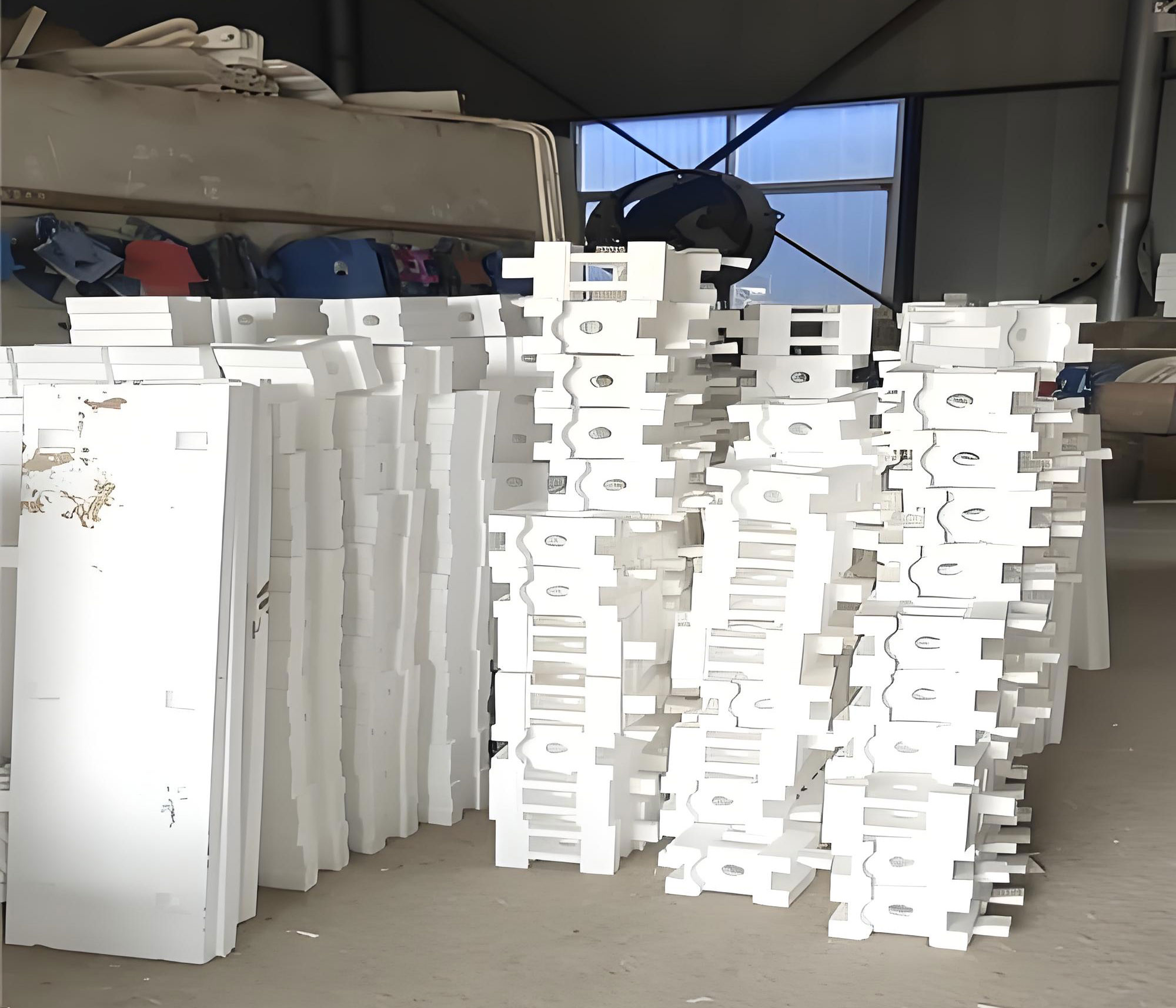
Molding and Compaction
We use a standardized flask size of 1500 mm x 1500 mm x 1300 mm equipped for vacuum extraction on five sides. The molding medium is dry, rounded silica sand (AFS 55-60). The filling and compaction procedure is rigorous: sand is added in layers not exceeding 300 mm, each layer is thoroughly vibrated before the next is added. This ensures uniform and high packing density around the complex pattern geometry, preventing mold wall movement or collapse during pouring. The final vacuum level is set and maintained between -0.045 MPa and -0.050 MPa (gauge pressure) during pouring and solidification.
Metallurgy and Pouring: The Heart of Control
Melting is conducted in a 5-ton electric arc furnace to the standard ZGMn13-2 composition, with tight control on detrimental elements.
| Element | Target Range (wt.%) |
|---|---|
| C | 0.90 – 1.50 |
| Mn | 11.0 – 14.0 |
| Si | 0.30 – 0.80 |
| P | ≤ 0.040 |
| S | ≤ 0.025 |
The most critical parameter in this riserless lost foam casting process is the pouring temperature. To minimize total liquid contraction, we employ a “low-temperature” pouring strategy. The theoretical basis considers the total volume change from pouring to solid. The liquid contraction $\Delta V_{l}$ is a function of the temperature drop $\Delta T$ and the liquid volume contraction coefficient $\alpha_{l}$ (approximately $1.6 \times 10^{-4}$ /°C for HMS):
$$\Delta V_{l} = V_{0} \cdot \alpha_{l} \cdot \Delta T$$
where $V_{0}$ is the initial volume. By minimizing $\Delta T$ (pouring closer to the liquidus), $\Delta V_{l}$ is reduced. The steel is tapped at approximately 1480°C into an 8-ton ladle and allowed to calm for a minimum of 6-8 minutes to facilitate slag separation and temperature homogenization. The target pouring temperature range is 1420°C – 1435°C, as measured by a submerged quick-response thermocouple. We supplement this with a practical test: immersing a clean mild steel rod into the ladle for 5 seconds. The ideal condition is a light, even coating of steel on the rod; a thick, globular coating indicates excessive temperature, while no adhesion indicates a temperature too low. Pouring must be rapid and uninterrupted, with the pour cup kept full to maintain metallostatic pressure and a steady flow through the gating system, which is designed for a minimal pressure drop. The synergistic effect of the vacuum drawing decomposition gases through the coating and the controlled, rapid fill is what enables the sound solidification of this demanding alloy without a riser.
Solidification and Defect Management
In the riserless lost foam casting process, feeding is not macroscopic but microscopic, driven by interdendritic capillary forces in an environment of controlled cooling. The simultaneous solidification, promoted by the uniform thermal properties of the dry sand mold and the vacuum, means that any shrinkage is distributed as micro-porosity at the thermal centers of sections. For a plate-like liner with relatively uniform thickness $t$, the porosity will align along the centerline. The condition for functional acceptability is that the service wear depth $d_w$ does not reach this zone before the part is replaced. If the part is replaced at a remaining thickness $t_{min}$, the criterion is:
$$ t_{min} > \frac{w_{p}}{2} $$
where $w_{p}$ is the width of the centerline porosity zone. In practice, $w_{p}$ is kept minimal by the low pouring temperature and rapid solidification, often less than 2-3 mm for a 50-70 mm thick liner, making it a non-issue.
Heat Treatment: Achieving Austenitic Toughness
Following shakeout and shot blasting, the castings undergo standard water quenching (austenitization) to dissolve carbides and achieve the required toughness. The cycle is carefully controlled:
- Heating: A slow heating rate (< 100°C/hr) to prevent thermal cracking in the brittle as-cast structure.
- Austenitization: Soak at 1080°C – 1100°C for a duration based on the section thickness, typically 4 hours, to ensure complete carbide dissolution. The time $t_{soak}$ can be approximated by:
$$ t_{soak} = k \cdot t^{2} $$
where $t$ is the critical section thickness and $k$ is a material constant. - Quenching: Rapid transfer to a agitated water quench tank. The quench water volume must be >10 times the casting weight, with an initial temperature < 35°C. The casting must enter the water at a temperature not below 950°C to prevent reprecipitation of carbides. Quenching time is a minimum of 40 minutes.
Results, Validation, and Economic Impact
The transition to the riserless lost foam casting process was validated through rigorous production trials and, most importantly, extended field performance. Multiple sets of liners for both Φ2.7m x 5m and Φ2.1m x 4m grinding mills were produced and installed. Over a monitoring period exceeding two years, the wear performance and operational life of these liners were equivalent to, and in some cases superior to, traditionally cast and riser-fed counterparts. No failures were attributed to the absence of a riser or the presence of centerline micro-porosity. The liners wore uniformly and were replaced at their scheduled intervals based on thickness measurement, not premature fracture.
The economic benefits are transformative and can be quantified across several axes, as summarized below:
| Cost Factor | Traditional Casting (with Riser) | Lost Foam Riserless Casting | Improvement |
|---|---|---|---|
| Process Yield | ~45% – 55% | ~75% – 85% | +20-30 percentage points |
| Metal Consumption per Casting | High (Includes Riser Weight) | Low (Net Shape + Gating) | Reduction of 25-35% |
| Riser Removal Cost | High (Machining/Torch Cutting) | Eliminated | 100% Savings |
| Finished Part Machining | Significant (Riser Contact Area) | Minimal (Light Grinding) | Major Reduction |
| Labor Intensity | High | Reduced | Significant Improvement |
The yield improvement is the most significant driver. The yield $Y$ is defined as:
$$ Y = \frac{W_{casting}}{W_{total metal poured}} \times 100\% $$
In the riserless lost foam casting process, $W_{total metal poured}$ approximates $W_{casting} + W_{gating}$, whereas the traditional method adds a substantial $W_{riser}$. Eliminating this term directly boosts yield and reduces melt energy consumption per saleable part.
Conclusion and Future Scope
The implementation of a riserless lost foam casting process for high manganese steel mill liners is a compelling demonstration of challenging conventional wisdom through a holistic analysis of component function, material behavior, and process physics. By accepting and managing a controlled, functionally benign defect (centerline micro-porosity), we eliminate a major source of cost, waste, and complexity. This success was not achieved by simply omitting the riser but by re-engineering the entire process—from foam density and coating permeability to molten metal temperature control and solidification management—to support this radical departure from standard practice. The lost foam casting process proves to be uniquely suited for this application due to its ability to facilitate simultaneous solidification and its precise control over the casting environment. The results confirm that for passively loaded, wear-limited components like grinding mill liners, this approach is not only viable but superior. This methodology has profound implications for the economic production of a wide range of similar high-shrinkage, wear-resistant alloy castings, paving the way for more sustainable and cost-effective manufacturing in the mining and mineral processing industry.