
In my research on advanced manufacturing techniques, I focused on the lost foam casting process for producing critical components like freight train adaptors. The lost foam casting process is a versatile method that involves creating foam patterns, coating them, and casting under negative pressure. This article details my comprehensive study, covering process design, solidification simulation, defect detection, and analysis, all centered on optimizing the lost foam casting process for industrial applications.
The lost foam casting process begins with creating a foam pattern of the desired part. For the freight train adaptor, I used expandable polystyrene (EPS) to fabricate the product model and gating-riser system. The patterns were assembled into a cluster using adhesives like hot melt glue, cold glue, or tape, ensuring integrity for casting. This step is crucial in the lost foam casting process as it directly affects the final铸件 quality. The assembled cluster was then dipped into a water-based ceramic coating rich in organic components to form a refractory layer. After drying, the cluster was placed in a flask and filled with dry quartz sand, which was compacted through vibration. Finally, casting was performed under negative pressure conditions, a hallmark of the lost foam casting process that minimizes defects and improves metal flow.
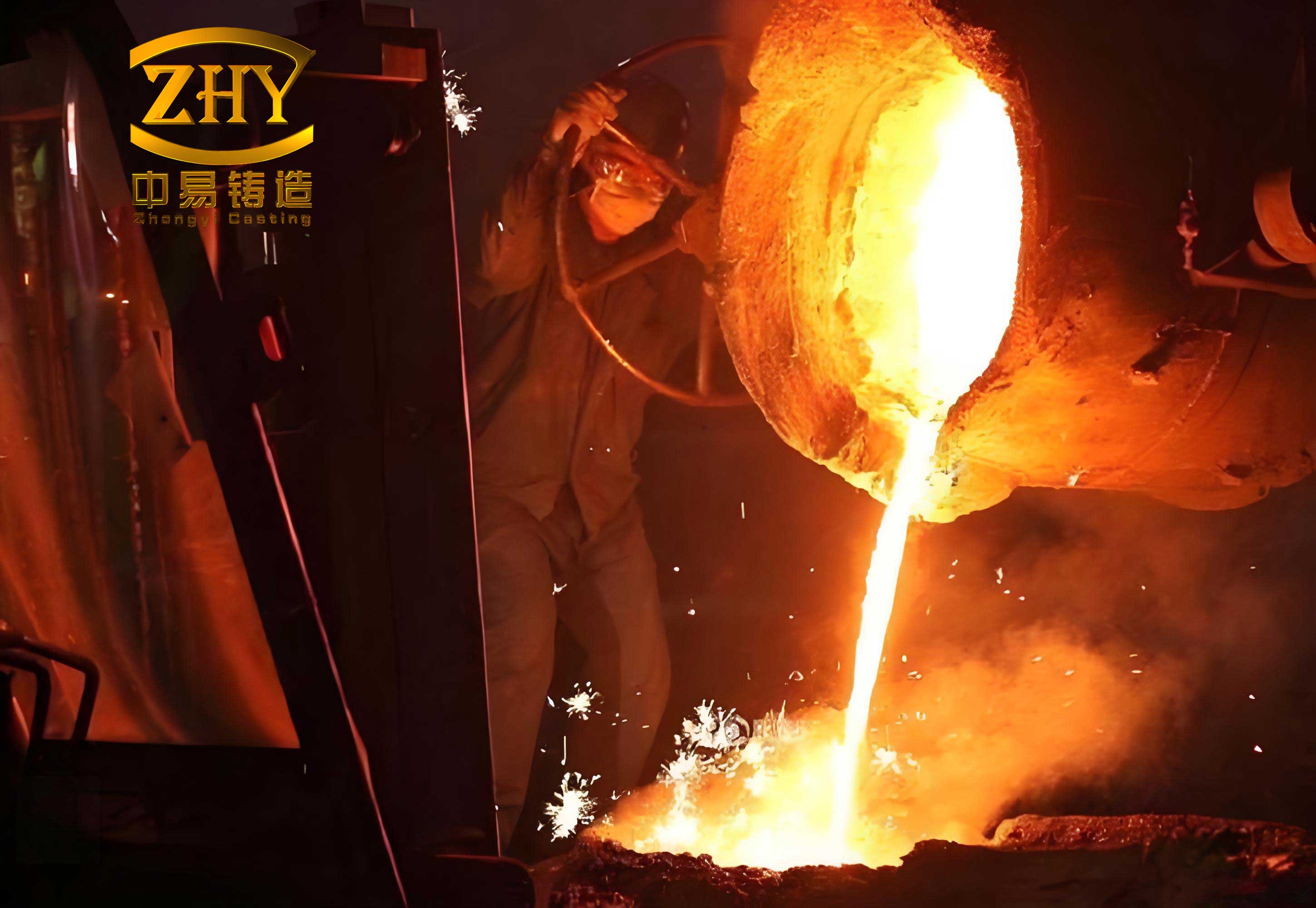
To ensure efficiency in the lost foam casting process, I employed CAD modeling to design the adaptor with allowances for machining and shrinkage. The scaling factor was set to 1.023 to account for solidification收缩 and foam degradation. The gating system was optimized using simulation software, which is essential in the lost foam casting process to predict and control solidification behavior. The following table summarizes key parameters used in the lost foam casting process for the adaptor:
| Parameter | Value | Description |
|---|---|---|
| Material | ZG230-450 Steel | Cast steel grade for adaptor |
| Foam Type | EPS | Expandable polystyrene for patterns |
| Coating | Water-based ceramic | High-temperature refractory coating |
| Sand Type | Dry quartz sand | Used for mold filling |
| 浇注 Temperature | 1580°C | Initial metal temperature |
| Negative Pressure | Applied during casting | Enhances mold stability and metal flow |
Solidification simulation is a critical aspect of the lost foam casting process, as it helps optimize the gating and riser design to prevent defects like shrinkage porosity. I conducted numerical simulations using finite element analysis to model the temperature distribution during solidification. The governing equation for heat transfer in the lost foam casting process is the heat conduction equation, which can be expressed as:
$$ \rho C_p \frac{\partial T}{\partial t} = \nabla \cdot (k \nabla T) + Q $$
where \( \rho \) is density, \( C_p \) is specific heat capacity, \( T \) is temperature, \( t \) is time, \( k \) is thermal conductivity, and \( Q \) represents heat sources such as latent heat release. For the lost foam casting process, I considered the following material properties in the simulation:
| Material | Density (kg/m³) | Thermal Conductivity (W/m·K) | Specific Heat (J/kg·K) |
|---|---|---|---|
| ZG230-450 Steel | 7400 | 0.25 | 0.12 |
| Dry Quartz Sand | 1600 | 0.0031 | 0.29 |
| Air | 1.3 | 0.0001 | 0.24 |
In the lost foam casting process simulation, I meshed the model with a grid size of 10 mm × 10 mm × 10 mm and set boundary conditions to mimic实际 casting. The浇注 temperature was 1580°C, and the environment temperature was 20°C. The simulation revealed that solidification initiated in the gating system and lower regions of the adaptor, progressing upwards. The last areas to solidify were the top central regions, indicating potential shrinkage sites. This insight allowed me to optimize riser placement in the lost foam casting process, ensuring adequate feeding. The temperature field evolution can be described by the following simplified equation for cooling rate:
$$ \frac{dT}{dt} = -\frac{hA}{\rho V C_p} (T – T_{\text{env}}) $$
where \( h \) is the heat transfer coefficient, \( A \) is surface area, \( V \) is volume, and \( T_{\text{env}} \) is environment temperature. For the lost foam casting process, I set \( h = 1000 \, \text{W/(m}^2 \cdot \text{K)} \) at the铸件-mold interface. The simulation results showed that complete solidification occurred in approximately 13.1 minutes, with temperature profiles indicating efficient heat dissipation in the lost foam casting process mold.
To validate the simulation, I performed experimental tests on cast adaptors produced via the lost foam casting process. Defects such as inclusions were observed, which are common challenges in the lost foam casting process. I used a KYKY-2800B scanning electron microscope (SEM) and an X-ray liquid nitrogen refrigeration silicon drift spectrometer for elemental analysis. The SEM images revealed regions with abnormal microstructures, and energy-dispersive spectroscopy (EDS) provided quantitative data on inclusion composition. The following table summarizes EDS results from a defect site:
| Element | Weight Percentage (%) | Atomic Percentage (%) |
|---|---|---|
| Fe | 79.67 | 67.46 |
| Si | 11.32 | 19.06 |
| Al | 6.10 | 10.69 |
| Mn | 2.00 | 1.72 |
| Ca | 0.91 | 1.07 |
The high Si and Al content in inclusions, compared to the base steel composition, suggested that the source was the ceramic coating used in the lost foam casting process. Coatings often contain Al₂O₃ and SiO₂ as refractory materials, and during casting, they can detach and enter the molten metal, leading to defects. This is a known issue in the lost foam casting process, especially at high-impact areas like gating connections. To analyze the detachment mechanism, I considered the stress on the coating layer, which can be modeled using the following equation for thermal stress:
$$ \sigma = E \alpha \Delta T $$
where \( \sigma \) is stress, \( E \) is Young’s modulus, \( \alpha \) is thermal expansion coefficient, and \( \Delta T \) is temperature difference. In the lost foam casting process, rapid heating during浇注 can cause coating cracking due to thermal mismatch. To mitigate this, I proposed design modifications, such as using semi-open gating systems to reduce metal turbulence and integrating the gating foam with the product pattern to enhance coating integrity. These improvements are essential for advancing the lost foam casting process.
Further analysis involved studying the microstructure evolution during the lost foam casting process. The solidification rate influences grain structure, which affects mechanical properties. I applied the Kurz-Giovanola-Trivedi (KGT) model for dendritic growth, given by:
$$ v = \frac{D \Delta T}{\Gamma k} $$
where \( v \) is growth velocity, \( D \) is diffusion coefficient, \( \Delta T \) is undercooling, \( \Gamma \) is Gibbs-Thomson coefficient, and \( k \) is partition coefficient. In the lost foam casting process, the negative pressure environment alters cooling conditions, impacting \( v \) and thus the final microstructure. By optimizing process parameters, I aimed to achieve a fine-grained structure for better fatigue resistance in adaptors.
In addition to simulations, I conducted practical trials to refine the lost foam casting process. For instance, I experimented with different coating formulations to improve adhesion and thermal resistance. The coating thickness \( \delta \) plays a role in defect prevention, and I derived an optimal range based on heat transfer calculations:
$$ \delta_{\text{opt}} = \sqrt{\frac{k_{\text{coating}} t_{\text{exp}}}{ \rho C_p }} $$
where \( t_{\text{exp}} \) is exposure time. For the lost foam casting process, a thickness of 1-2 mm proved effective in reducing inclusion formation. Moreover, I implemented statistical process control to monitor key variables in the lost foam casting process, such as sand compaction density and浇注 speed, using control charts to ensure consistency.
The economic and environmental aspects of the lost foam casting process were also considered. Compared to traditional casting, the lost foam casting process reduces waste and energy consumption due to its dry sand usage and minimal binder requirements. I calculated the efficiency gain using the formula:
$$ \eta = \frac{E_{\text{saved}}}{E_{\text{total}}} \times 100\% $$
where \( \eta \) is efficiency, \( E_{\text{saved}} \) is energy saved from reduced machining, and \( E_{\text{total}} \) is total energy input. The lost foam casting process showed a 15-20% improvement, making it a sustainable choice for mass production.
To summarize, my research demonstrates the importance of integrating simulation and experimental analysis in the lost foam casting process. The lost foam casting process offers significant advantages for complex parts like freight train adaptors, but it requires careful optimization to avoid defects. Through numerical modeling, I identified solidification patterns that guided riser design, and through microscopy, I traced inclusions to coating detachment. The lost foam casting process can be enhanced by adopting integrated foam patterns, optimized coatings, and controlled浇注 parameters. Future work will focus on real-time monitoring systems for the lost foam casting process to further improve quality and reliability.
In conclusion, the lost foam casting process is a robust method for manufacturing high-integrity components. My study highlights how simulation tools can predict solidification behavior, while analytical techniques like SEM and EDS provide insights into defect origins. By iteratively refining the lost foam casting process based on these findings, I achieved better cast adaptors with fewer defects. The lost foam casting process continues to evolve, and with ongoing research, it will play a pivotal role in advancing casting technology across industries. The integration of digital twins and AI for the lost foam casting process could be the next frontier, enabling predictive maintenance and adaptive control.