
In the context of accelerating industrialization, the emission of greenhouse gases, primarily carbon dioxide, has become a critical global concern. As a foundational sector in traditional manufacturing, the casting industry remains a significant source of resource consumption and environmental pollution. The energy utilization rate in casting processes is notably low, often ranging from 15% to 25%, and waste emissions, including sand, slag, and exhaust gases, can be substantially higher compared to advanced international standards. This underscores the urgent need for carbon reduction strategies within the industry. To address this, we focus on developing a quantitative calculation method for carbon emissions specific to individual casting parts produced via sand casting. This approach aims to provide a granular understanding of emissions, enabling targeted mitigation efforts and supporting the transition toward greener manufacturing practices.
The quantification of carbon emissions in manufacturing typically relies on lifecycle assessment (LCA) principles, which encompass both direct and indirect emissions. Direct emissions arise from on-site processes, while indirect emissions stem from material consumption and energy use throughout the production cycle. For sand casting, the process can be segmented into distinct stages: molding, melting, recycling, and machining. Each stage contributes to the overall carbon footprint through material inputs, energy consumption, and waste generation. By leveraging a hybrid methodology that combines input-output (IO) and process analysis (PA) techniques, we establish a detailed model to apportion emissions to individual casting parts. This model facilitates precise carbon accounting, essential for evaluating the environmental impact of casting parts and informing sustainable production decisions.
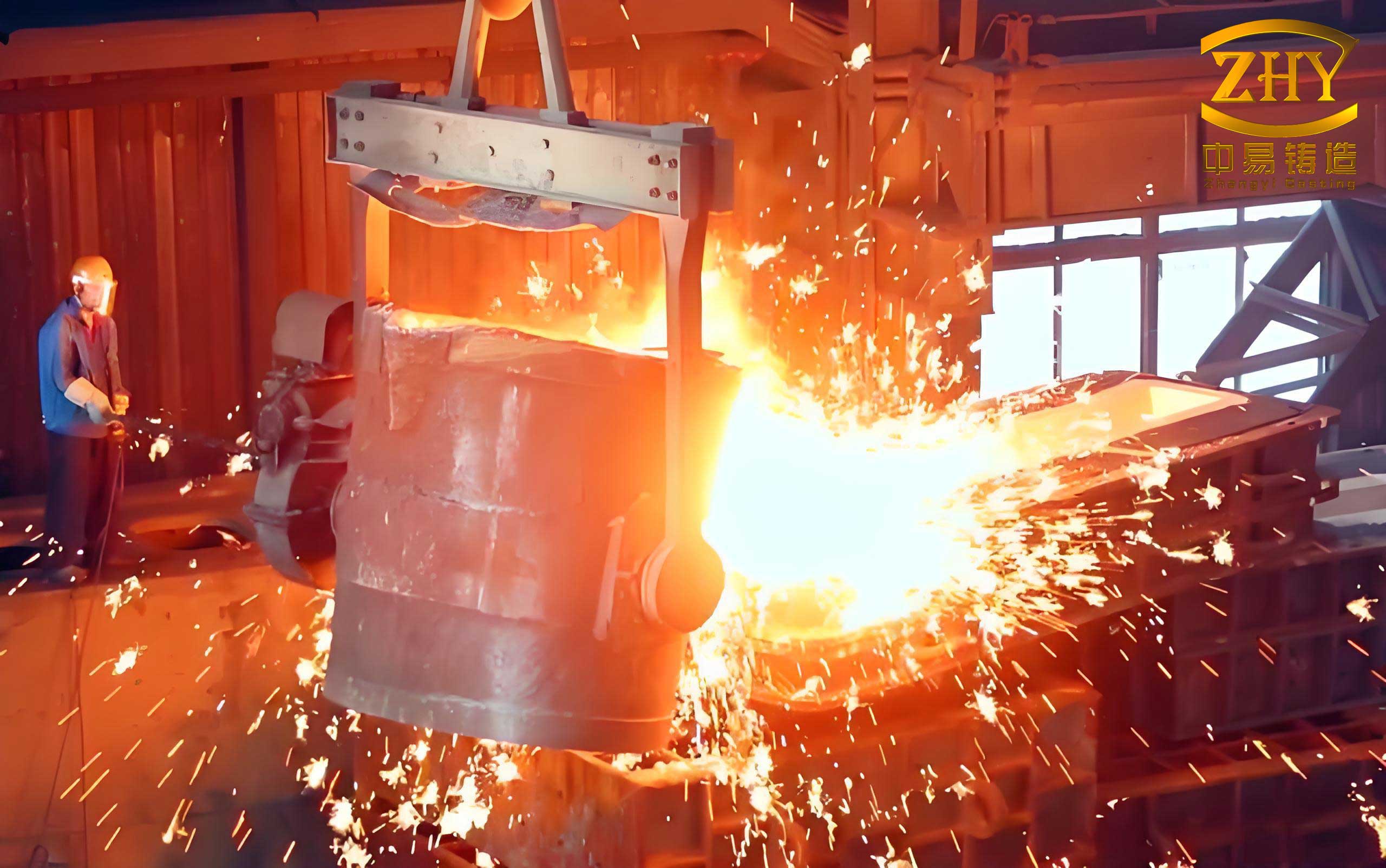
Our methodology is grounded in lifecycle theory, which allows for a comprehensive evaluation of carbon emissions across the casting process. We define system boundaries to include all relevant carbon sources: material-related emissions from consumables like resin sand and molten metal ingredients; energy-related emissions from equipment such as mixers, furnaces, and cranes; and waste-related emissions from the treatment of by-products like dust and slag. The model is designed to handle batch production scenarios, where emissions are allocated to each casting part based on its weight and process parameters. This ensures that the carbon footprint of a single casting part can be accurately determined, providing a basis for comparison and optimization. In the following sections, we elaborate on the carbon emission calculation model, breaking it down into material, energy, and waste components, and apply it to a real-world example to demonstrate its practicality.
The carbon emission model for sand casting parts is structured around three primary categories: material carbon emissions, energy carbon emissions, and waste carbon emissions. Each category is further analyzed across the four production stages—molding, melting, recycling, and machining—to capture the nuanced contributions of different processes. The total carbon emission for a casting part, denoted as \( C_d \), is expressed as the sum of these components:
$$ C_d = CM_d + CE_d + CU_d $$
where \( CM_d \) represents material carbon emissions, \( CE_d \) denotes energy carbon emissions, and \( CU_d \) signifies waste carbon emissions for casting part \( d \). This holistic equation forms the backbone of our quantitative assessment, enabling a stage-wise decomposition of emissions for each casting part.
Material carbon emissions arise from the consumption of raw materials during the casting process. These emissions are categorized into variable and fixed components. Variable material emissions depend on process-specific parameters, such as the sand-to-metal ratio and recycling rates, which directly influence the quantity of materials used per casting part. Fixed material emissions, on the other hand, are associated with auxiliary consumables that are apportioned across multiple casting parts based on production output. For the molding stage, the variable material carbon emission \( C^1_{\text{VR},d} \) for casting part \( d \) is calculated using the sand-to-metal ratio \( R^1 \), resin sand density \( \rho_b \), and recycling efficiency \( \eta \). The formula is:
$$ C^1_{\text{VR},d} = M_d R^1 (1 – \eta) f_b $$
where \( M_d \) is the weight of the casting part, \( f_b \) is the carbon emission factor for resin sand, and \( \eta \) is the recycling rate of resin sand. The sand-to-metal ratio \( R^1 \) is derived from the volume of the sand mold and the casting part, given by:
$$ R^1 = \frac{\rho_b V_x}{V_d} $$
with \( V_x \) as the sandbox volume and \( V_d \) as the casting part volume. Fixed material emissions in the molding stage are allocated based on the total consumption of materials like refractory coatings over a production period, expressed as:
$$ C^1_{\text{ST},d} = \sum_{c=1}^{c_0} \frac{I^1_c}{O_d} f_c $$
where \( I^1_c \) is the consumption of fixed material \( c \) in the molding stage, \( O_d \) is the output of casting parts, and \( f_c \) is the carbon emission factor for material \( c \). Thus, the total material carbon emission for the molding stage \( CM^1_d \) is:
$$ CM^1_d = M_d R^1 (1 – \eta) f_b + \sum_{c=1}^{c_0} \frac{I^1_c}{O_d} f_c $$
For the melting stage, material carbon emissions are primarily from molten metal ingredients, such as scrap steel, pig iron, and carburizers. These are considered variable emissions, as their usage scales with the weight of the casting part and the pouring surplus. The emission \( CM^2_d \) is computed as:
$$ CM^2_d = M_d (1 + \text{MIR}) \sum_{g=1}^{g_0} R^2_g f_g $$
where MIR is the ratio of pouring surplus to casting part weight, \( R^2_g \) is the proportion of ingredient \( g \) in the molten metal, and \( f_g \) is its carbon emission factor. This stage is critical, as the choice of ingredients significantly impacts the carbon footprint of the casting part. In the recycling and machining stages, material emissions are treated as fixed, derived from consumables like steel shot or binders, allocated similarly across casting parts:
$$ CM^3_d = \sum_{c=1}^{c_0} \frac{I^3_c}{O_d} f_c \quad \text{and} \quad CM^4_d = \sum_{c=1}^{c_0} \frac{I^4_c}{O_d} f_c $$
Summing across all stages, the total material carbon emission for casting part \( d \) is:
$$ CM_d = M_d R^1 (1 – \eta) f_b + M_d (1 + \text{MIR}) \sum_{g=1}^{g_0} R^2_g f_g + \sum_{a=1}^{4} \sum_{c=1}^{c_0} \frac{I^a_c}{O_d} f_c $$
This formulation highlights the dependency on casting part weight and process parameters, enabling targeted reductions through material efficiency improvements.
Energy carbon emissions result from electricity consumption by equipment during the casting process. Each stage involves specific machinery, such as sand mixers in molding, furnaces in melting, sand treatment lines in recycling, and shot blasting machines in machining. Additionally, material handling equipment like cranes contributes to energy use across stages. The energy carbon emission for the molding stage \( CE^1_d \) is calculated based on the power ratings and operational times of equipment:
$$ CE^1_d = \left( \sum_{l=1}^{l_0} \frac{p_l M_d R^1}{v_l} + \sum_{m_1=1}^{m_1_0} \frac{p_{m_1} s_{m_1}}{v_{m_1}} \right) f_e $$
where \( p_l \) and \( v_l \) are the power and efficiency of sand mixer \( l \), \( p_{m_1} \), \( s_{m_1} \), and \( v_{m_1} \) are the power, travel distance, and speed of crane \( m_1 \), and \( f_e \) is the carbon emission factor for electricity. This accounts for both processing and handling energy per casting part. For the melting stage, energy emissions \( CE^2_d \) include furnace operation and crane usage:
$$ CE^2_d = M_d (1 + \text{MIR}) E_n f_e + \sum_{m_2=1}^{m_2_0} \frac{p_{m_2} s_{m_2}}{v_{m_2}} f_e $$
with \( E_n \) as the electricity consumption per ton of molten metal. The recycling stage emission \( CE^3_d \) involves sand treatment and crane energy:
$$ CE^3_d = M_d R^1 E_o f_e + \sum_{m_3=1}^{m_3_0} \frac{p_{m_3} s_{m_3}}{v_{m_3}} f_e $$
where \( E_o \) is the energy per ton of resin sand processed. Similarly, the machining stage emission \( CE^4_d \) is:
$$ CE^4_d = \left( \sum_{u=1}^{u_0} p_u t_u + \sum_{m_4=1}^{m_4_0} \frac{p_{m_4} s_{m_4}}{v_{m_4}} \right) f_e $$
with \( p_u \) and \( t_u \) as the power and operation time of shot blasting machine \( u \). The total energy carbon emission for casting part \( d \) is then:
$$ CE_d = \left( \sum_{l=1}^{l_0} \frac{p_l M_d R^1}{v_l} + \sum_{m_1=1}^{m_1_0} \frac{p_{m_1} s_{m_1}}{v_{m_1}} \right) f_e + M_d (1 + \text{MIR}) E_n f_e + M_d R^1 E_o f_e + \left( \sum_{u=1}^{u_0} p_u t_u + \sum_{m_4=1}^{m_4_0} \frac{p_{m_4} s_{m_4}}{v_{m_4}} \right) f_e $$
This detailed breakdown allows for the identification of energy-intensive steps in producing a casting part, guiding efficiency enhancements.
Waste carbon emissions originate from the treatment of by-products generated during casting, such as dust, fumes, and slag. These emissions are indirect, arising from the energy consumed by waste handling equipment like dust collectors and transport vehicles. For each stage, waste carbon emissions are computed based on the quantity of waste per casting part and the energy efficiency of treatment devices. In the molding stage, waste emission \( CU^1_d \) is:
$$ CU^1_d = M_d \frac{M^1_{U1}}{v_{w1}} p_{w1} f_e $$
where \( M^1_{U1} \) is the waste generation per ton of casting part, \( p_{w1} \) and \( v_{w1} \) are the power and processing speed of dust collector \( w_1 \). For the melting stage, emissions \( CU^2_d \) include both gaseous and solid waste treatment:
$$ CU^2_d = M_d \left( \frac{M^2_{U1}}{v_{w2}} p_{w2} + \frac{M^2_{U2}}{M_{i2}} \frac{p_{i2} s_{i2}}{v_{i2}} \right) f_e $$
with \( M^2_{U2} \) as solid waste per ton, and \( p_{i2} \), \( s_{i2} \), \( v_{i2} \), and \( M_{i2} \) as the power, distance, speed, and load capacity of transport equipment \( i_2 \). The recycling and machining stages follow similar patterns:
$$ CU^3_d = M_d \frac{M^3_{U1}}{v_{w3}} p_{w3} f_e \quad \text{and} \quad CU^4_d = M_d \frac{M^4_{U1}}{v_{w4}} p_{w4} f_e $$
Summing these, the total waste carbon emission for casting part \( d \) is:
$$ CU_d = M_d f_e \left( \sum_{a=1}^{4} \frac{M^a_{U1}}{v_{wa}} p_{wa} + \delta_{a2} \frac{M^2_{U2}}{M_{i2}} \frac{p_{i2} s_{i2}}{v_{i2}} \right) $$
where \( \delta_{a2} \) is an indicator for the melting stage. This component, though often smaller, is essential for a comprehensive carbon assessment of each casting part.
To validate the model, we apply it to a practical case involving a locking disk casting part used in wind turbine applications. This casting part is made of ductile iron QT500-14, with a weight \( M_d = 6,932 \, \text{kg} \). Key parameters include a sand-to-metal ratio \( R^1 = 8.25 \), resin sand recycling rate \( \eta = 0.93 \), pouring surplus ratio MIR = 0.1, and electricity carbon emission factor \( f_e = 0.93 \, \text{kg CO}_2/\text{kWh} \). Material carbon emission factors are as follows:
| Material/Energy | Carbon Emission Factor | Unit |
|---|---|---|
| Resin Sand | 0.02543 | kg CO₂/kg |
| Refractory Coating | 6.0232 | kg CO₂/kg |
| Methanol | 2.5 | kg CO₂/kg |
| Scrap Steel | 8.2 | kg CO₂/kg |
| Pig Iron | 2.13 | kg CO₂/kg |
| Return Material | 2.67 | kg CO₂/kg |
| Carburizer | 4.2 | kg CO₂/kg |
| Silicon Carbide | 14.68 | kg CO₂/kg |
| Ferrosilicon | 2.3 | kg CO₂/kg |
| Steel Shot | 0.12 | kg CO₂/kg |
| Electricity | 0.93 | kg CO₂/kWh |
The molten metal composition for this casting part is:
| Ingredient | Proportion \( R^2_g \) (%) |
|---|---|
| Scrap Steel | 58.19 |
| Pig Iron | 24.69 |
| Return Material | 14.26 |
| Carburizer | 2.20 |
| Silicon Carbide | 0.49 |
| Ferrosilicon | 0.17 |
Using the model, we compute the material carbon emission \( CM_d \) for the locking disk casting part:
$$ CM_d = 6,932 \times 8.25 \times (1 – 0.93) \times 0.02543 + 6,932 \times (1 + 0.1) \times (0.5819 \times 8.2 + 0.2469 \times 2.13 + 0.1426 \times 2.67 + 0.022 \times 4.2 + 0.0049 \times 14.68 + 0.0017 \times 2.3) + \text{fixed terms} $$
This yields \( CM_d = 44,791.79 \, \text{kg CO}_2 \). Energy carbon emission \( CE_d \) is calculated based on equipment parameters: sand mixer power \( p_l = 11.5 \, \text{kW} \), efficiency \( v_l = 6.2855 \, \text{kg/s} \); furnace energy \( E_n = 500 \, \text{kWh/t} \); sand treatment energy \( E_o = 0.0119 \, \text{kWh/t} \); shot blaster power \( p_u = 80 \, \text{kW} \), time \( t_u = 20 \, \text{min} \); crane power \( p_{ma} = 20.5 \, \text{kW} \), distances \( s_{m1} = 0 \, \text{m} \), \( s_{m2} = 70 \, \text{m} \), \( s_{m3} = 40 \, \text{m} \), \( s_{m4} = 110 \, \text{m} \), speed \( v_{ma} = 16 \, \text{m/min} \). Thus,
$$ CE_d = \left( \frac{11.5 \times 6,932 \times 8.25}{6.2855} + \frac{20.5 \times 0}{16} \right) \times 0.93 + 6,932 \times 1.1 \times 500 \times 0.93 + 6,932 \times 8.25 \times 0.0119 \times 0.93 + \left( 80 \times \frac{20}{60} + \frac{20.5 \times 110}{16} \right) \times 0.93 $$
resulting in \( CE_d = 4,234.82 \, \text{kg CO}_2 \). Waste carbon emission \( CU_d \) uses waste generation data per ton of casting part: molding dust \( M^1_{U1} = 0.586 \, \text{kg} \), melting fumes \( M^2_{U1} = 0.500 \, \text{kg} \), recycling dust \( M^3_{U1} = 1.050 \, \text{kg} \), machining dust \( M^4_{U1} = 0.011 \, \text{kg} \), and melting slag \( M^2_{U2} = 0.054 \, \text{kg} \). Dust collector power \( p_{wa} = 7.5 \, \text{kW} \), processing speed \( v_{wa} = 14.2515 \, \text{kg/h} \); transport equipment for slag: power \( p_{i2} = 3.5 \, \text{kW} \), distance \( s_{i2} = 126.25 \, \text{m} \), speed \( v_{i2} = 10 \, \text{m/min} \), load \( M_{i2} = 500 \, \text{kg} \). Then,
$$ CU_d = 6,932 \times 0.93 \times \left( \frac{0.586}{14.2515} \times 7.5 + \frac{0.500}{14.2515} \times 7.5 + \frac{1.050}{14.2515} \times 7.5 + \frac{0.011}{14.2515} \times 7.5 + \frac{0.054}{500} \times \frac{3.5 \times 126.25}{10} \right) $$
giving \( CU_d = 14.552 \, \text{kg CO}_2 \). The total carbon emission for the locking disk casting part is:
$$ C_d = 44,791.79 + 4,234.82 + 14.552 = 49,041.162 \, \text{kg CO}_2 $$
A breakdown of emissions by category and stage for this casting part is summarized below:
| Emission Type | Stage | Sub-Component | Consumption | CO₂ Emission (kg) | Percentage of Total (%) |
|---|---|---|---|---|---|
| Material Emissions | Molding | Resin Sand | 4,001.13 kg | 101.75 | 0.21 |
| Molding | Refractory Coating | 10.87 kg | 65.46 | 0.13 | |
| Molding | Methanol | 16.3 kg | 40.76 | 0.08 | |
| Melting | Scrap Steel | 4,437.1 kg | 36,384.25 | 74.19 | |
| Melting | Pig Iron | 1,882.66 kg | 4,010.07 | 8.18 | |
| Melting | Return Material | 1,087.35 kg | 2,906.5 | 5.93 | |
| Melting | Carburizer | 167.75 kg | 704.57 | 1.44 | |
| Melting | Silicon Carbide | 37.36 kg | 548.5 | 1.12 | |
| Melting | Ferrosilicon | 12.96 kg | 29.81 | 0.06 | |
| Machining | Steel Shot | 0.01 kg | 0.12 | 0.00 | |
| Energy Emissions | Molding | Sand Mixer | 29.05 kWh | 27.03 | 0.06 |
| Molding | Crane | 0 kWh | 0 | 0.00 | |
| Melting | Furnace | 3,812.6 kWh | 3,545.72 | 7.23 | |
| Melting | Crane | 1.49 kWh | 1.39 | 0.00 | |
| Recycling | Sand Treatment | 680.19 kWh | 632.91 | 1.29 | |
| Recycling | Crane | 0.85 kWh | 0.79 | 0.00 | |
| Machining | Shot Blaster | 26.67 kWh | 24.80 | 0.05 | |
| Machining | Crane | 2.35 kWh | 2.18 | 0.00 | |
| Waste Emissions | Molding | Dust Treatment | 4.28 kWh | 3.97 | 0.01 |
| Melting | Fume Treatment | 3.65 kWh | 3.39 | 0.01 | |
| Melting | Slag Transport | 7.66 kWh | 7.12 | 0.00 | |
| Recycling | Dust Treatment | 0.08 kWh | 0.07 | 0.00 | |
| Machining | Dust Treatment | 0.002 kWh | 0.002 | 0.00 |
From this analysis, material carbon emissions dominate the total footprint of the casting part, accounting for over 91% of emissions, with the melting stage alone contributing approximately 90% of material emissions. This highlights the critical role of molten metal ingredients in the carbon profile of a casting part. Energy emissions, while smaller, are non-negligible, particularly from furnace operation, which underscores the importance of energy efficiency in melting processes for each casting part. Waste emissions are minimal but should be considered for comprehensive carbon management. The results demonstrate that optimizing material selection, such as increasing the use of low-carbon alternatives in molten metal, can significantly reduce the carbon footprint per casting part. Additionally, improving sand recycling rates and equipment efficiency can further lower emissions across stages.
The proposed quantitative model offers a robust framework for assessing carbon emissions in sand casting, with direct applicability to individual casting parts. By integrating lifecycle principles with detailed process analysis, it enables precise allocation of emissions to each casting part, facilitating targeted reductions. This approach is particularly valuable for batch production environments, where understanding per-unit impacts is essential for sustainable decision-making. Future work could expand the model to include other casting methods or incorporate dynamic factors like fluctuating energy grids. Moreover, the model can support carbon labeling for casting parts, promoting transparency and environmental stewardship in the manufacturing sector. Ultimately, this research contributes to the broader goal of industrial decarbonization, providing a practical tool for reducing the environmental impact of casting parts while maintaining economic viability.
In conclusion, we have developed and validated a comprehensive carbon emission calculation model for sand casting parts, emphasizing the quantification of emissions at the individual casting part level. The model synthesizes material, energy, and waste emissions across production stages, offering a detailed perspective on carbon hotspots. Through the case study of a locking disk casting part, we illustrated how the model can be applied to real-world scenarios, revealing that material choices in melting are paramount for carbon reduction. This work lays a theoretical foundation for low-carbon strategies in casting, empowering manufacturers to optimize processes, select sustainable materials, and minimize the carbon footprint of each casting part. As global efforts to combat climate change intensify, such granular carbon accounting methods will become increasingly vital for achieving carbon neutrality in the casting industry and beyond.