
The bed of a Horizontal Machining Center (HMC) serves as the foundational cornerstone, bearing the weight of the column, workpiece table, and the dynamic forces generated during cutting operations. Its performance in terms of static rigidity, dynamic stability, and thermal behavior is paramount to achieving and maintaining high machining accuracy. Traditionally, gray cast iron has been the material of choice for such large structural casting parts due to its favorable manufacturability, good damping properties compared to steels, and proven history. However, the pursuit of higher precision, especially in finishing operations, and improved dynamic stability has driven the exploration of alternative materials. Among these, mineral casting, also known as polymer concrete or artificial granite, has emerged as a compelling candidate for critical machine tool casting parts.
This article presents a detailed, first-person analysis comparing a mineral casting part bed with a traditional cast iron bed for a specific HMC model. The investigation encompasses finite element modeling, static structural analysis under a defined drilling load case, dynamic modal analysis, and thermal characteristic evaluation. The goal is to objectively quantify the performance differences, highlighting the contexts where the unique properties of a mineral casting part provide distinct advantages.
Material Properties: Cast Iron vs. Mineral Casting Part
The fundamental differences in performance stem from the intrinsic material properties. Gray cast iron (e.g., HT300) is a metallic alloy primarily of iron, carbon, and silicon, with graphite flakes imparting its characteristic damping. Mineral casting, however, is a composite material. It consists of a matrix, typically an epoxy or polyester resin, binding a carefully graded aggregate filler composed of mineral materials like granite, quartz, or basalt chips. This composition yields a markedly different property profile, as summarized in Table 1.
| Property | Mineral Casting Part (Typical Grade) | Gray Cast Iron (HT300) |
|---|---|---|
| Tensile/Bending Strength [MPa] | 30 – 40 | 200 – 300 |
| Compressive Strength [MPa] | 120 – 180 | ~580 |
| Young’s Modulus, E [GPa] | 30 – 45 | 110 – 130 |
| Density, ρ [kg/dm³] | 2.2 – 2.4 | 7.1 – 7.3 |
| Damping Ratio (Loss Factor) | 0.01 – 0.03 | 0.001 – 0.002 |
| Thermal Conductivity, λ [W/m·K] | 1.0 – 2.0 | 45 – 55 |
| Coefficient of Thermal Expansion, α [10⁻⁶/K] | 14 – 20 | 10 – 12 |
| Specific Heat Capacity, c [J/kg·K] | ~1,200 | ~450 |
The lower elastic modulus of the mineral casting part implies lower inherent stiffness. However, this is counteracted in design by creating solid or densely ribbed sections, moving away from the thin-walled, cored cavities typical of iron casting parts. The drastically higher damping is a key advantage for dynamic stability. The low thermal conductivity and high specific heat capacity suggest slower heat penetration and potentially better thermal inertia, albeit with a higher thermal expansion coefficient.
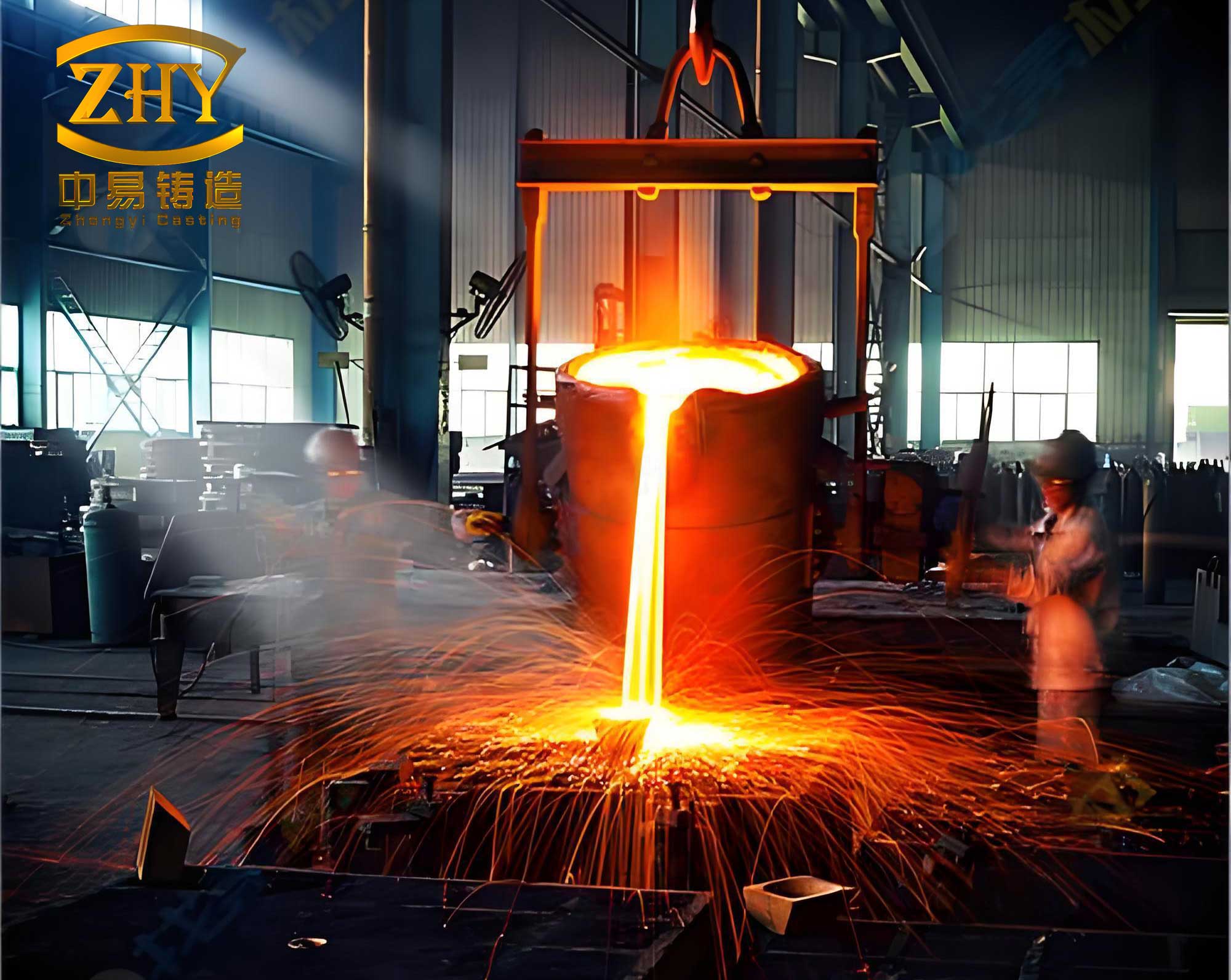
The visual contrast in manufacturing is stark. While traditional casting parts involve complex sand molds and molten metal, a mineral casting part is produced by mixing resin and aggregate at room temperature and pouring it into a formwork, often with pre-placed inserts for mounting surfaces. This process allows for great geometric freedom and the integration of features like piping channels or sensor mounts directly into the mass of the part.
Finite Element Modeling and Boundary Conditions
For a fair comparison, two 3D CAD models of the HMC bed were created, maintaining identical overall envelope dimensions and functional mounting interfaces (guide rail surfaces, motor mounts, leveling foot pads). The cast iron model featured internal ribbing for structural efficiency. The mineral casting part model, leveraging its different manufacturing constraints, was modeled as a largely solid block with local reinforcements at high-stress interface areas using integrated steel inserts. This is a common and critical practice in designing a mineral casting part to handle localized clamping and bolt forces.
The models were discretized using a combination of tetrahedral and hex-dominant solid elements, with mesh refinement at critical areas like guide rail mounts. Convergence studies were performed to ensure mesh-independent results. The material properties from Table 1 were assigned accordingly.
A representative drilling operation was selected as the load case for static analysis. The forces and moments acting on the bed through the guideway carriages and ball screw nuts were calculated from the process forces and the moving masses’ weights. The force equilibrium for the system is established by equations such as those for the workpiece table (X-axis) subsystem:
Vertical Force Equilibrium: $$ \sum F_z = 0: G_W + F_c – (F_{Z1} + F_{Z2}) = 0 $$
Moment Equilibrium (about Y): $$ \sum M_y = 0: G_W \cdot d_{G} + F_c \cdot d_{Fc} – F_{Z1} \cdot d_1 – F_{Z2} \cdot d_2 = 0 $$
where \( G_W \) is the weight of the table and workpiece, \( F_c \) is the vertical component of the cutting force, and \( F_{Z1}, F_{Z2} \) are the reaction forces from the front and rear guideway carriages, respectively. Similar equations govern the column (Z-axis) subsystem.
The calculated reaction forces were applied as pressure loads on the projected areas of the guide rail blocks. The bed was constrained at the locations of the leveling feet, restricting all translational degrees of freedom. For the thermal analysis, a heat source representing the X-axis servomotor loss was applied to its mounting region on the bed, with a convective boundary condition (h = 10 W/m²K) applied to all external surfaces in an ambient temperature of 25°C.
Static Structural Performance
The primary metrics for static performance are deformation under load and induced stress. The results for the critical drilling load case are summarized below.
| Static Performance Metric | Mineral Casting Part Bed | Cast Iron Bed |
|---|---|---|
| Max. Deformation (Overall) [µm] | ~5.8 | ~5.5 |
| Deformation at Key Guideway Mount (Point A) [µm] | 2.4 | 2.2 |
| Max. von Mises Stress (in Base Material) [MPa] | 0.44 (at steel insert interface) | 2.95 (at foot constraint) | Stress Safety Factor (Relative to Bending Strength) | > 70 | > 80 |
The analysis reveals a crucial finding: despite the mineral casting part’s elastic modulus being roughly one-third that of cast iron, the strategic use of a solid, bulky design results in static deformation at the critical guideway locations that is virtually identical to that of the ribbed iron casting part. The maximum deformation occurs in non-critical overhang areas for both designs.
The stress distribution tells a different story. The mineral casting part exhibits significantly lower stress levels in its main body. The peak stress of 0.44 MPa occurs at the boundary of a steel insert. In contrast, the cast iron bed shows a higher peak stress concentration of 2.95 MPa near the constraint points. While both values are extremely low relative to their material strengths (indicating ample static load capacity), the mineral casting part’s structure inherently distributes load more evenly, reducing stress peaks. The relationship between stress (\(\sigma\)), strain (\(\epsilon\)), and modulus is given by Hooke’s Law: $$ \sigma = E \cdot \epsilon $$. For a similar strain (deformation) at the guideway, the lower \(E\) of the mineral casting part directly results in lower stress, provided the geometry can achieve that similar strain, which the solid design accomplishes.
Dynamic Modal Characteristics
The dynamic stiffness and vibrational behavior are critical for surface finish and tool life. Modal analysis extracts the natural frequencies and mode shapes of the structure. A higher fundamental natural frequency generally allows for a wider stable operating speed range for the machine’s axes and spindle. The damping ratio significantly affects the amplitude at resonance.
The first five modal frequencies and their characteristics are compared in Table 3.
| Mode Order | Mineral Casting Part Bed | Cast Iron Bed |
|---|---|---|
| Freq. [Hz] / Max. Amp. [µm] / Description | Freq. [Hz] / Max. Amp. [µm] / Description | |
| 1 | 621.3 / 0.055 / Torsion of Z-axis section | 275.9 / 0.281 / Bending of front overhang |
| 2 | 655.8 / 0.088 / Bending of front overhang | 293.3 / 0.121 / Bending of side wall |
| 3 | 680.9 / 0.052 / Torsion of X-axis section | 350.9 / 0.279 / Torsion of front overhang |
| 4 | 692.8 / 0.215 / Rocking mode | 370.7 / 0.201 / Bending of side wall |
| 5 | 787.0 / 0.243 / Complex bending | 391.8 / 0.186 / Torsion of side structure |
The results are striking. The mineral casting part bed exhibits a fundamental natural frequency more than 125% higher than that of the cast iron bed (621 Hz vs. 276 Hz). Furthermore, the vibration amplitudes for the mineral casting part’s first three modes are smaller than the amplitudes of the first five modes of the cast iron structure. This performance leap is attributed to two synergistic factors inherent to a well-designed mineral casting part:
- High Structural Damping: The viscoelastic resin matrix and the internal friction at the countless aggregate/resin interfaces provide exceptional energy dissipation, directly reducing resonant amplitudes.
- High Specific Stiffness (E/ρ) and Solid Geometry: While cast iron has a higher absolute Young’s Modulus, its density is over three times higher. The specific stiffness \( \frac{E}{\rho} \) of the mineral casting part is competitive. When combined with a solid, non-slender geometry that avoids local panel vibrations common in thin-walled iron casting parts, the result is a structure with higher natural frequencies.
The equation for the natural frequency \(f_n\) of a simple single-degree-of-freedom system illustrates the relationship: $$ f_n = \frac{1}{2\pi} \sqrt{\frac{k}{m}} $$ where \(k\) is stiffness and \(m\) is mass. The mineral casting part achieves a favorable \(k/m\) ratio through its geometry, despite its material’s lower \(E\).
Thermal Behavior Analysis
Thermal deformation is a primary source of positioning error in precision machine tools. The analysis simulated the bed’s steady-state temperature field and the resulting thermo-elastic deformation when the X-axis motor acts as a heat source.
The thermal response is governed by the heat diffusion equation and the constitutive law for thermal strain. The steady-state temperature distribution \(T(x,y,z)\) satisfies: $$ \nabla \cdot (\lambda \nabla T) + \dot{q} = 0 $$ where \(\lambda\) is thermal conductivity and \(\dot{q}\) is internal heat generation rate. The induced thermal strain \(\epsilon_{th}\) is: $$ \epsilon_{th} = \alpha \cdot \Delta T $$ where \(\alpha\) is the coefficient of thermal expansion (CTE).
| Thermal Performance Metric | Mineral Casting Part Bed | Cast Iron Bed |
|---|---|---|
| Max. Temperature Rise (at steady state) [°C] | ~10 (localized near heat source) | ~10 (more widespread) |
| Area with >5°C Temp Rise | Confined to motor mount region | Extends significantly along bed length |
| Thermal Deformation at Key Guideway (Point C) [µm] | 52 | 55 |
| Characteristic Time Constant (Estimated) τ | Higher (due to high ρ*c/λ) | Lower |
The thermal analysis yields nuanced insights. Due to its low thermal conductivity, the mineral casting part localizes the heat, creating a steeper temperature gradient near the source. The cast iron, with its high conductivity, spreads the heat more effectively, resulting in a lower peak gradient but a larger volume of the bed experiencing a temperature change.
At steady state, the calculated thermal deformation at the critical guideway location is nearly identical for both beds (~52-55 µm). This occurs because the mineral casting part’s higher CTE (\(\alpha\)) compensates for its lower average temperature rise in the critical region. The thermal displacement \(u_{th}\) can be approximated for a simple case by: $$ u_{th} = \alpha \cdot L \cdot \Delta T_{avg} $$ where \(L\) is a characteristic length and \(\Delta T_{avg}\) is the average temperature change along it.
The most significant advantage of the mineral casting part lies in its transient thermal response, indicated by its higher estimated thermal time constant \(\tau \propto \frac{\rho c}{\lambda}\). The combination of high specific heat (\(c\)) and low conductivity (\(\lambda\)) means a mineral casting part heats up and cools down much more slowly than a cast iron part when subjected to intermittent heat loads. This slower response dampens thermal drift variations, leading to better short-term and long-term thermal stability, which is often more valuable than the absolute steady-state deformation for precision machining.
Conclusion and Application Context
The comprehensive finite element analysis demonstrates that a bed designed as a mineral casting part can match or exceed the performance of a traditional cast iron bed in key areas relevant to machining accuracy. While the absolute static stiffness at the guideways is engineered to be equivalent, the mineral casting part offers superior dynamic performance, with significantly higher natural frequencies and lower resonant amplitudes due to its excellent internal damping and solid construction. Thermally, while steady-state deformations may be similar, the mineral casting part’s inherent thermal inertia promotes greater stability against fluctuations in internal heat loads.
These characteristics make the mineral casting part particularly well-suited for application contexts where:
- High dynamic stability is paramount for achieving superior surface finish and avoiding chatter, especially during finishing operations with smaller cutting forces.
- Precision and accuracy retention over time are critical. The reduced sensitivity to vibration and improved thermal inertia contribute directly to this goal.
- Complex internal structures for coolant lines, cable routing, or sensor integration are desired, as the casting process for a mineral casting part readily accommodates such features.
The successful implementation of a mineral casting part, however, requires careful design adaptation. The lower tensile strength necessitates the use of metallic inserts (usually steel or iron) at all load-introduction points like bolt holes, guide rail mounts, and leveling foot supports. Furthermore, the design philosophy shifts from thin-walled, ribbed structures to more solid, homogeneous sections to leverage the material’s damping and compensate for its lower modulus.
In conclusion, the mineral casting part represents a sophisticated evolution in machine tool structural components. It is not a universal replacement for cast iron but a specialized solution that excels in environments demanding the highest levels of precision, smooth operation, and thermal stability. For the design of a high-performance Horizontal Machining Center focused on precision finishing, adopting a mineral casting part for the bed structure is a technically sound strategy that directly addresses several key challenges in advanced manufacturing.