
The pursuit of optimized production methodologies for high-volume, high-quality casting parts remains a central challenge in foundry engineering. This study presents a comprehensive analysis and practical implementation of a novel Double-Layer Pouring Process (DLPP), developed specifically to address the significant limitations inherent in conventional single-layer methods. This article details our journey from conceptualization to full-scale production validation, focusing on a class of connecting casting parts used extensively in industrial machinery, such as wind power gearboxes. These components, while geometrically straightforward, present a formidable challenge for cost-effective mass production when using traditional techniques.
Conventional single-layer pouring processes for such casting parts are often plagued by systemic inefficiencies. Chief among these is a low process yield rate, defined as the ratio of the finished casting part weight to the total weight of metal poured. This low yield stems from the necessity of large, heavy gating and risering systems required to ensure proper filling and feeding during solidification. The material used in these systems is remelted, incurring energy, handling, and melt loss costs. The single-layer layout also severely constrains production density on a molding line, limiting the number of casting parts produced per molding cycle and per unit area of foundry floor space. Consequently, the overall production efficiency, measured in parts per hour, is suboptimal, directly driving up the unit cost of each casting part. Our objective was to systematically dismantle these “high-cost” barriers through an innovative process redesign centered on spatial efficiency and improved thermal management.
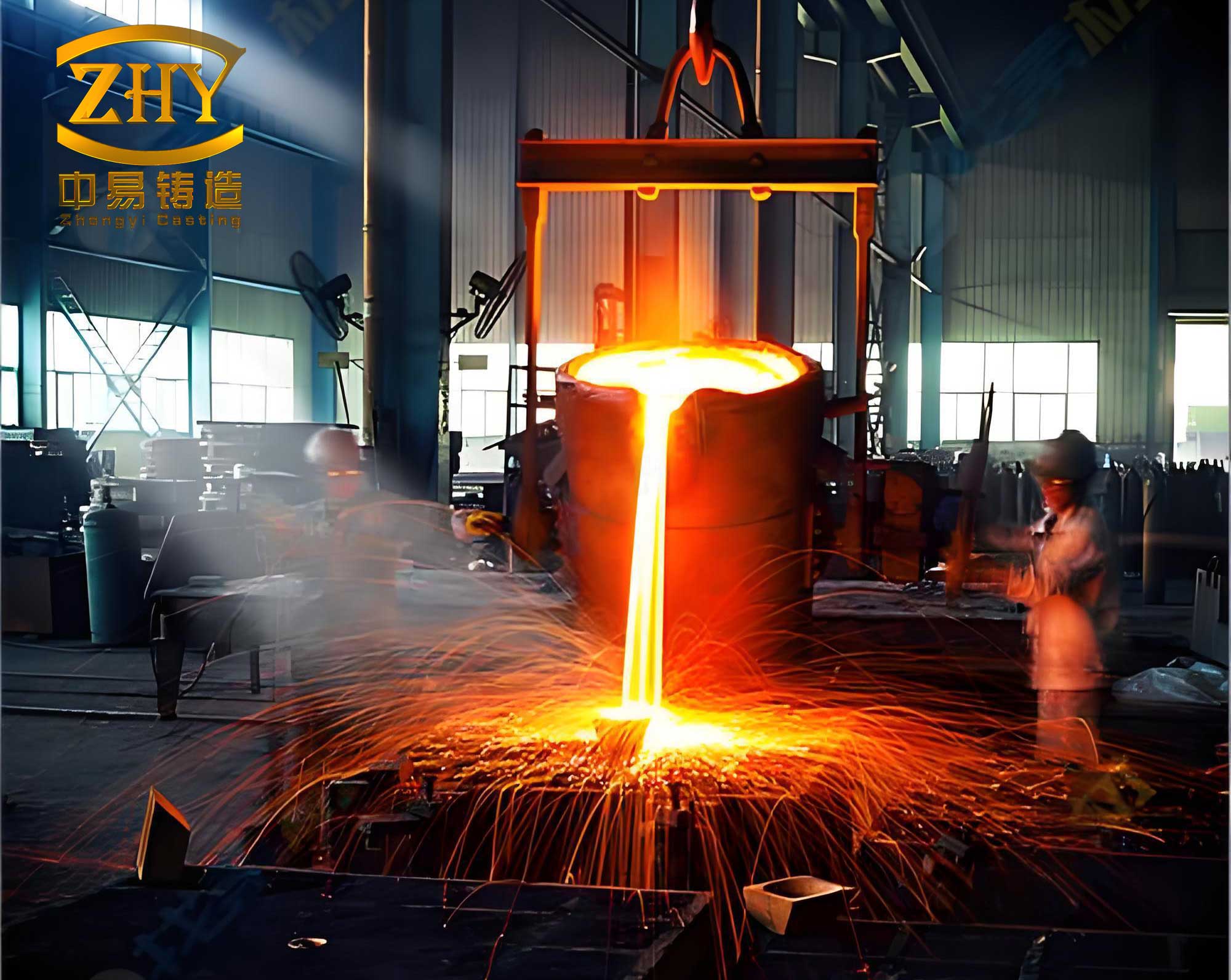
The technical core of our solution is the Double-Layer Pouring Process. Unlike the single-layer layout where one set of casting parts occupies a single plane within the mold, the DLPP stacks two layers of identical casting parts vertically within the same mold cavity. This is achieved through a strategic redesign of the pattern equipment and core placement. The symmetry of the target casting part—featuring a large flange at one end and a smaller one at the other—was key. In the DLPP configuration, the large flanges of two casting parts are aligned and placed back-to-back at the central parting plane of the mold. This arrangement effectively creates two mirrored cavities, one in the cope (upper mold half) and one in the drag (lower mold half), connected through a shared central core assembly. The gating system was re-engineered to feed both layers simultaneously and uniformly. A primary downsprue branches into separate runner networks for the upper and lower layers, ensuring balanced filling. The strategic placement of in-gates and risers was optimized using solidification simulation software to ensure both layers receive adequate thermal feeding, mitigating the risk of shrinkage defects in either the top or bottom casting part.
The fundamental advantage of this approach can be expressed through several key metrics. First, the process yield (PY) sees a dramatic improvement. The yield is calculated as:
$$
PY = \frac{n \cdot W_c}{W_t} \times 100\%
$$
where \( n \) is the number of castings per mold, \( W_c \) is the weight of a single casting part, and \( W_t \) is the total poured weight per mold. The DLPP increases \( n \) significantly while \( W_t \) increases sub-linearly because the shared central gating and risering system is more efficient per casting part produced. Second, the production density \( D \) (parts per mold area) increases substantially:
$$
D_{DLPP} \approx 2 \times D_{SLP}
$$
where \( D_{SLP} \) is the density of the Single-Layer Process. This directly translates to higher hourly output on the same automated molding line. Third, the economic benefit per ton of saleable casting parts is profound. The cost saving \( S \) per ton can be modeled as:
$$
S = \rho_{Fe} \cdot (W_{t, SLP} – W_{t, DLPP}) \cdot C_{reproc}
$$
where \( \rho_{Fe} \) is the density of cast iron, the weight difference term represents the saved melt per ton of castings, and \( C_{reproc} \) is the net cost of reprocessing returned scrap (including energy, melt loss, and handling).
To quantify these advantages, we conducted a controlled comparison across three production setups on two different automated molding lines. The target casting part was a ductile iron QT400-18AL connecting component with a weight of approximately 18.6 kg. The key parameters and results are summarized in the table below.
| Process Parameter | Single-Layer (Line A) | Single-Layer (Line B) | Double-Layer (Line B) |
|---|---|---|---|
| Molding Line Type | Horizontal Auto-Molding | Automatic Squeeze Molding | Automatic Squeeze Molding |
| Mold Box Dimensions (mm) | 609 x 508 x 200 | 1300 x 900 x 350 | 1300 x 900 x 350 |
| Casting Parts per Mold (n) | 1 | 4 | 8 |
| Total Casting Weight per Mold (kg) | 18.6 | 74.4 | 148.8 |
| Total Poured Weight per Mold (kg) | 38.8 | 144.4 | 253.8 |
| Process Yield Rate (%) | 47.9 | 51.5 | 58.6 |
| Production Rate (parts/hour) | 60 | 160 | 280 |
| Relative Cost Saving per Ton | Baseline | +530 CNY | +1410 CNY |
The data unequivocally demonstrates the superiority of the DLPP. The process yield jumped from 47.9% in the baseline single-layer process to 58.6%, an increase of 10.7 percentage points or 22.3% relative improvement. This directly stems from the more efficient use of molten metal, where the gating and risering weight is amortized over twice the number of casting parts in the same mold footprint. Production efficiency saw an even more dramatic leap. The output increased from 60 parts/hour to 280 parts/hour on the higher-capacity line, representing a 4.67-fold increase in the production rate of saleable casting parts. This step-change in productivity is a direct consequence of doubling the packing density of casting parts within each mold cycle.
The economic impact is substantial. The saving of 1,410 CNY per metric ton of finished casting parts is a decisive competitive advantage. For a foundry with an annual output of, for example, 3,000 tons of such components, this translates to annual cost savings exceeding 4.23 million CNY. This calculation is conservative, as it primarily accounts for direct melt savings and does not fully capture secondary benefits such as reduced energy consumption per part, lower sand-to-metal ratio (reducing sand system load), and decreased logistics and handling overhead per unit produced.
A critical concern when implementing any new process is the potential impact on the quality and integrity of the final casting part. To validate the DLPP, we produced multiple batches totaling several hundred casting parts. A rigorous quality assurance protocol was followed, with samples taken from both the upper and lower layers of the mold. The results confirmed that the DLPP does not compromise quality. All evaluated casting parts met the stringent technical specifications for this ductile iron grade. The mechanical properties—tensile strength, yield strength, elongation, and hardness—were all within specification and showed no statistically significant difference between parts from the upper and lower layers or compared to single-layer process parts. The metallurgical structure was also excellent, with the required ferritic matrix, graphite nodularity (>90%), and nodule count achieved consistently. This confirms that the redesigned thermal profile and feeding mechanism of the DLPP are sufficient to ensure sound solidification for both layers of casting parts.
The success of the Double-Layer Pouring Process can be attributed to its elegant synergy of principles. First, it exploits geometric symmetry to maximize spatial efficiency. Second, it utilizes the thermal mass of the stacked casting parts and the intervening sand core to create a more favorable and uniform temperature gradient during solidification, which can actually aid feeding in certain configurations. Third, it fundamentally rethinks the foundry “unit operation” from a single-plane activity to a volumetric one. This principle has broad applicability beyond the specific casting part studied here. Any family of casting parts that is relatively flat, symmetric, and produced in high volume is a potential candidate for adaptation to a double-layer or even multi-layer strategy. The limiting factors become mold box height, core complexity, and the ability to design an effective common feeding system.
In conclusion, our development and implementation of the Double-Layer Pouring Process represents a significant advancement in the high-volume manufacturing of metallic components. By systematically addressing the core inefficiencies of traditional single-layer pouring—low yield, low density, and high cost—this method delivers a transformative improvement in foundry productivity and economics. The process has proven capable of producing high-integrity casting parts that meet all mechanical and metallurgical standards while dramatically improving key performance indicators. The principles demonstrated here provide a powerful new framework for process engineers seeking to optimize the production of dense-packed casting parts, offering a clear pathway towards more sustainable and cost-competitive manufacturing in sectors like wind energy and industrial machinery. Future work will focus on refining predictive models for gating design in multi-layer systems and exploring the application of this principle to a wider array of casting part geometries and alloys.