
In our production of gray cast iron cylinder block casting parts, we initially used low sulfur nitrogen recarburizer for molten iron smelting, which resulted in a high rejection rate primarily due to blowholes and depression defects. This posed significant quality risks and financial losses. To address this issue, we explored the use of high sulfur nitrogen recarburizer in combination with low sulfur nitrogen recarburizer, along with increasing the carbon content of the molten iron. This approach not only maintained the tensile strength of the casting parts but also significantly reduced the rejection rate. In this article, I will detail our methodology, experimental results, and the underlying mechanisms, emphasizing how nitrogen from the recarburizer enhances the microstructure and performance of casting parts.
The casting parts in question are engine cylinder blocks made of HT250 gray cast iron. These casting parts are crucial components in engines, and their quality directly impacts engine performance. With increasing demands for higher quality and lower costs, optimizing the melting process has become essential. We use medium-frequency induction furnaces for melting, with a charge composition of pig iron, scrap steel, returns, alloys, and recarburizer. Initially, we relied solely on low sulfur nitrogen recarburizer, which is a graphitized type with low sulfur and nitrogen content. However, this led to persistent defects in the casting parts.
From January to March 2021, the rejection rate for these casting parts was alarmingly high, as summarized in Table 1. The average rejection rate was 3.35%, with blowholes accounting for 2.28% and depression for 0.34%. These two defects constituted 78% of the total rejects, indicating a need for targeted improvements. The high rejection rate not only increased production costs but also raised concerns about the reliability of the casting parts in service.
| Period | Blowhole Rejection Rate (%) | Depression Rejection Rate (%) | Total Rejection Rate (%) |
|---|---|---|---|
| January 2021 | 1.88 | 0.13 | 2.91 |
| February 2021 | 2.21 | 0.22 | 2.96 |
| March 2021 | 2.75 | 0.69 | 4.18 |
| Average | 2.28 | 0.34 | 3.35 |
To understand the root causes, we analyzed the defects in detail. Blowholes, particularly subcutaneous types, often appeared after machining, as shown in the image below. These defects are typically caused by gases trapped during solidification. Factors include aluminum content in the molten iron, moisture in the mold, and solidification rate. Our analysis revealed that the aluminum content was within an acceptable range (0.007–0.009%), and mold moisture was controlled (2.6–3.0%). However, the solidification rate was identified as a key factor. Higher carbon content can delay solidification, allowing gases to escape before the casting parts solidify. The carbon equivalent (CE) of the molten iron with low sulfur nitrogen recarburizer was calculated using the formula:
$$CE = C + \frac{1}{3}(Si + P)$$
For our initial process, the average CE was 3.77%, indicating a hypoeutectic composition. This led to the formation of primary austenite dendrites during solidification, which can cause shrinkage and poor feeding, especially in thermal junctions. The reduced graphite precipitation due to low CE limited graphite expansion, exacerbating shrinkage defects like depression. Thus, increasing carbon content was necessary, but without compromising tensile strength.
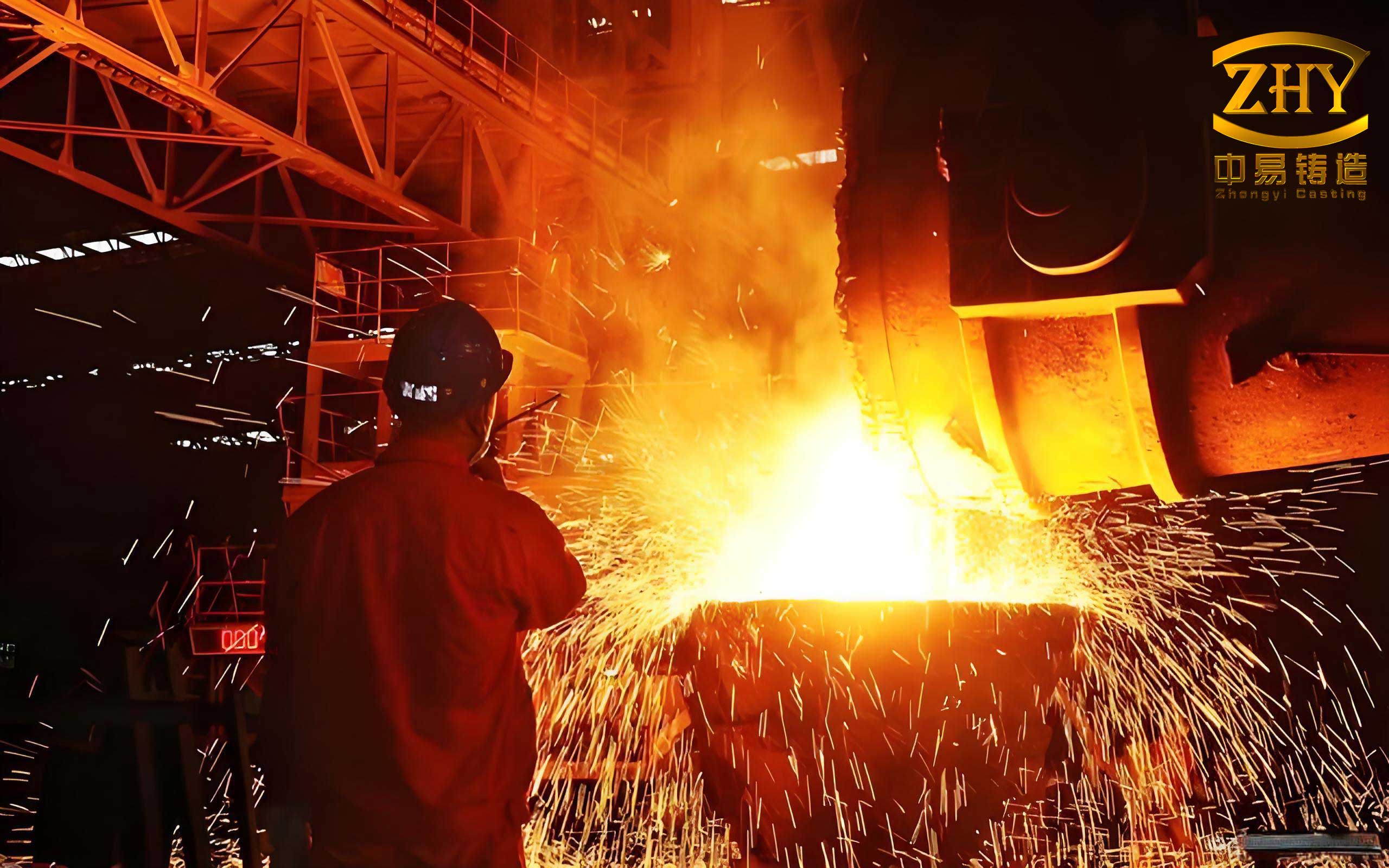
We proposed using a blend of high sulfur nitrogen recarburizer and low sulfur nitrogen recarburizer to increase carbon content while leveraging the nitrogen in the high sulfur variant to enhance mechanical properties. High sulfur nitrogen recarburizer is a calcined petroleum coke type with high sulfur and nitrogen levels, whereas low sulfur nitrogen recarburizer is graphitized with low impurities. By mixing these in a ratio of 7:3 (high sulfur to low sulfur), we aimed to boost nitrogen content in the molten iron. The recarburizer addition rate was set at 1.6–2.0% of the charge, added in batches during melting to ensure proper dissolution and minimize burn-off.
The carbon absorption efficiency of recarburizer depends on diffusion and dissolution processes, which can be modeled as:
$$C_{\text{absorbed}} = k \cdot A \cdot \Delta C \cdot t$$
where \(k\) is the rate constant, \(A\) is the surface area, \(\Delta C\) is the concentration gradient, and \(t\) is time. By optimizing addition timing, we achieved a carbon increase to an average of 3.302%, raising CE to 3.91%. Table 2 shows the chemical composition, tensile strength, and hardness after implementing this blend. Importantly, tensile strength remained around 305 MPa, and hardness averaged 198 HBW, comparable to the previous process. This allowed us to improve fluidity and feeding capacity without degrading the casting parts’ performance.
| Sample No. | C (%) | Si (%) | Mn (%) | S (%) | P (%) | N (approx. %) | Tensile Strength (MPa) | Hardness (HBW) |
|---|---|---|---|---|---|---|---|---|
| 1 | 3.32 | 1.79 | 0.83 | 0.084 | 0.023 | 0.006 | 296 | 197 |
| 2 | 3.31 | 1.78 | 0.82 | 0.082 | 0.025 | 0.006 | 303 | 201 |
| 3 | 3.30 | 1.82 | 0.80 | 0.074 | 0.023 | 0.006 | 325 | 195 |
| 4 | 3.29 | 1.81 | 0.80 | 0.073 | 0.024 | 0.006 | 318 | 198 |
| 5 | 3.31 | 1.79 | 0.83 | 0.077 | 0.024 | 0.006 | 312 | 197 |
| 6 | 3.30 | 1.78 | 0.81 | 0.078 | 0.024 | 0.006 | 299 | 203 |
| 7 | 3.32 | 1.81 | 0.84 | 0.082 | 0.024 | 0.006 | 309 | 195 |
| 8 | 3.31 | 1.78 | 0.83 | 0.080 | 0.022 | 0.006 | 312 | 205 |
| 9 | 3.31 | 1.77 | 0.82 | 0.078 | 0.024 | 0.006 | 290 | 192 |
| 10 | 3.30 | 1.79 | 0.83 | 0.074 | 0.022 | 0.006 | 296 | 200 |
| 11 | 3.28 | 1.82 | 0.81 | 0.070 | 0.023 | 0.006 | 293 | 197 |
| 12 | 3.27 | 1.83 | 0.81 | 0.074 | 0.023 | 0.006 | 303 | 195 |
| Average | 3.302 | 1.798 | 0.819 | 0.077 | 0.023 | 0.006 | 305 | 198 |
The rejection rate after implementing this change dropped significantly, as shown in Table 3. From April to August 2021, the average rejection rate was 1.96%, a reduction of 1.39% compared to the previous period. Blowhole rejection decreased to 0.65%, and depression defects were nearly eliminated. This improvement underscores the effectiveness of using high sulfur nitrogen recarburizer for enhancing the quality of casting parts.
| Period | Blowhole Rejection Rate (%) | Depression Rejection Rate (%) | Total Rejection Rate (%) |
|---|---|---|---|
| April 2021 | 1.19 | 0.00 | 2.15 |
| May 2021 | 0.47 | 0.00 | 1.47 |
| June 2021 | 0.30 | 0.00 | 1.36 |
| July 2021 | 0.47 | 0.00 | 2.83 |
| August 2021 | 0.66 | 0.00 | 1.98 |
| Average | 0.65 | 0.00 | 1.96 |
The key to this success lies in the nitrogen content of the high sulfur nitrogen recarburizer. Table 4 compares the compositions of the two recarburizer types. The high sulfur variant contains approximately 1.15% nitrogen, which is about 100 times higher than the low sulfur type. When added to the molten iron, this increases the nitrogen content to around 0.006–0.01%, compared to 0.0001–0.00015% with low sulfur recarburizer alone. Nitrogen plays a crucial role in modifying the microstructure of gray cast iron casting parts.
| Recarburizer Type | S (%) | N (%) | Fixed Carbon (%) | Ash (%) | Volatiles (%) | Moisture (%) |
|---|---|---|---|---|---|---|
| Low Sulfur Nitrogen | 0.04 | 0.011 | 99.2 | 0.31 | 0.45 | 0.02 |
| High Sulfur Nitrogen | 0.45 | 1.15 | 99.13 | 0.43 | 0.41 | 0.026 |
Nitrogen influences graphite morphology by shortening graphite flakes, increasing their curvature, and blunting their ends. This reduces the notch effect and strengthens the matrix. The mechanism can be described by the following relationship for graphite aspect ratio:
$$AR = \frac{L}{W} \propto \frac{1}{\sqrt{N_{\text{content}}}}$$
where \(AR\) is the aspect ratio, \(L\) is length, \(W\) is width, and \(N_{\text{content}}\) is nitrogen concentration. Higher nitrogen leads to lower aspect ratios, improving mechanical properties. Additionally, nitrogen lowers the eutectic transformation temperature, increasing undercooling and promoting finer eutectic cells. It also solid-solves in ferrite and cementite, causing lattice distortion and strengthening the matrix. The combined effect enhances tensile strength and hardness, allowing for higher carbon content without performance loss.
Microstructural analysis confirmed these changes. With low sulfur nitrogen recarburizer, graphite flakes were longer and sharper, while with the blend, they appeared shorter and blunter. Pearlite was also refined, contributing to better performance. This microstructural improvement is critical for producing high-integrity casting parts, especially for demanding applications like engine components.
From a production standpoint, using high sulfur nitrogen recarburizer offers cost benefits. It is cheaper than graphitized recarburizer, and by blending it with low sulfur types, we can control sulfur levels to prevent issues like brittleness. However, excessive nitrogen can lead to nitrogen porosity, so careful monitoring is essential. We implement strict incoming inspection for recarburizer batches to ensure consistent nitrogen content. The optimal nitrogen range for our casting parts is 0.005–0.02%, as beyond this, defects may reappear.
The improvement in casting parts quality also impacts overall production efficiency. Reduced rejection rates mean less scrap, lower rework costs, and higher throughput. For instance, if we produce 10,000 casting parts monthly, a 1.39% reduction in rejection saves 139 parts, translating to significant cost savings. Moreover, consistent quality enhances customer satisfaction and competitiveness in the market.
To further optimize the process, we developed a model for predicting rejection rate based on process parameters. Using regression analysis, we found that rejection rate \(R\) can be expressed as:
$$R = \alpha \cdot \frac{1}{CE} + \beta \cdot N_{\text{content}} + \gamma$$
where \(\alpha\), \(\beta\), and \(\gamma\) are constants derived from historical data. For our casting parts, \(\alpha = 0.5\), \(\beta = -0.2\), and \(\gamma = 0.1\). This model helps in fine-tuning carbon equivalent and nitrogen content to minimize defects.
In conclusion, the application of high sulfur nitrogen recarburizer blended with low sulfur nitrogen recarburizer has proven effective in reducing the rejection rate of gray cast iron casting parts. By increasing nitrogen content, we improved graphite morphology and matrix strength, enabling higher carbon content for better fluidity and feeding. This resulted in lower blowhole and depression defects while maintaining tensile strength. For foundries facing similar issues, this approach offers a practical solution for enhancing casting parts quality and reducing costs. Future work will focus on optimizing the blend ratio for different casting parts geometries and expanding this methodology to other iron alloys.
Throughout this study, the term ‘casting parts’ has been emphasized to highlight the broader applicability of our findings. Whether for cylinder blocks or other components, the principles remain relevant. By leveraging nitrogen’s benefits, we can produce more reliable and economical casting parts, meeting the evolving demands of the industry. As we continue to refine our processes, we aim to set new standards for quality in casting parts manufacturing.